Friday, January 02, 2009

Finding Lubchenko


By Michael Simmons

Teenage Evan is a rich man's son, but his dad thinks money will spoil his child and so Evan is perpetually short of cash. To make up for this lack, Evan liberates office equipment from his dad's company and sells it on E-Bay with the help of his best friend, Ruben.
Evan and his dad don't get along and not only because the dad doesn't give his son a generous allowance. Evan's mom died when he was young and the dad is raising Evan alone. Plus the dad is way older than most dads with kids Evan's age so there is a huge generation gap there. The dad also hails from conservative, old fashioned stock that Evan finds alien to his modern, California lifestyle.
Things come to a boil when Evan's dad is arrested for the murder of one of his employees. Not only is he accused of murder, but he is also accused of trafficking in deadly smallpox virus and of embezzling millions from the company. Evan may not like his dad much but he knows his dad is not a killer. Even a kid like Evan can see that his dad has been framed.
At first Evan finds it kind of fun to have his mean old dad locked up in jail. He even throws a party to celebrate. But things stop being fun when Evan faces the fact that he has the murdered man's computer in his possession, having stolen it the very day that the man was killed. Currently stored at Ruben's house, Evan wonders if anything on that computer could help prove his dad's innocence. Luckily Ruben is a computer whiz and manages to break into the computer files, which reveal that the dead man had been in touch with a person calling himself Lubchenko and that he suspected someone at the company was selling smallpox virus to terrorists. The emails to Luchenko are not full of a lot of detail, but they reveal that a meeting has been arranged in Paris at a cafe.
Ruben wants to turn the computer over to the police but Evan is against it because he knows his larceny will be revealed if they do and he doesn't want to go to jail. Somehow he talks Ruben and another friend, Erika, into going to Paris and showing up at the cafe at the time and date indicated. Evan books rooms at a first class hotel and the three friends set off for Paris to do their own investigation. While they are in Paris, they don't forget to enjoy the lively nightlife and visit lots of clubs, often not getting back to the hotel until nearly morning. Following up clues, it eventually dawns upon them that they are making targets of themselves and they switch hotels and lay low. It's a race between them and the killer as they struggle to get to Lubchenko and get back home before the killer finds them.

As I have said before, it is hard to like a story when you don't like the main character, which in this case is Evan. Evan is not a nice boy. He steals, he lies, he's a slacker and he justifies his actions by whining about what a hard ass his dad is. Yes, maybe his dad is cold and harsh, but it seems Evan does everything he can to get under his dad's skin. Evan is even willing to let his dad stay in jail while Evan sits on evidence that could help the police track down the real killer. Instead of doing the right thing, Evan does the easy thing.
Not only did I dislike Evan, I was disappointed that Evan didn't come to a better understanding of his father as the story progresses. They start out estranged and they end up estranged with Evan's dad enraged at all the money Evan spent while the dad was in prison: plane tickets to Paris, expensive new luggage, the best suites at the hotel. So even though the dad is exonerated, the book doesn't really have a happy ending as Evan is unrepentant and their relationship is even more strained than at the start of the book. Though I understand the story is continued in another book. Maybe in that book Evan manages to grow up a little and stop being such a selfish child.
Also, despite the trip to Paris, not much happens in the story. The kids party in Paris, meet with Lubchenko and go home. It's pretty slow. I never really got into the story. It just didn't capture my attention and I thought Evan was a brat.

For another review see Book Shelves of Doom.

New Word

Arrondissement: an administrative division; Paris is divided up into twenty arrondissements or districts. 'So, Café Saint-Beauvais was in a pretty nice neighborhood (the so-called Seventh Arrondissement) on the other side of the river from the Ritz.'

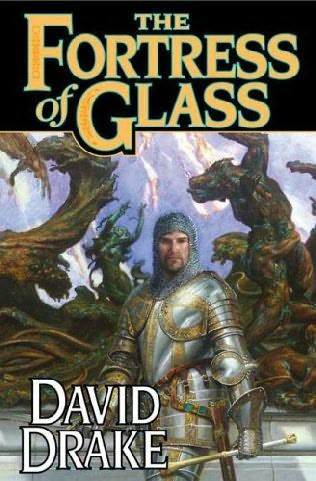
Fortress of Glass


By David Drake

Volume One in the Crown of the Isles Trilogy.
A new book in the long running Lord of the Isles series and the first book in a new trilogy, this book does not require that the reader be familiar with the preceding books, although it would be helpful. Still, the text informs the reader as to the characters backgrounds but not in a lot of detail.
This book finds Prince Garric paying a formal visit to the ruler of First Atara, an island nation, ruled by King Cervoran. Independent for generations, now First Atara will be recognizing the supremacy of Valence III, Lord of the Isles and father of Garric. Upon nearing the island, Garric is greeted with the news that King Cervoran is dead and is to be cremated shortly.
Meanwhile, a charged atmosphere hangs over Garric's fleet. His wizard, an old lady, senses that something stupendous is about to happen and it does when a meteor falls from the sky and into the ocean near the fleet.
Garric's party survives the meteor and subsequent tidal wave and arrives on First Atara, ready to witness the dead king's cremation. Once again, strange powers fill the air and another meteor streaks down, this time toward the island only to burst in the air above the dead king and his pyre. Stunned by the meteor, few people notice that King Cervoran is no longer dead. Trapped by the rising flames of his pyre, he is sure to die a second death until he is helped down by one of Garric's people, the lady Ilna, a weaver with mystical powers she acquired when she was in hell. Ilna saves the resurrected king, but what exactly she has saved remains to be seen.
During the furor Garric has disappeared, magically snatched away from his world and placed in a dismal swamp world, destined to help the peaceful Grass People dwelling there who are being hunted to extinction by blood thirsty cat people who view humans as cattle to be eaten.
Back on First Atara, Princess Sharina, Garric's sister, is forced to take over his duties. Her first duty is to protect the island from deadly mobile plants that have crawled out of the sea soon after Cervoran rose from the dead. These giant plants seem unstoppable as they seize and dismember the defenders at will. Luckily Cervoran, who is a powerful wizard, has a plan and uses his magical powers to temporarily halt the plants advance. Cervoran knows the plants have been sent to the island by the Green Woman, a wizard who arrived on his world via the meteor that crashed into the sea.
Taking the battle to the Green Woman, Cervoran sails out to confront her and the two wizards struggle against each other but the battle is inconclusive. Cervoran is rescued by Ilna again, this time from drowning. As they head back to the island, a huge crystal fortress arises out of the sea at the place where the meteor splashed down. Now it's a battle to the death between Cervoran and the Green Woman with the people of First Atara and Garric's friends and family caught in between. Before it is over, loved ones will be killed, treachery unmasked and Garric's people scattered throughout time and space.

This novel started off pretty slowly but once it got going it really moved along. It turns into a rip-roaring tale with lots of battles, lots blood and gore (too much for my taste) and people caught in desperate situations that seem hopeless. Garric's sojourn among the Grass People was especially interesting, as were the stories of the other characters who were magically transported to strange, alien locations. I did get tired of reading about the people left behind on the island who had to continue to cope with the repeated assaults of the killer plants sent against them by the Green Woman. That and the continual gore got pretty old. Despite those drawbacks I found the book pretty interesting and at times surprising and I will certainly check out the next book in the trilogy, The Mirror of Worlds.

For another review of the book, see Bookreporter.com.

New Words

Apotheosis: the occasion when someone (often an emperor) becomes a god or goddess after death. '"But I thought -- that is, the council did -- that since you were arriving just in time, you could preside over the apotheosis ceremony of King Cervoran and add, well, luster to the affair."'

Coffle: a chained line of prisoners, slaves or animals. 'The last of the coffle moved through. The gates groaned shut on their rope hinges.'

Masar: a mazer, a large drinking bowl or goblet, originally of a hard wood, probably maple, later of metal. 'Instead of being terra cotta or a simple wooden masar, the sort of thing people who dressed like Antesiodorus generally drank out of, this was glass clearer than the water that filled it.'

Bight: the term bight is used in knot tying to refer to any curved section, slack part, or loop between the two ends of a rope, string, or yarn. '"Get out of the way!" Ilna said, making a quick change to the pattern -- gathering a bight in the middle of the fabric because there wasn't time to do the job properly with an additional length of yarn.'

Misfortune


By Wesley Stace

It's the early 1800s and a baby has been tossed on a garbage heap to die only to be rescued by the richest man in all the kingdom. That is the baby's good fortune, right? Maybe not so good, though, because the man who rescued the baby isn't playing with a full deck. When he looks at the baby he sees his dead sister reborn, this despite the fact that the baby is a little boy. So, living in safety and luxury, yet forced to deny his gender and live his life as a girl, is this his good fortune or misfortune?
This is the conflict that Rose must deal with, raised his whole young life with the belief that he is a girl when, of course, he is not. The truth doesn't begin to dawn on Rose until he enters his early teens and starts to develop those characteristics of a young man on the verge of manhood. At this point, his previously affectionate and indulgent adoptive father turns against Rose, unable to bear the sight of his daughter becoming a man. So distressed is the father that he refuses to see Rose and the father gradually fades away and dies.
Although Rose is the official heir of his father's millions, other claimants appear, scenting the possibility of gaining a toehold on the millions. Rose is soon forced to reveal the fact that he is a boy who was raised as a girl by his mentally ill father. At this point the relatives take charge and Rose is forced to put off his girly garb and don the breeches and boots befitting a man. Rose, who has been raised his whole life only wearing female attire, feels constrained and disoriented in his boy clothes. Plus the relatives who are now running everything because Rose is underage are a nasty and unpleasant lot who are bent on living the high life, no matter how much it costs Rose's estate.
Eventually the truth of Rose's origins is revealed and then the relatives hire lawyers to dispute Rose's claims to the estate. At this point life has become so intolerable that Rose runs away, leaving the evil relatives in command of all the vast assets and the estate that his father left him.

I did enjoy reading about poor mixed up Rose, but the first part of the story was more engrossing than the later part dealing with Rose's life after he ran away. Being a woman and knowing what it is like to wear a dress or to wear pants, I definitely vote for pants as the most comfortable and the most efficient type of clothing and I would think that Rose would have found the shift from yards and yards of stifling fabric to the simplicity of trousers to be immensely freeing. I would think that, as a boy, he would be thrilled with the freedom available to him that girls of that time were not permitted. So at the point where Rose puts off his dresses and corsets and is forced to switch to the hated pants I somewhat lost interest. Later Rose settles on a kind of compromise, wearing dresses but keeping his mustache, a frankly freakish combination that was even harder to understand than his distaste for his men's clothing. Still it was a pretty good story though the ending is too pat. The author was trying to write a novel in the style of the nineteenth century Gothic novel and perhaps such coincidences are typical of those novels. I would have liked to have the novel center less on Rose's life of luxury in the mansion and more about his escapades after he ran off, but that part of his life is touched on very briefly. Still, despite the rather draggy latter part of the story, I mainly enjoyed reading about Miss Fortune's Misfortune.

For another review see BookPage.
New Words

Chaunters: a chaunter is a street seller of ballads and other broadsides. 'There was always the crowd of chaunters, and they'd be looking for the opportunity of some work as the afternoon wore on.'

Lady Skimmington: in Wiltshire bands of peasants protested against the enclosure of common land by dressing as women and calling themselves Lady Skimmington; a man who wears women's clothes. 'Some silently suspected that he might not be interested in women at all, that he was a bit of a Lady Skimmington.

Water budgets and compony counter-componies: In heraldry, a water budget is an emblem which represents the ancient water budget, or bucket, consisting of two leather vessels connected by a stick or yoke and carried over the shoulder. In heraldry, a compony counter-compony is a border composed of two rows of squares or rectangles in alternating colors, like a checkerboard. 'Others could keep their escutcheons of pretense, their water budgets and their compony counter-componies, he was happy with this simple sign and the motto beneath: Amor Vincit Omnia [Love Conquers All].'

Barleybreaks: an old English country game. 'Despite his relative invisibility in the parish calendar, he could be relied upon to appear, with great aplomb, at the annual games in which the May queens and their attendants played at barleybreaks for the whole town.'

Sarcenet: a fine, soft silk cloth. 'The counterpane of the Great Bed, purple velvet edged with a delicate blue and yellow sarcenet, was heavily weighed down by the family arms embroidered upon it.'

Orgeat: a sugared milk beverage with pulverized almonds or originally barley; brandy was frequently added. 'A half-finished decanter of orgeat stood on her bedside table, the stopper still spinning on the silver tray.'

Encaustic: a wax-based paint that is fixed in place by heating; a painting produced using this paint. 'Everything else was an exceptional facsimile, down to the minute encaustic tiles with the family motto inside the front door; if the actual hall ever fell into neglect and disrepair but the Hemmen House survived, then the contents and the spirit of its arrangement would be easily recalled.'

Quidnuncing: a quidnunc is a nosy person, a busybody. 'The lower floor was for noise, dirt, and business, and the most useful rooms were there: a breakfast room, a small dining room and a dinner room, a room for afternoon entertainments, and another for "quidnuncing," all branching from the massive Baron's Hall.'

Parterre: in landscape gardening, a formal area of planting, usually square or rectangular. 'Looking beyond the Terra-cotta Bridge, which crossed the river that snaked along the bottom of the parterre, her eyes fell upon the Northern Avenue.'

Periphrasis: the substitution of an elaborate phrase for a simple word or expression. 'I would have excited your apprehensions with periphrasis such as "It might have been at about this time that ...," or I would have spoken too knowledgeably and later been caught in a lie.'

Recto and verso: the recto is the right-hand page and the verso the left-hand page of a folded sheet or bound item, such as a book, broadsheet, or pamphlet. 'It was a letter, recto and verso, from Mary Day's printer to the author, addressed simply as M, outlining certain changes he was bound to make to the text of "Sophia of Light" to enable him to include the designs she requested.'

Kapellmeister: German for the leader of a choir or orchestra. 'The dispersal of the orchestra around the country, and the return of the kapellmeister to the court at Prague whence he had come, gave my father pause.'

Vitrine: a glass-fronted cabinet which stood independently or on a stand and was used to display china, silver and curios. 'In the downstairs library, the desk sat next to a vitrine called the Museum, full of those family mementos that were valuable to my father: my first tooth, which my mother said he handled as though it were a sacred relic; the cameo broach that bears my mother's profile; the locket containing my miniature drawing of them at the desk.'

Idée fixe: obsession. 'I was my mother's idea and my father's idée fixe.'

Fard: to paint, especially one's face. 'The powder, a noxious combination of lead plate, vinegar, and perfume, prepared (to my horror) in horse manure, suffocated and chafed my skin, so every night I rubbed my face with Mother's fard of sweet almond oil, melted with spermaceti and honey, which soothed me until the next morning's onslaught.'

Rubric: rubrics are the instructions that form chapter headings or titles that are not a part of the text. The word rubric is derived from the Latin word, rubrica, which means “red” because the color of the ink used to write rubrics was red. '"The rubric eludes him, but the pictures will give him enormous pleasure and perhaps stir him to greater dalliance with his muse."'

Senex: Latin for old man. In Ancient Rome, the title of Senex was only awarded to elderly men with families who had good standing in their village. 'Hood, in his usual position by the Hemmen House, was wrapped in a very large towel with, I assumed, some pajamas beneath; this togaed senex was the very same man whom I had only recently seen out of formal attire for the first time.'

Parturient: of or relating to or giving birth. '"Adam -- the first man! The only parturient male!" exclaimed my mother.'

Clinquant: glittering with gold or silver, tinsel or spangles. 'At Calais, she reminded me (not, I thought, that I had ever known), the French had stood, according to the national poet, "all clinquant, all in gold, like heathen gods."'

Belvederes: a belvedere is a pavilion or raised turret, built for the view or for its own appearance sake. 'Step back in time as you wander through the spectacular formal gardens and lose yourself on the estate, in a forgotten world of belvederes, follies, and surprise views.'

Son et lumières: sound and light shows. 'Animatronix™ figures bring the servants' quarters to vivid life once again for the twenty-first century in a series of son et lumières in kitchen and laundry.'

Bildungsroman: a novel about the education and maturing of a young person; also known as a coming of age story. 'I wanted to write a novel that creates a whole world and tells a complete story, a bildungsroman, a coming-of-age story -- but with a subject matter they couldn't have written about in the nineteenth century.'

Monday, December 29, 2008

Why Do Men Have Nipples?

By Mark Leyner and Billy Goldberg, M.D. An informative little book that answers those quirky questions you'd like to ask your own doctor but don't. As for the title question, according to the authors, the male fetus starts out as female and when it switches to male at about six weeks of development some female characteristics remain. The book is divided into nine chapters dealing each with a specific category of questions, starting with 'You are what you eat,' which addresses questions like "Does it really take seven years to digest chewing gum?" and "Can carrots help improve your vision?" and ending with, appropriately, 'Getting Older,' which answers questions like "Why does hair turn gray?" and "What's up with the ear hair?" This book is packed full of answers to questions that you never even knew you had, like "Can you die from chasing Pop Rocks with Coke?" and "Is it dangerous to hold in a sneeze?", two things I had never thought about or considered. To find the answers to these and much more, delve into Why Do Men Have Nipples?, it is interesting, funny and informative. New Words Autodidact: a self-taught person. 'He [Leyner] was a medical autodidact with an astonishingly bizarre and encyclopedic store of arcane medical knowledge.' Conflate: blend; mix together different elements. 'Leyner: I love when you conflate urology and heavy machinery.' Focal seizure: also called partial seizure; it is a seizure which affects only a small part of the brain. 'I mistake Leyner's gesticulations for a focal seizure and I run across the room to administer first aid.'

Neverwhere


By Neil Gaiman

Richard Mayhew is a successful young man living in London. He has a fiancee, Jessica, who is ambitious and very sure of herself and not too popular with Richard's friends. Her true character is revealed one weekend night when she and Richard stumble across a young, injured street person and Jessica sees no reason to involve herself in the injured woman's troubles. Richard, despite Jessica's protests, helps the girl, whose name is Door. Richard, involved with Door, fails to show up to an important dinner with Jessica and her boss and Jessica breaks off the engagement.
Trying to help Door get somewhere safe, Richard is introduced to Door's world, which is called London Below. It seems there is a vast other city, invisible to London Above, where people of strange appearance and strange abilities live out their lives in the sewers, subways and basements of London Above. Richard delivers Door safely but when he tries to go back to his normal life he finds that he has become unreal to it. He no longer exists and everyone who knew him has forgotten him. His credit cards are invalid, his bank account has vanished, his apartment has been rented and he is forced to retreat to London Below just to survive.
Tracking down Door, Richard is desperate to get his old life back. Once he finds her, he becomes involved in her problems which could cost him his life as Door is a marked woman, being hunted by two ruthless and very creepy killers, Mr. Croup and Mr. Vandemar. Door leads Richard on a perilous adventure through the filthy, gloomy byways of London Below as they flee the two deadly assassins and Richard struggles to get back to reality and London Above.

This book started out as a series on British TV. The landmarks and locales of London play an important part in the story and were probably a lot more meaningful to British viewers than they could be to a person who is not familiar with the sights and locales mentioned. For example, the angel Islington, which is an angel named Islington in the book which is probably a lot more charming and amusing if you know, which I did not when reading the book, that there used to be, long ago, an inn in Islington named the Angel and that there is no actual angel in Islington. So, yeah, those kind of details totally meant nothing to me, unfamiliar as I am with the streets of London and its surrounds.
But not only that, the whole depiction of the street people lifestyle just didn't appeal. Bit of a spoiler here: but when Richard gets his normal life back he finds himself bored and dissatisfied. I couldn't relate, better boredom that eating alley cats and wearing the same unwashed clothing for weeks at a time. Give me a hot shower, a soft bed, clean clothes and a good meal over excitement any day. I found the characters too grubby, too creepy and too elitist. Nevertheless, Gaiman presents a fascinating netherworld full of strangeness and strange people and it is a lot of fun to picture such dwelling places beneath the streets of our big cities, as the book makes clear that all the big cities of the world have their hidden counterpart just out of sight. So, though it had it problems for me, I still liked reading about Richard, Door and London Below.

New Words

Arbalests, mangonels, trebuchets, glaives and knobkerries: An arbalest is a crossbow; a mangonel is a catapult; a trebuchet is also a catapult; a glaive is a long-handled blade or a broadsword; and a knobkerry is a club. 'He made his own, out of whatever he could find, or take, or steal, parts of cars and rescued bits of machinery, which he turned into hooks and shivs, crossbows and arbalests, small mangonels and trebuchets for breaking walls, cudgels, glaives and knobkerries.'

Inhume: to bury; place in a grave or tomb. '"We should butcher the bitch. Annul, cancel, inhume, and amortize her."'

Grimoires: a grimoire is a book of instructions in the use of magic, especially summoning demons. 'But the shelves were filled with a host of other things: tennis rackets, hockey sticks, umbrellas, a spade, a notebook computer, a wooden leg, several mugs, dozens of shoes, pairs of binoculars, a small log, six glove puppets, a lava lamp, various CDs, records (LPs, 45s, and 78s), cassette tapes and eight-tracks, dice, toy cars, assorted pairs of dentures, watches, flashlights, four garden gnomes of assorted sizes (two fishing, one of them mooning, the last smoking a cigar), piles of newspapers, magazines, grimoires, three-legged stools, a box of cigars, a plastic nodding-head Alsatian, socks ... the room was a tiny empire of lost property.'

Fuliginous: pertaining to soot; sooty. 'At the apex of the bridge, another monk was waiting for them: Brother Fuliginous.' [Brother Fuliginous is one of the Black Friars.]

Kris: a double-edged, wavy-bladed knife or short sword designed primarily for thrusting. 'It was made of a bronze-colored metal; the blade was long, and it curved like a kris, sharp on one side, serrated on the other; there were faces carved into the side of the haft, which was green with verdigris, and decorated with strange designs and odd curlicues.'

Friday, December 26, 2008

Rabbit, Run


By John Updike

Rabbit Angstrom used to be the star of the high school basketball court. Now he is just another schmuck stuck in a boring job, married to a woman he doesn't really like, with a small son and a baby on the way. What he would really like to be is that high school kid again, sinking those winning baskets.
Coming home from work one day, and after a petty quarrel with his wife, Rabbit gets in his car, supposedly to run an errand, but ends up driving all night, headed to the southern sun and a warm ocean beach. When morning comes, he has second thoughts, and returns back to his home town where he contacts his old high school basketball coach. The coach hooks Rabbit up with a call girl and Rabbit ends up at the call girl's place, spending the night. After that night, Rabbit thinks he is in love with the girl and moves in with her.
Later, when his wife goes into labor, Rabbit returns home to take care of his family, abandoning Ruth, the call girl, who now pregnant with Rabbit's kid. Feeling romantic, Rabbit tries to talk his wife into having sex, even though she has just given birth a couple weeks ago. When she refuses, he goes off in a snit, leaving his wife to deal with the baby and their young son by herself, with dire consequences. Returning to deal with the aftermath, Rabbit once again shows his true colors and ends up running away again, back to Ruth who tries to talk him into making some kind of stand, but, of course, he can't.

It really hard to like a story about a person who is so despicable. This is what he says to his very pregnant wife when he hears she was trying on bathing suits in anticipation of the day when she can again fit into one.
"What the hell ails you? Other women like being pregnant. What's so damn fancy about you? Just tell me. What is so frigging fancy?"
Real nice guy, that Rabbit.
Once he moves in on the call girl, Ruth, he won't let her use a diaphragm because he doesn't like the way it feels, so naturally she gets pregnant. Later when he is back with his wife after she has given birth, he wants to have sex and she can't as she tries to explain to him:
"No I can't. Even if I wasn't all tired and confused from Rebecca's crying all day I can't. Not for six weeks. You know that....Why can't you try to imagine how I feel? I've just had a baby."
"I can. I can but I don't want to, it's not the thing, the thing is how I feel. And I feel like getting out. ... You can just lie there with your precious ass. Kiss it for me."
What a swell guy.
So, yeah, reading about this child in a man's body didn't have much appeal for me. In fact, if anyone should have died in this story, it should have been Rabbit. I think the only part of the story that I enjoyed was Rabbit's aborted drive south to the ocean, which called to mind the pleasure of driving just for fun of going somewhere.

New Words

Suntans: a type of pants; chinos. 'In frightened haste he takes clean Jockey pants, T-shirts, and socks from a drawer, three shirts in cellophane and blue cardboard from another, a pair of laundered suntans from a third, draws his two suits and a sports shirt from the closet, and wraps the smaller clothing in the suits to form a bundle he can carry.'

Exegetical: exegesis is an explanation or critical interpretation (especially of the Bible). 'To know him back in seminary you would never think he would take all this so seriously; he and his friends sitting in their drafty old rooms lined with handsome blue exegetical works made it all seem an elegant joke.'

Wednesday, December 17, 2008

Lolita


By Vladimir Nabokov; annotated by Alfred Appel, Jr.

Humbert Humbert is a pedophile from Europe. He lusts after young girls which he calls nymphets, claiming these youngsters have a come-hither and alluring appearance. Possessed of independent means, Humbert leaves Europe and heads to America, looking to prey on some child there. He finds a home with Charlotte Haze who has a daughter, Dolores, who is twelve and of whom Humbert becomes obsessed at first sight. Figuring that being married to Charlotte will give him better access to Dolores, with whom Humbert has only had limited contact so far (one particularly nasty session occurs when the girl innocently lays her legs in his lap and Humbert rubs himself to climax against her legs while singing a loud, silly song to cover what he is doing), Humbert marries the eager Charlotte. The jig is up, though, when Charlotte finds his journal in which he details his lust for her daughter and his scorn for herself. In her agitation and distress, Charlotte rushes out of her house and is struck and killed by a car, leaving Humbert as the sole guardian of Dolores.
Humbert hits the road with Dolores after taking her out of summer camp and without telling her of her mother's death. He has his cruel way with the girl then spends the next year traveling the country with his captive. Eventually he wearies of the constant travel and they settle down in a town where Dolores attends school. Humbert keeps Dolores in his control with threats and lies, leaving her to believe that she will be in as much trouble with the law as he if she turns him in and being a naive kid she believes him. Still she resents and despises Humbert and she becomes involved with another man behind Humbert's back. Humbert suspects this but can't prove it so he pulls Dolores out of school and they start traveling around again. Dolores maintains contact with her lover behind Humbert's back and eventually gives Humbert the slip and runs off with the other man, a fellow called Clare Quilty, who is as twisted and as sick a bastard as Humbert himself.
The last part of the novel is mostly about Humbert's desire to hunt down Dolores and to kill Quilty for stealing her from him. As he progresses he finally admits to himself just exactly how much damage he did to an innocent child and how much she has lost because of him.

This book was a giant pain to read. Going into it, with some preconceptions, it turned out not to be so much erotic as it was difficult. It is stuffed full of French phrases, hard and obscure words, and literary allusions up the wazoo. Frankly, if I didn't have the annotated version I doubt I would have read it past the first few chapters. Even with the annotated version the literary references were just too much. This book is not light reading! The Annotated Lolita was put together by Alfred Appel, Jr., and it was super helpful.
Despite its intellectual slant, the subject matter is sad and depressing and upsetting. Humbert was scum and reading about his abuse of Dolores was not fun. Humbert and Quilty get theirs in the end but Humbert's regrets and capture and Quilty's murder are not enough to make up for having to wallow in their filth. I didn't like the book but apparently it does have its fans. For another review see The Atlantic.

New Words
Usually, when I put a word on the new word list I include the sentence from the book that contained the word. However this book had so many new words that I am not going to include the pertinent sentence, it would just make the list much too long.

Solecisms: a solecism is a mistake in grammar; an idiom.
Etiolated: etiolate means to deprive of strength; weaken.
Apotheosis: A glorified example, the apex of perfection.
Paleopedology: paleopedology is the study of geologic soils.
Aeolian harp: a harp having strings tuned in unison; they sound when wind passes over them.
Lycée: a French academic high school.
Solipsism: the philosophical theory that the self is all that you know to exist.
Plage: the beach at a seaside resort.
Beetle-browed: sullen or unfriendly in appearance.
Manqué: Unfulfilled due to some inherent flaw or an often uncertain constitutional lacking of some kind.
Uranists: a uranist is a homosexual.
Pastiches: a pastiche is a work of art that intentionally imitates other works, often to ridicule or satire.
Mympholepts: A nympholept is a person suffering from nympholepsy, which is a frenzied state of (usually erotic) emotion, especially concerning something or someone unattainable.
Fascinum: an ivory phallus used in certain ancient erotic rites.
Axillary: of or having to do with the armpit or underarm areas.
Frétillement: movement; wriggling.
Grues: a grue is a prostitute, a slut, a drab.
Pot-au-feu: a stew of meat and vegetables.
Estampe: a print or engraving.
Coruscating: glittering, sparkling.
Favonian: pertaining to the west wind; mild, gentle.
Phocine: pertaining to a seal; seal-like.
Nates: the buttocks.
Charshaf: the veil worn by Turkish women.
Pederosis: pedophilia.
Monogrammic: of, pertaining to, or resembling, a monogram.
Iliac: Iliac refers to the ilium, which are the large, wing-like bones of the pelvis.
Catullus: a Roman lyric poet remembered for his love poems to an aristocratic Roman woman (84-54 BC).
Neuralgia: severe sharp pain along the course of a nerve.
Incondite: unpolished, unrefined, referring to literary works; jumbled, long winded.
Cretonnes: Cretonne is a heavy unglazed cotton, linen, or rayon fabric, colorfully printed and used for draperies and slipcovers.
Congeneric: Congener means a member of the same kind, class, or group.
Saporous: tasty.
Acrosonic: This word was coined up by Nabokov and it meant a noise reaching to and past the sonic barrier.
Olisbos: a dildo.
Argent: the heraldic color silver or white.
Glaucous: sea-green or pale blue-green.
Tombal: like a tomb.
Lentigo: lentigo is a freckle; a small brownish spot on the skin. Plumbaceous umbrae: Latin for leaden shadows.
Mägdlein: German for little girl.
Purblind: having poor sight; slow in understanding.
Backfisch: German for an immature, adolescent girl; a teenager.
Lentor: slowness, slugishness; viscosity.
Antiphony: an antiphon is alternate, or responsive singing by a choir split into two parts; a piece sung or chanted in this manner.
Nebulous: in the form of a cloud or haze; hazy; vague or ill-defined; relating to a nebula or nebulae.
Emeritus: retired or honorably discharged from active professional duty, but retaining the title of one’s office or position.
Callypygean: also spelled callipygian, it means pertaining to or having finely developed buttocks.
Clathrate: having a lattice-like structure pierced with holes or windows.
Swooners: Nabokov coined this word and uses it to refer to some type of clothing that was worth swooning over.
Trochaic: one stressed syllable followed by unstressed syllable.
Gouache: a thick, opaque watercolour paint; a painting made with this paint.
Inutile: lacking in utility or serviceability; not useful; unprofitable.
Samaras: a samara is a dry fruit with one or two flat wings attached to a seed, as on ash trees and maples.
Teleological: of or pertaining to teleology; showing evidence of design or purpose.
Canthus: either of the corners of the eye where the upper and lower eyelids meet.
Kurort: German for health resort, spa, watering place.
Lanugo: soft down or fine hair, specifically as covering the human fetus.
Pollex: Latin for thumb.
Viatic: of or relating to traveling, a road, or a way.
Natatoriums: a natatorium is a swimming pool, especially indoors.
Pavonine: like a peacock; iridescent.
Oculate: relating to the the eye.
Raffish: cheaply or showily vulgar in appearance or nature; tawdry; low-class; disreputable; vulgar.
Leporine: of, relating to, or resembling a hare or rabbit.
Salutory: Salutary. Unpleasant, but ultimately providing a useful lesson; promoting good health; wholesome; curative.
Orchideous: like an orchid.
Habitus: Latin for moral condition, state, disposition, character.
Mythopoeic: giving rise to myths.
Dackel: a dachshund.
Remises: carriage houses.
Envoy: An envoy (or envoi) is a short stanza at the end of a poem used either to address an imagined or actual person or to comment on the preceding body of the poem.
Ballade: not to be confused with ballad, a ballade is a a poem consisting of three stanzas and an envoy.
Tesselated: marked with little checks or squares, like tiles.
Tyros: a tyro is a novice: someone new to a field or activity.
Wimbles: a wimble is any of various hand tools for boring holes.
Syncope: in phonetics, syncope is the loss of one or more sounds from the interior of a word; especially, the loss of an unstressed vowel. Syncope is also a brief period of fainting or collapse.
Purling: gently murmuring, as a brook.
Alembics: an alembic is a kind of flask used by alchemists for distilling.
Fatamorganas: mirages.
Erlkönig: the king of the elves, from a poem where an elf king pursues a little boy traveling with his father.
Mordant: a substance used in dyeing to fix the coloring matter.
Gitanilla: little gypsy girl.
Maquette: a small model of an intended work, such as a sculpture or piece of architecture.
Telestically: with the projection of a purpose, with a definite end in view, inwardly expressed.
Logodaedaly: the arbitrary or capricious coining of words.
Logomancy: Nabokov's coined word, logo (word) plus -mancy (divination).
Undinist: a person who derives sexual pleasure from urine and urination.
Bodkin: a dagger or stiletto.
Ancilla: accessory, aid.
Appended: Append means to hang or attach to, as by a string, so that the thing is suspended; to add, as an accessory to the principal thing; to annex; as, notes appended to a chapter.
Lithophanic: lithophane is a porcelain panel with a relief decoration that is visible when light passes through it.
Turpid: Foul; base; wicked; disgraceful.
Physiognomization: Physiognomy is the art of judging human character from facial features; divination based on facial features.
Penele: a coined word, penele means penis-like.
Selenian: of or relating to the moon.
Flavid: yellowish or tawny.
Herculanita: heroin.
Palearctic and Nearctic: one of the four world faunal regions which is subdivided into the Palearctic (Europe and Asia) and the Nearctic (North America).

Wednesday, December 10, 2008

On Beauty


Zadie Smith

Howard and Kiki Belsey live in a suburb of Boston where Howard is a college professor. They have three kids, two in college and one younger. Howard teaches a course about art appreciation, or it might be better to say art unappreciation, as he strives to strip the romance and symbolic meanings that have been traditionally attached to our perceptions of art. He especially likes to go after Rembrandt, pointing out that Rembrandt was just a guy trying to earn a living painting what his wealthy patrons wanted him to paint and that's all.
Howard and his wife are liberals, believing all the usual liberal tenets. Their son Jerome is a born-again Christian, much to Howard's dismay. Howard's enemy and nemesis is Sir Monty Kipps, a conservative Christian who despises liberal doctrines and whose mission is to take the "liberal out of liberal arts".
Howard's oldest child, Jerome, briefly worked for Monty and had a short affair with Monty's beautiful and wayward daughter, Vee. The news that Monty and family are moving to the Belsey's hometown and that Monty will be lecturing at Howard's college doesn't make anyone in the Belsey family happy, especially Howard. To Howard, Monty stands for everything that Howard despises, and vice versa.
To complicate things, Howard and Kiki are going through a rough patch in their marriage due to Howard's infidelity. Theirs is a mixed marriage, Kiki is African American and Howard is white and from England. Their youngest son, Levi, is suffering from an identity crisis and trying to identify himself with the hip-hop street culture of which he really has no experience, being a child of privilege. He ends up hanging around with a gang of Haitian refugees and, in his efforts to ingratiate himself with them, gets into trouble. And Kiki starts a friendship with the enemy when she discovers that she really likes Monty's wife Carlene despite their differences.
Howard's and Kiki's daughter, Zora, who goes to the same college her dad teaches at, becomes enamored of a young street poet, Carl, and comes into conflict with Monty's daughter Vee over this handsome young rapper. Howard also finds himself entangled with Vee and trying to conceal it from his wife. Meanwhile, Howard and Monty are engaged in a power struggle at the college.
Everyone in the Belsey family ends up feeling betrayed. Howard feels betrayed by his wife's tolerance and friendship for the Kippses. Kiki feels betrayed by Howard's continuing infidelity. Jerome feels betrayed by Howard's relationship with Vee. Zora feels betrayed by Carl's relationship with Vee. And Levi feels betrayed by his parents, who are not poor and not street and don't understand, he thinks, what it means to be Haitian.

This is a very interesting and often amusing book about a modern college family, a family of mixed race and mixed culture with an intellectual father and a non-intellectual mother and three kids who are like them and yet different. Lots is going on in this story and it was rather sad watching Howard destroy his marriage. I kept hoping Howard and Kiki would work it out, but how can they when Howard keeps cheating on his wife, a woman he claims to love. Kiki tries to keep it together but finally admits that her marriage has run its course and that she has had enough of Howard Belsey. I do wish Murdoch had played a larger part in the story, I really enjoyed reading about Kiki's little dog. This was a good story about a family and a failing marriage.

On a side note, I was reading Lolita by Vladimir Nabokov at the same time as I was reading On Beauty and, in a strange coincidence, Lolita is mentioned in the book:
"She jumped off the bed and into his lap. His erection was blatant, but first she coolly drank the rest of his wine, pressing down on him as Lolita did on Humbert, as if he were just a chair she happened to sit on. No doubt she had read Lolita.


New Words

Gnomically: in a gnomic manner -- mysterious and often incomprehensible yet seemingly wise. "'It's just what it is,' he said gnomically."

Pulvinate: cushion, cushion-shape, flattened pads or pad-like. "Their pulvinate bellies were red satin, and it was here that the needles pierced."

Crepitations: clicking, rattling, or crackling noises. "The Boston primness Howard associated with these kind of events [concerts] could not quite survive the mass of hot bodies and the crepitations of the crickets, the soft, damp bark of the trees and the atonal tuning of instruments -- and all this was to the good."

Cernuous: having branches or flower heads that bend downward; drooping. "Walking up Redwood Avenue with its tunnel of cernuous willows, Levi found he had lost the will even to nod his head, usually an involuntary habit with him when music was playing."

Vol-au-vent: a small canapé - circular pieces of puff pastry with a small hole which accommodates various fillings. "'You know, I wasn't really in the mood to stuff three hundred tiny little vol-au-vent cases with crab paste,' she said, following her brother through the open front door."

Decline: in certain languages, to give the inflected forms of a noun, pronoun or adjective. "'You can decline a Latin noun, but apparently you can't even --'"

Aperçus: discerning perceptions; insights (plural form of aperçu). "He segued into Aristotle's praise of friendship, and from there to some aperçus of his own."

Lido: a public outdoor swimming pool and surrounding facilities, or part of a beach where people can swim, lie in the sun or participate in water sports. "A sprawling North London parkland, composed of oaks, willows and chestnuts, yews and sycamores, the beech and the birch; that encompasses the city's highest point and spreads far beyond it; that is so well planted it feels unplanned; that is not the country but is no more a garden than Yellowstone; that has a shade of green for every possible felicitation of light; that paints itself in russets and ambers in the autumn, canary-yellow in the splashy spring; with tickling bush grass to hide teenage lovers and joint smokers, broad oaks for brave men to kiss against, mown meadows for summer ball games, hills for kites, ponds for hippies, an icy lido for old men with strong constitutions, mean llamas for mean children and, for the tourists, a country house, its façade painted white enough for any Hollywood close-up, complete with a tea room, although anything you buy from there should be eaten outside with the grass beneath your toes, sitting under the magnolia tree, letting the white upturned bells of blossoms, blush-pink at their tips, fall all around you."

Windrush: As a result of the losses during World War II, the British government began encouraging mass immigration for the first time in order to fill shortages in the labor market. This included Poles and Italians from Europe, however to provide the numbers required the government turned to the countries of the empire and commonwealth countries. Many West Indians were attracted by better prospects in the United Kingdom. The ship Empire Windrush brought the first group of several hundred immigrants from Jamaica to Tilbury near London on June 22, 1948. The 492 passengers from Jamaica were the first large group of West Indian immigrants to the UK after the Second World War. "A few minutes later the children filed out again, feeling a degree more confused as to the true character of the person whose obituary was to appear in tomorrow morning's Times: Lady Kipps, loving wife of Sir Montague Kipps, devoted mother of Victoria and Michael, Windrush passenger, tireless church worker, patron of the arts."

Eglantine: sweetbrier; Eurasian rose with prickly stems and fragrant leaves and bright pink flowers. "Standing in the pebbled forecourt under the bare branches of a cherry tree, Howard could almost imagine the busy main road completely vanished and in its place paddocks, hedgerows and eglantine, cobbled lanes."

Concameration: an arch or vault. "Howard alone looked up into the simple concameration of the roof, hoping for escape or relief or distraction."

Flâneur: French for stroller; a person who strolls walks the city in order to experience it. "At this distance, walking past them all, thus itemizing them, not having to talk to any of them, flâneur Howard was able to love them and, more than this, to feel himself, in his own romantic fashion, to be one of them."

Halal: a halal butcher shop is one where the meat is prepared in accordance with Muslim ritual and laws. In Islam, halal is an Arabic term meaning lawful or permissible and not only encompasses food and drink, but all matters of daily life. "Whatever the fear or force that had thrust him from Carlene Kipps's funeral out on to these cold streets was what now compelled him to make this rare trip: down the Broadway, past the McDonalds's, past the halal butchers, second road on the left, to arrive here, at No. 46 with the thick glass panel in the door."

Dyad: any two entities regarded as some kind of unit; two units regarded as a pair or opposite in a whole. "'There are,' said Jack, bringing his hands together, 'a dyad of reasons why last month's meeting was delayed, rescheduled ... maybe in fact it would be more accurate to say repositioned, for this date, for January tenth, and I feel that before we can proceed with this meeting, to which, by the way, I warmly welcome you all after what I sincerely hope was a pleasurable -- and most importantly -- a restful Christmas break -- yes, and as I say, before we do proceed with what promises to be a really rather packed meeting as far as the printed agenda is concerned -- before starting I just wanted to speak briefly about the reasons for this repositioning, for it was, in itself, as many of you know, not entirely without controversy.'"

Mythemes: in the study of mythology, a mytheme is the essential kernel of a myth, an irreducible, unchanging element, one that is always found shared with other, related mythemes and reassembled in various ways or linked in more complicated relationships. "'And publications next year will include Dr J. M. Wilson's "Windmills of My Mind": Pursuing the Dream of Natural Energy Branvain Press, which is due for publication in May; Dr Stefan Guilleme's "Paint It Black: Adventures in Minimalist America, Yale University Press, in October; Borders and Intersections, or Dancing with Anansi: A Study in Caribbean Mythemes by Professor Erskine Jegede, published by our own Wellington Press this August ...'"

The Noah Confessions


Br Barbara Hall

Lynnie is turning sixteen and is sure she is getting a car for her birthday. It's what every one gets on their sixteenth at the upscale high school she attends. It never crosses her mind that it will be any different for her, after all, her dad is a successful lawyer and can certainly afford to get her a car. But she doesn't get a car. She gets a rather beat-up charm bracelet that used to belong to her mom, who died some years ago. While this is a sentimental and meaningful gift, it sure isn't a car. Yet Lynnie's dad can't understand why his daughter is a little peeved. He gives Lynnie a letter that her mom wrote when she was about Lynnie's age, hoping it will enlighten his daughter as to his reasoning; Lynnie thinks she didn't get a car because her mom died in a car crash.
Her mother's letter to Noah, a boy at her school, reveals a nightmare family. Lynnie's grandfather was a sociopath and her grandmother was depressed and losing touch with reality. Lynnie's mom witnessed her father commit several crimes and it blighted her whole childhood even to the point of blaming herself for her father's acts.
After Lynnie reads the letter, she is very upset at her parents for keeping this sad family history from her. As she faces up to the truth she begins to understand and accept the choices her parents and especially her father have made for her, even though it takes a near death experience along the way.

This novel wasn't what I hoped it would be. I guess I misunderstood the blurb that said, "And so Lynnie begins the journey to Union Grade, Virginia, into the world of her mother." I thought this meant she was going there physically. Instead she just reads her mom's letter. I thought this story would be about the contrast between her wealthy California lifestyle and the down home, back east lifestyle of a more rural setting in Virginia. It wasn't that at all. I was also hoping, since the blurbs went on to say that the author had worked on the TV shows Northern Exposure, Chicago Hope, and Judging Amy that the book would be in a lighter, funnier vein. It wasn't. So I was doubly disappointed.
It also seemed to me that Lynnie got upset way out of proportion when she discovered her mother's dodgy past. So her parents didn't tell her the whole truth of their backgrounds. What law says children are entitled to know all the family's dirty secrets? Some things are best left unsaid until the child has reached adulthood. It's better for the kid and better for the family.
Finally, I never really got what her mother's hardships had to do with Lynnie not getting a car. If her dad felt she wasn't mature enough to have a car, why not just say so: "Lynnie, I just don't feel that you are ready for the responsibility that comes with having a car." Enough said. I'm sure lots of teens have heard those words whether they are rich and privileged or have to earn the money for a car themselves.
Bottom line, this preachy novel just didn't engage me.

Tuesday, December 09, 2008

Kitty and the Midnight Hour


By Carrie Vaughn

Kitty is a late night talk radio host and her topic is the weird and strange, the supernatural, which is a natural for her since she is a supernatural: she's a werewolf. Nobody else knows except for the members of her werewolf pack and a few of the local vampires. She hasn't even told her mother.
Kitty was attacked one night, first by her date and later on by a werewolf. She was taken in by the attacking wolf's pack and thus became the youngest member of the pack, which works just like a real wolf pack, with all the dominance and submissiveness, and the crawling and whining that is typical of wolves. As the newest member of her pack, Kitty is subservient to all the other werewolves. Not only does Kitty find herself at the bottom of the pack, she also has to turn a portion of her work earnings over to the alpha male and female, Carl and Meg.
Since Kitty started leading the talk on her radio show to the supernatural, ratings have soared and her show is being broadcast by more and more stations and Kitty starts to make more money. This makes Carl happy and yet unhappy. He likes the extra money but he doesn't like the extra publicity and neither do the local vampires. Kitty manages to win Carl over to her side, briefly, but some one has hired a hitman to take Kitty out. No only does she have to protect herself from the hitman, she has to discover who hired him and also try to track down a rogue werewolf who is attacking women and making the werewolf community look very bad at a time when humans are just finding out about them, thanks to Kitty spilling the beans on her radio show.

This was an OK story. The wolf pack interactions were very wolf-like, uncomfortably so. I kept waiting for her to say, "Now wait a minute, I'm not really a wolf and I refuse to act like one." She does eventually come to a similar conclusion although it is not so clearly stated. Another problem I had was the indifference the human world showed to the revelation of werewolves and vampires in their midst. This would be a huge story, generating a media circus this likes of which would rival baby Jessica in the well (for those of you old enough to remember that) but in Kitty's world it hardly even raises an eyebrow. Another problem I had was how easily the police accepted Kitty's werewolf activities. At one point Kitty eats a fellow werewolf's throat out and kills him and the cops pretty much just let her go home, no questions asked. Very understanding cops for ones just introduced to whole idea of werewolves and vampires. Also, I found the book a little too violent and gruesome for my taste. From the ending I would say that this book is definitely intended to be the first in a series. Even though I had a quite a few problems with the story, I will probably continue to follow the adventures of Kitty if the next books in the series happen to come my way.
The book cover features a woman dressed rather provocatively and a few blurbs that describe the novel as sexy. However, the sex was rather minimal (I can only recall one sex scene and one almost-sex scene) so if you are looking for a sex romp, this is not it.

For another review of the story, see Publishers Weekly.

Tuesday, December 02, 2008

Wit's End

By Karen Joy Fowler

Rima is recovering from the loss of her family: her mother died when Rima was little, her brother died in a car accident not that long ago and her father died recently. When her godmother invites her out to California, Rima gladly accepts, eager to get away from her tragic home.
Rima's godmother, Addison Early, is a famous and prolific mystery writer who hasn't published a new Maxwell Lane (her fictional detective) in about three years. Fans and friends are worried that she has run out of ideas or has writer's block. Whatever the problem is, Addison is not talking about it.
Addison is a bit of an odd duck. She has no relatives and has never been married. She lives in a beautiful seaside home called "Wit's End." Her home is filled with miniature tableaus depicting the scene of the crime of almost every one of her mystery novels. She has two wiener dogs and two young people who come every morning to walk the wiener dogs. She is also a person who keeps her own counsel.
Rima comes to Wit's End hoping to find an answer to something that has puzzled her for a long time. She wants to know just exactly what Addison's relationship to Rima's dead father was. Rima suspects they were lovers, which would explain the animosity her parents seemed to hold toward the woman they choose to be Rima's godmother. So Rima set out to solve this mystery and to try to develop some kind of relationship to this woman who is really just a stranger to her.

I came to this novel with two expectations. First, since it was written by the author of The Jane Austen Book Club, which was a highly successful novel that was made into a movie, its author could probably be relied upon to tell a good story. Second, it was in the mystery section, so I assumed it was a mystery novel. I disappointed on both accounts.
I found this novel hard to follow. So much that occurs seemed to me to be just hinted at, creating bogus suspense, suspense that could have been easily resolved if Rima would have simply asked Addison, "Hey, what was the deal with you and my father?" Or when Rima saw the box in the attic with her dad's name on it, why didn't she just ask if she could look in it? Why all the pussyfooting around this woman Addison? It's not like Rima was stuck in Wit's End, dependent upon the largess of her godmother.
Another problem I had was, since I thought this was a mystery novel, I kept waiting for someone to be killed. Yes, there is a murder, but it happened decades ago and the murderer is never brought to justice or the murder even really solved, although what happened is pretty much guessed towards the end of the book.
This book was kind of like one of those TV soap operas where all the misunderstandings and hurt feelings could be cleared up with a little openness and honesty. I never did understand why Rima was so careful of Addison's feelings. I just didn't understand these characters. I especially didn't understand why Addison was so coy about her background. So what if her family was screwed up? Whose family isn't? To me this whole novel was mountains out of mole hills.

For another review see The Washington Post.

Wednesday, November 26, 2008

Straight Man

By Richard Russo

Russo is also the author of Nobody's Fool, which was made into a 1994 movie with Paul Newman, Bruce Willis and Melanie Griffith.

After the prologue, the first chapter of the book is called "Occam's Razor." If, like me, you don't really know what that is, then here is a link to a web page about it: Occam's Razor. It seems to me that Occam's Razor is the idea that, in seeking to understand something, go with the solution that uses the simplest, most proven explanation. Like if something keeps nibbling the food in your kitchen at night, it is most likely rats and mice not fairies and elves.
The main character, William Henry Devereaux, Jr., keeps trying to apply Occam's Razor to the events in his life. He is so fond of it that he has named his dog Occam. I don't know if he succeeds that well at it though. Hank is an English professor who seems to be at war with everyone in the English department at the university where he teaches. This is probably because he is a smart ass; his favorite activity is goading everyone with whom he comes into contact except for his family and a few friends. He is so addicted to getting a rise, he even teases animals:

They [a flock of ducks] are easily faked out, too, as if they've been too long separated from their better instincts, too often seduced by baser ones. Their heads rotate on their otherwise motionless bodies, and when I take my hands out of my pockets and make a flicking motion, tossing imaginary popcorn along the bank, the birds start toward me, trailing V's on the placid surface of the pond...waddling up out of the water and quacking around on the brown grass in search of what I've pretended to throw them...I take my hands out of my pockets to show the troops I have no popcorn, no stale bread, no candy. Some of the smaller ducks shove off the bank again and begin their slow return, offering a parting, disillusioned quack or two.

Other than being a prize jerk, Hank is struggling with what he thinks is a urinary stone which is causing him various symptoms. Meanwhile, the university is going through a financial crisis of sorts (while continuing to build a new technical arts wing) and people are afraid of losing their jobs. Hank, who is chair of the department, is constantly being approached by coworkers who want some reassurance that they are not going to be cut, which Hank refuses to give them, gaining himself even more enemies than he had before do to his irreverent and aggravating attitude to almost everything. As the crisis builds and Hank's urinary symptoms worsen, eventually something is going to have to give way. Oh and by the way, according to Hank, virtually everyone in the English department is a loser who will never be more than what they are, including himself. As he declares, '"I wish you would promote mediocrity...Mediocrity is a reasonable goal for our institution."'
This novel is about a man in crisis, even if he doesn't want to admit it. He is going down, unable to cope with the pressures of his job. He disguises his desperation with a flip attitude but his body is crumbling. He is not an evil man, even though his main joy seems to be baiting the unwary. He certainly likes to make his little jokes, viewing almost everyone as straight men in his little comedy routine.

I can't say I cared much for this novel, especially the main character, Hank, who is a jerk. Oddly, while reading this book about Hank the smart ass jerk, I was also reading Rabbit, Run about Rabbit, the jerk who leaves his pregnant wife and baby son and Lolita about Humbert the pedophile jerk. What an unfortunate combination, knee deep in jerks all around.

Review from Publishers Weekly.

New Words
Elided: to elide means to omit. "Simplicity and justice require that thought and deed not be carelessly elided."
Syllogisms: a syllogism is a method of presenting a logical argument. In its most basic form, the syllogism consists of a major premise, a minor premise, and a conclusion. "He [William of Occam] died of the Black Death, and he never saw it coming until it was upon him, a dirty, brutish, democratic foe who argued with William in precise, elegant syllogisms, defeating all the philosopher's logic and unifying in swift death, as life never could, the conflicting impulses of reason and faith that had shaped his life."

Friday, November 21, 2008

The Host

By Stephenie Meyer

Hostile and implacable aliens have completely taken over the Earth and their motto is leave no survivors! Every human must captured and destroyed! But these sneaky little bastards don't use guns or bombs in their war against humanity. Theirs is the ultimate cruelty ... they are body snatchers! They implant their tiny worm-like bodies into their victims and they take over, destroying the human mind and absorbing their memories, thus blending into human society. By the time humanity figured out what was going on, it was too late. Still a few ragtag bands of resistance fighters are holding out on the fringes of the now alien society.
How do these aliens justify this ruthless takeover? Well, they are just nicer than we are! We don't deserve to survive because we are too mean and violent.
One of these aliens, Wanderer, is a bit of a misfit. Although she has lived on many planets and occupied several different host bodies, she has never really found the place were she felt at home. So she ended up on the alien's latest conquest, Earth, planted in the body of Melanie Stryder.
Melanie Stryder, along with her brother Jamie and her boyfriend Jared, have managed to escape the alien occupation. One day Melanie sees a cousin of hers on TV and decides she has to go find her. She leaves Jamie with Jared and sets off alone to find her cousin. In the process, she is captured. She tried to kill herself by jumping down an elevator shaft, but the superior alien medicine has repaired her body only to insert the tiny Wanderer into it.
Wanderer wakes up in Melanie's body to the unwelcome discovery that Melanie is still hanging on inside the body's brain. Although Wanderer has control of the body, Melanie lingers in the brain, arguing and fighting with Wanderer. As Wanderer becomes more familiar with Melanie and her memories of Jared and Jamie, she too starts to care about those who are nearest and dearest to Melanie's heart.
The other aliens begin to suspect that all is not right with Wanderer and a Seeker is placed to watch her. The Seeker mission is to seek out and capture any remaining humans and Melanie's memories may hold the key to discovering more human holdouts.
Wanderer doesn't like the Seeker at all, and on a trip to Arizona, she manages to elude the Seeker. Giving in to Melanie's need to see Jamie and Jared, Wanderer sets off into the desert to find them. Hiking in the Arizona desert is not for neophytes and Wanderer is nearly dead when she is found by a band humans and is taken into their cave hideout.
These humans are not happy to have Wanderer among them. Fortunately for her, Jamie and Jared are part of this group and Wanderer is not summarily killed. Instead, she becomes a willing captive, which makes Melanie inside her very happy, happy to be with her little brother and happy just to be near Jared. Wanderer's sufferings at the hands of the humans are rather harsh, but not as harsh as they could have been, given the anger of the survivors. She bears their anger and never fights back because the aliens don't get angry. Eventually the people come to trust her and she becomes a part of their little survival group, giving them inside information and access they desperately need. As Wanderer worms (ha-ha) her way into the hearts of this struggling community, she begins to understand the crime her kind has committed against humanity.

This was an interesting and absorbing story. At first, it was rather disconcerting that the whole story is told from the point of view of the alien, Wanderer. The outrage of destroying the personality of the host bodies is not dealt with very deeply, although Wanderer does come to realize that taking over humans for the "good" of the species is a ridiculous justification for destroying the very essence of what it is to be human. Also, although this is touted as an "adult" novel from an author that has specialized in young adult fiction, the sex never goes beyond kisses and cuddles, which just didn't feel right. I kept waiting for the real deal and it never appeared. I think she missed an opportunity to develop her alien character more deeply by having Wanderer experience physical love.
Another quibble I have with the book is the ending, which I felt was a little too soft. I kept wanting the humans to confront their alien oppressors and that never happened. They continue to exist on the outskirts of the alien society and never force their conquerors to confront the enormity of their crime against humanity.
But otherwise, I did enjoy the book a lot. The other worlds are only touched on lightly, but sound fascinating. Stephenie has a marvelous imagination and paints a detailed and engaging picture, even frightening in how easily these insidious aliens were able to take over and rule the world without a shot being fired. I hope she writes more science fiction and I am looking forward to reading those stories.

Review by Keith Brooke in The Guardian.


Monday, November 17, 2008

The Life and Times of the Thunderbold Kid

By Bill Bryson

Bill Bryson grew up in Des Moines, Iowa in the United States in the 1950s and 60s. He revisits his childhood in this interesting and often very funny memoir. Finding lots of material in his own family, his friends and neighbors and his school, Bryson paints a picture that is both charming and amusing, visiting a time in American culture that is now consigned to history.
He also paints a very beguiling picture of the city of Des Moines, describing tree-shaded hills, graceful family homes and vanished restaurants and stores. He takes us back to a time when downtown was the place to shop and to eat, before fast food joints and national chains and malls changed the urban landscape into the sprawl of today. I enjoyed this part too, but I think it would probably be more appealing to those who have been there and seen that.
He also visits the national preoccupations of the time ranging from the atomic bomb to anti-communist hysteria to teenage delinquents. Although he is quick to say that the majority of America's youth were law-abiding and conservative, some of his funniest stories concern the antics of his friends who plot and scheme to steal beer, even going so far as to break into and empty a beer warehouse and who also have a plan to explode a confetti bomb on the front lawn of their school. The bomb goes off prematurely and explodes inside their own home, causing thousands of dollars of damage, even knocking the house slightly off its foundation.

I really enjoyed this book, it was laugh-out-loud funny. When I read a funny book this is what I want, a book so funny that I just have to laugh. I wish all books that claim to be funny could be as amusing as this one.
Bill Bryson is one of my favorite authors. I am always quick to grab a new Bryson the minute I spy it on the shelf. Bryson never disappoints, so far his books are always amusing and informative.

For another review see The Guardian.

New Words
Squamous: scaly, flat, and plate-like. "You could also get small artificial ice-cream cones made of some crumbly chalklike material, straws containing a gritty sugar so ferociously sour that your whole face would actually be sucked into your mouth like sand collapsing into a hole, root-beer barrels, red-hot cinnamon balls, licorice wheels and whips, greasy candy worms, rubbery dense gelatinlike candies that tasted of unfamiliar (and indeed unlikable) fruits but were a good value as it took more than three hours to eat each one (and three hours more to pick the gluey remnants out of your molars, sometimes with fillings attached), and jawbreakers the size and density of billiard balls, which were the best value of all as they would last for up to three months and had multiple strata that turned your tongue interesting new shades as you doggedly dissolved away one squamous layer after another."
Bifurcated: Bifurcate means too separate, split, or divide. "So earthy devastation became both a constant threat and a happy preoccupation of that curiously bifurcated decade."


Friday, November 14, 2008

Undead and Unreturnable

By Mary Janice Davidson

Fourth in Davidson's Undead series about vampire queen Betsy Taylor, this one finds Betsy in the midst of her wedding plans to vampire king Eric Sinclair when her cop friend Nick shows up to tell to beware of a serial killer who is preying on women of Betsy's type, tall and blond. Betsy dismisses his concerns since she is a vampire and more than capable of dealing with any threat posed by a would-be killer. Still she is forced to deal with the killer when Cathie, the ghost of his latest victim, shows up demanding justice.

This was the first novel in this series that I had come across. It stands on its own, but reading the first three books probably would have been helpful. Lots of characters from the previous stories show up in this one, in fact they trot in and out of the story constantly. I had to make a list just to keep track of them all.
Even though a killer is running amok, the novel doesn't really focus on that part of the plot. Mostly it is about Betsy rocky romance with Sinclair. They have their little spats and disagreements, many of which concern the impending wedding, and then they have torrid makeup sex.
There are lots of intriguing characters in the story, like Betsy's demon sister Laura and George the Fiend who lives in the basement. I would have liked more of the story to be about them. Lots of other characters make brief appearances designed, I guess, to provoke conflict between Betsy and Eric so they can quarrel again and screw again.

Betsy is queen of the vampires but she seems totally unsuited to the job, coming off as ditsy and silly. The novel doesn't really go anywhere as the serial killer plot is not the main focus of the story. It's a pretty shallow story aimed mainly at leading the reader on to the next one in the series. Some of the characters and ideas in the book are really interesting but this novel just wasn't that compelling or even all that funny. Although I have read that the first three books are supposed to be pretty good.

For another review see Crescent Blue Book Views.


Killing Bridezilla

By Laura Levine

Part of the Jaine Austen mystery series, this novel finds Jaine facing financial difficulties that force her to take a job for the last person she ever imagined working for, her high school enemy, the rich and spoiled Patti. Patti is getting married and she needs Jaine to write the vows for the wedding. What Patti wants is for Jaine to rewrite the balcony scene from Romeo and Juliet. Patti wants something more upbeat, something like from the sitcoms Friends or Seinfeld. Jaine's mind boggles at the task but since she needs the money she knuckles under and gets to it.
Patti, high school bully and general mean girl, hasn't changed in the years since school. Her wedding is turning into a regular high school reunion as she calls upon her old classmates to help with the wedding. Indeed, she met her hubby-to-be at a recent reunion and even though he was married, it was love at first sight.
Patti has run-ins with virtually everyone as the big day approaches. It isn't really much of a surprise when, during the big wedding day balcony scene, Patti falls from the balcony to her death. Investigators discover the balcony railing was tampered with.
Number one on the cops suspect list is the grooms ex-wife. But as Jaine discovers, lots of people had reason to hate the bride. As Jaine looks into the murder, she attracts the attention of the killer.

This is the first book I have read in the Jaine Austen series and I enjoyed it a lot. The author is a skillful and funny writer with a lengthy resume including writing for the Bob Newhart Show, Laverne & Shirley, and Three's Company. She also contributes material to Garrison Keillor's A Prairie Home Companion. In this novel, her heroine Jaine has lots of goofy and humiliating encounters, encounters that would send a more sensitive character into permanent exile. Like when her date for the wedding is exposed as a hired escort and like when Jaine lights some hapless schmuck's hairpiece on fire, also at the wedding. All in all, this book was a lot of fun to read and I am looking forward to reading more from this talented author.

Review by Kirkus Reviews.


Thursday, November 13, 2008

Hollywood Crows

By Joseph Wambaugh

Things have changed in policing since Wambaugh first began writing his gritty cop dramas decades ago. He explores these changes in this story about the Hollywood Crows. Crow is short for Community Relations Officers. These cops serve as liaisons with the Hollywood community and generally handle quality-of-life types of complaints, like complaints about squatters and cars parked in other people's parking spaces; easy stuff that doesn't generally entail a lot of risk.
Filled with Wambaugh's usual cast of oddball characters, this story is a fun look at the behind scenes lives of these so-called Crows. Despite their cushy jobs, some of these Crows get tangled up in a nasty custody dispute. Strip club owner Aziz and his gorgeous and unscrupulous wife Margot are divorcing. Each one is convinced that the other is determined to take their young son away and disappear with him. They are going to do whatever it takes to stop the other, even if it means someone has to die. Margot, beautiful and cunning, set sights on one of the more vulnerable Crows in her plot to gain permanent custody of her child and Aziz uses his criminal contacts to go after Margot.

Wambaugh's novels are always a great look at the behind scenes world of cops and this story is no exception. The Crows are characters and the problems they deal with, while not earth-shaking, are still fun and interesting. The child custody plot was thrilling and exciting and also very sad to watch these two people at war over their young son. I really enjoyed this story. Wambaugh has done his usual stellar job with the Hollywood Crows.

For another review of this book see BookReporter.com.


Blasphemy

By Douglas Preston

Isabella is supercollider whose mission is to discover that moment in time when the universe came into existence, the big bang. Costing millions of dollars, the brain child of ego-maniacal physicist Hazelius and set in the middle of nowhere in the American desert, the powers-that-be in Washington DC begin to wonder what the heck is going on out there as this massively expensive project is producing no results. So they send ex-CIA agent Wyman Ford to infiltrate and investigate the team of scientists and discover what is really going on with Isabella.
The locals would like to know what is going on with Isabella also. A small-time local preacher contacts a powerful televangelist with his concerns about the supercollider project. The televangelist latches onto the preacher's concerns and rouses his audience against the project, claiming that its true goal is to prove that God does not exist. Hoards of overwrought fundamentalist Christians rally in the desert, determined to bring Isabella down.
Meanwhile Ford discovers that the hang up with Isabella is that the supercollider is not peering into the past but is being taken over by a being that claims to be God. Knowing things that no one else could know, it has convinced some of the scientists that it is what it claims to be. But before the scientists and Ford can investigate further, the facility is overrun by the raging Christian mob.

Exciting at the beginning, this novel falls flat at the end. The plot twist at the end turns it from an fascinating look at the idea of God into just another mass-market thriller. I found the portrayal of the fundamentalists nasty and hateful. True, televangelists probably are a bunch of slimy worms. But I doubt the average Bible-believing Christian is willing to commit murder just because some televangelist flaps his big mouth. At least I hope so! Anyways, I just don't like stories whose main thrust is Christian bashing. And the plot twist was just a big let-down.

Review from Kirkus Reviews.

Wednesday, November 12, 2008

Me of Little Faith

By Lewis Black

I am not real familiar with the work of comedian Lewis Black. The only times I have seen him is when he appears on the late night talk shows. I remember from those times that he is one of those angry, acerbic comedians. Since I enjoy reading funny books, when I saw his new book I decided to check it out.
In this book, Black comments on religion and faith, telling of his own spiritual experiences, including transcendental moments he felt when taking drugs. He also talks about his experiences with a psychic whom he feels has real ability. It was kind of surprising that a man that pretty much dismisses religion gives such credence to drug experiences and psychics. Whatever floats your boat, I guess.
Anyway, I was hoping for a laugh out loud funny book, but this wasn't it. Sometimes his musings were mildly humorous. Towards the end of the book is a play he wrote and performed in, The Laundry Hour, which I found boring and a chore to wade through. About the only thing in the book that I thought was really funny was "An Airline Traveler's Prayer," in which a frustrated Lewis declares that, "I want to tear off my clothes and run on all fours onto the tarmac and bark at the planes like a dog." Now that was funny.
For people who enjoy reading religious ponderings, this book would probably be a good read. But for me, I just wanted a good laugh which I mostly didn't find in Me of Little Faith.

Review froPublishers Weekly.

New Words
Granfalloon: A term coined by Kurt Vonnegut, it is a group of two or more people who imagine or are manipulated to believe they share a connection based on some circumstance of little or no real significance. "But more than that, it was when I read Kurt Vonnegut's Cat's Cradle that I really understood my feelings about Israel. It's there I read about granfalloons and other false groupings. I felt like a Jew, I was a Jew, but I was not, by any stretch of the imagination, an Israeli."
Kol Nidre: the holiest Jewish prayer which is recited several times on Yom Kippur, the Day of Atonement. "The spooky strains of the Kol Nidre, the sense of foreboding that God was getting out his pen to write my name in the Book of Death, and just sitting with all those people."