Monday, September 06, 2010

The Hephaestus Plague


By Thomas Page

After an earthquake, strange bugs appear. They are hard, black, beetle-like bugs that chirp like a cricket. And they can start fires. They start fires because they eat pure carbon.
Naturally, people have to eliminate this new threat. But these bugs seem totally resistant to pesticide. Also, since they eat carbon they are quickly transported around the country in vehicle exhaust systems.
Scientists are frantically studying the bugs to figure out how to kill them. But one scientist takes a shine to the bugs. He is the one who discovers that the bugs are not beetles but are a kind of cockroach. He is also the one who figures out how to kill them. But he is also the one who proceeds to breed a new bug, a cross between a hissing roach and the fire roaches. But these hybrid bugs are a whole lot smarter than any bugs humankind has ever encountered. And they don't like people trying to get rid of them.

This science fiction horror story was pretty good. The bugs are certainly strange and different, almost like something from another world. The story is mostly about the reclusive scientist who gets way too interested in these bugs and lets his scientific curiosity override his better judgment, wreaking havoc on his town and neighbors in the process. The only problem I had with the book were the rather detailed descriptions of the bug's innards. I don't really want to know about the internal structure of a cockroach, even if it is a superbug. But, overall I enjoyed the book.

Sunday, September 05, 2010

Wartime Lies


By Louis Begley

Maciek was born in Poland in 1933, the son of a successful and prosperous Jewish physician. Right from the start, though, life was a struggle. His mother died giving birth to him. Her older sister, his aunt Tania, stepped in to help care for and raise Maciek. But Tania was a strong, independent woman who perhaps was a bit unavailable to her young charge. A sweet Polish girl became Maciek's nanny, but as the German's start their pogrom against the Jews and it becomes more acceptable to openly hate and revile Jews, the girl's father removes her from Maciek's home as he doesn't want her lowering herself to work for Jews.
As the crisis deepens and Maciek's father heads for Russia, Maciek and Tania, with the grandfather's help try to maintain their home and dignity. When the Germans arrive, Tania develops a relationship with a sympathetic German officer who arranges an apartment for them and they also acquire fake papers identifying them as Catholic Poles. They eventually have to flee and move to Warsaw, moving from apartment to apartment, living on the money and jewelry Tania brought with them. They get caught in the Polish uprising in Warsaw and are almost packed off to a concentration camp but Tania is able to charm and bamboozle a German officer into letting her and Maciek board a train to another town. The two end up working for Polish peasants, milking cows, digging vegetables, selling bootleg vodka. They even manage to locate Maciek's grandfather, but just as they hope to see him again, he is killed.
All this happened to Maciek at a very young age and although his aunt constantly drills him on the necessity of passing as Christian Poles, little Maciek is troubled by all the deceit and lies. Forced to pretend to be Christian, Maciek finds himself studying with a priest for his first communion. He feels guilty and sad that he cannot make a perfect act of contrition because to do so would be to reveal all the lies and risk his and Tania's very lives. He finds the unending subterfuge a heavy burden, but, even in his struggles, he remembers and he is successful at maintaining his fake identity.
His story is told by his older self, a middle-aged man, who is still struggling with the events and memories of that terrible time in the formative years of a young boy's life.

This captivating and astonishing story is based on the author's own experiences as a Jewish boy in Poland during World War II. He and his mother went through the same trials as Maciek and managed to survive. It's a very moving and personal look at two people doing the all they have to do to make it out alive. I found it very interesting and it is the kind of story that stays with you long after you have read it.

Bergdorf Blondes


By Plum Sykes

Ah, New York high society! Where the haves have it all and yet want more, more, more! Dripping with jewels, the latest designer clothes and accessories, groomed and doctored to the nth degree, these fashion butterflies are never content, never satisfied that they are all they can be. So when our heroine notices that girls who are engaged have a lovely glow about themselves, she figures the only way to get that same look is to find a PH or potential husband. And the search is on.
Well, finding a husband turns out not to be so easy. Yeah, she gets engaged right away to an up-and-coming handsome young photographer. But, before too long, her dream date turns into a callous cad and the engagement is over. Our heroine gets so depressed she tries to off herself with an overdose of over-the-counter pain pills, but only succeeds in making herself sick.
But things are looking way up when she meets a handsome, charming, seductive prince. He is everything she is looking for in a mate except for one thing...he has a wife and three kids. Maybe our heroine should listen to her mummy and take a serious look at the boy next door, the little Earl, whom Mummy has been trying to get her daughter together with since they were kids.

This was an OK book, it even has its funny moments. Of course, it is pretty clear from the beginning who the girl will end up with, but that's typical of romance novels, which this is, in its uptown, Park Avenue way. The only problem I really had with it was its heavy emphasis on fashion. Fashion is a closed book to me, I don't even know what a kitten heel is, so all the fashion references meant nothing to me. Still, you don't have to know fashion to know that the women in this book live and die by it and their obsession is not only funny but also kind of sad.

Friday, September 03, 2010

Sword-Dancer


By Jennifer Roberson

What do you do if raiders swoop down on your village, slaughter its inhabitants, take you captive and sell your little brother as a slave? Well, if you are Del, you manage escape and then you dedicate yourself to becoming a fierce sword fighter in order to eventually track down your lost little brother.
After being a student of the sword, young and beautiful Del is fully capable of taking care of herself and she sets off to rescue her little brother, who was taken five years ago. Taken into the harsh desert south, a place totally alien to the likes of Del, a pale, blonde northern lass. And even though Del is an accomplished swordswoman, she knows she is no match for the hostile environment of the South. So she enlists the aid of one of the best swordsmen of the South, Tiger.
Like Del, Tiger has a past full of pain and sorrow. And like Del's little brother, Tiger too was a young slave boy subject to all the neglect, suffering and indignities which that implies. So even though he thinks Del is on a fool's mission, he agrees to guide her across the desert to the slave dealer who may know her brother's whereabouts. But the challenges they come up against may be tougher than any even the hardened desert swordsman Tiger has ever faced.

This was, all in all, a rather disappointing book. Del's time as a captive of the raiders is completely glossed over. No description of her time there or how she managed to escape is given. At one point in the story, Del and Tiger are drugged and captured, Del sent to a harem and Tiger to labor as a slave in a mine. That time is also just skipped over with almost no details given, especially as to Del's experience in the harem. Seems like the most interesting details of their lives are omitted. But page after page goes on and on about Del's experience with a life-threatening sunburn. Too much detail there. It seemed to me like the best parts of the story were left out.

Scorpio


By Alex McDonough

Scorpio is a member of a gentle, peace-loving people who are being threatened with extermination. They share their planet with another intelligent biped who are hostile and intent on world domination. This people, known as the Hunters, has found three magical orbs with amazing power. Unfortunately, they have decided to use this power to exterminate Scorpio's people. In desperation, Scorpio sneaks into the Hunter citadel and steals one of the precious orbs. In the process of trying to escape, the orb, reading his need, transports him away from the danger zone and onto a strange planet, Earth. But not the Earth of our time, the Earth of the 14th century, to Avignon, France, at the time the home of the Catholic Pope.
Scorpio's people are water dwellers and chameleon-like in their ability to change their skin color to match the background. So when young Leah stumbles across Scorpio in a field outside the city, she naturally concludes that she is facing a demon. Scorpio, who only wants to get back home, needs to understand how the orb works and how he ended up where he did. He shows the orb to Leah and asks her if she has ever seen anything like it and she tells him it looks like the orb the Pope holds in a painting she has seen. So Scorpio decides he needs to visit the Pope.
Leah is the daughter of a Jewish physician and her father is about to become entangled in a power struggle between rival factions in the church hierarchy. He is set up as the fall guy in the murder of a church official and thrown into prison. Now Leah has the same mission as Scorpio, she needs to visit the Pope to convince him that her father is wrongly accused. She and Scorpio team up and help each other, with Scorpio disguised as a monk with leprosy, to account for his strange appearance. But, to add to the complications, the Hunters have tracked down Scorpio, using one of the orbs, and they want two things: the stolen orb and Scorpio dead.

This was a pretty interesting story, if a bit illogical. First off, how Scorpio and Leah can understand each other's language is never explained. One could assume it is the magic of the orb, but even when the orb is buried and not close by, they still have no trouble understanding each other. I wish that had been explained. Second, why are the Hunters so determined to destroy Scorpio's people? Apparently these two peoples have lived on their planet together for generations without undue conflict. And Scorpio's people are portrayed as peaceful, gentle agriculturalists. Why the Hunters suddenly turn against them is not explained. It's not like the Hunters need the habitat. Scorpio's people like wet, damp environments. Water is like acid to the Hunters, they can't even handle humidity, living in their climate-controlled citadel where all the water is wrung out of the air before it is piped in to the buildings. They are obviously a desert-adapted race and would have no interest in living in the swamps and waters of Scorpio's people.
But, getting past those problems, overall, it was a good story. Scorpio is a really likable, good-hearted fellow. He doesn't hesitate to help people out, even though he is desperate to get on with his own problems of dodging the Hunters and trying to understand the orb he has stolen. He even tries to help Leah get her father out of prison and to prove his innocence. I enjoyed the story and I am looking forward to reading the other two books in the trilogy.

Thursday, August 26, 2010

Elegance


By Kathleen Tessaro

Louise is a woman from Pennsylvania who is married and living in London, England. She finally admits to herself that her marriage is not working out, probably because her husband is a homosexual. One day she finds a book in a used book store titled Elegance by Genevieve Antoine Dariaux. Written in the 1960s, the author gives advice on how to be an elegant woman and Louise decides that the advice is just what she needs to get her life back on track. Turns out that the advice is exactly what she needs, even though she ignores it most of the time, because every time she screws up, she goes back to the book and discovers that the author was totally correct in her advice.

Anyway the book is about a woman trying to get herself together after her marriage falls apart. It was the typical chick lit story. Not especially interesting or compelling and pretty predictable, following the usual course of screwing up, dating the wrong guys, doing the wrong things, working for the wrong place, drinking too much and eventually landing a better job and a better boyfriend but, of course, learning to be her own woman. The usual routine. About the only thing that was really interesting in the story was the advice book which was based on a real book of the same title and author as in the story. Probably would be more interesting reading that book than this chick lit version of it.

Wednesday, August 25, 2010

The Broken Circle


By Rodney Barker

Farmington, New Mexico is in the northwest corner of the state and lies on the northern border of the Navajo Reservation. Starting out as a farming community because of its location at the confluence of the San Juan, Animas and La Plata rivers, when oil and coal were discovered in the area it became an energy boom town in the 1950s and 60s, but by the 1970s the boom was starting to fade. The local population, mainly white, were politically conservative and there was a quite a bit of resentment of the Navajos on the reservations who had the advantage of government help in many areas of their lives, like free health care. The Reservation was dry: no alcohol was sold to its citizens. So if a Navajo wanted to have a drink, they headed to the towns bordering the reservation, of which Farmington was one of the larger ones. Unfortunately, alcohol abuse is a major problem in these border towns and it was not uncommon to find Navajos passed out in alleys, abandoned cars, doorways and other areas around the bars in Farmington.
There developed among the teenage boys of Farmington (and probably of the other border towns) the game of rolling drunken Navajos. They would steal their money, jewelry, hats, clothes and sometimes even beat them up. The authorities looked the other way. So eventually one group of boys took it too far. And three Navajos were taken out into the desert north of town, beaten, striped, tortured, set on fire and ultimately killed. The three boys were just young teens, aged about 15 and 16. The Navajos were adults in their 30s and older but unable to defend themselves because they were completely inebriated.
The boys, instead of being tried as adults, were tried as juveniles and sent to reform school for a term of two years or until the age of 21. Naturally the Navajo community was riled at this injustice, resulting in a confrontation and near riot with authorities in Farmington. The United States Commission on Civil Rights eventually investigated and found widespread mistreatment and prejudice against Navajos.
The author came upon this story while stopping briefly in Farmington one day and he ended up in jail when he embroiled himself in the protest. His curiosity piqued and he decided to investigate the incident more fully, trying to understand how a bunch of high school boys could so casually cause the deaths of three helpless men. He also delved into the effects of the murders on the Navajo community.

This was a fascinating story. The author looks at both groups closely, trying to understand how things turned out the way they did. He goes into the history of Farmington and he also follows up on the lives of the three guilty boys, two of whom were admitted murderers (one claimed to have left the scene before the killings). It is a very interesting and heartbreaking story and well worth the read.

Monday, August 23, 2010

A Girl Named Zippy


By Haven Kimmel

Haven Kimmel grew up in a very small town in Indiana in the 1960s. A town of only 300 people, of course she knew most of them. But even in a small town, people are people and, as a little girl, Haven had her own ideas about her fellow towns folk, including her own parents. Her mother was apparently depressed and spent most of her time on the couch reading and snack foods. Her father, a tall, imposing man, had a very quick temper. She was the baby of the family, with a brother and sister who were almost teens when Haven came along.
Mostly things were good for Haven. Her parents didn't have a lot of money but Haven still had a rich childhood, with lots of pets, lots of visits with friends and family. She was a bit of a tomboy and most of her teachers felt she was disruptive. She certainly was a high-spirited, on-the-go youngster, racing around her small town in grubby clothes and wild hair. Like all kids she had some unpleasant encounters with the facts of life, some grisly, some sad. But it was all leavened by her boundless enthusiasm for life and by the quiet love of her two parents.

This was a very good read. Parts of the book are quite funny, and some parts a bit disturbing, like when their neighbors butchered their rabbits for meat. I was not familiar with that method of slaughter, it was gross and shocking. I can image it was pretty traumatic for the little girl witnessing it in the backyard next door (not to mention the rabbits). But even despite the grim bits of country life, it was a real joy to read about little Haven and her small town adventures.

Dark Is the Sun


By Philip José Farmer

Deyv, a young savage, is going out into the world to find a woman and make her his wife. That is if their soul eggs are compatible. The soul egg is a large crystalline stone that all people wear. Anyone without one is an outcast, considered no longer human. So Deyv becomes suicidally depressed when his soul egg is stolen one night while he was sleeping. Somehow, with the help of his two intelligent companion animals, a dog and large cat, he pulls himself together and he and the animals set off to track down the thief. Things start to look up when he encounters a beautiful young woman who is on the same quest he is, tracking down the same thief who also stole her soul egg. They are soon joined on the quest by a third victim of the thief but this victim is not human. It is a huge plant man, very old and wise, who can sense the trail of the thief even in places where the two animals cannot.
The setting is an Earth in its last days, some 15 billion years in the future. The universe is coming to an end and all will be destroyed before much longer. As the unlikely trio continues on their quest, it becomes clear that finding their soul eggs is the least of their worries, that the end of time is at hand. But with the help of an old witch woman and of a half snake, half woman-like being from another planet, perhaps a few can be saved if only they can find a doorway into a younger, thriving world.

This was a classic science fiction adventure with encounters with monsters, strange people, peculiar beings and threats to be face and conquered. I really enjoyed the story right up to end, when the author starts killing off some of my favorite characters. Sometimes, when reading a story, it seems as it gets towards the end that the author gets bored with it and wraps it up rather abruptly. Just kind of wham, bam, you're dead, you're out, it's over. This book felt like that at the end. But up to the very end, I enjoyed the book quite a bit, it was exciting and full of weird, wild stuff. Overall, I'd say it was a good read.

*batteries not included


By Wayland Drew (based on a screenplay)

An old apartment building is in danger of being torn down by a developer, which it might not be if the building is fixed up and shown to be of some historical value to the city. But the tenants have run out of time and have no money and the developer has sent some thugs to persuade the holdouts to move. One of the tenants sends out a desperate prayer for some kind of help and the prayer is heard and two miniature flying saucers show up. These saucers, which seem to be a male and female, like things nice and neat and clean and they soon get the place looking spic and span, including one of the tenants' cafe in the first floor of the building. Soon the cafe is doing a good business and the thugs, dismayed to see these holdouts prospering, bust up the cafe and break out its windows.
But the little saucers, joined my their tiny offspring, are up to the task and they get the cafe repaired overnight. What the thugs do next just may be the end for the people of the old apartment building and of the little flying saucers.

I think this book is basically meant for children, such an unlikely story and a pretty simple plot. I never saw the movie it was based on, so I don't know if the movie was any good. The book was an OK read, but pretty juvenile.

Friday, August 13, 2010

Veil of Roses


By Laura Fitzgerald

Tami is a young Iranian woman who gets to come the USA for two months. She is unhappy living under the oppressive religious regime running Iran and her hope is that she will find a nice Iranian man to marry while in the USA. She will be staying with her older sister and her sister will introduce her to all the eligible Iranian males in the area, which is Tucson, Arizona.
Tami finds America a little disorienting. She if offered a free sample at Starbucks and she doesn't understand the concept of a free sample, trying to pay the clerk for it. And when the police arrive a short time later, just to get a beverage, Tami is sure they have come to arrest her for stealing the sample. So even though she speaks English, she takes a class in conversational English to improve her understanding.
Her class is small and is composed of other foreigners. These people soon become like a second family, offering advice and helping her cope with American life. Tami is so closed off from living in Iran for almost all her life that she is constantly shocked by the openness and freedom she sees around her. At the same time she realizes that this is exactly what she wants. She is determined that she will find a man to marry before her two months are up.
Problem is that all the prospects are just not measuring up. One guy is already engaged. One guy is a loon. Meanwhile there is a guy who really likes Tami but she won't give him a chance because he is not Iranian. Her family would be really unhappy if she married a non-Iranian. Looks like she is doomed to go back to the Iran . . .

I liked this story a lot. Tami's friends in her English class give her a crash course in American Life and though she is somewhat dismayed she finds herself craving the freedom she sees all around her. Freedom to take her shoes off in public and walk in the soft, dewy grass. Freedom to hold hands in public with a man. Freedom to let her hair blow free in the wind. Freedom to sing and dance in public. Freedom from the constant censure that makes life back home so burdensome. Is was nice reading about life here through the eyes of someone new to it. It was a very enjoyable read.

Wednesday, August 11, 2010

The Original Big Hair Girls


By Stella Cooper Mitchell

Being a teenage girl in the early 1960s could be a lot of fun. It could also have its complications, but the heroines of this story manage to scrape through without permanent damage. Sadie and her friends are a tight knit group always looking for a chance to have a little fun even though they may end up in the police station, either as victims or perps.

This is a very lighthearted book, a nostalgic look back at American life in the 1960s before kids learned to "tune in, turn on and drop out." Before the days of war protest, draft card burnings, riots, the Beatles, Watergate, Vietnam and on and on. Maybe such a time never really existed, but still it was a fun trip to a sweeter, gentler time and place. I enjoyed it.

The Girl Who Remembered Snow


By Charles Mathes

Emma was raised by her grandfather, a Frenchman, in San Francisco. He was shot to death and Emma inherited his house. She goes out soon after the funeral to pour his ashes into the sea, where she meets a new Frenchman who seems very taken with her. They arrange to meet but before they can get together again, he is shot and killed in his hotel room, by the same gun that killed her grandfather.
Emma has a mystery on her hands and so she sets off for the Caribbean island where her grandfather lived before coming to California. She hopes something in his past lead to an understanding of why two men were murdered.

This was an OK book. Emma spends quite a bit of it wandering around this island with a local urchin, looking for clues to her grandfather's past. I found this part of the book pretty boring. Eventually she figures out the puzzle which was, I thought, rather improbable and also an unsatisfying way to end the story.

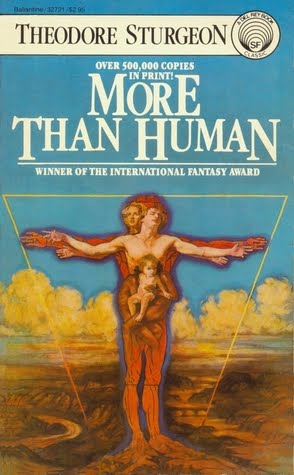
More Than Human


By Theodore Sturgeon

Lone was a wild man, living in the woods, unable to speak, unable to think very clearly. He was rescued by a farmer who saw possibilities in Lone and took him in. Under the farmer's care, Lone learned to speak a few words, to do chores, to be more human. All was good until the farmer's wife got pregnant. She didn't want Lone to be around the baby. So he went back to the woods and built himself a snug home in a cave. And gradually he acquired a family of sorts of little children on the run who needed a place to grow up, a place safe from the rest of us. Because they weren't ordinary kids, they were kids with powers. There is Baby, who never grows up; the twins Bonnie and Beanie, Janie and, later on, Gerry. Baby is an organic computer, unable to speak or walk, a seeming idiot. Bonnie and Beanie also never speak, but are able to transport themselves instantly anywhere. Janie also transports, but not herself, only things. Janie can hear Baby's thoughts and he keeps them informed and he guides them. Gerry is a powerful telepath, but he can't hear Baby. Lone serves as the front man, the one who goes out and buys food and clothes. He takes care of them until he is killed by a falling tree. At which point they move in with a woman from Lone's past. With Lone gone, the new front man becomes Gerry. Which is a real problem, because Gerry, an abused street kid, is lacking in morality and compassion. This band of misfits may be a new kind of person, homo gestalt, but until it learns some humanity, the rest of us could be in serious trouble.

This was a pretty good book. The story kind of jumps, which is not surprising since it was apparently put together from three short stories. I read this book a long time ago and even knowing how it came out, I still enjoyed rereading it.

Wyrms


By Orson Scott Card

Eight thousand years ago, a space ship happened to pass too close to the planet of the wyrms. Singing her siren song, Mother Wyrm called the captain of the space ship to her side. He landed the ship and was compelled to mate with the huge disgusting worm-like female, a mating that resulted in 4 new creatures: geblings, dwelfs, gaunts and unwyrm. Unwyrm was the only unwyrm born and at his birth he devoured Mother Wyrm and, in the process, gained not her memory and knowledge but the memory and knowledge of every mother wyrm before her. He then rested, high on the top of the mountain in his dead mother's cave, knowing that his time was not yet, that it would not be until eight thousand years in the future. At which point he would take a mate, a human woman, a woman who would either save her people from Unwyrm or send all humanity to its doom. The seventh daughter of the seventh daughter of the seventh daughter is that woman and her name is Patience and she is only fifteen when she is called upon to face her fate in Unwyrm's cave.

Well, this certainly was an imaginative and compelling story. The wyrms have got to be one of the best aliens ever thought up by an author. There will be a final clash between human and wyrm, as the son of wyrm, Unwyrm, makes a desperate bid to save his people from anihilation by humankind. It's survival of the fittest as two opposing species struggle to save their respective peoples and only one will come out alive. Who will be the ultimate ruler of the universe, Wyrm or Human? An epic battle will played out in the small confines of an icy, mountain top cave. Quite an unforgettable and fascinating story.

First Evidence


By Ken Goddard

Crime scene investigator Colin Cellars has been called in to look into the disappearances of several people in the Pacific Northwest. Before he can even get started on his investigation, he is called to a crime scene of a possible shooting at a cabin deep in the rugged forest landscape. What he doesn't know is that the cabin belongs to an old estranged friend of his named Bobby, the very man who had stood him up just a few hours before. Cellars' first discovery is the mauled body of a large dog. His next is the body of a man whose face is gone. He doesn't realize at first that it is his old friend, Bobby. But as Cellars tries to work the crime scene he realizes that he is not alone at this isolated cabin in the woods. Indeed, whoever killed Bobby is in the vicinity and is not happy that Cellars is collecting evidence of the murder.
Thus starts what is the weirdest case of his career, as Cellars comes face to face with visitors from outer space. Visitors that will do anything, including murder, to protect the secret of their presence on our planet.

This was a pretty good story, even though rather gruesome and creepy. The setting is gloomy and threatening, with the oppressive mountains, dense forests, constant rain and the shadowy aliens lurking at the edge of vision, not clearly seen but ever menacing. This kind of story isn't the sort of thing that I usually enjoy but this one was engrossing and suspenseful.

Monday, August 02, 2010

Girls of Tender Age


By Mary-Ann Tirone Smith

When Mary-Ann was about nine years old, a classmate of hers was molested and murdered by a pedophile. This book is Mary-Ann's exploration of that event and her memories of that time and also of what it was like growing up in the 1950s. Her brother was autistic, although at that time, he was just considered retarded, despite the fact that he reading at an adult level when still just a child. His condition required his parents to focus most of their energy on him, leaving Mary-Ann on the sidelines. In addition, Mary-Ann's mother was an indifferent parent, preferring to golf or play cards to being with at home with her children.
When the murder occurred, the adults in her life refused to discuss it with the children, leaving Mary-Ann with many unanswered questions. It was so traumatic to her that later in life she couldn't remember the two years of her life after the event. But as an adult, she started to confront that time in her life and to find out for herself exactly what happened to the little girl who was strangled to death in a backyard just a few houses down from where Mary-Ann lived at the time.

The subject of this book is sad and tragic, a young life cut short because of some man's depraved sexual appetite. But that isn't the only story in the book, mainly it is about Mary-Ann and her family, about growing up in the 1950s and about being sister to a brother with autism. It's a really interesting story.

American Wife


By Curtis Sittenfeld

Alice was just an ordinary girl from an ordinary family in an ordinary town. Her folks were neither rich nor poor. Alice was neither beautiful or ugly, neither brilliant or stupid. If fate had been a little kinder, she probably would have spent the rest of her life in her home town, married to a local boy, maybe teaching school, with a couple of kids, leading an ordinary life.
But fate stepped in and everything went awry and Alice went on to have the kind of life that very few ever experience: First Lady of the United States.
Alice had a crush on a boy in her high school and she was sure he liked her too. But driving to a party one night, Alice ran a stop sign and hit another car, a car that was being driven by the same boy she had a crush on. The boy was killed. Alice naturally felt terribly guilty. Her guilt drove her to seek a life away from her home town. She ended up in Chicago, where she met the man who would be her husband and who would become the President of the United States.

I picked up this book at a used book sale, not knowing anything about it. But I gradually came to realize that Alice was based on First Lady Laura Bush. In the book, Alice always carries a torch for the boy she killed and while she loves her husband, in her way, she never forgets that boy and she never stops wondering what kind of life they could have had together. Marrying Charles, Alice gets swept along on his quest to make his mark in the world. She doesn't agree with his politics and she doesn't like the public life but she does what is expected of her. She doesn't make waves and she behaves like a good little wifey should.
This book started out pretty good but after Charles & Alice are married, the story slows way down. At that point it was so boring that I stopped reading it for several weeks. Charles is not an appealing character and it was a puzzle as to why Alice stayed with him, especially since he was a conservative and she a liberal. The book doesn't go into a lot of detail about the political years and takes up the story of the presidency only in the second term.
So I did enjoy the first part of the book but after Alice and Charles get married the story was a lot less interesting.

Thursday, July 29, 2010

Nothing's Sacred


By Lewis Black

The abbreviated story of Lewis Black's life, with numerous shots at religion, school, economics, Americans, and, of course, politics and politicians. Lewis grew up in the suburbs, a Jewish kid in a not very religious family. A child of the 60s and an active participant in the counterculture movement, Lewis did all the typical things kids of that era were supposed to do, drugs, sex (not so much) and rock and roll. Still, he managed not only to graduate college but to go on to earn a Masters in drama from Yale.
Lewis has a real nose for bullshit and he loves bringing it to our attention and good for him. We need people like Lewis to point out the absurdities. Talking about gay marriage, here is his take on why the Old Testament states that man must marry woman:
Now, to be fair, there's a good reason why the Old Testament states that man must marry woman. It's because at that time, the Jewish people weren't civilized, and the Bible was, in large part, written for that very reason—to civilize people. So the leaders were forced to come up with a God who was such a prick he could keep those peckerheads in line. And I don't want to get any mail about this, but we were, as a breed, only ten hairs away from being baboons back then. So they came up with this really scary God and a list of rules, and they told everybody that God was there to enforce those rules.
They needed to do this because as the Jews were wandering around willy-nilly in the desert, one of them no doubt led a camel up to a rabbi and said, "I met her at an oasis and it's been wonderful. She looked at me in a way that I've always wanted to be looked at. We're in love and, well, Rabbi, we want to be married."
And the rabbi said, "Perhaps you didn't notice, but she's a fucking camel." Then he went back to the other rabbis and informed them, "Son of a bitch, we have to come up with another rule! Today a guy came back with a camel and yesterday one of them showed up with a snapping turtle. God knows what's going to happen tomorrow. We've got to get these people on track." Hence, the man-woman marriage rule in the Bible.


This is a funny, profane, vulgar book and I really enjoyed reading it. It is not for the easily offended though.

Lost and Found


By Alan Dean Foster

Marcus was a Chicago commodities broker enjoying a nice placid vacation on the shores of a lake high in the mountains. Until the aliens showed up and grabbed him. And his tent and the ground under it and even a slice of the lakeshore. In effect, it was a little habitat, ready made for the new addition to their collection of strange and unusual creatures from the far-flung reaches of the universe, all destined to be sold as pets, slaves or entertainers for the more heartless denizens of galactic civilization. And their captors don't care if their captives are intelligent, thinking beings; no, all they care about is their monetary value.
Marcus lives a life of unbearable loneliness and boredom, eating the same bland rations provided by his captors, drinking the water provided to him daily. When he misbehaves, tries to break through the force field confining him to his little slice of Earth, he is punished by being deprived of food. He despairs.
His captors, to ease his despair, open one side of his prison to his neighboring captive, which is revealed to be a small dog, captured from an alley in Chicago. The dog's habitat is the noisome Chicago alley and a junked car. Marcus is so pleased with this new roommate and even more so when the dog actually talks to him. It seems the aliens, in order to facilitate communication, have boosted the dog's intelligence and installed universal translators into all the captives. And as Marcus soon learns, if he behaves nicely, he will be allowed into the huge common area where all the many captives are permitted to congregate and socialize. Of course, these new privileges are just a tool to bludgeon the captives with. The least step out of line and it's back to the tent and its slice of lakeshore.
Marcus and the dog, whom Marcus names George, manage to make friends with two of the most reclusive captives among all the aliens. One an octopus-like creature of such vast intellect that she regards all her fellow captives as beneath her notice. The other a huge, voracious beast that the other captives are simply terrified of. In fact, the captors toss Marcus into the beast's habitat as punishment for misbehaviour in the hopes, maybe, that Marcus will be eaten. Instead, Marcus manages to break through the monster's seeming beastliness to discover the fragile and sensitive heart of a poet, but a poet who is prone to violent rages.
Together, this unlikely foursome are going to try to use their talents to bust out of their hated prison.

This was a pretty good story. Marcus is an enterprising fellow and his sidekick George the dog adds a lot to the story also. The other two members of the foursome are less charming, as the monster tends to speak in haiku and the octopus is frankly unbearable, conceited, and rude. Still it was fun reading about their adventures aboard the capture ship. I do wish that the dog, George, had been more doggy. Most of the time, he sounded like a human. I mean, even if you could make a dog more intelligent, wouldn't it still be a dog? Wouldn't it still get a kick out of sniffing butts and eating garbage and rolling in manure? Other than that, I enjoyed the story a lot.

Year of Wonders


By Geraldine Brooks

Its the 1660s and the young village woman Anna had a pretty good life, a strong, loving husband and two healthy, vigorous young boys. She was blessed, she knew it and was grateful to God. But then it all went horribly wrong. Her husband died in a mine collapse. But she managed to cope, working part time as a maid and she also took in a border, a tailor from London.
The tailor had recently moved to the village in an effort to escape the plague that was currently making life hell in the big city. People were dying in droves, in such numbers that the gravediggers didn't have time to dig individual graves so people were being tossed into bigs pits and buried. The tailor was so glad to be away from the plague zone. He was a nice young man and seemed to take a liking not only to Anna but to her two youngsters also. He even made Anna a beautiful dress as a gift, a dress unlike any she had ever owned. But the dress ended up in the fire because some cloth the tailor had ordered from London came with something extra...plague.
Pretty soon the tailor was dead and Anna's two boys soon sickened too. Since no one really understood the source of the disease, it spread rapidly. The village took the brave step of voluntarily isolating itself from the rest of England, setting up boundaries beyond which no villager would go and no outsider would pass. They managed to maintain the boundary even as the disease ravaged them, even as the stress and horror turned them against each other.

This was a pretty engrossing story about Anna's struggles & about how the village coped with the crisis. It starts out kind of strange in that it begins the autumn after the plague first appeared, so Anna's husband and children are already dead. Then it switches to the time before the plague, with the husband and children all alive and happy and all the bad stuff yet to come, basically adding details to the bare bones of which you already know from the first chapter. Yet, despite knowing the basic ending, the story is still fascinating, heartbreaking and awe-inspiring. Imagine, a whole village voluntarily quarantining itself and having the resolve and courage to maintain that quarantine through the worse crisis they ever faced. An the amazing thing about it is that there really was a village in England during the time of the plague that did exactly that. It is based on a true story.

Wednesday, July 21, 2010

Prep


By Curtis Sittenfeld

Lee wants a different life. A middle class kid from Indiana, Lee wants to be more. She is pretty smart so she is able to earn a scholarship to an East Coast prep school. The scholarship won't cover all her expenses but her parents are willing to pay for what the scholarship doesn't. So at age 14, Lee goes off to boarding school.
It doesn't take her long to figure out that most of the students at the school come from money. And that kids like Lee who don't come from affluent backgrounds are the exception.
Teen years are years when most kids want desperately to fit in. But now Lee, who formerly was a popular, outgoing person, finds herself an outsider. She just doesn't feel comfortable around these rich, seemingly self-confident upper class teens. She becomes silent, withdrawn, and angry.
Yet, oddly, she chooses to stay. Year after year, never feeling quite at home, always conscious of the gap between herself and the others, she stays on. She makes a few close friends but never dates, never attends dances, never lets on to her fellow students just how lonely and sad she really is. She is always on the fringes, a hanger-on, closely observing but keeping her distance. She is never really accepted as one of the gang, probably because she is never able to relax and just be herself. She is always on guard, always trying to protect herself from imagined rejection.

This was an OK book. The first half was better than the last because the novel seemed to stall and not really go anywhere towards the middle of the book. It doesn't pick up again until Lee becomes involved with a boy she has been yearning for since first attending that school. Also, I didn't really like Lee, I found her to be very off-putting. But other than that, the book is a close look at life at a boarding school for children of the wealthy, a glimpse of the lives of the privileged few.

Monday, July 19, 2010

Look Me in the Eye


By John Elder Robison

Ever since he was a little kid, John Elder Robison felt like the odd man out. He couldn't figure out why he seemed to be such a misfit. Add to that his parents' failing marriage, his father's alcoholism and abuse and his mother's slow slide into insanity and it was a recipe for disaster. But John rose above his disadvantages and managed to make a success of himself on his own terms. And it wasn't until he was in his forties that he finally learned he had Asperger's, a milder form of autism.

I really enjoyed this book. Robison writes a fascinating and compelling story about his journey through life learning to cope with his trouble relating to other people and using his amazing talents to have four different successful careers: developing sound systems and special effects for top bands, including KISS; becoming a toy engineer for Milton Bradley without even having a college degree; having a high-end car restoration and repair business; and finally, successful author. His is an amazing story and very much worth reading.

Wednesday, July 14, 2010

God's Problem


By Bart D. Ehrman

Ehrman looks at what the Bible has to say about why there is so much suffering in the world. Ehrman is a professor of religious studies and an expert on the Bible and the life of Jesus. He used to be a devout, fundamentalist Christian but now considers himself an atheist. He lost his faith because of this very question: how can a loving, caring God permit so much misery, pain and suffering?
So he began studying what the Bible had to say about this. He figured out that the Bible has several things to say about it. Suffering is punishment for sin, suffering is God's way of reproving his people and getting them back on the right track, suffering is the result of a fallen creation, suffering is caused by evil people and/or evil spirits, and that suffering, like God, is mysterious. But delving into what the Bible had to say didn't provide Ehrman with answers that satisfied him, leaving him to conclude that there simply is no God and that this life is all there is so best enjoy it while you can. And while you're at it, try to make things a little better for your fellow humans.

This was an interesting book to read. While I don't agree with his conclusions, still it provided a lot to think about, plus it has lots of information about the Bible. It was kind of a mini-tour through the Bible. Very inspiring, in its odd way. I enjoyed reading it a lot.

Tuesday, July 13, 2010

The Good Samaritan Strikes Again


By Patrick F. McManus

A collection of stories by humor and outdoors writer Pat McManus which includes, of course, the title story where Pat tries to help at the scene of a crash, only to be mistaken for the victim and hauled off to the hospital despite his protests. In the last paragraph, the actual victim is finally discovered:
Fortunately, the folks at the wrecking yard found the true victim under the dashboard and rushed him off to the hospital. He was released the next day, hardly the worse for wear. I heard he kept asking the identity of the Good Samaritan who covered him with a blanket, but no one knew. Once again the helpful stranger vanished without so much as leaving his name. I think it's better that way, I really do.

This book does contain a few tall tales of his childhood days, which are the most fun to read, still the other stories in this collection are amusing and enjoyable too.

Monday, July 12, 2010

The Other End of the Leash


By Patricia B. McConnell PhD

Patricia McConnell is an expert on dog behavior, especially on dogs who are troubled. She looks at dog training from a different point of view, that our human tendencies get in the way of communication with our dogs. In her advice on how to handle your dog, she points out that our human instinct is at variance with the canine instinct, since we come from different biological backgrounds. The things we do instinctively are not well received or maybe not understood by the dogs in our lives. For instance, dogs don't hug. Hugging is one of humankind's favorite ways to express caring. But for dogs, it just isn't natural. In fact, dogs may find hugging rather threatening.
Another thing dogs do is they are very good at reading body language. They not only read body language, but it is a huge part of their communication, so learning to understand your dog's body language is very helpful in understanding your dog.
She also discusses the importance of consistency in training and in using verbal commands. She describes how to train your dog using rewards, both food, praise, and play rewards to let your dog know he has performed correctly. She also debunks the idea that you have to physically dominate your dog to win its respect. As she points out, a dog displays its tummy voluntarily to a dominate dog, but the dominate dog doesn't roll the other dog over and force it to display its tummy. She says that doing this to a dog is humiliating and unnatural for the dog and, according to McConnell, totally unnecessary. Your dog comes to recognize your authority through proper training, not by putting the dog on its back.

This is a really interesting book not only about dog behavior but also about human behavior and about how our instincts thwart our good communication with our dogs. It has lots of great tips on training dogs and on having a happy, loving, safe relationship with them.

Mother of Demons


By Eric Flint

The people from Earth set out to explore a new planet. But something went very wrong. Some managed to land on the planet in the ship's lifeboats but the ship itself and the supplies were destroyed. So the people are stranded with no hope of rescue for hundreds of years. Worse, they discover that all the animals are toxic to them and the plant life, while edible, makes them ill. Still, they manage to survive. Barely.
The animal life on the planet seems to be solely based on mollusk-type creatures, most commonly slugs, snails and something that is similar to squids except adapted to life on land. In the place where the humans landed are very large squid-ish animals; peaceful, slow grazers. Like earth squids, these land squids have the ability to change the color of their skin in a kind of emotional code to their fellow squids. One day, one of the human children wanders into the vicinity of one of the squids, wearing a garment of the same color that the creature's offspring use to signal hunger. The squid feeds the child by regurgitating into its mouth. It doesn't take the humans long to figure out that the squid vomit is the only thing humans can eat on the planet without becoming ill. They also figure out that the squids are mildly intelligent and soon a system is in place where the humans plant and grow the crops the squids like to eat and the squids repay them by feeding the humans.
It soon becomes clear that these squids are not the only squids. There are other, smarter, carnivorous, dangerous squids. And these squids are intent on capturing and enslaving or eating the good, gentle squids. So the humans find themselves embroiled in tribal warfare to protect the squids that are vital to human survival. But what ultimate effect will contact with the more technologically advanced humans have on the bronze-age population of the intelligent, aggressive squids who became the allies of the humans in their war to protect the gentle, grazing squids and the brutal, enslaving enemy squids?

Despite its intriguing premise, this book is mainly about battles. Squid vs squid, squid vs human, with a lot of lectures about human history included. I found it rather dry going. Descriptions of battles have never interested me. I also found the idea of people living on squid-puke just disgusting. And the long discourses on history and religion and biology were too much like reading a text book.

And just a note: the demons in the title refers to the humans. The squids think the humans must be demons because they are so strange looking.

Tuesday, July 06, 2010

Prominent American Ghosts


By Susy Smith

A visit around the country to old buildings and houses rumored to be haunted by the author. She recounts the stories connected to these hauntings along with much background information about the history and people involved. Although she never actually gets to see any of the ghosts, still her reporting makes for lively and interesting reading and it is also quite a stroll through early American history. Some of the stories are very amazing, especially the ones dealing with poltergeists like the Bell Witch, a poltergeist that tormented a young girl and her family for many years, eventually resulting in the death of the girl's father. The author also details her own experience with a poltergeist that afflicted a warehouse in Florida, believed to be activated by a teenage boy who worked there, since poltergeists are said to be attracted to teenage children. It makes for pretty fascinating and somewhat chilling reading.

Monday, July 05, 2010

Gentle People


By Era Zistel

Era and her husband Eric owned a house on a large acreage in the Catskill Mountains. They both loved animals, acquiring many cats, at least one dog, several goats and a few rabbits. In the course of the years, and through Era's efforts mainly, they also had some wild guests too: chipmunks, pack rats, skunks, raccoons, opossums and flying squirrels. Era's affinity for wild creatures is just amazing, as she becomes fast friends with animals most people would prefer to avoid, much less have living within their own house, like skunks, rats and opossums. Most, like the skunks and raccoons, just stop by to be fed and admired but for a few years, Era had opossums living in her house until one died from a life of too much ease and comfort at which point she concluded they were better off on their own. She also had cages of chipmunks, rescued from her cats, and later a cage of flying squirrels, those elusive spirits of the forest, common but only rarely seen. She and Eric also kept goats for a while and rabbits but couldn't bear to eat them or sell them for meat, which became a problem.

It was great fun reading about Era and her critters. She has an incredible knack for communing with wild animals that almost seems like magic. It's a talent that only a lucky few have. One of the most enchanting chapters is the one about the chipmunks; charming, amusing little rodents. I also enjoyed the chapter about the pack rat and her family of baby rats. I especially like the chapter about the opossums, having had a few close encounters with opossums myself, one of which my dog attacked and wounded. Unlike the opossums in her book, my opossum played dead and I was able to pick it up by its tail and put it in a box to transport to the humane society. It wasn't much damaged, just a small wound on its throat, which the people at the society treated and they took care of the opossum until it was well enough to release. I also disturbed an opossum sleeping under an old pillow inside a tractor tire laying on the ground. I had picked up the pillow to toss in the garbage and a little opossum was curled up under it fast asleep. So I carefully laid the pillow down and left it. I didn't remove it until spring so the opossum could have a warm spot in which to sleep through the winter.
If you like stories about animals, this book is sure to please.

Monday, June 28, 2010

The Know-It-All


By A.J. Jacobs

When he was a little boy, Jacobs thought he was the smartest boy in the world. Of course, he wasn't, which he realized as he grew older. For one thing, his father was a very accomplished man who had written several scholarly law books, a feat that Jacobs envied greatly. Because Jacob's dad really was a very smart man and Jacobs always felt like he was competing with his father, and in view of his father's obvious accomplishments, Jacobs was falling way short.
At one time in his life, the father had set out to read the whole Encyclopaedia Britannica but had quit in the Bs. So Jacobs decides he will read it, A to Z, and in doing so will not only top his father but will acquire such vast amounts of knowledge that people will be amazed and admiring.
Jacobs does read the whole encyclopedia and he does acquire vast amounts of knowledge and people are amazed. But mostly they are annoyed because he keeps spouting off little tidbits of info about oysters and gagaku and other trivia.

I enjoyed this book. It was funny and informative and full of snippets of info Jacobs gleaned from his journey through the encyclopedia. At times the trivia was a tad overwhelming but for the most part the stuff he chose to include in the book is pretty interesting and offbeat, with anecdotes included from his own life and struggle to read the encyclopedia making for a nice balance of facts and memoir.

Mondo Canine


Compiled and edited by Jon Winokur

As it says on the cover, it is a treasury of quotations, anecdotes, essays, and lore in celebration of doggie joie-de-vivre. This is an amusing, sometimes sad, sometimes inspiring collection of stories, snippets and quotes. One of my favorite quotes from the book is by Jerome K. Jerome, author of Three Men in a Boat (To Say Nothing of the Dog) who says, "Fox terriers are born with about four times as much original sin in them as other dogs." Having a fox terrier, I know this is true.
The hardest and most touching part of the book to read was the section containing stories where owners say that final goodbye to their beloved dogs. It also has a section on dog heroes. One of my favorites of that section is the story of King, a German shepherd mix who saved his family one night when their house caught fire:
King ... literally walked through fire to save his masters' lives. At 3:30 a.m. on December 22, 1980, Howard and Fran Carlson and their daughter Pearl were asleep in their home in Granite Falls, Washington, when flames from an electrical fire erupted in their kitchen and roared through the house. King entered the house from his outdoor sleeping area, ran into Pearl's bedroom, tore off the blankets, and began tugging her arm, finally pulling her out of bed. Pearl ran screaming through the thick smoke into her parents' room. Fran woke her husband—who had recently been hospitalized with lung disease—led him to an open window and told him to jump. Then she grabbed Pearl, who in the confusion had wandered into the living room. Fran opened another window, pushed Pearl out, and then jumped herself. At that moment King appeared at Pearl's window. He was trying to bark, but all he could manage was a squeak. Fran ordered King to jump, but when he ran back toward the master bedroom instead, Fran realized that Howard was still in the burning house. Fran made her way back through the smoke and flames toward the sound of King's whining and found Howard lying semiconscious on the floor. She helped him to his feet, and they managed to break open a sliding glass door and jump to safety, followed closely by King. "He was the last to leave," she said. "He wouldn't budge before we were outside."
It wasn't until daybreak that the Carlsons saw the singed hair on King's body and his burned, swollen paws. They discovered that his metal chain collar had become so hot it had burned his throat, preventing him from barking normally. And when King refused food, they found wood splinters in his mouth and realized that to save his family, King had gnawed through a plywood door.


This is a fun book to read and I really enjoyed it. It is jammed pack full of amusing and informative tidbits and amply illustrates just how much dogs add to our lives.

Dog Heroes


By Tim Jones

A book of true stories of dogs who have saved lives, helped people in need and given their lives in the performance of their duties. It includes tales of dogs in the military and of rescue dogs and of working dogs doing their duty and of ordinary pets behaving in extraordinary ways.
One of my favorite stories was about Chips. Chips was a family pet who was a tad over-protective of his family. So with the arrival of World War II, Chips was sent to serve in the military. Chips was involved in the invasion of Italy in July, 1943, landing on the beach with his unit under terrible enemy fire. The unit was pinned down by heavy machine gun fire coming from a bunker just above them. The situation was extremely precarious. Then Chips, all on his own without being sent by his handler, raced toward the bunker. He was shot twice but kept going, charging over the barricade and grabbing the machine gunner by the neck. His actions gave the troops below the break they needed to swarm the bunker and capture the soldiers inside. Chips recovered from his wounds and continued to serve until 1945 at which point he was sent home to his family. He was awarded the Silver Star and the Purple Heart.

This was a fun and heart-warming book to read. Full of stories of the good dogs do for humanity, with their service and devotion, it makes one realize how wonderful dogs can be and what an asset they are and how under-valued they are for the what they bring to our lives.

Dakota: A Spritual Geography


By Kathleen Norris

Kathleen Norris writes about living in the small town of Lemmon in north central South Dakota. The house she lived in was built by her grandparents and she used to spend summers there as a child but she grew up in Hawaii and lived on the East Coast before moving to Lemmon where her family's roots in the community go back generations.
Written during the farm crisis of the 1980s when crop prices were depressed, interest rates increasing, land values falling and many farms failing, Norris observed how the local community reacted. So she writes of small town life in changing times. She also writes about her feelings about life in a monastery and about how the challenges of living in and the landscape of the wide open spaces of the grasslands of the Dakotas helped her to understand and develop her own spirituality.

This was a pretty good book. I especially enjoyed her reflections on the insularity of small town people and of how it makes life harder for new members trying to fit in to a community that will never stop thinking of them as outsiders. I also enjoyed her descriptions of life on the prairie and of the struggles to make a living in a less than hospitable environment. I didn't enjoy as much her raptures over monastery life. Overall, I found the book interesting and surprisingly inspiring, and I am not a person who is easily inspired.

Blessings


By Sheneska Jackson

Blessings is the name of a hair salon in Los Angeles. Its owner is Pat who was given the salon by her husband to take her mind off the fact that she in unable to conceive a child. The salon wasn't doing too well until Zuma showed up one day wanting a job. Zuma was an accomplished hair stylist who brought lots of new business to the salon. Also working at the salon was Faye, a single mother with a small son and a wayward teen daughter. Shortly after the story begins, Pat hires another person, Sandy, an ex-stripper and mother to two youngsters.
Both Pat and Zuma want the same thing, to have children of their own. They end up spending thousands of dollars on fertility doctors and, after giving up on that, on trying to adopt. Zuma has lots of men friends but no one she wants to raise a child with so she has saved up her money and is planning on getting pregnant via artificial insemination, something she is keeping a secret from the gals at the salon.
Meanwhile, Faye is having a really hard time with her kids, her young son is getting into fights and her teenage daughter, who is pregnant, has run away to be with her boyfriend. And Sandy turns out to be a psycho bitch who thinks nothing of leaving her preschool age son at home alone with his baby sister who is only a few months old. Her jealousy and rage eventually drive away the father of the two kids, leaving the children in her neglectful care.

This was an OK story. Of the four characters, Faye is the most likable, but is described as on overweight pig, stuffing her face with junk food. Pat seems like a mental case in her obsession with getting a child. Zuma is just plain mean and the least likable of the bunch. The oddest character of the group is Sandy, who starts out as quite sympathetic, sassy and brave, standing up to and facing down Zuma's hate and racism. But then we are told she is pathologically jealous and that she actually hates her two small children, slapping and pinching them, forgetting to feed them, leaving them home alone while she goes off to work. Gutsy and feisty at first, the Sandy character is then transformed into a monster and a villain. I guess I didn't warm up to the book because I didn't warm up to the characters, selfish, baby-crazed Pat, Zuma the hateful bigot, Faye the fat pig and Sandy the psycho bitch child abuser. So, although the story was pretty interesting, the characters just left me cold.

A Bride Goes West


By Nannie T. Alderson and Helena Huntington Smith

The true story of a young woman's life on the Montana range in the 1880s and 1890s.
Nannie was a young Southern woman from West Virginia when she and her new husband set out to become cattle ranchers in Montana. Their first year together was fun and exciting as Nannie became familiar with the ranching life. She wasn't really trained to be a self-sufficient country woman, having been raised in a household where being a lady was more important that knowing how to cook and clean. In fact, the only thing she actually knew how to cook were rolls and it also never occurred to her or her husband that her city clothes were entirely unsuited to the hard life she would now be living. But like many a young bride, she learned and she coped and she adapted.
At first, things seemed to be going really well. Those first few years the rains were timely and the grazing was good. To begin with they were living in a dirt floor shack but her husband and his men soon built them a snug little log house. But then one of the hired hands got into a dispute and in revenge, the little house was burned along with all its contents, including some heirlooms Nannie had brought with her from back East.
After that, they moved and a new place was built. But things just went downhill from there. The weather turned dry and the winters were brutally cold. Between the drought, the cattle lost to cold and blizzards and the decline in the market price and the money spent to build the new place, their dream of cattle ranching was never realized. They had to sell out and move into town where Nannie's husband was killed in a freak accident, kicked to death by two feuding stallions. She was left to raise their four kids by herself, which she did to the best of her ability and helped by a small life insurance policy her husband had.

This was an interesting story about life on a cattle ranch in the pioneer days and about a young woman's education in the school of hard knocks. The bulk of the story is about the time before Nannie's husband died with her life after his death being allotted just one chapter. Like most pioneer narratives, it is a story of hardship, hard work, family, love, danger and survival. It's a good story.

Friday, June 11, 2010

The Moon's a Balloon


By David Niven

Niven's autobiography, tracing his life from childhood until the late 1960s. Growing up in England, entering the military, gradually settling upon a career in movies that took him to Hollywood where he struggled for a time. Marriage, kids, success, back to England to fight in WW II, then back to Hollywood & more success, then the tragic death of wife #1, then more success, new wife, new kids, more success, an Oscar, a few slightly bawdy stories, lots of encounters with famous people, leaving Hollywood for a more Continental life, more success, more famous people and there you have it.

David Niven certainly knew a lot of famous people, including Winston Churchill and John F. Kennedy and scores of show folk like Elizabeth Taylor & Mike Todd, Frank Sinatra, Noël Coward, Greta Garbo, Errol Flynn, Sam Goldwyn, Humphrey Bogart & Lauren Bacall, Peter Ustinov, Lawrence Olivier, Merle Oberon and on and on. So if you want to read about the early days of Hollywood and some of its most famous stars then this is the book for you. However, I found it a little dull at times, especially the WW II section and it took me several weeks to read it.

Tuesday, June 08, 2010

Are You There, Vodka? It's Me, Chelsea


By Chelsea Handler

A series of stories supposedly taken from events in her real life by comedienne Chelsea Handler. Some of the stories are mildly amusing, but they are all vulgar, crude and nasty. Her comedy is mainly just cruel and mean, whether dealing with her lovers, her family, her friends, dwarfs or animals. It's scary how cold and uncaring she seems to be and how willing to sneer at everyone, including her elderly father whom she refers to as Shamu and Bitch Tits. But what can you expect from a woman who urinates out of her vagina? Quoth Chelsea:
I had my drink in between my legs and was trying to redirect the urine that was seeping its way out of my vagina.

Bottom line, this is a gross book. Which would be OK if it was gross and funny. But this book is mostly just gross.

Fearless Fourteen


By Janet Evanovich

Another in the Stephanie Plum series. Stephanie is a bounty hunter. She tracks down people who have missed their court date and hauls them back to jail. She is not a trained law enforcement officer, she is just a woman who needed a job and was able to land one with her cousin Vinnie who owns the bail bond company.
Stephanie has an on-again, off-again relationship with Joe Morelli, who is a cop. In this book, the relationship is definitely on, with Stephanie spending most nights at Joe's house. But while she is sleeping with Joe, she still has eyes for Ranger, who owns a security company and he sometimes throws work her way. In this story, Stephanie is body guarding an aging star who is making an appearance in Trenton. But this is just a side story to the main story, which is about a long-ago bank robbery.
Joe's house used to belong to his aunt, but when she died she left the house to Joe, something that Joe's cousin Dom didn't anticipate when he hid a very valuable set of keys in her basement, keys to a garage and a van full of nine million dollars stolen in a bank robbery by Dom and his gang. Now that Dom is out of prison, he is looking to find those keys and finally split the money with the rest of the gang. Dom took the fall for the robbery while the other members of the gang remained free and anonymous.
So now Dom is angry at Joe for usurping his inheritance, for shtupping his sister Loretta, and for standing between Dom and the nine million. But when the dead bodies start to pile up, it turns out Dom is not to blame and that someone in the gang has turned against his fellows. And as per usual, Stephanie manages to find herself smack in the middle of all the action.

This was a pretty good story and lots of fun, despite the body count. Stephanie manages to get herself dyed blue while searching for a clue to the whereabouts of the money and a potato gun plays a significant role in foiling the guy out to get all the money for himself. Lulu is there to help in her usual outrageous outfits and also giving her boyfriend Tank the heebee-jeebies when she tries to finagle him into marriage. All in all, it is another excellent and fun addition to the Stephanie Plum saga.

Tuesday, June 01, 2010

To Say Nothing of the Dog


By Connie Willis

This novel is set about fifty years in the future and time travel has been around for about thirty years. When first developed, time travelers had hoped to go to the past and bring back treasure. But it didn't work. The time travelers could not bring anything from past back. Time wouldn't allow it. Every time it was tried, the device to travel back to the future refused to work until the contraband was removed. After this was figured out, the greedy exploiters lost interest in time travel and it was relegated to academics and historians who wished to used it for simple research.
Of course, messing about in the past can have grave consequences for the future. Even something as simple as causing a fated meeting not to occur by delaying one of the principals for a few minutes can have repercussions that last into generations. So it's a good thing that Time is very stable and has the ability to correct interference. So time travelers have to be very careful when visiting the past.
But major, pivotal events are off-limits to time travelers. When they try to visit these times, they can't do it. They end up somewhere else or somewhen else. At the time of this story, one of those critical events is the destruction of Coventry Cathedral in England in World War II by a bombing raid from Germany.
Anyway, a very influential and wealthy woman in the present time of the story, the 2050s, has decided to rebuild Coventry Cathedral. She is determined to produce an exact replica of the building, including all its furnishings and decorations. She has managed to do so with the exception of one item, the bishops bird stump, which is a large, iron, heavily decorated vase. This vase may have been in the cathedral when it was bombed or it may have been removed with most of the other valuables just before the bombing. But it was never seen again after the bombing. So this woman has mobilized the time travelers, who refer to themselves as historians, to go into the past and try to figure out what happened to the vase.
Meanwhile, one of the historians has come back from the past with a cat. Now, this is supposed to be impossible, since previously no one was able to bring anything forward, alive or inanimate. The historian is part of the crew trying to gather info on the lost vase for which task she has been in the late 1800s attempting to gain access to a young woman's diary that may have the last name of a person who may have knowledge about the lost vase, some fifty years in that person's future. The historian, Verity, impulsively rescued the cat from being drowned by the family's butler (in the 2050s, cats are extinct), and also impulsively brought the cat to the future. Of course, everyone is astounded that she was able to do this and also concerned that removal of the cat might affect the course of history. So another historian, Ned, is sent to take the cat back.
Repeated time jumps make the time traveler loopy and Ned has been making lots of jumps trying to gather info about the lost vase. As a result, he is very time-lagged and completely zones out when he is given the instructions about returning the cat. The only thing he really remembers is that he is supposed to stay in the past for a few days to rest and recuperate. He doesn't remember about the cat or even realize that it is in a basket with the rest of his gear that he is traveling back with.
So he goes back to the same time and locale as the cat came from and, in his befuddled state, accidentally prevents the owner of the cat, who also is the owner of the diary that Verity was trying to get a look at, from meeting the man she is supposed to marry and instead the young woman meets another young man and they fall in love, which also prevents this young man from meeting the woman who is supposed to be his future wife. So somehow Ned and Verity have to correct their interference with the past in order to keep from changing the future. And also locate the bishops bird stump.

Whew, that was a long explanation and that's just laying the foundation. Ned and Verity go on to have quite a time in Victorian England, with Ned embarking on a boat trip down the river that has a lot in common with another boat trip, recorded in Jerome K. Jerome's humorous book, THREE MEN IN A BOAT (TO SAY NOTHING OF THE DOG). You don't need to be familiar with the Jerome book to enjoy this story, but it does add an extra something if you are.
Well, a lot doesn't happen in this story, it's mostly about Ned coping with Victorian times and trying to correct the consequences of his actions. Sometimes the plot gets a little thick, with all the time travel intrigue, bouncing back and forth between the future, 1940s Coventry, and the Victorian era. It's a lighthearted book, often mildly amusing, but not a funny as the book it emulates, THREE MEN IN A BOAT.