By Mardi Jo Link
Mardi Jo's marriage fell apart and she, staying in their family home, tried to carry on as best she could raising three boys and maintaining her acreage. Mardi had always wanted to live in the country and have horses and she and her husband had purchased the acreage with its hundred-year-old house and a barn and some pastureland. Mardi had also purchased two horses and installed them in the barn and put electrified fencing around the pasture for them. But then her marriage ended.
She stayed on the acreage with the kids and had to keep up the mortgage and take care of the place, the kids, the horses and herself on her now very limited funds. She had some income as a writer but it wasn't enough as became quite apparent when winter arrived and she couldn't afford to heat the house and had to rely upon the big old fireplace for heat. Due to lack of foresight and poor planning she had failed to acquire adequate firewood before winter. She had trees on her acreage but no chain saw so she and the boys had to gather limbs small enough to cut with an ax and scrounge for wood along roadsides.
After that first cold winter on her own, scrimping and saving and making due, the next summer she planted a large garden and bought a feeder pig which was later butchered and the meat stored in her freezer. But then there was a power failure and when the electric came back on, the power surge burned out the motor on the freezer and Mardi failed to check on the freezer periodically to see if it was OK. She didn't realize something was wrong until the meat began to stink up the whole house.
But somehow, despite her many goofs, she still managed to keep her sons clothed and fed and she also managed to hang on to the acreage despite the divorce. And at the end she marries the man who was doing some improvements to her house. Who, coincidentally, was granted his divorce on the same day as hers. Uh huh.
This was a pretty good story. I just have my doubts about how truthful it really is, which kind of spoils it for me.
Thursday, October 31, 2013
Sunday, September 29, 2013
Zone Yellow
By Keith Laumer
Brion Bayard is an agent of the Imperium. When his world is invaded by an army of intelligent, evolved rats, Bayard is the man on the spot. He travels to the alternate universe the rats originated from and attempts to understand what has caused them to launch an assault on the Imperium. What he finds is a convoluted tangle of disease, politics, and double-dealing. But nothing that Bayard can't handle.
This story was so confused and disjointed. At first you are supposed to hate the rat people, who are portrayed very negatively (they eat their wounded comrades while the wounded are still alive). Then they are portrayed as the downtrodden dupes of a mysterious leader who has overthrown the rightful ruler, a young and appealing royal girl rat. The evil villain war lord rat who invaded the human world suddenly becomes the hero rat who helps defeat the usurper. It was all rather convoluted and not in a good way. It just didn't make a lot of sense, and unlike many of Laumer's novels, was not the least bit amusing. Just a huge waste of time.
Brion Bayard is an agent of the Imperium. When his world is invaded by an army of intelligent, evolved rats, Bayard is the man on the spot. He travels to the alternate universe the rats originated from and attempts to understand what has caused them to launch an assault on the Imperium. What he finds is a convoluted tangle of disease, politics, and double-dealing. But nothing that Bayard can't handle.
This story was so confused and disjointed. At first you are supposed to hate the rat people, who are portrayed very negatively (they eat their wounded comrades while the wounded are still alive). Then they are portrayed as the downtrodden dupes of a mysterious leader who has overthrown the rightful ruler, a young and appealing royal girl rat. The evil villain war lord rat who invaded the human world suddenly becomes the hero rat who helps defeat the usurper. It was all rather convoluted and not in a good way. It just didn't make a lot of sense, and unlike many of Laumer's novels, was not the least bit amusing. Just a huge waste of time.
Ladies' Night
By Mary Kay Andrews
Grace Stanton is a successful lifestyle blogger. Indeed, she is so successful that she and her husband live in a large home in a gated Florida community, all paid for by her blog. Grace, a decorator by profession, doesn't really pay as much attention as she should to the business aspects of her blog, as becomes painfully clear when her marriage falls apart. It turns out that her much more savvy husband has put everything in his name and Grace, who stormed out when she found hubby getting a BJ from her assistant, is now without a means of support. She ends up moving back in with her mother in the apartment over the bar her mother runs. Plus she has been ordered to undergo counseling by the divorce judge because she drove hubby's fancy car into their swimming pool. Seems like things can't get any worse but they do when it becomes clear that hubby and girlfriend are determined to sabotage Grace's efforts to start a new blog and rescue her floundering career.
This was a good read. I enjoyed it a lot more than I should have, given the over-the-top behavior of hubby and girl friend and various other characters in the story. So even though I found the several of the characters rather unbelievable, I still liked the story, it was quite entertaining and I liked the pacing, with the main character and the new love not falling into bed together immediately.
Grace Stanton is a successful lifestyle blogger. Indeed, she is so successful that she and her husband live in a large home in a gated Florida community, all paid for by her blog. Grace, a decorator by profession, doesn't really pay as much attention as she should to the business aspects of her blog, as becomes painfully clear when her marriage falls apart. It turns out that her much more savvy husband has put everything in his name and Grace, who stormed out when she found hubby getting a BJ from her assistant, is now without a means of support. She ends up moving back in with her mother in the apartment over the bar her mother runs. Plus she has been ordered to undergo counseling by the divorce judge because she drove hubby's fancy car into their swimming pool. Seems like things can't get any worse but they do when it becomes clear that hubby and girlfriend are determined to sabotage Grace's efforts to start a new blog and rescue her floundering career.
This was a good read. I enjoyed it a lot more than I should have, given the over-the-top behavior of hubby and girl friend and various other characters in the story. So even though I found the several of the characters rather unbelievable, I still liked the story, it was quite entertaining and I liked the pacing, with the main character and the new love not falling into bed together immediately.
Eighty Days
November 14, 1889 -- Two women set off from New York, one heading east and one heading west. Their goal: get back to New York in less than eighty days.
Inspired by the Jules Verne novel, Around the World in Eighty Days, Nelly Bly, intrepid woman reporter known for her investigative journalism, and sponsored by her employer, the New York newspaper The World, set forth by ship, headed to Europe in a trek around the world. Getting wind of Bly's excursion, the magazine Cosmopolitan decided to send one of their female writers off on a similar trek, only their writer, Elizabeth Bisland, would start out by heading across the U.S. by train to California, there to board ship for the Orient. Their idea was that Bly, upon arriving on the West Coast would have to deal with the harsh Midwestern winter weather as she traveled east back to New York which might slow her down drastically, maybe even stall her for some time.
Bly and Bisland were alike in some respects. Both were young women in their twenties, unmarried and obliged to support themselves. Both were talented and evocative writers. Bly was a reporter, not afraid to go undercover to expose abuse and corruption. Bisland was not a reporter, she wrote genteel magazine articles about literature and poetry. Bly set forth with only one small piece of luggage and only one dress and a coat but Bisland took several pieces of luggage with her and several dresses suitable for various occasions. But both women had this in common, that they were going to experience and see things they never dreamed of and it would a very rewarding and enlightening experience.
This was a great and exciting read. The author really made the two trips come alive. Bly came back convinced that America had all the other places of the world beat. But Bisland came back enriched by and appreciative of what other cultures had to offer. I particularly enjoyed the picture painted by the author of those cultures before they became changed by contact with the rest of the world. A real trip back in time, I almost felt like I'd been there and seen it all for myself.
Friday, August 30, 2013
Tuesday's Gone
By Nicci French
A social worker stops by a client's home to check up on her only to find the woman taking care of a dead man. The woman, who has some kind of brain disease, is incoherent and can't tell authorities who the man was or how he came to be in her apartment.
Detective Chief Inspector Karlson, who has previously worked with Frieda Klein, a psychotherapist, asks her to speak to the woman, who is now in the psychiatric hospital.
With Frieda's help, the man is identified as one Robert Poole and further investigation reveals that he was a con man with a whole list of victims, anyone of which may have murdered him.
This was an OK story. The main character, Frieda, comes off as a bit of a cold fish. She also seems to have some baggage, some to do with a previous case and some to do with her own past. I didn't really care for Frieda, I had more sympathy for the confused and tragic young woman living in the boat who I hoped very much would be rescued. All in all, not caring for the main character nor for how the story concludes, I will say it was only a fair read.
A social worker stops by a client's home to check up on her only to find the woman taking care of a dead man. The woman, who has some kind of brain disease, is incoherent and can't tell authorities who the man was or how he came to be in her apartment.
Detective Chief Inspector Karlson, who has previously worked with Frieda Klein, a psychotherapist, asks her to speak to the woman, who is now in the psychiatric hospital.
With Frieda's help, the man is identified as one Robert Poole and further investigation reveals that he was a con man with a whole list of victims, anyone of which may have murdered him.
This was an OK story. The main character, Frieda, comes off as a bit of a cold fish. She also seems to have some baggage, some to do with a previous case and some to do with her own past. I didn't really care for Frieda, I had more sympathy for the confused and tragic young woman living in the boat who I hoped very much would be rescued. All in all, not caring for the main character nor for how the story concludes, I will say it was only a fair read.
The Nitrogen Fix
By Hal Clement
Something terrible happened in the past. Somehow, Earth's atmosphere has lost most of its oxygen and life on Earth has been devastated. Now the only animal life left are a few struggling settlements of humans. There is plant life, of a sort, and people are able to survive by maintaining greenhouses full of crops and plants that provide food and oxygen. But life is very harsh and life spans greatly shortened.
Kahvi and Earrin are nomadic traders, traveling by raft to and from seaside communities. They have a young daughter and Kahvi is pregnant. They have a small greenhouse in which they sleep and recharge their oxygen equipment. They also have a traveling companion, Bones.
Although Kahvi and Earrin are sure they are the aliens and Bones is the native, the reverse is the actual truth. Bones is an observer from another star system, on Earth to study its native life and atmosphere.
A group of young scientists from the former city of Boston has developed the hypothesis that Bones and his fellow aliens on Earth are the ones responsible for the destruction of the oxygen as part of a plot to seize the world for themselves. To that end, they have captured a small alien and are now attempting to capture Bones. They don't know that the aliens are mere observers and are on Earth just to gather information. But Kahvi and Earrin have known Bones for years and trust the alien, even leaving it to watch over their young daughter.
It all comes to a head when the radicals take not only Bones but Earrin too and Kahvi has to try to save both her husband and Bones from the well-meaning but mistaken young scientists.
I liked this book. It paints a picture of a very different world in which people are barely managing to hang on, a real survivor tale, with the added interest of strange, peculiar aliens. The humans have made science a forbidden subject, blaming it for the collapse of the atmosphere. The young scientists in the story are revolutionaries, going against the established wisdom in order to attempt to save their damaged world. And even though they are the "bad guys," at least they are trying to do something, unlike their elders. Very interesting and exciting story.
Something terrible happened in the past. Somehow, Earth's atmosphere has lost most of its oxygen and life on Earth has been devastated. Now the only animal life left are a few struggling settlements of humans. There is plant life, of a sort, and people are able to survive by maintaining greenhouses full of crops and plants that provide food and oxygen. But life is very harsh and life spans greatly shortened.
Kahvi and Earrin are nomadic traders, traveling by raft to and from seaside communities. They have a young daughter and Kahvi is pregnant. They have a small greenhouse in which they sleep and recharge their oxygen equipment. They also have a traveling companion, Bones.
Although Kahvi and Earrin are sure they are the aliens and Bones is the native, the reverse is the actual truth. Bones is an observer from another star system, on Earth to study its native life and atmosphere.
A group of young scientists from the former city of Boston has developed the hypothesis that Bones and his fellow aliens on Earth are the ones responsible for the destruction of the oxygen as part of a plot to seize the world for themselves. To that end, they have captured a small alien and are now attempting to capture Bones. They don't know that the aliens are mere observers and are on Earth just to gather information. But Kahvi and Earrin have known Bones for years and trust the alien, even leaving it to watch over their young daughter.
It all comes to a head when the radicals take not only Bones but Earrin too and Kahvi has to try to save both her husband and Bones from the well-meaning but mistaken young scientists.
I liked this book. It paints a picture of a very different world in which people are barely managing to hang on, a real survivor tale, with the added interest of strange, peculiar aliens. The humans have made science a forbidden subject, blaming it for the collapse of the atmosphere. The young scientists in the story are revolutionaries, going against the established wisdom in order to attempt to save their damaged world. And even though they are the "bad guys," at least they are trying to do something, unlike their elders. Very interesting and exciting story.
The Uninvited
By Heather Graham
Allison Leigh is a guide at an historic home in Philadelphia. Landon Mansion was commandeered by the British and used by Lord Bedford during the Revolutionary War. Legend has it that young Lucy Tarleton, resident in the home with her family, was a spy for the Americans and cozied up to Lord Bedford to glean information. When he found out, he was said to have stabbed her to death, earning him the nickname Butcher Bedford. Ever since, Landon Mansion has had a rather iffy reputation. Of course, any really old house has had people die in it. Most people died at home, not in a hospital in the past. But in more modern times, there have been at least three unexpected deaths associated with the house. One person died in a fall on the stairs, one died at the desk in the study of a heart attack and a student died while trying to break into the house. All this Allison dismisses as just unfortunate occurrences. But now one of her fellow guides has been found with a bayonet shoved through his throat in the study of the old house. And, as his ghost assures Allison, it was no accident. Allison, who was a staunch denier of all things paranormal, now has to grapple with this ghost haunting her and wanting her to find his unknown killer. That is where the Krewe of Hunters can help. An elite group of FBI agents, the Krewe are all psychics and are used to dealing with the supernatural. Together with Allison they will unearth the truth behind the legend of Butcher Bedford, a truth for which someone is willing to commit murder to keep buried in history.
This was a pretty good story. I had never before read one of the Krewe of Hunters stories and I don't know if it is typical that the ghosts are as interactive as that of the murdered guide in this story. This ghost was pretty much the same as when the young man was alive, rackety, undependable, and even prone to taking naps. He just didn't seem very ghostly. I didn't much care for that. Also, the motive of the killer seemed very weak to me, killing people just to keep anyone from finding out the truth about what happened 250 years in the past. I just didn't find that believable. But other than that, I liked it.
Allison Leigh is a guide at an historic home in Philadelphia. Landon Mansion was commandeered by the British and used by Lord Bedford during the Revolutionary War. Legend has it that young Lucy Tarleton, resident in the home with her family, was a spy for the Americans and cozied up to Lord Bedford to glean information. When he found out, he was said to have stabbed her to death, earning him the nickname Butcher Bedford. Ever since, Landon Mansion has had a rather iffy reputation. Of course, any really old house has had people die in it. Most people died at home, not in a hospital in the past. But in more modern times, there have been at least three unexpected deaths associated with the house. One person died in a fall on the stairs, one died at the desk in the study of a heart attack and a student died while trying to break into the house. All this Allison dismisses as just unfortunate occurrences. But now one of her fellow guides has been found with a bayonet shoved through his throat in the study of the old house. And, as his ghost assures Allison, it was no accident. Allison, who was a staunch denier of all things paranormal, now has to grapple with this ghost haunting her and wanting her to find his unknown killer. That is where the Krewe of Hunters can help. An elite group of FBI agents, the Krewe are all psychics and are used to dealing with the supernatural. Together with Allison they will unearth the truth behind the legend of Butcher Bedford, a truth for which someone is willing to commit murder to keep buried in history.
This was a pretty good story. I had never before read one of the Krewe of Hunters stories and I don't know if it is typical that the ghosts are as interactive as that of the murdered guide in this story. This ghost was pretty much the same as when the young man was alive, rackety, undependable, and even prone to taking naps. He just didn't seem very ghostly. I didn't much care for that. Also, the motive of the killer seemed very weak to me, killing people just to keep anyone from finding out the truth about what happened 250 years in the past. I just didn't find that believable. But other than that, I liked it.
Gateway
By Frederik Pohl
Bob Broadhead grew up in the food mines, in a world starved for resources. His was a brutal, dead-end existence, so when he won a small fortune in the lottery, he bought a one-way ticket to Gateway.
Gateway was a base established by the Heechee, now long abandoned and recently discovered by humans. Almost nothing is known about the vanished Heechee, except that they had a penchant for building space bases and leaving their ships at the bases, destinations already set and ready to launch. Humans do not understand the technology that drives the ships, nor have they figured out how the settings work. But unable to resist the opportunity, brave souls set forth on these ships, with their pre-programmed destinations and returns, hoping to find treasure, namely Heechee artifacts and technology and also hoping to come back alive and well. But climbing into a space ship without knowing where it will end up and when it will return is, at the very least, a risky business. Lots of trips lead nowhere and lots lead to death, something Bob failed to grasp before he came to Gateway.
His first flight out leads to nothing, as does the second. But the third flight hits paydirt, but out of the ten people who went, he is the only survivor. And although he is now set for life, wealthy beyond his wildest expectations, the guilt and sorrow he feels has blighted his life and he wrestles everyday with depression and sadness.
This was an OK story. It is told in a series of flashbacks, as the now-wealthy main character tries to deal with his guilt and feelings of loss. The character's psychological state is an important (and, to me, boring) part of the story. We get to follow the young man as he learns the truth about the Gateway missions and as he struggles to face his fears and leap off into the unknown and possible death or possible success. Gateway thrives on people's willingness to risk it all for a chance to become wealthy, or if not wealthy, then at least able to afford the finer things in life like food, water, clean air and a better life for their kids.
I liked the parts about Gateway and its people. The parts about Bob's struggles with his survivor guilt just didn't appeal to me at all.
Bob Broadhead grew up in the food mines, in a world starved for resources. His was a brutal, dead-end existence, so when he won a small fortune in the lottery, he bought a one-way ticket to Gateway.
Gateway was a base established by the Heechee, now long abandoned and recently discovered by humans. Almost nothing is known about the vanished Heechee, except that they had a penchant for building space bases and leaving their ships at the bases, destinations already set and ready to launch. Humans do not understand the technology that drives the ships, nor have they figured out how the settings work. But unable to resist the opportunity, brave souls set forth on these ships, with their pre-programmed destinations and returns, hoping to find treasure, namely Heechee artifacts and technology and also hoping to come back alive and well. But climbing into a space ship without knowing where it will end up and when it will return is, at the very least, a risky business. Lots of trips lead nowhere and lots lead to death, something Bob failed to grasp before he came to Gateway.
His first flight out leads to nothing, as does the second. But the third flight hits paydirt, but out of the ten people who went, he is the only survivor. And although he is now set for life, wealthy beyond his wildest expectations, the guilt and sorrow he feels has blighted his life and he wrestles everyday with depression and sadness.
This was an OK story. It is told in a series of flashbacks, as the now-wealthy main character tries to deal with his guilt and feelings of loss. The character's psychological state is an important (and, to me, boring) part of the story. We get to follow the young man as he learns the truth about the Gateway missions and as he struggles to face his fears and leap off into the unknown and possible death or possible success. Gateway thrives on people's willingness to risk it all for a chance to become wealthy, or if not wealthy, then at least able to afford the finer things in life like food, water, clean air and a better life for their kids.
I liked the parts about Gateway and its people. The parts about Bob's struggles with his survivor guilt just didn't appeal to me at all.
Monday, August 12, 2013
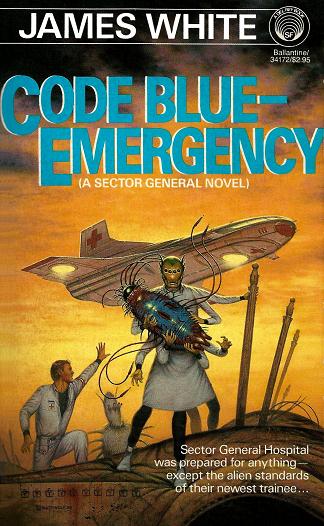
Code Blue -- Emergency
By James White
Cha Thrat was a warrior-surgeon. As her people had been at peace for a very long time, the warrior part of her title was mainly an indication of status only. But Cha Thrat came from a very stratified society, with just three classes of people, serviles, warriors and rulers. As a surgeon, Cha Thrat was very traditional, which made her unpopular with her peers. But she was one of the best surgeons. So when an injured human was found in a wrecked craft, and Cha Thrat was on vacation in the area, it only made sense that she should attempt to put back together a gravely injured being, even though she was totally unfamiliar with human anatomy. But she did such a good job that the man's life and limbs were saved and his superiors were so impressed with her skills as a surgeon that she was invited to join the staff of Sector General, the huge multi-species space-hospital that served as a treatment facility for fifty-plus different species of beings.
Due to pressures at work, Cha Thrat felt obliged to accept the offer and shortly found herself in a completely alien environment, surrounded by strange and often fearsome-appearing creatures, gabbling in a bewildering variety of languages, and all part of the massive conglomeration that was Sector General. How she would ever find a place within this complex and confusing hospital remained to be seen, and even more disheartening was that she had to become a student again, required to take classes and attend lectures and start her professional life over. Further, it seemed everything she did upset her superiors and she found herself the talk of the hospital and banned from every ward, finally ending up working as a maintenance technician. She didn't give though because even maintenance techs are a vital and important part of the smooth running of the giant institution that is Sector General.
This was a good book, with Cha Thrat trying to adapt to a strange new environment and her fellows trying to adapt to her in return. White's aliens are always strange and interesting and following Cha Thrat struggles was quite engrossing and entertaining.
Cha Thrat was a warrior-surgeon. As her people had been at peace for a very long time, the warrior part of her title was mainly an indication of status only. But Cha Thrat came from a very stratified society, with just three classes of people, serviles, warriors and rulers. As a surgeon, Cha Thrat was very traditional, which made her unpopular with her peers. But she was one of the best surgeons. So when an injured human was found in a wrecked craft, and Cha Thrat was on vacation in the area, it only made sense that she should attempt to put back together a gravely injured being, even though she was totally unfamiliar with human anatomy. But she did such a good job that the man's life and limbs were saved and his superiors were so impressed with her skills as a surgeon that she was invited to join the staff of Sector General, the huge multi-species space-hospital that served as a treatment facility for fifty-plus different species of beings.
Due to pressures at work, Cha Thrat felt obliged to accept the offer and shortly found herself in a completely alien environment, surrounded by strange and often fearsome-appearing creatures, gabbling in a bewildering variety of languages, and all part of the massive conglomeration that was Sector General. How she would ever find a place within this complex and confusing hospital remained to be seen, and even more disheartening was that she had to become a student again, required to take classes and attend lectures and start her professional life over. Further, it seemed everything she did upset her superiors and she found herself the talk of the hospital and banned from every ward, finally ending up working as a maintenance technician. She didn't give though because even maintenance techs are a vital and important part of the smooth running of the giant institution that is Sector General.
This was a good book, with Cha Thrat trying to adapt to a strange new environment and her fellows trying to adapt to her in return. White's aliens are always strange and interesting and following Cha Thrat struggles was quite engrossing and entertaining.
Saturday, August 03, 2013
Fat White Vampire Blues
By Andrew Fox
Born and raised in New Orleans, Jules Duchon can't imagine being anywhere else. Fat and happy, Jules loves dining on the rich, cholesterol-laden blood of his hometown neighbors. It's why he has gotten so fat. Apparently even vampires can have weight issues. But something has to change because now Jules is starting to feel the effects of his fatty diet: shortness of breath and aching joints. Plus the love of his life, the woman vampire who made him, Maureen, wants nothing to do with him. He is just too fat to love.
But soon his weight isn't the only problem Jules has to deal with. There is a new, aggressive young vampire in town and he is muscling in on Jules' territory. In fact, he is trying to run Jules out of town, even going to far as to burn down Jules' house. Jules is forced to leave town, leading to an unfortunate incident with a real bitch, but comes back ready to face down Malice X, the mean new vampire and his gang of bullies. But to do so he'll need a little help from his friends, namely his plus-size ex-girlfriend and stripper, Maureen, and his sidekick from the good old days, a crossing-dressing homosexual vampire called Doodlebug. Together, they will stand and in the process maybe Jules will finally grow up.
I really enjoyed this book. It was funny and I liked that the vampires are the traditional, old-fashioned vampires. In fact, these vampires are so old-fashioned that they can't even talk to a priest without starting to roast a little:
For another review see http://shinybookreview.com/2011/03/08/fat-white-vampire-blues-title-says-it-all/
Born and raised in New Orleans, Jules Duchon can't imagine being anywhere else. Fat and happy, Jules loves dining on the rich, cholesterol-laden blood of his hometown neighbors. It's why he has gotten so fat. Apparently even vampires can have weight issues. But something has to change because now Jules is starting to feel the effects of his fatty diet: shortness of breath and aching joints. Plus the love of his life, the woman vampire who made him, Maureen, wants nothing to do with him. He is just too fat to love.
But soon his weight isn't the only problem Jules has to deal with. There is a new, aggressive young vampire in town and he is muscling in on Jules' territory. In fact, he is trying to run Jules out of town, even going to far as to burn down Jules' house. Jules is forced to leave town, leading to an unfortunate incident with a real bitch, but comes back ready to face down Malice X, the mean new vampire and his gang of bullies. But to do so he'll need a little help from his friends, namely his plus-size ex-girlfriend and stripper, Maureen, and his sidekick from the good old days, a crossing-dressing homosexual vampire called Doodlebug. Together, they will stand and in the process maybe Jules will finally grow up.
I really enjoyed this book. It was funny and I liked that the vampires are the traditional, old-fashioned vampires. In fact, these vampires are so old-fashioned that they can't even talk to a priest without starting to roast a little:
"Uh, forgive me, Father, for I have sinned. It's been . . . let's see . . . eighty years since my last confession; maybe eighty-five years. Lemme think here . . . uh, I have purchased pornography..." "Excuse me, my son. Surely you realize that smoking is not permitted in the confessional booth." Jules was slightly stunned at having been interrupted midconfession by the priest. "But I'm not smoking, Father."I also liked the way the author logically extended the traditional vampire power of transmogrification. Plus the book is just plain funny. And creepy. But most of all, a good, enjoyable read.
"I smell smoke."
Jules waved his arms around, trying to disperse the smoke, but his exertions only made his skin burn faster.
For another review see http://shinybookreview.com/2011/03/08/fat-white-vampire-blues-title-says-it-all/
Isle of Palms
By Dorothea Benton Frank
Anna didn't have a happy childhood. Her mom was a tad indifferent, her father conservative and busy, her grandmother harsh and judgmental. But the one thing Anna really cared about was the place where she lived, Isle of Palms. Close to Charleston, South Carolina, Isle of Palms was where Anna wanted to be. But after her mom died and her grandmother moved in, her father moved them away from the island. It left a hole in Anna's life and a yearning that took her years to gratify.
After being drugged and raped on a date in high school, Anna became pregnant. Her best friend Jim stepped up and married her. But Jim was a homosexual and the marriage soon floundered. Anna moved back in with her dad and began a career as a hair stylist, just plugging away at life, taking care of her dad and her daughter, coping but not really enjoying life. But after her daughter went off to college, Anna decided she wanted to move back to the Isle of Palms. She bought herself a little house, opened her own salon and met an exciting new man. And with the help of her best friend, some new friends, some old friends and even with the help of her stodgy old father, Anna is finally feeling like she has come home.
I enjoyed reading about Anna and her interesting and often funny life, like the night she and her new boyfriend got naked on the dock, then climbed into a boat because Anna felt too exposed on the dock. They both fell asleep and the boat drifted away from the dock and out to sea. Fortunately and unfortunately, they were discovered by the coast guard and had to resort to wearing garbage bags to cover their nakedness. It was a good story and I liked Anna and all her fun and annoying friends and family.
Anna didn't have a happy childhood. Her mom was a tad indifferent, her father conservative and busy, her grandmother harsh and judgmental. But the one thing Anna really cared about was the place where she lived, Isle of Palms. Close to Charleston, South Carolina, Isle of Palms was where Anna wanted to be. But after her mom died and her grandmother moved in, her father moved them away from the island. It left a hole in Anna's life and a yearning that took her years to gratify.
After being drugged and raped on a date in high school, Anna became pregnant. Her best friend Jim stepped up and married her. But Jim was a homosexual and the marriage soon floundered. Anna moved back in with her dad and began a career as a hair stylist, just plugging away at life, taking care of her dad and her daughter, coping but not really enjoying life. But after her daughter went off to college, Anna decided she wanted to move back to the Isle of Palms. She bought herself a little house, opened her own salon and met an exciting new man. And with the help of her best friend, some new friends, some old friends and even with the help of her stodgy old father, Anna is finally feeling like she has come home.
I enjoyed reading about Anna and her interesting and often funny life, like the night she and her new boyfriend got naked on the dock, then climbed into a boat because Anna felt too exposed on the dock. They both fell asleep and the boat drifted away from the dock and out to sea. Fortunately and unfortunately, they were discovered by the coast guard and had to resort to wearing garbage bags to cover their nakedness. It was a good story and I liked Anna and all her fun and annoying friends and family.
Nennonite in a Little Black Dress
By Rhoda Janzen
The author reminisces about her life after her husband left her and she was injured in an auto accident. Feeling somewhat at loose ends and slowly recovering from her injuries, Janzen went to stay with her parents. Her folks were traditional Mennonites, not to be confused with the Amish and their rejection of modern conveniences. Mennonites use electricity, drive vehicles, have telephones, computers, dishwashers, etc. But they are conservative and early in her life, Janzen decided it was not for her. She chose a different path, a more worldly path, one that included marrying a homosexual, abusive man who eventually left her high and dry and in financial difficulties.
This book just kind of meanders along, revealing snippets of the Mennonite way of life. It is mostly entertaining and often amusing. The only real drawback is the author's extensive vocabulary that too often went over my head. For example: "Sure, from a ratiocinative point of view, the invention of angels on the wall seems an unlikely way to achieve virtue in praxis." I have no idea what this means and my spell checker didn't know either ratiocinative or praxis. Another example: "...my brothers don't follow events in the belletristic world..." Belletristic? Really? I looked it up ... which didn't help because I didn't understand the definition either.
So other than the annoying difficult vocabulary, I pretty much enjoyed her story.
For a better review see: http://www.nytimes.com/2009/11/08/books/review/Christensen-t.html?_r=0
The author reminisces about her life after her husband left her and she was injured in an auto accident. Feeling somewhat at loose ends and slowly recovering from her injuries, Janzen went to stay with her parents. Her folks were traditional Mennonites, not to be confused with the Amish and their rejection of modern conveniences. Mennonites use electricity, drive vehicles, have telephones, computers, dishwashers, etc. But they are conservative and early in her life, Janzen decided it was not for her. She chose a different path, a more worldly path, one that included marrying a homosexual, abusive man who eventually left her high and dry and in financial difficulties.
This book just kind of meanders along, revealing snippets of the Mennonite way of life. It is mostly entertaining and often amusing. The only real drawback is the author's extensive vocabulary that too often went over my head. For example: "Sure, from a ratiocinative point of view, the invention of angels on the wall seems an unlikely way to achieve virtue in praxis." I have no idea what this means and my spell checker didn't know either ratiocinative or praxis. Another example: "...my brothers don't follow events in the belletristic world..." Belletristic? Really? I looked it up ... which didn't help because I didn't understand the definition either.
So other than the annoying difficult vocabulary, I pretty much enjoyed her story.
For a better review see: http://www.nytimes.com/2009/11/08/books/review/Christensen-t.html?_r=0
Friday, July 19, 2013
Florabama Ladies' Auxiliary & Sewing Circle
By Lois Battle
Bonnie Duke Cullman lived a life of comfort and privilege. Until her husband revealed that they were facing bankruptcy and that he no longer wished to be married to her. So Bonnie had to leave her cushy lifestyle behind and set out to make a new life for herself.
Fortunately for Bonnie, her daddy, Duke, is a man of influence and connections and, calling in a few favors, got Bonnie a job as a councilor at a small college in Florabama. And her clients are a group of women who lost their jobs at a local mill when the mill suddenly closed.
At first terrified and ill-prepared to reenter the workforce after decades as a well-to-do married woman, Bonnie soon settles into her new job and gets to know some of the women who have turned to her for guidance and advice. There's Hilly, outspoken and fiery, who manages to find a job as a waitress and to fall in love with her new boss. Ruth, quiet and a bit of a doormat, dreams of being a teacher but fears she is too old and too stupid. There is Ruth's whiny grown daughter who isn't above thievery and abandoning her children. As for Bonnie, she starts out shaky and scared but finds out she is more than capable of standing on her own two feet.
This was an OK read. It was mainly about Bonnie, Ruth and Hilly and not so much about the sewing circle. The other women are peripheral to the story and their trials and tribulations are only touched on briefly. Also the story just kind of peters out at the end.
Bonnie Duke Cullman lived a life of comfort and privilege. Until her husband revealed that they were facing bankruptcy and that he no longer wished to be married to her. So Bonnie had to leave her cushy lifestyle behind and set out to make a new life for herself.
Fortunately for Bonnie, her daddy, Duke, is a man of influence and connections and, calling in a few favors, got Bonnie a job as a councilor at a small college in Florabama. And her clients are a group of women who lost their jobs at a local mill when the mill suddenly closed.
At first terrified and ill-prepared to reenter the workforce after decades as a well-to-do married woman, Bonnie soon settles into her new job and gets to know some of the women who have turned to her for guidance and advice. There's Hilly, outspoken and fiery, who manages to find a job as a waitress and to fall in love with her new boss. Ruth, quiet and a bit of a doormat, dreams of being a teacher but fears she is too old and too stupid. There is Ruth's whiny grown daughter who isn't above thievery and abandoning her children. As for Bonnie, she starts out shaky and scared but finds out she is more than capable of standing on her own two feet.
This was an OK read. It was mainly about Bonnie, Ruth and Hilly and not so much about the sewing circle. The other women are peripheral to the story and their trials and tribulations are only touched on briefly. Also the story just kind of peters out at the end.
Sunday, July 07, 2013
Bad Monkey
By Carl Hiaasen
Andrew Yancy is an ex-cop. Not because he wants to be but because he did something really stupid: he sodomized his girlfriend's husband in public with a vacuum cleaner. That got him kicked out of the sheriff's department. Luckily for Yancy he was able to get a new job as Health Inspector of the local restaurants. Unluckily for Yancy, he discovers conditions in restaurant kitchens are so unwholesome and disturbing that he has totally lost his appetite and has become gaunt and skinny. For his own sake, he needs his old job back before he wastes away to nothing. Rescue appears in the form of an unattached arm hooked by an angler. Because, despite the appearance that the owner of the arm was the victim of a shark attack, Yancy is certain that the arm's owner was murdered. If he can prove it he just might be able to get his old job with the sheriff's office back. But, since he is a character in a Hiaasen novel, Yancy is going to come up against a lot of weirdness including an ex-girlfriend who will resort to arson to win Yancy back; a sexy but a tad bit perverse new girlfriend who likes to do it on the autopsy table; a voodoo witch; a Medicare scammer and his wife; and the title character, the bad monkey who used to be a movie star but is now bald and addicted to fried foods and tobacco.
I really liked this story. Very readable, frequently funny with strange and unforgettable characters, including Driggs, the bad monkey. There really was nothing I didn't like about it including the ending where justice is served and all the bad guys get what they have coming to them. In fact, I think this is probably one of the most enjoyable of the Hiaasen's novels I have read.
For another review, see: http://www.nytimes.com/2013/06/18/books/carl-hiaasens-bad-monkey-features-a-cast-of-oddballs.html?_r=0.
Andrew Yancy is an ex-cop. Not because he wants to be but because he did something really stupid: he sodomized his girlfriend's husband in public with a vacuum cleaner. That got him kicked out of the sheriff's department. Luckily for Yancy he was able to get a new job as Health Inspector of the local restaurants. Unluckily for Yancy, he discovers conditions in restaurant kitchens are so unwholesome and disturbing that he has totally lost his appetite and has become gaunt and skinny. For his own sake, he needs his old job back before he wastes away to nothing. Rescue appears in the form of an unattached arm hooked by an angler. Because, despite the appearance that the owner of the arm was the victim of a shark attack, Yancy is certain that the arm's owner was murdered. If he can prove it he just might be able to get his old job with the sheriff's office back. But, since he is a character in a Hiaasen novel, Yancy is going to come up against a lot of weirdness including an ex-girlfriend who will resort to arson to win Yancy back; a sexy but a tad bit perverse new girlfriend who likes to do it on the autopsy table; a voodoo witch; a Medicare scammer and his wife; and the title character, the bad monkey who used to be a movie star but is now bald and addicted to fried foods and tobacco.
I really liked this story. Very readable, frequently funny with strange and unforgettable characters, including Driggs, the bad monkey. There really was nothing I didn't like about it including the ending where justice is served and all the bad guys get what they have coming to them. In fact, I think this is probably one of the most enjoyable of the Hiaasen's novels I have read.
For another review, see: http://www.nytimes.com/2013/06/18/books/carl-hiaasens-bad-monkey-features-a-cast-of-oddballs.html?_r=0.
The Ocean at the End of the Lane
By Neil Gaiman
The little boy lived in a small town in England in a large house with his parents and his sister. Due to an economic downturn, his parents decided to take in a boarder, meaning the boy had to give up his room and move in with his sister. The boarder was an opal miner who came to England to invest his own and his friends' money. Instead he gambled it all away. He then stole his landlord's car and drove to the nearby outskirts of town to a pond and killed himself. The dad received a phone call informing him of the whereabouts of the car and he and his son walked there. And that is where the boy met Lettie Hempstock, a girl who lived on the farm where the pond was located. And Lettie Hempstock took the boy to places that he never should have been and accidentally caused the boy a lot of unnecessary problems, including being deliberately almost killed by his own father.
If you read the reviews about this book, you will find widespread acclaim about what a wonderful story it is. I may be the only person to review it who was not enchanted by this odd and disturbing tale. Not being of a philosophical mind set nor caring much for mythology, there was much about the book that just didn't appeal, especially the Hempstocks, the three godlike women at the center of the story. I mean, what are they doing there, on a farm in rural England? Just hanging around pretending to be human? I didn't get it. What I also didn't get was why a father who never abused his children would suddenly attempt to murder his only son. That just seemed out of character to me. Some may say he was under evil influences and maybe so. That just didn't ring true to me.
It's an OK story but not a keeper.
The little boy lived in a small town in England in a large house with his parents and his sister. Due to an economic downturn, his parents decided to take in a boarder, meaning the boy had to give up his room and move in with his sister. The boarder was an opal miner who came to England to invest his own and his friends' money. Instead he gambled it all away. He then stole his landlord's car and drove to the nearby outskirts of town to a pond and killed himself. The dad received a phone call informing him of the whereabouts of the car and he and his son walked there. And that is where the boy met Lettie Hempstock, a girl who lived on the farm where the pond was located. And Lettie Hempstock took the boy to places that he never should have been and accidentally caused the boy a lot of unnecessary problems, including being deliberately almost killed by his own father.
If you read the reviews about this book, you will find widespread acclaim about what a wonderful story it is. I may be the only person to review it who was not enchanted by this odd and disturbing tale. Not being of a philosophical mind set nor caring much for mythology, there was much about the book that just didn't appeal, especially the Hempstocks, the three godlike women at the center of the story. I mean, what are they doing there, on a farm in rural England? Just hanging around pretending to be human? I didn't get it. What I also didn't get was why a father who never abused his children would suddenly attempt to murder his only son. That just seemed out of character to me. Some may say he was under evil influences and maybe so. That just didn't ring true to me.
It's an OK story but not a keeper.
Tuesday, July 02, 2013
The Fresco
By Sheri S. Tepper
Aliens have discovered Earth. It is quite a mixed bag of aliens, though. Some want to help us. Some want to eat us. But the ones who want to help us mainly want human beings to straighten out and be good neighbors to each other. It seems that neighborliness is the requirement for joining the galactic union. But neighborliness doesn't come easy for human beings. So the friendly aliens go about imposing their vision of proper human society upon the Earth. Jerusalem vanishes and now no one can fight over it 'cause it ain't there no more! Oppressive Muslim males suddenly find their women changed into ugly old men. And towards the end of the book, alcoholics can no longer tolerate booze, one sip makes them vomit. Human don't so much learn to be neighborly as have it forced upon them by the aliens as the aliens infiltrate the atmosphere with their invisible control mechanisms and chemicals. And that's the happy ending. The sad ending is leaving humanity to deal with its own problems and being turned into game animals to be hunted by the bad aliens, with the added promise that the predator aliens would not be allowed to exterminate us. Take about being between a rock and a hard place. Mind control versus being hunted for sport.
I did enjoy this book a lot. I thought the nice aliens were interesting even if rather creepy with their mind control and their parasitism. One race of aliens implants their eggs in the bodies of host animals and it turns out middle-aged, conservative men make ideal hosts. Those are the good aliens. The bad aliens are just a bunch of blood-thirsty killers who want to turn the Earth into a giant game park with humans as their main target. As they point out, there is a surfeit of humans on the Earth and they would be doing us a favor by thinning the herd.
Tepper imposes a new order on the world, taking away freedom of choice and using mind control to keep people from realizing what they have lost. It's a creepy and frightening vision, and one that doesn't appeal to me. So I didn't find her happy ending to be very happy but I still enjoyed the story even if I don't agree with her solution for humanities many ills.
For another review, check out http://www.bewilderingstories.com/issue160/fresco_rev.html.
Aliens have discovered Earth. It is quite a mixed bag of aliens, though. Some want to help us. Some want to eat us. But the ones who want to help us mainly want human beings to straighten out and be good neighbors to each other. It seems that neighborliness is the requirement for joining the galactic union. But neighborliness doesn't come easy for human beings. So the friendly aliens go about imposing their vision of proper human society upon the Earth. Jerusalem vanishes and now no one can fight over it 'cause it ain't there no more! Oppressive Muslim males suddenly find their women changed into ugly old men. And towards the end of the book, alcoholics can no longer tolerate booze, one sip makes them vomit. Human don't so much learn to be neighborly as have it forced upon them by the aliens as the aliens infiltrate the atmosphere with their invisible control mechanisms and chemicals. And that's the happy ending. The sad ending is leaving humanity to deal with its own problems and being turned into game animals to be hunted by the bad aliens, with the added promise that the predator aliens would not be allowed to exterminate us. Take about being between a rock and a hard place. Mind control versus being hunted for sport.
I did enjoy this book a lot. I thought the nice aliens were interesting even if rather creepy with their mind control and their parasitism. One race of aliens implants their eggs in the bodies of host animals and it turns out middle-aged, conservative men make ideal hosts. Those are the good aliens. The bad aliens are just a bunch of blood-thirsty killers who want to turn the Earth into a giant game park with humans as their main target. As they point out, there is a surfeit of humans on the Earth and they would be doing us a favor by thinning the herd.
Tepper imposes a new order on the world, taking away freedom of choice and using mind control to keep people from realizing what they have lost. It's a creepy and frightening vision, and one that doesn't appeal to me. So I didn't find her happy ending to be very happy but I still enjoyed the story even if I don't agree with her solution for humanities many ills.
For another review, check out http://www.bewilderingstories.com/issue160/fresco_rev.html.
I'd Like to Apologize to Every Teacher I Ever Had
By Tony Danza
Tony Danza is famous for his acting career. Not for his teaching ability. But it turns out that Danza had always had a yen for teaching, this despite the fact he himself was a rather indifferent student. So when A&E wanted to do a reality TV show about teaching, with Danza in the starring role, he was enthusiastic. That's how Danza came to teach English for a year at a large Philadelphia high school, Northeast High. Danza's goal was to highlight the importance of teachers and schools to the future success of America's students.
But what he found out was that no matter how dedicated and skillful and compassionate the teachers may be, if they are not backed up by the community and, especially by the parents, they are fighting a losing battle. It is up to the parents to stress the importance and benefits of education and to make sure their kids are at school every day and doing the required work. Which is not the case in some homes in America where it seems everything is more important that education.
I enjoyed this book, for the most part. I did find that Danza seems to center the conversation on himself a lot. Even his students quickly caught on to the fact that Danza loves to talk about himself, using this tendency to derail the lessons. Don't most students love it when the teacher starts gasbagging? You don't learn much but you don't have to pay attention either. But other than that, this was a pretty good read and quite informative on conditions in U.S. schools these days.
For another review see http://www.cleveland.com/books/index.ssf/2012/09/tony_danzas_id_like_to_apologi.html.
Tony Danza is famous for his acting career. Not for his teaching ability. But it turns out that Danza had always had a yen for teaching, this despite the fact he himself was a rather indifferent student. So when A&E wanted to do a reality TV show about teaching, with Danza in the starring role, he was enthusiastic. That's how Danza came to teach English for a year at a large Philadelphia high school, Northeast High. Danza's goal was to highlight the importance of teachers and schools to the future success of America's students.
But what he found out was that no matter how dedicated and skillful and compassionate the teachers may be, if they are not backed up by the community and, especially by the parents, they are fighting a losing battle. It is up to the parents to stress the importance and benefits of education and to make sure their kids are at school every day and doing the required work. Which is not the case in some homes in America where it seems everything is more important that education.
I enjoyed this book, for the most part. I did find that Danza seems to center the conversation on himself a lot. Even his students quickly caught on to the fact that Danza loves to talk about himself, using this tendency to derail the lessons. Don't most students love it when the teacher starts gasbagging? You don't learn much but you don't have to pay attention either. But other than that, this was a pretty good read and quite informative on conditions in U.S. schools these days.
For another review see http://www.cleveland.com/books/index.ssf/2012/09/tony_danzas_id_like_to_apologi.html.
Saturday, June 22, 2013
Spin
By Robert Charles Wilson
Tyler Dupree lives in a small house on the grounds of a mansion owned by E.D. Lawton, a mover and shaker in the world of aerospace. Tyler's mom is Lawton's housekeeper and also serves as a kind of surrogate mother to Lawton's two kids, Jason and Diane since their mother is an alcoholic. The Jason and Diane are fraternal twins and about the same age as Tyler. The three are pretty good friends. Tyler has a serious crush on Diane, but she is not that responsive to his feelings. Both Jason and Diane are very intelligent and E.D. intends to bring Jason into the aerospace business.
One night when Tyler, Diane and Jason were outside playing, the stars vanished. A brief flare of starlight and then nothing but blackness. Data transmission that relied on satellites failed. Even the moon was gone. But the sun rose the next day like nothing had changed.
Before much longer, it was understood that the Earth was enclosed in a pocket of slow-time. Outside the black spin membrane, time passed normally. Inside it passed much, much slower. So slow, that outside the sun was aging rapidly, soon to go through its death throes, which would engulf the Earth in its expanding body, destroying all life. The Earth only had about fifty years of normal life left for its inhabitants.
So a plan was hatched, led by Jason Lawton, now an adult and working for his father, to seed Mars with life. Then, as conditions improved on Mars, relative to the slower time on Earth, humans would travel there, hopefully to survive and thrive. Amazingly the plan worked, the success made apparent by the arrival on Earth of a human being from Mars, Wun Ngo Wen. Martian civilization is hundreds of thousands of years old and highly advanced. Wun may have a solution to the crisis facing the people of Earth. But just as Wun arrives on Earth, another spin membrane appears, but now it is surrounding Mars.
This story is told in a series of flashbacks, interweaving the story of Diane and Tyler as they are trying to escape from their pursuers. Who exactly is chasing them and why isn't made clear until quite a bit later in the book. The enclosure of the Earth by the spin membrane sent Diane off on a spiritual quest that resulted in her marrying a religious fundamentalist. Jason becomes a brilliant scientist but becomes ill with a form of multiple sclerosis. Tyler goes off to medical school and becomes a doctor, ending up working at E.D. Lawton's aerospace firm and as personal physician to Jason and to the man from Mars, Wun. He never gets over his love for Diane and she refuses to leave her fanatic of a husband.
The story is frequently depressing, as society starts to break down and everyday life becomes more dangerous and precarious. None of the characters have happy lives, not even the man from Mars, who lost his wife and children in a terrible flood (back on Mars). Diane is married to a nut, Tyler can't shake his obsession with Diane, and Jason's MS doesn't respond well to treatment. Plus, I felt the story was a little too long and a bit tedious. But I did really like the ending. So, given that, I rate it a fair read.
For another review, see: http://www.davidlouisedelman.com/book-reviews/spin/.
Tyler Dupree lives in a small house on the grounds of a mansion owned by E.D. Lawton, a mover and shaker in the world of aerospace. Tyler's mom is Lawton's housekeeper and also serves as a kind of surrogate mother to Lawton's two kids, Jason and Diane since their mother is an alcoholic. The Jason and Diane are fraternal twins and about the same age as Tyler. The three are pretty good friends. Tyler has a serious crush on Diane, but she is not that responsive to his feelings. Both Jason and Diane are very intelligent and E.D. intends to bring Jason into the aerospace business.
One night when Tyler, Diane and Jason were outside playing, the stars vanished. A brief flare of starlight and then nothing but blackness. Data transmission that relied on satellites failed. Even the moon was gone. But the sun rose the next day like nothing had changed.
Before much longer, it was understood that the Earth was enclosed in a pocket of slow-time. Outside the black spin membrane, time passed normally. Inside it passed much, much slower. So slow, that outside the sun was aging rapidly, soon to go through its death throes, which would engulf the Earth in its expanding body, destroying all life. The Earth only had about fifty years of normal life left for its inhabitants.
So a plan was hatched, led by Jason Lawton, now an adult and working for his father, to seed Mars with life. Then, as conditions improved on Mars, relative to the slower time on Earth, humans would travel there, hopefully to survive and thrive. Amazingly the plan worked, the success made apparent by the arrival on Earth of a human being from Mars, Wun Ngo Wen. Martian civilization is hundreds of thousands of years old and highly advanced. Wun may have a solution to the crisis facing the people of Earth. But just as Wun arrives on Earth, another spin membrane appears, but now it is surrounding Mars.
This story is told in a series of flashbacks, interweaving the story of Diane and Tyler as they are trying to escape from their pursuers. Who exactly is chasing them and why isn't made clear until quite a bit later in the book. The enclosure of the Earth by the spin membrane sent Diane off on a spiritual quest that resulted in her marrying a religious fundamentalist. Jason becomes a brilliant scientist but becomes ill with a form of multiple sclerosis. Tyler goes off to medical school and becomes a doctor, ending up working at E.D. Lawton's aerospace firm and as personal physician to Jason and to the man from Mars, Wun. He never gets over his love for Diane and she refuses to leave her fanatic of a husband.
The story is frequently depressing, as society starts to break down and everyday life becomes more dangerous and precarious. None of the characters have happy lives, not even the man from Mars, who lost his wife and children in a terrible flood (back on Mars). Diane is married to a nut, Tyler can't shake his obsession with Diane, and Jason's MS doesn't respond well to treatment. Plus, I felt the story was a little too long and a bit tedious. But I did really like the ending. So, given that, I rate it a fair read.
For another review, see: http://www.davidlouisedelman.com/book-reviews/spin/.
Labels:
fair read,
fiction,
science fiction,
Wilson (Robert Charles)
Naked
By David Sedaris
A collection of humorous essays recounting David's childhood and young adulthood.
To say David was an odd kid is an understatement. His mother, who comes off as sarcastic and cold, nevertheless let her quirky son be himself, despite the many visits from concerned teachers, worried about his tics and strange obsessions, like licking light switches.
You can't say David Sedaris was just your average kid. I don't know if his life has been as funny as he portrays, but I did enjoy these often amusing and frequently rather disturbing stories.
For a better review, see: http://www.nytimes.com/books/97/03/16/reviews/970316.16seligmt.html.
A collection of humorous essays recounting David's childhood and young adulthood.
To say David was an odd kid is an understatement. His mother, who comes off as sarcastic and cold, nevertheless let her quirky son be himself, despite the many visits from concerned teachers, worried about his tics and strange obsessions, like licking light switches.
You can't say David Sedaris was just your average kid. I don't know if his life has been as funny as he portrays, but I did enjoy these often amusing and frequently rather disturbing stories.
For a better review, see: http://www.nytimes.com/books/97/03/16/reviews/970316.16seligmt.html.
Tuesday, June 18, 2013
Killing Kennedy: The End of Camelot
By Bill O'Reilly & Martin Dugard
This very readable book looks at the life of John Kennedy, focusing mainly on his presidency and his assassination. The prose is bit over-heated at times, but gets its point across in a clear and easy to understand style. Many intimate details of John and Jackie's lives are included, including their sex lives.
The book also discusses Kennedy's presidency and his relationships with his brother Robert and his vice-president, Johnson.
So, even though it is a bit on the sensational side, it is still a very informative and well-laid out look at the life and death of one of America's most popular presidents, John Kennedy. It was a good read.
This very readable book looks at the life of John Kennedy, focusing mainly on his presidency and his assassination. The prose is bit over-heated at times, but gets its point across in a clear and easy to understand style. Many intimate details of John and Jackie's lives are included, including their sex lives.
The book also discusses Kennedy's presidency and his relationships with his brother Robert and his vice-president, Johnson.
So, even though it is a bit on the sensational side, it is still a very informative and well-laid out look at the life and death of one of America's most popular presidents, John Kennedy. It was a good read.
Thursday, June 13, 2013
The Revenge of the Radioactive Lady
By Elizabeth Stukey-French
When Marylou was a young woman and pregnant, she given a radioactive concoction to drink by her doctor, Wilson Spriggs. She was not told it was radioactive, she was told it was a vitamin supplement and she drank it. She and hundreds of other pregnant women were unknowingly dosed in a secret study. (This actually happened to real women in the USA.) Years later her daughter, with whom she pregnant when she was dosed by Spriggs, developed cancer and died. At that time Marylou still did not know about her exposure to radiation but she did find out about it much later when the secret study was revealed. Her anger at the callous young physician who dosed her with poison grew and festered.
Now an old lady in her seventies, Marylou has discovered that Dr. Spriggs is living in Tallahassee, Florida. So she moves into a house just a few blocks from where Spriggs is living with his daughter and her family. Marylou is out for blood: Dr. Spriggs must admit his guilt and accept his punishment. Dr. Spriggs must die.
But how to kill him? Marylou, going by the name Nancy Archer (the giant woman in the old movie, Attack of the 50 Ft. Woman),
can't quite figure out how. After all, she is a frail old woman. Then she hits on the idea of insinuating herself into her enemy's family, with the view to gaining access to the old man. But in the process, she comes to know Spriggs' family much better than she ever intended and nothing seems to turn out the way she envisioned, starting with the fact that Dr. Spriggs has Alzheimers and his memory is failing.
I enjoyed this novel very much and read it in one sitting. Dr. Spriggs lives with his daughter and her husband and three kids, all teenagers and the two oldest have Aspergers. So things are pretty tense, what with the mom coming unglued, and teenage angst aggravated by Aspergers, and the dad kind of checking out all together and the youngest daughter feeling lonely and neglected and also carrying all the responsibility of being the "normal" one. So when Marylou sticks her nose into this stressed out family's business, all hell pretty much breaks loose. Just a really fascinating and thoroughly enjoyable read.
For a better review, see http://www.nytimes.com/2011/02/13/books/review/Willett-t.html?_r=0
When Marylou was a young woman and pregnant, she given a radioactive concoction to drink by her doctor, Wilson Spriggs. She was not told it was radioactive, she was told it was a vitamin supplement and she drank it. She and hundreds of other pregnant women were unknowingly dosed in a secret study. (This actually happened to real women in the USA.) Years later her daughter, with whom she pregnant when she was dosed by Spriggs, developed cancer and died. At that time Marylou still did not know about her exposure to radiation but she did find out about it much later when the secret study was revealed. Her anger at the callous young physician who dosed her with poison grew and festered.
Now an old lady in her seventies, Marylou has discovered that Dr. Spriggs is living in Tallahassee, Florida. So she moves into a house just a few blocks from where Spriggs is living with his daughter and her family. Marylou is out for blood: Dr. Spriggs must admit his guilt and accept his punishment. Dr. Spriggs must die.
But how to kill him? Marylou, going by the name Nancy Archer (the giant woman in the old movie, Attack of the 50 Ft. Woman),
can't quite figure out how. After all, she is a frail old woman. Then she hits on the idea of insinuating herself into her enemy's family, with the view to gaining access to the old man. But in the process, she comes to know Spriggs' family much better than she ever intended and nothing seems to turn out the way she envisioned, starting with the fact that Dr. Spriggs has Alzheimers and his memory is failing.
For a better review, see http://www.nytimes.com/2011/02/13/books/review/Willett-t.html?_r=0
Wednesday, June 12, 2013
Cycle of Fire
By Hal Clement
Dar was on a delivery mission when he ran into trouble and was forced to make a crash landing. He managed to land safely but his aircraft was defunct. He removed his cargo, a bag of books, and proceeded to continue his mission on foot.
Dar lived on a large planet with two suns. The two suns created a cycle of conditions in which the planet gradually became too hot. So Dar's people packed all their knowledge away in the coldest spot on their planet, under the glaciers, safe for when the cycle reversed and the planet began to cool off and became more moderate again. This cycle meant that almost everyone faced certain death, including Dar, except for a few individuals, the Teachers, who resided with the books of knowledge under the glaciers.
Dar was making his way across a brutal, uninhabited and increasing hot landscape when he came across something he had never seen before: a human being. Nils Kruger was just a cadet when he fell into the mudpot and sank from sight. His fellow explorers assumed he was dead so they returned to their spacecraft and left without him. But Nils wasn't dead, he managed to drag himself out of the mudpot only to find he had been abandoned, left alone to survived on a hostile world. Through trial and error he managed to find plants that were edible and get by. But he was all alone when his and Dar's paths crossed. Finding each other to be non-hostile and desirous of heading to the same place, Dar to place his precious books into safe storage and Nils to find a place where the temperatures were more moderate and bearable for a human, they traveled together, headed to the land of glaciers.
This was an OK story. It started out pretty good, with the two traveling together and getting to know and understand each other. The author doesn't go into much detail about the plants and animals they encountered, which was disappointing. Also I didn't find the circumstances of Nils being stranded very believable. Then in the last half of the book, the adventure part ends and the rest of the story was just not that interesting. And there was a lot of scientific stuff in the last half of the book about how the planet ended up with two suns that I didn't understand, it was just too technical. I just skimmed those parts.
Dar was on a delivery mission when he ran into trouble and was forced to make a crash landing. He managed to land safely but his aircraft was defunct. He removed his cargo, a bag of books, and proceeded to continue his mission on foot.
Dar lived on a large planet with two suns. The two suns created a cycle of conditions in which the planet gradually became too hot. So Dar's people packed all their knowledge away in the coldest spot on their planet, under the glaciers, safe for when the cycle reversed and the planet began to cool off and became more moderate again. This cycle meant that almost everyone faced certain death, including Dar, except for a few individuals, the Teachers, who resided with the books of knowledge under the glaciers.
Dar was making his way across a brutal, uninhabited and increasing hot landscape when he came across something he had never seen before: a human being. Nils Kruger was just a cadet when he fell into the mudpot and sank from sight. His fellow explorers assumed he was dead so they returned to their spacecraft and left without him. But Nils wasn't dead, he managed to drag himself out of the mudpot only to find he had been abandoned, left alone to survived on a hostile world. Through trial and error he managed to find plants that were edible and get by. But he was all alone when his and Dar's paths crossed. Finding each other to be non-hostile and desirous of heading to the same place, Dar to place his precious books into safe storage and Nils to find a place where the temperatures were more moderate and bearable for a human, they traveled together, headed to the land of glaciers.
This was an OK story. It started out pretty good, with the two traveling together and getting to know and understand each other. The author doesn't go into much detail about the plants and animals they encountered, which was disappointing. Also I didn't find the circumstances of Nils being stranded very believable. Then in the last half of the book, the adventure part ends and the rest of the story was just not that interesting. And there was a lot of scientific stuff in the last half of the book about how the planet ended up with two suns that I didn't understand, it was just too technical. I just skimmed those parts.
Saturday, June 08, 2013
Tuf Voyaging
By George R. R. Martin
Haviland Tuf was just a humble and none-too-successful trader when he and his spaceship were hired to haul a small group of adventurers out to where they were certain a huge treasure would be found. The treasure was a gigantic seedship, a remnant of Old Earth's once powerful Ecological Engineering Corps. Within its storage banks could be found tissues samples of beasts and plants from the four corners of space. Whoever grabbed this prize would be wealthy beyond imagining.
Of course, with such a huge prize in their grasp, it's not very surprising that the adventurers turned on themselves and even on Haviland Tuf. Dreams of wealth and power went to their heads and, after all the dust settled, so to speak, the only one left standing was Haviland Tuf and his two kitties, Chaos and Havoc. And with the might of the giant EEC seedship to back him up, Tuf was going to make a few changes, changes a lot of folks wouldn't much care for but that didn't bother Haviland Tuf or his kitties.
I really enjoyed the story of Haviland very much, so much that I read the book in one day. Haviland is a bit of an enigma, and I was left wondering. He is not a friendly guy, not convivial, but he is scrupulously honest and he dearly loves his cats. He is a strange duck but very interesting and I was sorry when I reached the end of the book. I would surely like to read more about Haviland Tuf. And his kitties.
Haviland Tuf was just a humble and none-too-successful trader when he and his spaceship were hired to haul a small group of adventurers out to where they were certain a huge treasure would be found. The treasure was a gigantic seedship, a remnant of Old Earth's once powerful Ecological Engineering Corps. Within its storage banks could be found tissues samples of beasts and plants from the four corners of space. Whoever grabbed this prize would be wealthy beyond imagining.
Of course, with such a huge prize in their grasp, it's not very surprising that the adventurers turned on themselves and even on Haviland Tuf. Dreams of wealth and power went to their heads and, after all the dust settled, so to speak, the only one left standing was Haviland Tuf and his two kitties, Chaos and Havoc. And with the might of the giant EEC seedship to back him up, Tuf was going to make a few changes, changes a lot of folks wouldn't much care for but that didn't bother Haviland Tuf or his kitties.
I really enjoyed the story of Haviland very much, so much that I read the book in one day. Haviland is a bit of an enigma, and I was left wondering. He is not a friendly guy, not convivial, but he is scrupulously honest and he dearly loves his cats. He is a strange duck but very interesting and I was sorry when I reached the end of the book. I would surely like to read more about Haviland Tuf. And his kitties.
Labels:
fiction,
good read,
Martin (George R. R.),
science fiction
Thursday, June 06, 2013
The Whispering Land
By Gerald Durrell
The true story of Gerald Durrell's trip to Argentina in the late 1950s to gather animals for his zoo in England. It took him eight months to get the animals he wanted and along the way he made many new friends among the locals, encountered rare and interesting animals and had a pretty good time of it, all in all. The only thing he wasn't able to get done was capturing some vampire bats. He even went so far as to sleep outside one night with his bare foot uncovered, hoping to entice the bats with his own vulnerable toes. The bats were certainly in the area but were not interested in his toes. Later on he reflected that it was probably for the best because if he had been bitten he would have most likely had to undergo a series of injections to prevent the development of rabies!
This was an enjoyable story, lots of critters, some adventure, and descriptions of exotic landscapes and of the many friendly and helpful people without whom his expedition would have been much more difficult and much less successful. While reading it, some fifty plus years after it was written, I couldn't help but wonder if the wild and untamed landscapes he describes have changed much over the decades and if the sleepy little villages are still sleepy and quiet and the abundant wildlife still abundant . . .
The true story of Gerald Durrell's trip to Argentina in the late 1950s to gather animals for his zoo in England. It took him eight months to get the animals he wanted and along the way he made many new friends among the locals, encountered rare and interesting animals and had a pretty good time of it, all in all. The only thing he wasn't able to get done was capturing some vampire bats. He even went so far as to sleep outside one night with his bare foot uncovered, hoping to entice the bats with his own vulnerable toes. The bats were certainly in the area but were not interested in his toes. Later on he reflected that it was probably for the best because if he had been bitten he would have most likely had to undergo a series of injections to prevent the development of rabies!
This was an enjoyable story, lots of critters, some adventure, and descriptions of exotic landscapes and of the many friendly and helpful people without whom his expedition would have been much more difficult and much less successful. While reading it, some fifty plus years after it was written, I couldn't help but wonder if the wild and untamed landscapes he describes have changed much over the decades and if the sleepy little villages are still sleepy and quiet and the abundant wildlife still abundant . . .
Wednesday, June 05, 2013
The Mystery of Mercy Close
By Marian Keyes
Helen is a private investigator, but, due to the economic downturn, business had dropped way off. She has moved out of her apartment and back into her old bedroom in her parents' house. Which she can't help but feel is a revolting development for a woman in her 30s. Plus she suffers from depression, for which she has been hospitalized in the past.
A local boy band is getting back together for a reunion concert. But one of the band members has disappeared and Helen has been hired to track him down. The concert is in about a week, so she doesn't have much time to locate him. But as she investigates the missing man, she finds nothing that points her in the right direction. And on top of that, her depression is getting worse, to the point where she is thinking of killing herself.
This was an OK read. The mystery was kind of interesting, as was Helen's relationships with her current and her ex-boyfriend. What I didn't particularly care for was all the stuff about depression. I would have enjoyed the book more if it had focused more on the mystery and less on Helen's mental problems.
Helen is a private investigator, but, due to the economic downturn, business had dropped way off. She has moved out of her apartment and back into her old bedroom in her parents' house. Which she can't help but feel is a revolting development for a woman in her 30s. Plus she suffers from depression, for which she has been hospitalized in the past.
A local boy band is getting back together for a reunion concert. But one of the band members has disappeared and Helen has been hired to track him down. The concert is in about a week, so she doesn't have much time to locate him. But as she investigates the missing man, she finds nothing that points her in the right direction. And on top of that, her depression is getting worse, to the point where she is thinking of killing herself.
This was an OK read. The mystery was kind of interesting, as was Helen's relationships with her current and her ex-boyfriend. What I didn't particularly care for was all the stuff about depression. I would have enjoyed the book more if it had focused more on the mystery and less on Helen's mental problems.
Wednesday, May 29, 2013
Angels
By Marian Keyes
Maggie Walsh's marriage falls apart when she discovers her husband has been seeing another woman. Looking for a change of scenery, she leaves Ireland and goes to stay with a friend in Los Angeles. She just wants to lay on the beach and veg out. But the friend, Emily, is in a bit of a crisis too. Emily is a writer and if she doesn't sell a screenplay soon, she is going to lose everything. So much of Maggie's vacation is spent helping Emily out. In the process Maggie gets to meet lots of Hollywood types and even runs across an old boyfriend who broke her heart when she was only seventeen.
Maggie has a lot of baggage, including an abortion as a teen and two miscarriages. The miscarriages certainly contributed to breakdown of her marriage. And since her old life wasn't working out too well for her, Maggie has decided to be a little more daring and a little more free and she also has something to say to that old boyfriend.
This was a pretty good book. A blurb on the front of the book describes it as hilarious, but it wasn't. I found it mildly amusing at the most. But I did think its depiction of Los Angeles and all the characters Maggie runs across very interesting. I am no judge, never having spent any time in LA, but it all seemed to ring true to me. So I did enjoy the book a lot, even though it was not as funny as it was cracked up to be.
For a better review of the book, see http://www.guardian.co.uk/books/2002/oct/19/featuresreviews.guardianreview10.
Maggie Walsh's marriage falls apart when she discovers her husband has been seeing another woman. Looking for a change of scenery, she leaves Ireland and goes to stay with a friend in Los Angeles. She just wants to lay on the beach and veg out. But the friend, Emily, is in a bit of a crisis too. Emily is a writer and if she doesn't sell a screenplay soon, she is going to lose everything. So much of Maggie's vacation is spent helping Emily out. In the process Maggie gets to meet lots of Hollywood types and even runs across an old boyfriend who broke her heart when she was only seventeen.
Maggie has a lot of baggage, including an abortion as a teen and two miscarriages. The miscarriages certainly contributed to breakdown of her marriage. And since her old life wasn't working out too well for her, Maggie has decided to be a little more daring and a little more free and she also has something to say to that old boyfriend.
This was a pretty good book. A blurb on the front of the book describes it as hilarious, but it wasn't. I found it mildly amusing at the most. But I did think its depiction of Los Angeles and all the characters Maggie runs across very interesting. I am no judge, never having spent any time in LA, but it all seemed to ring true to me. So I did enjoy the book a lot, even though it was not as funny as it was cracked up to be.
For a better review of the book, see http://www.guardian.co.uk/books/2002/oct/19/featuresreviews.guardianreview10.
My Fair Lazy
By Jen Lancaster
Another memoir by Jen Lancaster, this time focusing on her lack of cultural attainments. As she explains in the book, after she lost her job she got into the habit of watching a lot of TV, especially reality TV. But once she became a successful author, she found herself at a disadvantage in social situations where folks were better informed about the arts. So she decided to have her own Renaissance, or as she calls it, Jenaissance, and improve her cultural awareness. So began trips to art museums, plays, ballets, poetry, great works of literature, and so on. By the end of the book, her understanding of liberal arts was greatly enhanced and she felt completely capable of holding her own at social functions filled with high-brow literary types.
This kind of sounds like it would be pretentious and boring, but Jen has such a wonderful sense of humor that the book is often laugh-out-loud funny. I have read several of her books and I think this one was actually the most amusing of them all. I really enjoyed it tremendously.
Another memoir by Jen Lancaster, this time focusing on her lack of cultural attainments. As she explains in the book, after she lost her job she got into the habit of watching a lot of TV, especially reality TV. But once she became a successful author, she found herself at a disadvantage in social situations where folks were better informed about the arts. So she decided to have her own Renaissance, or as she calls it, Jenaissance, and improve her cultural awareness. So began trips to art museums, plays, ballets, poetry, great works of literature, and so on. By the end of the book, her understanding of liberal arts was greatly enhanced and she felt completely capable of holding her own at social functions filled with high-brow literary types.
This kind of sounds like it would be pretentious and boring, but Jen has such a wonderful sense of humor that the book is often laugh-out-loud funny. I have read several of her books and I think this one was actually the most amusing of them all. I really enjoyed it tremendously.
Diary of a Provincial Lady
By E. M. Delafield
The lady is question is never named, but we do get to meet her husband and two children. The husband is an estate manager or something like that, the youngest child has a live-in governess and the other child attends private school. The lady is a "woman of leisure" but as she points out, she has almost no actual leisure time. Most of her time is taken up with social obligations and attempting to maintain a smooth-running household, helped by a couple of maids, a cook, and a gardener. She and her family are members of the upper middle class in England of the 1930s and it is of vital importance to keep up appearances. She and her husband are frequently called upon to attend various functions and a lot of her time and effort are taken up with coping with those demands, on top of which is their rather limited income. Her servants are discontent, her children often unruly, her husband at times unfeeling and demanding and her life is a constant balancing act between what is expected and what can be afforded. Keeping up appearances means having to pawn her jewelry at times in order to afford a new dress or to put money in the bank, as she is chronically overdrawn. It is a bit of a rat race, but throughout it all, her wry and sly comments about herself and those around her help her cope with all the demands and amuse and charm her readers.
Even though this book was written back in the 1930s, it is still very funny and revealing of a lifestyle that is probably still practiced by many. Delafield based the book on her own life and she quite a prolific author, and followed up Diary with several more books based on her life. I did enjoy the book a lot, after I got over the fact that she had all those servants but was continually grousing about the shortage of funds. I guess a woman of her class was required to maintain a certain lifestyle or lose the respect of her peers.
For a better review of the book, check out http://mmycomments.blogspot.com/2011/11/book-review-diary-of-provincial-lady.html.
The lady is question is never named, but we do get to meet her husband and two children. The husband is an estate manager or something like that, the youngest child has a live-in governess and the other child attends private school. The lady is a "woman of leisure" but as she points out, she has almost no actual leisure time. Most of her time is taken up with social obligations and attempting to maintain a smooth-running household, helped by a couple of maids, a cook, and a gardener. She and her family are members of the upper middle class in England of the 1930s and it is of vital importance to keep up appearances. She and her husband are frequently called upon to attend various functions and a lot of her time and effort are taken up with coping with those demands, on top of which is their rather limited income. Her servants are discontent, her children often unruly, her husband at times unfeeling and demanding and her life is a constant balancing act between what is expected and what can be afforded. Keeping up appearances means having to pawn her jewelry at times in order to afford a new dress or to put money in the bank, as she is chronically overdrawn. It is a bit of a rat race, but throughout it all, her wry and sly comments about herself and those around her help her cope with all the demands and amuse and charm her readers.
Even though this book was written back in the 1930s, it is still very funny and revealing of a lifestyle that is probably still practiced by many. Delafield based the book on her own life and she quite a prolific author, and followed up Diary with several more books based on her life. I did enjoy the book a lot, after I got over the fact that she had all those servants but was continually grousing about the shortage of funds. I guess a woman of her class was required to maintain a certain lifestyle or lose the respect of her peers.
For a better review of the book, check out http://mmycomments.blogspot.com/2011/11/book-review-diary-of-provincial-lady.html.
Wednesday, May 22, 2013
Star Island
By Carl Hiaasen
Cherry Pye is a young pop star who has a serious drug and alcohol problem. Her favorite activity is getting trashed, so trashed that she often can't perform. Her excesses require frequent stints in rehab, which is not good for her image. So her handlers hired a lookalike as a stand in to cover up the seriousness of Cherry's addictions. The lookalike makes brief public appearances at parties and events while Cherry is confined to rehab.
Cherry is on the verge of releasing a new CD and is preparing for a concert in Miami. Once again, she overdoses on a crazy mixture of drugs, booze and birdseed, requiring a secret trip back to rehab. Her handlers smuggle her out of the back door of the hotel, while her double is taken out the front on a stretcher, posing as Cherry suffering from a violent attack of gastritis.
One of the score of photographers that chase after that winning celebrity candid shot is Claude Abbott. Abbott is a true fan of Cherry Pye's and, knowing her crash and burn lifestyle, he is pretty sure Cherry is about at the end of her road and he really wants to be there to cash in on her celebrity when she finally goes too far. He follows her to the rehab clinic and offers her a ride in his car when she sneaks away from the clinic. Together, they fly back to Florida and Cherry initiates sex with him (she is trashed and later doesn't remember the incident at all). But when they arrive in Florida, she drives off in a limo that has the bag containing Abbott's cameras and cell phone, leaving Abbott stranded.
Meanwhile, Cherry's double is having problems of her own. Since Cherry is supposed to be secured in rehab, the double, Ann, has been given some time off and has driven to the Florida Keys. But she crashes her rental car and finds herself captive of a strange loner called Skink. Skink used to be governor of Florida but the uncontrolled land development sent him off the deep end and he ran away, to live off the land in the swamps. He has grabbed Ann in an attempt to foil a development scheme and is using her as bait to lure the developer into his grasp. Ann eventually is released only to be captured by crazed photographer Abbott who thinks he is grabbing Cherry Pye. But when he finds out Ann is not who he thought, he hits upon the idea of exchanging Ann for a one-day photo shoot with Cherry that he is sure will be the best work he has ever done and result in fame and acclaim and, of course, lots of money. But are Cherry's handlers all that worried about the fate of her double? Not so much, it turns out.
This was a pretty good story. Unlike some of his novels, this one does not have as many cruel and gruesome scenes, the gore limited to a shot-off finger, some ass-whipping with a weed-whacker, a spiny urchin applied to a man's testicles and one fatal shooting. That sounds like a lot, but compared to some of Hiaasen's books, it is quite toned down. It is also very entertaining and often amusing, although at times a bit chaotic. I enjoyed it and at the end of the novel he wraps up the lives of the main characters, letting you know how they ended up. That was fun and nice.
Cherry Pye is a young pop star who has a serious drug and alcohol problem. Her favorite activity is getting trashed, so trashed that she often can't perform. Her excesses require frequent stints in rehab, which is not good for her image. So her handlers hired a lookalike as a stand in to cover up the seriousness of Cherry's addictions. The lookalike makes brief public appearances at parties and events while Cherry is confined to rehab.
Cherry is on the verge of releasing a new CD and is preparing for a concert in Miami. Once again, she overdoses on a crazy mixture of drugs, booze and birdseed, requiring a secret trip back to rehab. Her handlers smuggle her out of the back door of the hotel, while her double is taken out the front on a stretcher, posing as Cherry suffering from a violent attack of gastritis.
One of the score of photographers that chase after that winning celebrity candid shot is Claude Abbott. Abbott is a true fan of Cherry Pye's and, knowing her crash and burn lifestyle, he is pretty sure Cherry is about at the end of her road and he really wants to be there to cash in on her celebrity when she finally goes too far. He follows her to the rehab clinic and offers her a ride in his car when she sneaks away from the clinic. Together, they fly back to Florida and Cherry initiates sex with him (she is trashed and later doesn't remember the incident at all). But when they arrive in Florida, she drives off in a limo that has the bag containing Abbott's cameras and cell phone, leaving Abbott stranded.
Meanwhile, Cherry's double is having problems of her own. Since Cherry is supposed to be secured in rehab, the double, Ann, has been given some time off and has driven to the Florida Keys. But she crashes her rental car and finds herself captive of a strange loner called Skink. Skink used to be governor of Florida but the uncontrolled land development sent him off the deep end and he ran away, to live off the land in the swamps. He has grabbed Ann in an attempt to foil a development scheme and is using her as bait to lure the developer into his grasp. Ann eventually is released only to be captured by crazed photographer Abbott who thinks he is grabbing Cherry Pye. But when he finds out Ann is not who he thought, he hits upon the idea of exchanging Ann for a one-day photo shoot with Cherry that he is sure will be the best work he has ever done and result in fame and acclaim and, of course, lots of money. But are Cherry's handlers all that worried about the fate of her double? Not so much, it turns out.
This was a pretty good story. Unlike some of his novels, this one does not have as many cruel and gruesome scenes, the gore limited to a shot-off finger, some ass-whipping with a weed-whacker, a spiny urchin applied to a man's testicles and one fatal shooting. That sounds like a lot, but compared to some of Hiaasen's books, it is quite toned down. It is also very entertaining and often amusing, although at times a bit chaotic. I enjoyed it and at the end of the novel he wraps up the lives of the main characters, letting you know how they ended up. That was fun and nice.
Bitten & Smitten
By Michelle Rowen
Sarah is having a bad night. First, her best friend set her up with a blind date. This guy was beyond creepy. . .he was actually a vampire who proceeded to attack Sarah. But before she could even grasp what was happening, the blind date was murdered by a gang of vampire hunters, who then turned their deadly attention toward Sarah. Now she is running for her life and she still hasn't even figured out what is going on!
So Sarah, newly turned and lost vampire, stumbles into the beginnings of an all out assault on the local vampire community and also into the arms of the local vampire lord and from him to a handsome and appealing vampire hunter.
This was an OK read. Like many authors these days, Rowen's vampires do not conform to the classic style. Her vampires are not undead, not sensitive to silver, holy water, crosses, garlic. They breathe, their hearts beat, they can eat regular food (in some cases), being out in the daytime only requires sunglasses. What they do have in common with old-timey vamps is fangs, drinking blood, immortality, and no reflection. These are pretty lightweight vampires, designed to be appealing and not scary monsters. And this is a pretty lightweight novel, often amusing and not too heavy with the romance. But it never really engaged me as much as I would like. Maybe the plot was a little too chaotic. The main character is like a tennis ball, back and forth, bouncing from situation to situation. The story never really grabbed me as much as I would like.
Sarah is having a bad night. First, her best friend set her up with a blind date. This guy was beyond creepy. . .he was actually a vampire who proceeded to attack Sarah. But before she could even grasp what was happening, the blind date was murdered by a gang of vampire hunters, who then turned their deadly attention toward Sarah. Now she is running for her life and she still hasn't even figured out what is going on!
So Sarah, newly turned and lost vampire, stumbles into the beginnings of an all out assault on the local vampire community and also into the arms of the local vampire lord and from him to a handsome and appealing vampire hunter.
This was an OK read. Like many authors these days, Rowen's vampires do not conform to the classic style. Her vampires are not undead, not sensitive to silver, holy water, crosses, garlic. They breathe, their hearts beat, they can eat regular food (in some cases), being out in the daytime only requires sunglasses. What they do have in common with old-timey vamps is fangs, drinking blood, immortality, and no reflection. These are pretty lightweight vampires, designed to be appealing and not scary monsters. And this is a pretty lightweight novel, often amusing and not too heavy with the romance. But it never really engaged me as much as I would like. Maybe the plot was a little too chaotic. The main character is like a tennis ball, back and forth, bouncing from situation to situation. The story never really grabbed me as much as I would like.
Monday, May 13, 2013
Honeymoon with My Brother
By Franz Wisner
Franz Wisner and Annie had been together for years. They did part at one point but got back together. But Annie kept having panic attacks brought on by her ambivalence about their relationship. Franz, perhaps sensing her unspoken ambivalence, decided he'd better marry her before she got away. So the date was set, wedding arranged, guests invited, reservations made and money spent. Annie finally listened to her gut and called off the wedding a few days before the event.
That sucked and Franz was heartbroken. Then, to make matters worse, he was demoted at work. So he decided to go ahead and make that honeymoon trip he'd planned to take with his new bride, but instead he asked his brother Kurt to come along. So they went off together to Costa Rica. It was a chance for the two brothers to reconnect. But while on the "honeymoon," they came up with a brilliant plan. They would quit their jobs, sell off most of their assets and continue their travels together, ultimately visiting fifty-three countries in two years time. And took about two years for Franz to finally get Annie out of his system.
This was an OK book. At times it got a little repetitive and somewhat dull. I put it down for a couple weeks when I was about two-thirds through it before I continued reading it again. I think I would have enjoyed it more if it had been a little less about Franz's emotional life and more about the travel.
Franz Wisner and Annie had been together for years. They did part at one point but got back together. But Annie kept having panic attacks brought on by her ambivalence about their relationship. Franz, perhaps sensing her unspoken ambivalence, decided he'd better marry her before she got away. So the date was set, wedding arranged, guests invited, reservations made and money spent. Annie finally listened to her gut and called off the wedding a few days before the event.
That sucked and Franz was heartbroken. Then, to make matters worse, he was demoted at work. So he decided to go ahead and make that honeymoon trip he'd planned to take with his new bride, but instead he asked his brother Kurt to come along. So they went off together to Costa Rica. It was a chance for the two brothers to reconnect. But while on the "honeymoon," they came up with a brilliant plan. They would quit their jobs, sell off most of their assets and continue their travels together, ultimately visiting fifty-three countries in two years time. And took about two years for Franz to finally get Annie out of his system.
This was an OK book. At times it got a little repetitive and somewhat dull. I put it down for a couple weeks when I was about two-thirds through it before I continued reading it again. I think I would have enjoyed it more if it had been a little less about Franz's emotional life and more about the travel.
Saturday, May 04, 2013
The Map of Time
By Felix J. Palma
A young man's life is blighted when the woman he loves is murdered by Jack the Ripper. Years pass and still Andrew grieves, unable to bear his loss. His closest friend and cousin Charles has hit upon a way to help Andrew. What if Andrew could travel back in time and stop the Ripper and save his true love's life?
Recently a new attraction has opened in London: Murray's Time Travel. Gilliam Murray claims that he can take people to the year 2000 where they will witness the deciding battle between mankind and the automatons, who have taken over the world and are bent on destroying all mankind. But Murray is unable to help, explaining that his time travel expeditions can only go to the year 2000 and can't travel to the past at all. Murray suggests that Andrew and Charles pay a visit to H. G. Wells, author of The Time Machine.
So Andrew and Charles do visit Wells and he agrees to let them use the time machine, which he keeps in his attic, to allow Andrew to travel eight years into the past and stop the Ripper. What Andrew doesn't know is that Charles had already had a meeting with Wells, who agreed to help Charles hoax his cousin into thinking he traveled into the past, using two actors to play the woman and the killer. Their ploy works, and Andrew comes back from the "past" a changed man, happy to have saved his beloved's life, even though, as explained by Wells, his actions caused a split in the time stream resulting in a parallel universe in which the woman is rescued, while Andrew has to stay in his reality where the woman was murdered. And after that it gets even more complicated, as this novel proceeds on its twisty way, nearing almost the end before the reader is introduced to any actual time travel. Most of the time travel in the book is as bogus as Andrew's rescue of his murdered lover.
The book certainly has a lot to offer if you enjoy reading about Victorian times. As a time travel story, though, it was rather frustrating, as you wade through episode after episode of fake time travel. Murray's expeditions to the year 2000 and Well's time machine expeditions are all fakery. And when we do finally get to meet a real time traveler, he turns out to be a total nutter who kills without compunction just so he can be the only person in the history to own copies of The Time Machine, The Turn of the Screw and Dracula. Complicated, convoluted, frustrating, and way too wordy, The Map of Time was an engrossing read, but in the end, rather a disappointment to me.
A young man's life is blighted when the woman he loves is murdered by Jack the Ripper. Years pass and still Andrew grieves, unable to bear his loss. His closest friend and cousin Charles has hit upon a way to help Andrew. What if Andrew could travel back in time and stop the Ripper and save his true love's life?
Recently a new attraction has opened in London: Murray's Time Travel. Gilliam Murray claims that he can take people to the year 2000 where they will witness the deciding battle between mankind and the automatons, who have taken over the world and are bent on destroying all mankind. But Murray is unable to help, explaining that his time travel expeditions can only go to the year 2000 and can't travel to the past at all. Murray suggests that Andrew and Charles pay a visit to H. G. Wells, author of The Time Machine.
So Andrew and Charles do visit Wells and he agrees to let them use the time machine, which he keeps in his attic, to allow Andrew to travel eight years into the past and stop the Ripper. What Andrew doesn't know is that Charles had already had a meeting with Wells, who agreed to help Charles hoax his cousin into thinking he traveled into the past, using two actors to play the woman and the killer. Their ploy works, and Andrew comes back from the "past" a changed man, happy to have saved his beloved's life, even though, as explained by Wells, his actions caused a split in the time stream resulting in a parallel universe in which the woman is rescued, while Andrew has to stay in his reality where the woman was murdered. And after that it gets even more complicated, as this novel proceeds on its twisty way, nearing almost the end before the reader is introduced to any actual time travel. Most of the time travel in the book is as bogus as Andrew's rescue of his murdered lover.
The book certainly has a lot to offer if you enjoy reading about Victorian times. As a time travel story, though, it was rather frustrating, as you wade through episode after episode of fake time travel. Murray's expeditions to the year 2000 and Well's time machine expeditions are all fakery. And when we do finally get to meet a real time traveler, he turns out to be a total nutter who kills without compunction just so he can be the only person in the history to own copies of The Time Machine, The Turn of the Screw and Dracula. Complicated, convoluted, frustrating, and way too wordy, The Map of Time was an engrossing read, but in the end, rather a disappointment to me.
Friday, April 26, 2013
When in Doubt, Add Butter
By Beth Harbison
Gemma Craig is a personal chef. She has five clients she cooks for every week. One of her most difficult clients is Angela Van Houghten, who claims to have a lot of food allergies. She requires foods with no diary, no onion, no soy, no nuts, no honey, no warm spices, no garlic, and so on. Plus she makes her husband and son adhere to her strict diet. Gemma cooks for the Van Houghtens on Mondays.
Tuesday is Paul McMann, a lawyer, who Gemma has never met in person, but who seems to appreciate her cooking judging by the kind and often humorous notes he leaves for her. Wednesdays in Lex Prather, who is also enjoyable to cook for, a pleasant man who enjoys fine cuisine. Thursdays are the Oleksei family, Russian immigrants who Gemma suspects of being gangsters. She is cooking recipes from their grandmother's cookbook and really enjoying learning about Russian foods. Friday is Marie Lemurra, who is almost as difficult to cook for as Angela, but not because she is so picky, she is just an unpleasant person to work for. Gemma soon loses Friday's client when she accidentally runs over Marie's pet peacock.
Money is tight so losing a client is bad news. So Gemma's friend takes her out drinking and Gemma hooks up with a man from the bar. They retire to her friend's place and have sex. He gives her his name and she promptly loses it. They run into each other at a store and he tries to give her his business card but hands her the wrong one and she doesn't realize it until he has left. Seems like they are fated to never connect again.
The weeks go by and Gemma comes to realize she is pregnant. The condoms they used were way past their use-by date. Now it is more important than ever that she locate Mr. Wonderful, if only to let him know he is going to be a daddy. But it turns out not to be that hard to find him, he has been right under her nose all the time.
I really enjoyed this story a lot, despite its rather contrived premise. It has a lot of humor, although it is not really a funny novel. Gemma has a lot of problems to deal with, including some unknown person trying to sabotage her career. Plus she has a lot of baggage from some poor decisions in her past. But I liked Gemma and liked this book. It was a good read. And the sex is not graphic, which I really appreciated. When they started to take each other's clothes off in the friend's apartment, I thought to myself, "OK, be prepared to skip ahead." But no skipping was required!
Gemma Craig is a personal chef. She has five clients she cooks for every week. One of her most difficult clients is Angela Van Houghten, who claims to have a lot of food allergies. She requires foods with no diary, no onion, no soy, no nuts, no honey, no warm spices, no garlic, and so on. Plus she makes her husband and son adhere to her strict diet. Gemma cooks for the Van Houghtens on Mondays.
Tuesday is Paul McMann, a lawyer, who Gemma has never met in person, but who seems to appreciate her cooking judging by the kind and often humorous notes he leaves for her. Wednesdays in Lex Prather, who is also enjoyable to cook for, a pleasant man who enjoys fine cuisine. Thursdays are the Oleksei family, Russian immigrants who Gemma suspects of being gangsters. She is cooking recipes from their grandmother's cookbook and really enjoying learning about Russian foods. Friday is Marie Lemurra, who is almost as difficult to cook for as Angela, but not because she is so picky, she is just an unpleasant person to work for. Gemma soon loses Friday's client when she accidentally runs over Marie's pet peacock.
Money is tight so losing a client is bad news. So Gemma's friend takes her out drinking and Gemma hooks up with a man from the bar. They retire to her friend's place and have sex. He gives her his name and she promptly loses it. They run into each other at a store and he tries to give her his business card but hands her the wrong one and she doesn't realize it until he has left. Seems like they are fated to never connect again.
The weeks go by and Gemma comes to realize she is pregnant. The condoms they used were way past their use-by date. Now it is more important than ever that she locate Mr. Wonderful, if only to let him know he is going to be a daddy. But it turns out not to be that hard to find him, he has been right under her nose all the time.
I really enjoyed this story a lot, despite its rather contrived premise. It has a lot of humor, although it is not really a funny novel. Gemma has a lot of problems to deal with, including some unknown person trying to sabotage her career. Plus she has a lot of baggage from some poor decisions in her past. But I liked Gemma and liked this book. It was a good read. And the sex is not graphic, which I really appreciated. When they started to take each other's clothes off in the friend's apartment, I thought to myself, "OK, be prepared to skip ahead." But no skipping was required!
Wednesday, April 24, 2013
Savannah Blues
By Mary Kay Andrews
Weezie Foley doesn't have it so good. Recently divorced, the judge awarded her the carriage house located in back of the house in which she used to live with her now ex-husband. He got the main house and she got what was basically the garage. And to make matters worse, the other woman promptly moved in with the hubby. So not only did Weezie get gypped in the divorce settlement, she also has to put up with the girl friend's constant complaints about Weezie and her dog.
Weezie earns her living as a "picker." Not of fruit or vegetables, but of antiques. She goes around to garage sales and estate sales and buys items to resell. It's not a great living, but she gets by. Her dream is to turn her carriage house into an antiques store but that requires cash she doesn't have. All she needs is one big antiques score and she thinks she has found it at an estate sale. An old cupboard could be worth many thousands if she can only beat all the other pickers and dealers to the item. She sneaks into the estate one night just to scope the place out but she finds her husband's girlfriend in an upstairs closet, shot to death. And of course the police think Weezie is the prime suspect.
This was an OK read, kind of a murder mystery slash romance. Weezie reconnects with a boy she knew in high school, but their relationship becomes rocky when he thinks she is carrying a torch for her ex. The on-again, off-again romance was kind of boring and repetitive. The killer turned out to be a very minor character. And the ex-husband who had been such a placid spouse through ten years of marriage suddenly and implausibly turned into a drunken wife-beater. Those things rather spoiled it for me. Plus it was too long.
Weezie Foley doesn't have it so good. Recently divorced, the judge awarded her the carriage house located in back of the house in which she used to live with her now ex-husband. He got the main house and she got what was basically the garage. And to make matters worse, the other woman promptly moved in with the hubby. So not only did Weezie get gypped in the divorce settlement, she also has to put up with the girl friend's constant complaints about Weezie and her dog.
Weezie earns her living as a "picker." Not of fruit or vegetables, but of antiques. She goes around to garage sales and estate sales and buys items to resell. It's not a great living, but she gets by. Her dream is to turn her carriage house into an antiques store but that requires cash she doesn't have. All she needs is one big antiques score and she thinks she has found it at an estate sale. An old cupboard could be worth many thousands if she can only beat all the other pickers and dealers to the item. She sneaks into the estate one night just to scope the place out but she finds her husband's girlfriend in an upstairs closet, shot to death. And of course the police think Weezie is the prime suspect.
This was an OK read, kind of a murder mystery slash romance. Weezie reconnects with a boy she knew in high school, but their relationship becomes rocky when he thinks she is carrying a torch for her ex. The on-again, off-again romance was kind of boring and repetitive. The killer turned out to be a very minor character. And the ex-husband who had been such a placid spouse through ten years of marriage suddenly and implausibly turned into a drunken wife-beater. Those things rather spoiled it for me. Plus it was too long.
Sunday, April 21, 2013
Angel with Attitude
By Michelle Rowen
Valerie Grace is a fallen angel, recently kicked out of heaven for the sin of pride and splashing down naked into the killer whale tank at MarineLand. Now she is alone in Niagara, New York and working at a run-down motel. Her task is to live a good life and hopefully, when she gets old and dies, she can get back into heaven. Of course, it isn't going to be all that easy, especially when Nathaniel shows up, just in time to save Valerie from a brutal assault. Nathaniel is a Tempter Demon, his task is to tempt Valerie to join him in Hell. Nathaniel is very tempting to Valerie but she manages to resist his charms, to his dismay.
Then Valerie finds out that Lucifer had in his possession a key to heaven. And this key could be her ticket back to her former life in the clouds. But the key is now in the possession of a very nasty demon and this demon thinks using the key is just the thing that will finally win him his demon father's approval. Yes, he is a demon with daddy issues. Valerie gets a very talented witch, who works at a burger place, to summon Nathaniel. Now Nathaniel is under Valerie's control and they are going to the Underworld (along with the witch's ex-boyfriend whom she turned into a rat as punishment) to track down the stolen key and hopefully get Valerie back to her home. Or not.
Lots going on in this fun and lively read. It's pretty light reading but I found it quite enjoyable and amusing. And pretty innocent too, as the romance is understated and not at all X-rated, which I appreciated, not being a fan of detailed and implausible sex scenes.
Valerie Grace is a fallen angel, recently kicked out of heaven for the sin of pride and splashing down naked into the killer whale tank at MarineLand. Now she is alone in Niagara, New York and working at a run-down motel. Her task is to live a good life and hopefully, when she gets old and dies, she can get back into heaven. Of course, it isn't going to be all that easy, especially when Nathaniel shows up, just in time to save Valerie from a brutal assault. Nathaniel is a Tempter Demon, his task is to tempt Valerie to join him in Hell. Nathaniel is very tempting to Valerie but she manages to resist his charms, to his dismay.
Then Valerie finds out that Lucifer had in his possession a key to heaven. And this key could be her ticket back to her former life in the clouds. But the key is now in the possession of a very nasty demon and this demon thinks using the key is just the thing that will finally win him his demon father's approval. Yes, he is a demon with daddy issues. Valerie gets a very talented witch, who works at a burger place, to summon Nathaniel. Now Nathaniel is under Valerie's control and they are going to the Underworld (along with the witch's ex-boyfriend whom she turned into a rat as punishment) to track down the stolen key and hopefully get Valerie back to her home. Or not.
Lots going on in this fun and lively read. It's pretty light reading but I found it quite enjoyable and amusing. And pretty innocent too, as the romance is understated and not at all X-rated, which I appreciated, not being a fan of detailed and implausible sex scenes.
How to Tame a Wild Bore & other Facts of Life with Lewis
By Kathy Grizzard Schmook
Kathy Schmook was Lewis Grizzard's third wife. Lewis was a humorist and author and was married four times. In this book, Kathy describes her life with Lewis and apparently it was not that great. She goes into great detail about Lewis's faults and shortcomings. I felt kind of sorry for Lewis, living under that critical eye of hers.
It's a pretty lopsided picture of their life together, as she completely leaves out any complicity she may have had in the failure of their marriage. (Although she does kind of hint that she had a fondness for expensive jewelry.) But even though the hate comes through loud and clear, this is still a funny read. I just hope that Lewis wasn't quite as disgusting as his ex-wife made him out to be.
Kathy Schmook was Lewis Grizzard's third wife. Lewis was a humorist and author and was married four times. In this book, Kathy describes her life with Lewis and apparently it was not that great. She goes into great detail about Lewis's faults and shortcomings. I felt kind of sorry for Lewis, living under that critical eye of hers.
It's a pretty lopsided picture of their life together, as she completely leaves out any complicity she may have had in the failure of their marriage. (Although she does kind of hint that she had a fondness for expensive jewelry.) But even though the hate comes through loud and clear, this is still a funny read. I just hope that Lewis wasn't quite as disgusting as his ex-wife made him out to be.
My Wilderness Wildcats
By Mike Tomkies
I didn't really know anything about the wildcats of the England, Scotland and Wales. I didn't even know there were wildcats or what a wildcat was exactly. Turns out the wildcat is a small cat, about the same size as the domesticated house cat, but with a much different temperament. They truly are "wild cats" and cannot be tamed, unlike many large wild cats, such as tigers and lions. They are native to Europe but are rare.
Wildcats have pretty disappeared from England and Wales but can still be found in the more remote areas of Scotland. Tomkies was given two small wildcat kittens who had either lost their mother or been abandoned by her. Tomkies lived in such an isolated area of Scotland that there were no roads leading to his house, it could only be reached by boat. Being a naturalist, and not really knowing much about wildcats, Tomkies felt the two kittens would make interesting study subjects. He named them Cleo and Patra and built pens for them and raised them on meat and milk. In time he also acquired a rather elderly male wildcat, a refugee from a zoo, and was able to successfully breed him with one of the females who produced two kittens, Fred and Mia. Eventually, he released all the wildcats back into the wild, in the fullness of time.
This was quite an interesting read, although at one point it became a bit repetitious as he described his routine of giving the wildcats some freedom, while continuing to feed them, then capturing them and once again placing them in pens. He was worried that they couldn't make it on their own, but they proved him wrong. Even the elderly male who had spent most his life in a zoo eventually became a skilled and successful hunter. But besides the wildcats, this book is an interesting glimpse of a life lived in the back country, without electricity or central heating, just a man and his dog and a some wildcats.
I didn't really know anything about the wildcats of the England, Scotland and Wales. I didn't even know there were wildcats or what a wildcat was exactly. Turns out the wildcat is a small cat, about the same size as the domesticated house cat, but with a much different temperament. They truly are "wild cats" and cannot be tamed, unlike many large wild cats, such as tigers and lions. They are native to Europe but are rare.
Wildcats have pretty disappeared from England and Wales but can still be found in the more remote areas of Scotland. Tomkies was given two small wildcat kittens who had either lost their mother or been abandoned by her. Tomkies lived in such an isolated area of Scotland that there were no roads leading to his house, it could only be reached by boat. Being a naturalist, and not really knowing much about wildcats, Tomkies felt the two kittens would make interesting study subjects. He named them Cleo and Patra and built pens for them and raised them on meat and milk. In time he also acquired a rather elderly male wildcat, a refugee from a zoo, and was able to successfully breed him with one of the females who produced two kittens, Fred and Mia. Eventually, he released all the wildcats back into the wild, in the fullness of time.
This was quite an interesting read, although at one point it became a bit repetitious as he described his routine of giving the wildcats some freedom, while continuing to feed them, then capturing them and once again placing them in pens. He was worried that they couldn't make it on their own, but they proved him wrong. Even the elderly male who had spent most his life in a zoo eventually became a skilled and successful hunter. But besides the wildcats, this book is an interesting glimpse of a life lived in the back country, without electricity or central heating, just a man and his dog and a some wildcats.
Merrill Markoe's Guide to Love
Merrill Markoe goes on a journey of discovery to see if she can figure out how to improve one's love life. She goes to the places and takes the classes that others might be too fearful, embarrassed or frugal to do. She takes the weird classes, including one where the attendees are given instruction on how to perform oral sex on men, visits psychics, attends meetings purporting to have the secrets that will assure success in the mating game. She meets some pretty iffy types but uses her friends for moral support as she talks them into attending many of these functions with her. She must be a pretty brave woman, in my opinion. She is also pretty funny and so is her book: not only funny but actually informative too.
Tuesday, April 09, 2013
The Husband Hunters
By Barbara Cartland
Andrina Maldon was the oldest of three sisters. They had been left without much to live on after their father died. They only really had three assets: the old house, a necklace that had belonged to their deceased mother, and their looks. All three girls were outstandingly good looking, but living in such an isolated, rural location meant that eligible bachelors were not abundant.
So Andrina hatched a plan to get her two sisters suitably established. She would take the necklace to London, and with the help of her godfather (a man she had never met) use the proceeds from the necklace to rent a home for a couple of months and introduce her lovely sisters to society. An excellent plan except Andrina really doesn't know what she is up against and has her first reality check when she is accosted by a man at an inn, a man who has the audacity to give Andrina her first kiss.
Things go even further downhill when, upon arriving at the godfather's house, she finds out that said godfather died years ago and that his son, the Duke, is the very man who accosted her at the inn.
But the Duke saves the day when he agrees to help Andrina with her quest of suitable husbands for the sisters. Chaperons are acquired, balls are given, and the men start piling up, smitten by the girls' good looks and winning personalities. The only thing that can mess this up is the girls themselves, including the scheming, mercenary Andrina!
This was a pretty good read, with the Andrina character set on acquiring rich and respectable husbands for her two sisters. She is clearly impressed by wealth and privilege and thinks that those two criteria are the only ones that matter. Needless to say, she finds out eventually that other things matter more and it all works out for the best. A light read but still fairly enjoyable.
Andrina Maldon was the oldest of three sisters. They had been left without much to live on after their father died. They only really had three assets: the old house, a necklace that had belonged to their deceased mother, and their looks. All three girls were outstandingly good looking, but living in such an isolated, rural location meant that eligible bachelors were not abundant.
So Andrina hatched a plan to get her two sisters suitably established. She would take the necklace to London, and with the help of her godfather (a man she had never met) use the proceeds from the necklace to rent a home for a couple of months and introduce her lovely sisters to society. An excellent plan except Andrina really doesn't know what she is up against and has her first reality check when she is accosted by a man at an inn, a man who has the audacity to give Andrina her first kiss.
Things go even further downhill when, upon arriving at the godfather's house, she finds out that said godfather died years ago and that his son, the Duke, is the very man who accosted her at the inn.
But the Duke saves the day when he agrees to help Andrina with her quest of suitable husbands for the sisters. Chaperons are acquired, balls are given, and the men start piling up, smitten by the girls' good looks and winning personalities. The only thing that can mess this up is the girls themselves, including the scheming, mercenary Andrina!
This was a pretty good read, with the Andrina character set on acquiring rich and respectable husbands for her two sisters. She is clearly impressed by wealth and privilege and thinks that those two criteria are the only ones that matter. Needless to say, she finds out eventually that other things matter more and it all works out for the best. A light read but still fairly enjoyable.
Monday, April 08, 2013
Old Man's War
By John Scalzi
The CDF has an odd approach to recruiting soldiers: they don't want young people, they want old people. Their promise to oldsters who join: they'll receive the best medical care and made young again and, after they have served, they will be given a homestead of their own.
So after his wife passed, John Perry joined the CDF. He thought he would receive some kind of rejuvenation treatments but what he got instead was way beyond what he had been expecting. As was the duty he was now required to perform. It was all a lot better and a whole lot worse than he had ever imagined.
This turned out to be an interesting read. After I got past the part where the oldsters found out what their new lives would really be like, I feared the story would just turn out to be one of those sci-fi action novels with lots of battles and fighting. And it does have some battles and fighting, but that is not the main feature of the story. It is mainly a story about a man coping with the demands of his profession and trying to keep himself sane and human and alive. It turned out to be quite a good read. Looking forward to others in the series.
Subscribe to:
Posts (Atom)


.jpg)