By Isabel Wolff
Phoebe Swift worked for Sotheby's in the textile department. She evaluated vintage clothing and conducted auctions. But events in her personal life led her to reevaluate her priorities and quit Sotheby's and open her own vintage clothing shop.
Her best friend, Emma, died unexpectedly and Phoebe felt she had let her down. Phoebe also blamed her fiance who she felt had her talked into ignoring Emma's last phone call to Phoebe. Emma had called her a lot that last day, saying she wasn't feeling well and asking Phoebe to stop by. But Phoebe put off visiting Emma until the next morning but by then it was too late. And Phoebe blamed it all on Guy, who she believed had talked her into staying with him that night. She was so upset, she broke off the engagement and refused to have any contact with him. This was also when she quit her job at Sotheby's.
Sometime after opening her own shop, Phoebe met a woman who was selling off some old clothes. Phoebe found out in talking to the elderly woman that she too had been burdened all her life with guilt from betraying and letting down her friend when they were young teens in pre-World War II France. The friend, a Jewish girl, was captured and shipped off to a German concentration camp through the inadvertent actions of her friend.
This story, with the old lady's regrets so similar to what Phoebe herself was feeling about Emma, captured her attention and, on a buying trip to France, Phoebe did a little investigating into the old lady's story. But when she presented her finding to the woman she became distraught and asked her not to continue looking into her friend's fate.
Meanwhile, with her shop prospering, Phoebe finds her romantic life heating up. An attractive and successful older man has been courting her and she really likes him a lot. But the man has a teenage daughter who is spoiled rotten and is resentful of her father's attentions to Phoebe, which doesn't bode well for the budding relationship. Luckily there is a handsome young newspaper reporter waiting to step in if given the opportunity.
I enjoyed this book quite a lot. Not the typical romance novel, the story is more about Phoebe's guilt over Emma's death than it is about making a love connection. The story of the old lady and her Jewish friend was also very interesting and added a lot to the novel. The end was quite satisfying too. This was a real good read.
Sunday, January 26, 2014
Wednesday, January 22, 2014
The Signature of All Things
By Elizabeth Gilbert
This very long novel, about 500 pages, tells the life story of Alma Whittaker. Her father, a self-made millionaire, of humble origin, made his fortune in pharmaceuticals. Her parents only had the one child, Alma. Alma inherited her parents' intelligence and her father's looks. She grew up to be very tall and very plain. And the sole heir to her father's vast fortune.
When Alma was about ten, her parents adopted a girl of about the same age as Alma. Polly's mother was a loose woman and was murdered by Polly's father, who finally tired of his wife's wandering ways. Her parents worked on the Whittaker estate and young Polly was a child of extraordinary grace and beauty. In order to protect the girl, Alma's mother decided to adopt her and changed her name to Prudence.
Alma never warmed to Prudence because she felt so ugly and graceless compared to her. And Prudence never warmed to Alma because Alma was so much beyond her in intelligence and learning.
Prudence became an ardent abolitionist (the novel is set in the middle 1800s in the USA) and gets married and leaves home. Alma never marries, despite being a fortune hunter's dream, and stays home studying plants, especially mosses. In the course of time her mother passes on and more and more of Alma's time is taken up with overseeing her father's business matters.
The Whittaker estate features several greenhouses containing many rare plants, including orchids. Alma learns of a talented artist whose paintings of orchids are exquisite. She meets the man, Ambrose Pike, and is captivated by him. She burns for him and craves his love. It seemed that he returned that love and they are soon married. But Pike is not interested in consummating the marriage. He wants a platonic relationship. (Too bad he didn't make that clear before he married her.) Alma is furious and sends him packing. She ships him off to Tahiti to oversee a vanilla plantation. He doesn't last long there and dies about three years later.
Alma eventually inherits everything and comes to understand, in the course of time, that Prudence, seemingly so indifferent to Alma, actually cared deeply. So Alma gives the estate to Prudence and most of the fortune that goes with it. She then boards a ship to set off for Tahiti, desiring to unravel the mystery of the man to whom she was so briefly married.
This was an OK story but very long. Alma is kind of a jerk, a bit too self-involved and really not a very sympathetic character. I didn't care for the brief husband either, who comes across as a weirdo. Also the big secret of his life turns out to be no surprise at all.
All these characters are so reticent, none of them can be open about anything they are feeling or thinking. Kind of like characters in a soap opera where, if someone would just speak up, a lot of misery and misunderstandings could be avoided.
This very long novel, about 500 pages, tells the life story of Alma Whittaker. Her father, a self-made millionaire, of humble origin, made his fortune in pharmaceuticals. Her parents only had the one child, Alma. Alma inherited her parents' intelligence and her father's looks. She grew up to be very tall and very plain. And the sole heir to her father's vast fortune.
When Alma was about ten, her parents adopted a girl of about the same age as Alma. Polly's mother was a loose woman and was murdered by Polly's father, who finally tired of his wife's wandering ways. Her parents worked on the Whittaker estate and young Polly was a child of extraordinary grace and beauty. In order to protect the girl, Alma's mother decided to adopt her and changed her name to Prudence.
Alma never warmed to Prudence because she felt so ugly and graceless compared to her. And Prudence never warmed to Alma because Alma was so much beyond her in intelligence and learning.
Prudence became an ardent abolitionist (the novel is set in the middle 1800s in the USA) and gets married and leaves home. Alma never marries, despite being a fortune hunter's dream, and stays home studying plants, especially mosses. In the course of time her mother passes on and more and more of Alma's time is taken up with overseeing her father's business matters.
The Whittaker estate features several greenhouses containing many rare plants, including orchids. Alma learns of a talented artist whose paintings of orchids are exquisite. She meets the man, Ambrose Pike, and is captivated by him. She burns for him and craves his love. It seemed that he returned that love and they are soon married. But Pike is not interested in consummating the marriage. He wants a platonic relationship. (Too bad he didn't make that clear before he married her.) Alma is furious and sends him packing. She ships him off to Tahiti to oversee a vanilla plantation. He doesn't last long there and dies about three years later.
Alma eventually inherits everything and comes to understand, in the course of time, that Prudence, seemingly so indifferent to Alma, actually cared deeply. So Alma gives the estate to Prudence and most of the fortune that goes with it. She then boards a ship to set off for Tahiti, desiring to unravel the mystery of the man to whom she was so briefly married.
This was an OK story but very long. Alma is kind of a jerk, a bit too self-involved and really not a very sympathetic character. I didn't care for the brief husband either, who comes across as a weirdo. Also the big secret of his life turns out to be no surprise at all.
All these characters are so reticent, none of them can be open about anything they are feeling or thinking. Kind of like characters in a soap opera where, if someone would just speak up, a lot of misery and misunderstandings could be avoided.
Spider Woman's Daughter
By Anne Hillerman
A continuation of Tony Hillerman's Leaphorn and Chee novels, this new story is by Hillerman's daughter, Anne.
The story starts with an unknown assailant shooting Leaphorn in the head in the parking lot of a cafe. Officer Bernie Manuelito witnesses the attack. Leaphorn is rushed off to the hospital, unable to speak or give the police a clue as to who shot him. Manuelito, as the main witness, is officially off the case and the investigation falls to the FBI and to her husband, fellow police officer Jim Chee. Together, Bernie and Jim will figure out the whys and wherefores of the crime while Leaphorn clings to life in the hospital.
I wasn't real pleased with this story. I didn't like that the author decided to take Leaphorn out of action by having him shot. That sort of soured me from the start. Maybe she didn't feel like she could do him justice and so just wrote Leaphorn off.
Other than that, this is a pretty typical entry in the mystery novel genre. It was an OK story, but it certainly didn't feel like a story by Tony Hillerman.
A continuation of Tony Hillerman's Leaphorn and Chee novels, this new story is by Hillerman's daughter, Anne.
The story starts with an unknown assailant shooting Leaphorn in the head in the parking lot of a cafe. Officer Bernie Manuelito witnesses the attack. Leaphorn is rushed off to the hospital, unable to speak or give the police a clue as to who shot him. Manuelito, as the main witness, is officially off the case and the investigation falls to the FBI and to her husband, fellow police officer Jim Chee. Together, Bernie and Jim will figure out the whys and wherefores of the crime while Leaphorn clings to life in the hospital.
I wasn't real pleased with this story. I didn't like that the author decided to take Leaphorn out of action by having him shot. That sort of soured me from the start. Maybe she didn't feel like she could do him justice and so just wrote Leaphorn off.
Other than that, this is a pretty typical entry in the mystery novel genre. It was an OK story, but it certainly didn't feel like a story by Tony Hillerman.
Wednesday, January 15, 2014
Fried Green Tomatoes at the Whistle Stop Cafe
By Fannie Flagg
Set in the 1920s to 1950s, this is the story of Whistle Stop, a very small town in Alabama. Told through a series of flash backs and folksy newsletter articles, the story focuses mainly on Idgie and Ruth, the two women who run the Whistle Stop Cafe.
The story has a brief introduction, a newsletter article announcing the opening of the Whistle Stop Cafe, June 1929. It then moves to 1985, with Evelyn Couch, a depressed and overweight housewife, visiting the nursing home where her mother-in-law is living. Not being a fan of the mother-in-law, Evelyn escapes to another part of the building where she encounters Ninny Threadgood, another resident of the home. Ninny loves to chatter and soon engulfs Evelyn in stories about Whistle Stop and its denizens. At first, Evelyn is rather taken aback by this gabby old lady, but as the weeks pass, she become more involved in the stories and begins to reexamine her life in an effort to understand her own deep unhappiness.
The Whistle Stop stories about Idgie and Ruth tell of a different era, a simpler era but a crueler era. A time where white racists used terror tactics to keep the blacks "in their place." But at the same time, a real community of caring and connections existed between the two races, if rather covertly. Some things about life in those days are charming and others horrifying, but overall, this is a charming and nostalgic look at life in a funny little town in Alabama.
I did enjoy reading this book again, just for the sake of nostalgia if nothing more. While the story of Idgie and Ruth didn't really grab me, what I enjoyed the most was Ninny Threadgood and her tales of her friends and family from the old days. I also liked Evelyn too, although I thought she caved into the modern obsession with being thin. I would have liked her better if she had accepted that she was chubby and got on with her life instead of running off to the fat farm.
Set in the 1920s to 1950s, this is the story of Whistle Stop, a very small town in Alabama. Told through a series of flash backs and folksy newsletter articles, the story focuses mainly on Idgie and Ruth, the two women who run the Whistle Stop Cafe.
The story has a brief introduction, a newsletter article announcing the opening of the Whistle Stop Cafe, June 1929. It then moves to 1985, with Evelyn Couch, a depressed and overweight housewife, visiting the nursing home where her mother-in-law is living. Not being a fan of the mother-in-law, Evelyn escapes to another part of the building where she encounters Ninny Threadgood, another resident of the home. Ninny loves to chatter and soon engulfs Evelyn in stories about Whistle Stop and its denizens. At first, Evelyn is rather taken aback by this gabby old lady, but as the weeks pass, she become more involved in the stories and begins to reexamine her life in an effort to understand her own deep unhappiness.
The Whistle Stop stories about Idgie and Ruth tell of a different era, a simpler era but a crueler era. A time where white racists used terror tactics to keep the blacks "in their place." But at the same time, a real community of caring and connections existed between the two races, if rather covertly. Some things about life in those days are charming and others horrifying, but overall, this is a charming and nostalgic look at life in a funny little town in Alabama.
I did enjoy reading this book again, just for the sake of nostalgia if nothing more. While the story of Idgie and Ruth didn't really grab me, what I enjoyed the most was Ninny Threadgood and her tales of her friends and family from the old days. I also liked Evelyn too, although I thought she caved into the modern obsession with being thin. I would have liked her better if she had accepted that she was chubby and got on with her life instead of running off to the fat farm.
Monday, January 06, 2014
Invitation to Tea
By Monica Lang
When Monica was a little girl living in England, a boy came to stay with her family, his name was George McCrie. This was in the early 1900s.
George's parents were English citizens living in India. It was the custom among the English to send their children home to England to be educated and that was why George was in England. He spent the next 10 years, studying in England with periodic visits home to India. And in due time, he became the manager of a large tea plantation there.
To Monica, George was her protector against the teasing and torments of her many older brothers. So it wasn't very surprising that the hero of her childhood turned out to be the love of her life. So at the young age of about 18, Monica found herself married to George and living in the wilds of Burma while George ran the tea plantation.
Coping with life in the tropics in the 1920s was quite a challenge for Monica. Unfortunately, she ignored George's advice about protecting herself from mosquitoes and she became very ill with malaria. She was able to recover after a while and realized that she had to grow up and face the realities of her situation. So she set about creating a comfortable and welcoming home for herself and her husband and, in a few years, for their little daughter, Elizabeth. Despite the dangers of their location, what with the tigers and the cobras and other wildlife, and the brutality of the climate in summer, Monica grew to love it there. But when their little girl was about seven, George was promoted and made manager of a larger tea plantation and they moved away from the jungle and to a new location.
Life in the jungle had been rather isolated and the new location offered much more opportunity to socialize, as it had quite a few English folks in the area. Monica missed the peace and beauty of the jungle but really enjoyed being around her peers.
But then the day came when it was time to send Elizabeth to England to go to school. Monica and George traveled there with their daughter but George had to return to his job and Monica stayed on to get Elizabeth settled into school. Elizabeth was very unhappy at being separated from her mother and Monica almost decided to stay in England for her daughter's sake but then felt she should be with George.
So back she goes and it all seemed to work out for the best. George got promoted again and their new home had electricity and an indoor toilet and a modern kitchen, quite a change from their previous dwellings. She and George had another baby, Rosemary, born almost ten years after Elizabeth. Life was good. But looming on the horizon was the chaos and destruction of World War II. Before much longer, Monica and Rosemary were refugees headed to South Africa with George staying behind, doing his duty. Nothing would ever be the same again.
This true story was really interesting, a picture of a different life and time. At that time all the normal housekeeping chores were done by servants. The house was lit by oil lamps and candles and food was cooked on a wood fired stove. They had servants for inside the house and servants for outside the house. That was one of the reasons that the social round was so important for Monica, because she had very little with which to occupy her time, all the cooking, cleaning, gardening, child care, laundry, etc was performed by servants. One of the local English people advised her to develop hobbies just so she would have something to do. And it is not as if she and George were wealthy, George had to work for a living. They couldn't even afford to buy a decent car.
When Monica was a little girl living in England, a boy came to stay with her family, his name was George McCrie. This was in the early 1900s.
George's parents were English citizens living in India. It was the custom among the English to send their children home to England to be educated and that was why George was in England. He spent the next 10 years, studying in England with periodic visits home to India. And in due time, he became the manager of a large tea plantation there.
To Monica, George was her protector against the teasing and torments of her many older brothers. So it wasn't very surprising that the hero of her childhood turned out to be the love of her life. So at the young age of about 18, Monica found herself married to George and living in the wilds of Burma while George ran the tea plantation.
Coping with life in the tropics in the 1920s was quite a challenge for Monica. Unfortunately, she ignored George's advice about protecting herself from mosquitoes and she became very ill with malaria. She was able to recover after a while and realized that she had to grow up and face the realities of her situation. So she set about creating a comfortable and welcoming home for herself and her husband and, in a few years, for their little daughter, Elizabeth. Despite the dangers of their location, what with the tigers and the cobras and other wildlife, and the brutality of the climate in summer, Monica grew to love it there. But when their little girl was about seven, George was promoted and made manager of a larger tea plantation and they moved away from the jungle and to a new location.
Life in the jungle had been rather isolated and the new location offered much more opportunity to socialize, as it had quite a few English folks in the area. Monica missed the peace and beauty of the jungle but really enjoyed being around her peers.
But then the day came when it was time to send Elizabeth to England to go to school. Monica and George traveled there with their daughter but George had to return to his job and Monica stayed on to get Elizabeth settled into school. Elizabeth was very unhappy at being separated from her mother and Monica almost decided to stay in England for her daughter's sake but then felt she should be with George.
So back she goes and it all seemed to work out for the best. George got promoted again and their new home had electricity and an indoor toilet and a modern kitchen, quite a change from their previous dwellings. She and George had another baby, Rosemary, born almost ten years after Elizabeth. Life was good. But looming on the horizon was the chaos and destruction of World War II. Before much longer, Monica and Rosemary were refugees headed to South Africa with George staying behind, doing his duty. Nothing would ever be the same again.
This true story was really interesting, a picture of a different life and time. At that time all the normal housekeeping chores were done by servants. The house was lit by oil lamps and candles and food was cooked on a wood fired stove. They had servants for inside the house and servants for outside the house. That was one of the reasons that the social round was so important for Monica, because she had very little with which to occupy her time, all the cooking, cleaning, gardening, child care, laundry, etc was performed by servants. One of the local English people advised her to develop hobbies just so she would have something to do. And it is not as if she and George were wealthy, George had to work for a living. They couldn't even afford to buy a decent car.
Sunday, December 29, 2013
Echoes of an Alien Sky
By James P. Hogan
People of Venus have arrived on Earth and are studying the remains of a vanished civilization, a civilization that spread over the face of the planet and then just disappeared. The Venusians want to understand what happened to these people, who, it appears, were very similar to the Venusians themselves.
Kyal Reen and Lorili Hilivar are scientists who have traveled to Earth as part of the on-going effort to understand the fate of the planet's denizens. It's a puzzle thousands of years old, with crumbling ruins showing signs of massive destruction. But the most puzzling thing about it all is the similarity between the lost people of Earth and the Venusians themselves.
This was a fairly good story, as Kyal and Lorili and their associates manage to piece together the last days of humanity. As for their being, as they believe, Venusians, it turns out, no surprise, that they are the descendants of the people of Earth, who, in the last days, managed to establish a refuge out in space and that later ended up settling on Venus when its climate became more livable. All this due to Hogan's idea that evolution and cosmology don't require the massive amounts of time that is the current accepted view.
I will say that I thought the book was too long, too slow, and too mean in its view of the people of Earth. Democracy is pretty much dismissed as being under the control of corrupt government and the media as hand-in-glove with the government to keep the population deluded. Also I didn't really understand or buy into Hogan's versions of evolution and cosmology.
People of Venus have arrived on Earth and are studying the remains of a vanished civilization, a civilization that spread over the face of the planet and then just disappeared. The Venusians want to understand what happened to these people, who, it appears, were very similar to the Venusians themselves.
Kyal Reen and Lorili Hilivar are scientists who have traveled to Earth as part of the on-going effort to understand the fate of the planet's denizens. It's a puzzle thousands of years old, with crumbling ruins showing signs of massive destruction. But the most puzzling thing about it all is the similarity between the lost people of Earth and the Venusians themselves.
This was a fairly good story, as Kyal and Lorili and their associates manage to piece together the last days of humanity. As for their being, as they believe, Venusians, it turns out, no surprise, that they are the descendants of the people of Earth, who, in the last days, managed to establish a refuge out in space and that later ended up settling on Venus when its climate became more livable. All this due to Hogan's idea that evolution and cosmology don't require the massive amounts of time that is the current accepted view.
I will say that I thought the book was too long, too slow, and too mean in its view of the people of Earth. Democracy is pretty much dismissed as being under the control of corrupt government and the media as hand-in-glove with the government to keep the population deluded. Also I didn't really understand or buy into Hogan's versions of evolution and cosmology.
The All-Girl Filling Station's Last Reunion
By Fannie Flag
Sookie, 59, has just married off the last of her daughters and is looking forward to relaxing and maybe travelling with her husband, Earle. Her life has run pretty smoothly, with no major problems except for her mother. Lenore, the mother, considers herself Southern aristocracy and wants her only daughter, Sookie, to carry on the family traditions.
Next to her flamboyant mother, Sookie has always felt dowdy and subdued. She has also always felt like she was a disappointment to her mother, who constantly tried to mold Sookie in her own image. But Sookie's failure to please her mother made sense once Sookie found out that she was adopted and no blood kin of Lenore's at all. In fact, Sookie wasn't even a Southerner, her birth mother was a woman of Polish descent from Wisconsin and a Catholic to boot!
So Sookie sets out to find out more about the woman whose name appears on Sookie's birth certificate, Fritzie Jurdabralinski, and who, it turns out, is alive and living in California.
I quite enjoyed this story. Fritzie was one of a group of women who took on jobs originally performed by men during World War II. She and her sisters ran their family gas station when their brother joined the military and when they had to close the gas station, the sisters, all of whom were pilots, became WASPs: Women Airforce Service Pilots. These women flew planes from the air plane factories to the military bases, freeing up male pilots for combat duty. It was hard and even dangerous work, with long hours and grueling schedules.
So not only is this just a good and entertaining read, it also tells the not-so-well-known story of the WASPs, the women pilots who showed that women can fly airplanes too.
For another review, see: http://www.washingtonpost.com/entertainment/books/the-all-girl-filling-stations-last-reunion-by-fannie-flagg/2013/11/18/5b32ac96-4af0-11e3-be6b-d3d28122e6d4_story.html
Sookie, 59, has just married off the last of her daughters and is looking forward to relaxing and maybe travelling with her husband, Earle. Her life has run pretty smoothly, with no major problems except for her mother. Lenore, the mother, considers herself Southern aristocracy and wants her only daughter, Sookie, to carry on the family traditions.
Next to her flamboyant mother, Sookie has always felt dowdy and subdued. She has also always felt like she was a disappointment to her mother, who constantly tried to mold Sookie in her own image. But Sookie's failure to please her mother made sense once Sookie found out that she was adopted and no blood kin of Lenore's at all. In fact, Sookie wasn't even a Southerner, her birth mother was a woman of Polish descent from Wisconsin and a Catholic to boot!
So Sookie sets out to find out more about the woman whose name appears on Sookie's birth certificate, Fritzie Jurdabralinski, and who, it turns out, is alive and living in California.
I quite enjoyed this story. Fritzie was one of a group of women who took on jobs originally performed by men during World War II. She and her sisters ran their family gas station when their brother joined the military and when they had to close the gas station, the sisters, all of whom were pilots, became WASPs: Women Airforce Service Pilots. These women flew planes from the air plane factories to the military bases, freeing up male pilots for combat duty. It was hard and even dangerous work, with long hours and grueling schedules.
So not only is this just a good and entertaining read, it also tells the not-so-well-known story of the WASPs, the women pilots who showed that women can fly airplanes too.
For another review, see: http://www.washingtonpost.com/entertainment/books/the-all-girl-filling-stations-last-reunion-by-fannie-flagg/2013/11/18/5b32ac96-4af0-11e3-be6b-d3d28122e6d4_story.html
Shaman
By Kim Stanley Robinson
Set in ice age, this is the story of Loon, a young apprentice shaman. It opens with Loon, naked and weaponless, on his "wander," a trial to see if he has what it takes to survive. If, at the end of a few weeks, Loon manages to take care of himself, he can come back to his tribe a man.
Loon does manage to survive but in the process he injures his ankle and the injury doesn't heal properly and this injury will continue to hamper Loon's activities. But the injury isn't only thing that is plaguing Loon. The shaman of the tribe, Thorn, wants Loon to settle down to his studies, but Loon just doesn't really care that much about being a shaman. Then, to anger Thorn even more, Loon falls for a foreign woman, Elga and marries her, becoming even more distracted from his apprenticeship. Then it turns out that Elga's people want her back and, at a large multi-tribal gathering, they steal Elga away. Loon sets out in pursuit only to find himself captured by her people and forced into slavery.
When Thorn gets word of Loon's capture, he sets off north to rescue both Loon and Elga, with the help of a Neanderthal friend, Click. He succeeds and the four of them set off for home hotly pursued by Elga's tribe. Their trek home is a terrible ordeal, with Loon's bad ankle, winter blizzards, and eminent starvation. But they do make it back and Loon finds new meaning in his shaman studies and settles down to become the tribe's new shaman in the course of time.
This was a very absorbing and, at times, intense read. A window on the past, as the author sees it, a time of struggle and life constantly on the edge. Loon's story is fascinating, frightening, enlightening and a terrific tale of our early ancestors. A very enjoyable read, one of those stories that I will remember long after reading.
For another review see http://valsrandomcomments.blogspot.com/2013/10/shaman-kim-stanley-robinson.html.
Set in ice age, this is the story of Loon, a young apprentice shaman. It opens with Loon, naked and weaponless, on his "wander," a trial to see if he has what it takes to survive. If, at the end of a few weeks, Loon manages to take care of himself, he can come back to his tribe a man.
Loon does manage to survive but in the process he injures his ankle and the injury doesn't heal properly and this injury will continue to hamper Loon's activities. But the injury isn't only thing that is plaguing Loon. The shaman of the tribe, Thorn, wants Loon to settle down to his studies, but Loon just doesn't really care that much about being a shaman. Then, to anger Thorn even more, Loon falls for a foreign woman, Elga and marries her, becoming even more distracted from his apprenticeship. Then it turns out that Elga's people want her back and, at a large multi-tribal gathering, they steal Elga away. Loon sets out in pursuit only to find himself captured by her people and forced into slavery.
When Thorn gets word of Loon's capture, he sets off north to rescue both Loon and Elga, with the help of a Neanderthal friend, Click. He succeeds and the four of them set off for home hotly pursued by Elga's tribe. Their trek home is a terrible ordeal, with Loon's bad ankle, winter blizzards, and eminent starvation. But they do make it back and Loon finds new meaning in his shaman studies and settles down to become the tribe's new shaman in the course of time.
This was a very absorbing and, at times, intense read. A window on the past, as the author sees it, a time of struggle and life constantly on the edge. Loon's story is fascinating, frightening, enlightening and a terrific tale of our early ancestors. A very enjoyable read, one of those stories that I will remember long after reading.
For another review see http://valsrandomcomments.blogspot.com/2013/10/shaman-kim-stanley-robinson.html.
This Body
By Laurel Doud
A fantasy story about a middle-aged woman, Katherine, who dies of a heart attack only to wake up and find herself living in the body of a young drug addict who has overdosed and also died, Thisby.
Katherine had a pretty ordinary middle class life living with her husband and her two teen age kids. True, she had some problems, namely a growing distance between herself and her husband and her kids with the usual teen rebellion. But all together she didn't have much adversity to deal with.
The same could be said of young Thisby, a talented but troubled young photographer. Born into a upper middle class family, Thisby never wanted for anything. But something wasn't right because Thisby seemed destined for trouble. Her parents and brother were constantly disappointed in her as she failed time and again to straighten out her life. Seemingly chronically depressed, Thisby sought refuge in drugs and alcohol, resulting in her untimely death and the possession of her body by Katherine.
So Katherine wakes up to find herself on Thisby's bathroom floor, covered in vomit, were Thisby passed away from too much booze and drugs. Amazed and confused, Katherine tries to make sense of what has happened. Fortunately she has the good sense to keep the truth from everyone because revealing her situation would only land her in the loony bin, a place where Thisby was pretty much headed any way. Katherine takes up the reins of Thisby's disordered life and tries to live as Thisby, only without her addictions. But it is very difficult as Thisby was a mess and had managed to alienate almost everyone who cared about her. Plus Katherine finds herself having to deal with the same destructive cravings that drove Thisby. Plus Katherine is longing to be reunited with her own family, to be loved again by her husband and to hold and cherish her two teen children. She even hires a private investigator to gather information about them.
She finds herself trying to juggle two families, Thisby's and her own, without either knowing the truth about herself and continuing to struggle with Thisby's addictions.
This was a pretty interesting story. Katherine does a good job of passing herself off as Thisby until almost the end of the story when she nearly ruins everything. Eventually she realizes that she is neither Thisby nor Katherine anymore and she has to stop living as if she were and make a life for the new person she has become.
A fantasy story about a middle-aged woman, Katherine, who dies of a heart attack only to wake up and find herself living in the body of a young drug addict who has overdosed and also died, Thisby.
Katherine had a pretty ordinary middle class life living with her husband and her two teen age kids. True, she had some problems, namely a growing distance between herself and her husband and her kids with the usual teen rebellion. But all together she didn't have much adversity to deal with.
The same could be said of young Thisby, a talented but troubled young photographer. Born into a upper middle class family, Thisby never wanted for anything. But something wasn't right because Thisby seemed destined for trouble. Her parents and brother were constantly disappointed in her as she failed time and again to straighten out her life. Seemingly chronically depressed, Thisby sought refuge in drugs and alcohol, resulting in her untimely death and the possession of her body by Katherine.
So Katherine wakes up to find herself on Thisby's bathroom floor, covered in vomit, were Thisby passed away from too much booze and drugs. Amazed and confused, Katherine tries to make sense of what has happened. Fortunately she has the good sense to keep the truth from everyone because revealing her situation would only land her in the loony bin, a place where Thisby was pretty much headed any way. Katherine takes up the reins of Thisby's disordered life and tries to live as Thisby, only without her addictions. But it is very difficult as Thisby was a mess and had managed to alienate almost everyone who cared about her. Plus Katherine finds herself having to deal with the same destructive cravings that drove Thisby. Plus Katherine is longing to be reunited with her own family, to be loved again by her husband and to hold and cherish her two teen children. She even hires a private investigator to gather information about them.
She finds herself trying to juggle two families, Thisby's and her own, without either knowing the truth about herself and continuing to struggle with Thisby's addictions.
This was a pretty interesting story. Katherine does a good job of passing herself off as Thisby until almost the end of the story when she nearly ruins everything. Eventually she realizes that she is neither Thisby nor Katherine anymore and she has to stop living as if she were and make a life for the new person she has become.
Thursday, December 05, 2013
The Good Lord Bird
By James McBride
The story of abolitionist John Brown as told by a young slave boy he rescued. The story starts in the Kansas territory when the boy Henry's father is shot during a confrontation between Brown and some pro-slavery advocates. Brown carried the boy off, making the mistaken assumption that Henry was actually a Henrietta, a charade that Henry goes along with. At first Henry tries to return several times to his owner but the attempts fail for various reasons. Later on he realizes returning would be a mistake and he remains with Brown and continues to masquerade as a girl.
Brown, Henry and others spend some time rushing around Kansas, getting into various battles. Henry gets to meet Harriet Tubman when Brown goes to Canada to raise money and volunteers. He also spends quite some time living with Frederick Douglass, another of Brown's supporters.
Henry is in the thick of the planning for the raid on Harper's Ferry and its sorry aftermath.
Henry/Henrietta dismisses most of what Brown intends as craziness. He doesn't have much respect for Brown's religious convictions or his zeal for ending slavery. Mainly he sticks by Brown because he really has nowhere else to go. And through Henry's rather skeptical eyes the reader gets to live a bit of American history in an interesting and absorbing story.
Thursday, November 21, 2013
2312
By Kim Stanley Robinson
Swan lives on Mercury. Wahram lives on Titan, one of the moons of Saturn. They are "spacers," people born and raised off of Earth. Out there in the solar system life is pretty good. Advanced technology enables humans to live almost anywhere they desire. And with the advanced technology comes advances in medical care too. Both Swan and Wahram are in their 100s but have the vitality and well-being of people in their thirties.
Swan's grandmother Alex is the "Lion" of Mercury. She is the de facto leader of the people of Mercury. She is quite old but in good health yet dies suddenly. Swan is devastated by her death. She is even more upset when she finds out that Alex had secrets she kept from Swan, secrets that involve the whole solar system. Wahram, one of Alex's confidants, arrives on Mercury just in time to be nearly killed in an attack on Mercury's largest city, Terminator. The city is destroyed and Swan and Wahram barely survive and spend many long weeks waiting for rescue in an underground passage.
But they are rescued and together they carry out Alex's secret mission and try to discover why Mercury's main city was targeted for destruction.
This was an interesting story and also a boring story. Over 600 pages long, it just goes on and on. What is interesting about it is the author's depiction of humanity free to wander the solar system, settling in the most unlikely places, like Mercury, the hottest planet in the system. The main city of Mercury, Terminator, moves on a track that keeps in constantly on the dark side of the planet and out of the burning sunlight. The attack that destroys Terminator is not directed at the city but at its track. Unable to maintain its trek in the shade, Terminator is caught in the light and burns up. Fortunately the population has plenty of time to evacuate.
Not only are people living on most of the planets of the solar system, they have also colonized the asteroids, hollowing them out and building small ecosystems that also serve as refuges for the Earth's endangered and even extinct (on Earth) species.
Robinson's vision of the future is quite appealing and that is what captured my interest. I didn't really care for the main character, Swan, who seems to be a bit unstable. I also didn't really understand the whole attack on Mercury plot of the story. I understand who but didn't get why. That part either didn't register with me or maybe it isn't fully explained. Anyway, my main problem with the book was its length: it's too damn long! That would be OK if it was an exciting, gripping story. But it's not. Interesting but not very exciting or engaging.
Swan lives on Mercury. Wahram lives on Titan, one of the moons of Saturn. They are "spacers," people born and raised off of Earth. Out there in the solar system life is pretty good. Advanced technology enables humans to live almost anywhere they desire. And with the advanced technology comes advances in medical care too. Both Swan and Wahram are in their 100s but have the vitality and well-being of people in their thirties.
Swan's grandmother Alex is the "Lion" of Mercury. She is the de facto leader of the people of Mercury. She is quite old but in good health yet dies suddenly. Swan is devastated by her death. She is even more upset when she finds out that Alex had secrets she kept from Swan, secrets that involve the whole solar system. Wahram, one of Alex's confidants, arrives on Mercury just in time to be nearly killed in an attack on Mercury's largest city, Terminator. The city is destroyed and Swan and Wahram barely survive and spend many long weeks waiting for rescue in an underground passage.
But they are rescued and together they carry out Alex's secret mission and try to discover why Mercury's main city was targeted for destruction.
This was an interesting story and also a boring story. Over 600 pages long, it just goes on and on. What is interesting about it is the author's depiction of humanity free to wander the solar system, settling in the most unlikely places, like Mercury, the hottest planet in the system. The main city of Mercury, Terminator, moves on a track that keeps in constantly on the dark side of the planet and out of the burning sunlight. The attack that destroys Terminator is not directed at the city but at its track. Unable to maintain its trek in the shade, Terminator is caught in the light and burns up. Fortunately the population has plenty of time to evacuate.
Not only are people living on most of the planets of the solar system, they have also colonized the asteroids, hollowing them out and building small ecosystems that also serve as refuges for the Earth's endangered and even extinct (on Earth) species.
Robinson's vision of the future is quite appealing and that is what captured my interest. I didn't really care for the main character, Swan, who seems to be a bit unstable. I also didn't really understand the whole attack on Mercury plot of the story. I understand who but didn't get why. That part either didn't register with me or maybe it isn't fully explained. Anyway, my main problem with the book was its length: it's too damn long! That would be OK if it was an exciting, gripping story. But it's not. Interesting but not very exciting or engaging.
Wednesday, November 06, 2013
Zero Point
By Neal Asher
Book Two of The Owner, opens with a new dictator, Serene Galahad, seizing power on Earth and eliminating all threats and potential threats with bloodthirsty efficiency. She wants to save the Earth from humanity and has released a plague called Scour which wipes out half the people. She then threw the blame for the plague on Saul, the man who has taken over the space station Argus. She follows that up with launching an attack on the Argus, sending a space plane after the space station, which is now fleeing towards Mars. It will take the plane months to catch up with the Argus, giving the space station some time to develop new weapons and defenses.
But Alan Saul is laying on a hospital bed, half his brain destroyed by an assassin's bullet. Nevertheless, he was able to transfer his consciousness to the space station's computer system with some limited success. Although he is still running everything on the station, he is no longer capable of communicating rationally.
I liked this story, but not as much as I did the first book in the series. The main character from the first book, Saul, spends much of this book out of the story. The lead is taken over by his companion, Hannah, who tries to fill in for Saul while he lies unconscious. He does wake up later on, but still seems to be less of a leading character than before, which is too bad, because I thought he was very interesting in the first book. The book devotes more time to the villain Serene Galahad than it does that of the hero, Saul. We get to watch her have her father gutted and tortured and have a group of hunters condemned to die via Vlad Tepes' impalement method. I could have done without all that needless gore.
There is a third book in the series, Jupiter War, but I don't think I will be reading it. I liked the ending of this book and am not really that interested in continuing the story.
Book Two of The Owner, opens with a new dictator, Serene Galahad, seizing power on Earth and eliminating all threats and potential threats with bloodthirsty efficiency. She wants to save the Earth from humanity and has released a plague called Scour which wipes out half the people. She then threw the blame for the plague on Saul, the man who has taken over the space station Argus. She follows that up with launching an attack on the Argus, sending a space plane after the space station, which is now fleeing towards Mars. It will take the plane months to catch up with the Argus, giving the space station some time to develop new weapons and defenses.
But Alan Saul is laying on a hospital bed, half his brain destroyed by an assassin's bullet. Nevertheless, he was able to transfer his consciousness to the space station's computer system with some limited success. Although he is still running everything on the station, he is no longer capable of communicating rationally.
I liked this story, but not as much as I did the first book in the series. The main character from the first book, Saul, spends much of this book out of the story. The lead is taken over by his companion, Hannah, who tries to fill in for Saul while he lies unconscious. He does wake up later on, but still seems to be less of a leading character than before, which is too bad, because I thought he was very interesting in the first book. The book devotes more time to the villain Serene Galahad than it does that of the hero, Saul. We get to watch her have her father gutted and tortured and have a group of hunters condemned to die via Vlad Tepes' impalement method. I could have done without all that needless gore.
There is a third book in the series, Jupiter War, but I don't think I will be reading it. I liked the ending of this book and am not really that interested in continuing the story.
Thursday, October 31, 2013
The Departure
By Neal Asher
Alan Saul woke up not knowing who he was. But he had a voice in his head, Janus, who told him what he needed to know to survive. With help from Janus, Saul is going to go after those who done him wrong.
Saul's Earth is in decline, overcrowded with humanity ruled by a cruel, oppressive world government. Ecosystems are failing, people are starving, chaos is only kept a bay through the use of cruel crowd-control robot weapons.
But Saul doesn't really care about the starving masses. What he cares about is tracking down the man who stole his memory. What he cares about is revenge.
But the man Saul is after isn't on Earth anymore. He is on the Argus, a huge space station. But that isn't going to keep Saul from coming after him.
Meanwhile the Mars colony has just been informed that they are on their own and will no longer receive any more support from Earth. The Mars colony leader is instructed to kill off most of the staff except for a few of the key people in order make their limited supplies last longer. This instruction is kept secret but one woman suspects something is terribly wrong and discovers the truth and makes a stand against extermination.
I liked this story a lot. I liked Saul and thought the idea of man allied with machine was interesting and intriguing. But the author does like to add a lot of technical detail to the story, for example:
I just skimmed those parts since that kind of technical stuff doesn't interest me.
Alan Saul woke up not knowing who he was. But he had a voice in his head, Janus, who told him what he needed to know to survive. With help from Janus, Saul is going to go after those who done him wrong.
Saul's Earth is in decline, overcrowded with humanity ruled by a cruel, oppressive world government. Ecosystems are failing, people are starving, chaos is only kept a bay through the use of cruel crowd-control robot weapons.
But Saul doesn't really care about the starving masses. What he cares about is tracking down the man who stole his memory. What he cares about is revenge.
But the man Saul is after isn't on Earth anymore. He is on the Argus, a huge space station. But that isn't going to keep Saul from coming after him.
Meanwhile the Mars colony has just been informed that they are on their own and will no longer receive any more support from Earth. The Mars colony leader is instructed to kill off most of the staff except for a few of the key people in order make their limited supplies last longer. This instruction is kept secret but one woman suspects something is terribly wrong and discovers the truth and makes a stand against extermination.
I liked this story a lot. I liked Saul and thought the idea of man allied with machine was interesting and intriguing. But the author does like to add a lot of technical detail to the story, for example:
When this thing was up and running, deuterium droplets sprayed into the aggregation plants, where they froze, and were next electrostatically coated with tritium dust. The resulting microspheres were then conveyed to the injectors, to be fired into each combustion chamber. Once a sphere reached the chamber's centre, it was briefly captured in a magnetic bottle, then targeted with the beams from high-intensity stacked gallium-arsenide lasers. With each ignition, the bottle expanded to form a tubular containment field, focusing the resulting blast out of the rear of the engine. The lasers fired, igniting fusion, then this process repeated itself a hundredth of a second later, and from then on kept repeating. The resulting plasma explosion from the engine provided thrust measurable in millions of tonnes.
I just skimmed those parts since that kind of technical stuff doesn't interest me.
Bootstrapper
By Mardi Jo Link
Mardi Jo's marriage fell apart and she, staying in their family home, tried to carry on as best she could raising three boys and maintaining her acreage. Mardi had always wanted to live in the country and have horses and she and her husband had purchased the acreage with its hundred-year-old house and a barn and some pastureland. Mardi had also purchased two horses and installed them in the barn and put electrified fencing around the pasture for them. But then her marriage ended.
She stayed on the acreage with the kids and had to keep up the mortgage and take care of the place, the kids, the horses and herself on her now very limited funds. She had some income as a writer but it wasn't enough as became quite apparent when winter arrived and she couldn't afford to heat the house and had to rely upon the big old fireplace for heat. Due to lack of foresight and poor planning she had failed to acquire adequate firewood before winter. She had trees on her acreage but no chain saw so she and the boys had to gather limbs small enough to cut with an ax and scrounge for wood along roadsides.
After that first cold winter on her own, scrimping and saving and making due, the next summer she planted a large garden and bought a feeder pig which was later butchered and the meat stored in her freezer. But then there was a power failure and when the electric came back on, the power surge burned out the motor on the freezer and Mardi failed to check on the freezer periodically to see if it was OK. She didn't realize something was wrong until the meat began to stink up the whole house.
But somehow, despite her many goofs, she still managed to keep her sons clothed and fed and she also managed to hang on to the acreage despite the divorce. And at the end she marries the man who was doing some improvements to her house. Who, coincidentally, was granted his divorce on the same day as hers. Uh huh.
This was a pretty good story. I just have my doubts about how truthful it really is, which kind of spoils it for me.
Mardi Jo's marriage fell apart and she, staying in their family home, tried to carry on as best she could raising three boys and maintaining her acreage. Mardi had always wanted to live in the country and have horses and she and her husband had purchased the acreage with its hundred-year-old house and a barn and some pastureland. Mardi had also purchased two horses and installed them in the barn and put electrified fencing around the pasture for them. But then her marriage ended.
She stayed on the acreage with the kids and had to keep up the mortgage and take care of the place, the kids, the horses and herself on her now very limited funds. She had some income as a writer but it wasn't enough as became quite apparent when winter arrived and she couldn't afford to heat the house and had to rely upon the big old fireplace for heat. Due to lack of foresight and poor planning she had failed to acquire adequate firewood before winter. She had trees on her acreage but no chain saw so she and the boys had to gather limbs small enough to cut with an ax and scrounge for wood along roadsides.
After that first cold winter on her own, scrimping and saving and making due, the next summer she planted a large garden and bought a feeder pig which was later butchered and the meat stored in her freezer. But then there was a power failure and when the electric came back on, the power surge burned out the motor on the freezer and Mardi failed to check on the freezer periodically to see if it was OK. She didn't realize something was wrong until the meat began to stink up the whole house.
But somehow, despite her many goofs, she still managed to keep her sons clothed and fed and she also managed to hang on to the acreage despite the divorce. And at the end she marries the man who was doing some improvements to her house. Who, coincidentally, was granted his divorce on the same day as hers. Uh huh.
This was a pretty good story. I just have my doubts about how truthful it really is, which kind of spoils it for me.
Sunday, September 29, 2013
Zone Yellow
By Keith Laumer
Brion Bayard is an agent of the Imperium. When his world is invaded by an army of intelligent, evolved rats, Bayard is the man on the spot. He travels to the alternate universe the rats originated from and attempts to understand what has caused them to launch an assault on the Imperium. What he finds is a convoluted tangle of disease, politics, and double-dealing. But nothing that Bayard can't handle.
This story was so confused and disjointed. At first you are supposed to hate the rat people, who are portrayed very negatively (they eat their wounded comrades while the wounded are still alive). Then they are portrayed as the downtrodden dupes of a mysterious leader who has overthrown the rightful ruler, a young and appealing royal girl rat. The evil villain war lord rat who invaded the human world suddenly becomes the hero rat who helps defeat the usurper. It was all rather convoluted and not in a good way. It just didn't make a lot of sense, and unlike many of Laumer's novels, was not the least bit amusing. Just a huge waste of time.
Brion Bayard is an agent of the Imperium. When his world is invaded by an army of intelligent, evolved rats, Bayard is the man on the spot. He travels to the alternate universe the rats originated from and attempts to understand what has caused them to launch an assault on the Imperium. What he finds is a convoluted tangle of disease, politics, and double-dealing. But nothing that Bayard can't handle.
This story was so confused and disjointed. At first you are supposed to hate the rat people, who are portrayed very negatively (they eat their wounded comrades while the wounded are still alive). Then they are portrayed as the downtrodden dupes of a mysterious leader who has overthrown the rightful ruler, a young and appealing royal girl rat. The evil villain war lord rat who invaded the human world suddenly becomes the hero rat who helps defeat the usurper. It was all rather convoluted and not in a good way. It just didn't make a lot of sense, and unlike many of Laumer's novels, was not the least bit amusing. Just a huge waste of time.
Ladies' Night
By Mary Kay Andrews
Grace Stanton is a successful lifestyle blogger. Indeed, she is so successful that she and her husband live in a large home in a gated Florida community, all paid for by her blog. Grace, a decorator by profession, doesn't really pay as much attention as she should to the business aspects of her blog, as becomes painfully clear when her marriage falls apart. It turns out that her much more savvy husband has put everything in his name and Grace, who stormed out when she found hubby getting a BJ from her assistant, is now without a means of support. She ends up moving back in with her mother in the apartment over the bar her mother runs. Plus she has been ordered to undergo counseling by the divorce judge because she drove hubby's fancy car into their swimming pool. Seems like things can't get any worse but they do when it becomes clear that hubby and girlfriend are determined to sabotage Grace's efforts to start a new blog and rescue her floundering career.
This was a good read. I enjoyed it a lot more than I should have, given the over-the-top behavior of hubby and girl friend and various other characters in the story. So even though I found the several of the characters rather unbelievable, I still liked the story, it was quite entertaining and I liked the pacing, with the main character and the new love not falling into bed together immediately.
Grace Stanton is a successful lifestyle blogger. Indeed, she is so successful that she and her husband live in a large home in a gated Florida community, all paid for by her blog. Grace, a decorator by profession, doesn't really pay as much attention as she should to the business aspects of her blog, as becomes painfully clear when her marriage falls apart. It turns out that her much more savvy husband has put everything in his name and Grace, who stormed out when she found hubby getting a BJ from her assistant, is now without a means of support. She ends up moving back in with her mother in the apartment over the bar her mother runs. Plus she has been ordered to undergo counseling by the divorce judge because she drove hubby's fancy car into their swimming pool. Seems like things can't get any worse but they do when it becomes clear that hubby and girlfriend are determined to sabotage Grace's efforts to start a new blog and rescue her floundering career.
This was a good read. I enjoyed it a lot more than I should have, given the over-the-top behavior of hubby and girl friend and various other characters in the story. So even though I found the several of the characters rather unbelievable, I still liked the story, it was quite entertaining and I liked the pacing, with the main character and the new love not falling into bed together immediately.
Eighty Days
November 14, 1889 -- Two women set off from New York, one heading east and one heading west. Their goal: get back to New York in less than eighty days.
Inspired by the Jules Verne novel, Around the World in Eighty Days, Nelly Bly, intrepid woman reporter known for her investigative journalism, and sponsored by her employer, the New York newspaper The World, set forth by ship, headed to Europe in a trek around the world. Getting wind of Bly's excursion, the magazine Cosmopolitan decided to send one of their female writers off on a similar trek, only their writer, Elizabeth Bisland, would start out by heading across the U.S. by train to California, there to board ship for the Orient. Their idea was that Bly, upon arriving on the West Coast would have to deal with the harsh Midwestern winter weather as she traveled east back to New York which might slow her down drastically, maybe even stall her for some time.
Bly and Bisland were alike in some respects. Both were young women in their twenties, unmarried and obliged to support themselves. Both were talented and evocative writers. Bly was a reporter, not afraid to go undercover to expose abuse and corruption. Bisland was not a reporter, she wrote genteel magazine articles about literature and poetry. Bly set forth with only one small piece of luggage and only one dress and a coat but Bisland took several pieces of luggage with her and several dresses suitable for various occasions. But both women had this in common, that they were going to experience and see things they never dreamed of and it would a very rewarding and enlightening experience.
This was a great and exciting read. The author really made the two trips come alive. Bly came back convinced that America had all the other places of the world beat. But Bisland came back enriched by and appreciative of what other cultures had to offer. I particularly enjoyed the picture painted by the author of those cultures before they became changed by contact with the rest of the world. A real trip back in time, I almost felt like I'd been there and seen it all for myself.
Friday, August 30, 2013
Tuesday's Gone
By Nicci French
A social worker stops by a client's home to check up on her only to find the woman taking care of a dead man. The woman, who has some kind of brain disease, is incoherent and can't tell authorities who the man was or how he came to be in her apartment.
Detective Chief Inspector Karlson, who has previously worked with Frieda Klein, a psychotherapist, asks her to speak to the woman, who is now in the psychiatric hospital.
With Frieda's help, the man is identified as one Robert Poole and further investigation reveals that he was a con man with a whole list of victims, anyone of which may have murdered him.
This was an OK story. The main character, Frieda, comes off as a bit of a cold fish. She also seems to have some baggage, some to do with a previous case and some to do with her own past. I didn't really care for Frieda, I had more sympathy for the confused and tragic young woman living in the boat who I hoped very much would be rescued. All in all, not caring for the main character nor for how the story concludes, I will say it was only a fair read.
A social worker stops by a client's home to check up on her only to find the woman taking care of a dead man. The woman, who has some kind of brain disease, is incoherent and can't tell authorities who the man was or how he came to be in her apartment.
Detective Chief Inspector Karlson, who has previously worked with Frieda Klein, a psychotherapist, asks her to speak to the woman, who is now in the psychiatric hospital.
With Frieda's help, the man is identified as one Robert Poole and further investigation reveals that he was a con man with a whole list of victims, anyone of which may have murdered him.
This was an OK story. The main character, Frieda, comes off as a bit of a cold fish. She also seems to have some baggage, some to do with a previous case and some to do with her own past. I didn't really care for Frieda, I had more sympathy for the confused and tragic young woman living in the boat who I hoped very much would be rescued. All in all, not caring for the main character nor for how the story concludes, I will say it was only a fair read.
The Nitrogen Fix
By Hal Clement
Something terrible happened in the past. Somehow, Earth's atmosphere has lost most of its oxygen and life on Earth has been devastated. Now the only animal life left are a few struggling settlements of humans. There is plant life, of a sort, and people are able to survive by maintaining greenhouses full of crops and plants that provide food and oxygen. But life is very harsh and life spans greatly shortened.
Kahvi and Earrin are nomadic traders, traveling by raft to and from seaside communities. They have a young daughter and Kahvi is pregnant. They have a small greenhouse in which they sleep and recharge their oxygen equipment. They also have a traveling companion, Bones.
Although Kahvi and Earrin are sure they are the aliens and Bones is the native, the reverse is the actual truth. Bones is an observer from another star system, on Earth to study its native life and atmosphere.
A group of young scientists from the former city of Boston has developed the hypothesis that Bones and his fellow aliens on Earth are the ones responsible for the destruction of the oxygen as part of a plot to seize the world for themselves. To that end, they have captured a small alien and are now attempting to capture Bones. They don't know that the aliens are mere observers and are on Earth just to gather information. But Kahvi and Earrin have known Bones for years and trust the alien, even leaving it to watch over their young daughter.
It all comes to a head when the radicals take not only Bones but Earrin too and Kahvi has to try to save both her husband and Bones from the well-meaning but mistaken young scientists.
I liked this book. It paints a picture of a very different world in which people are barely managing to hang on, a real survivor tale, with the added interest of strange, peculiar aliens. The humans have made science a forbidden subject, blaming it for the collapse of the atmosphere. The young scientists in the story are revolutionaries, going against the established wisdom in order to attempt to save their damaged world. And even though they are the "bad guys," at least they are trying to do something, unlike their elders. Very interesting and exciting story.
Something terrible happened in the past. Somehow, Earth's atmosphere has lost most of its oxygen and life on Earth has been devastated. Now the only animal life left are a few struggling settlements of humans. There is plant life, of a sort, and people are able to survive by maintaining greenhouses full of crops and plants that provide food and oxygen. But life is very harsh and life spans greatly shortened.
Kahvi and Earrin are nomadic traders, traveling by raft to and from seaside communities. They have a young daughter and Kahvi is pregnant. They have a small greenhouse in which they sleep and recharge their oxygen equipment. They also have a traveling companion, Bones.
Although Kahvi and Earrin are sure they are the aliens and Bones is the native, the reverse is the actual truth. Bones is an observer from another star system, on Earth to study its native life and atmosphere.
A group of young scientists from the former city of Boston has developed the hypothesis that Bones and his fellow aliens on Earth are the ones responsible for the destruction of the oxygen as part of a plot to seize the world for themselves. To that end, they have captured a small alien and are now attempting to capture Bones. They don't know that the aliens are mere observers and are on Earth just to gather information. But Kahvi and Earrin have known Bones for years and trust the alien, even leaving it to watch over their young daughter.
It all comes to a head when the radicals take not only Bones but Earrin too and Kahvi has to try to save both her husband and Bones from the well-meaning but mistaken young scientists.
I liked this book. It paints a picture of a very different world in which people are barely managing to hang on, a real survivor tale, with the added interest of strange, peculiar aliens. The humans have made science a forbidden subject, blaming it for the collapse of the atmosphere. The young scientists in the story are revolutionaries, going against the established wisdom in order to attempt to save their damaged world. And even though they are the "bad guys," at least they are trying to do something, unlike their elders. Very interesting and exciting story.
The Uninvited
By Heather Graham
Allison Leigh is a guide at an historic home in Philadelphia. Landon Mansion was commandeered by the British and used by Lord Bedford during the Revolutionary War. Legend has it that young Lucy Tarleton, resident in the home with her family, was a spy for the Americans and cozied up to Lord Bedford to glean information. When he found out, he was said to have stabbed her to death, earning him the nickname Butcher Bedford. Ever since, Landon Mansion has had a rather iffy reputation. Of course, any really old house has had people die in it. Most people died at home, not in a hospital in the past. But in more modern times, there have been at least three unexpected deaths associated with the house. One person died in a fall on the stairs, one died at the desk in the study of a heart attack and a student died while trying to break into the house. All this Allison dismisses as just unfortunate occurrences. But now one of her fellow guides has been found with a bayonet shoved through his throat in the study of the old house. And, as his ghost assures Allison, it was no accident. Allison, who was a staunch denier of all things paranormal, now has to grapple with this ghost haunting her and wanting her to find his unknown killer. That is where the Krewe of Hunters can help. An elite group of FBI agents, the Krewe are all psychics and are used to dealing with the supernatural. Together with Allison they will unearth the truth behind the legend of Butcher Bedford, a truth for which someone is willing to commit murder to keep buried in history.
This was a pretty good story. I had never before read one of the Krewe of Hunters stories and I don't know if it is typical that the ghosts are as interactive as that of the murdered guide in this story. This ghost was pretty much the same as when the young man was alive, rackety, undependable, and even prone to taking naps. He just didn't seem very ghostly. I didn't much care for that. Also, the motive of the killer seemed very weak to me, killing people just to keep anyone from finding out the truth about what happened 250 years in the past. I just didn't find that believable. But other than that, I liked it.
Allison Leigh is a guide at an historic home in Philadelphia. Landon Mansion was commandeered by the British and used by Lord Bedford during the Revolutionary War. Legend has it that young Lucy Tarleton, resident in the home with her family, was a spy for the Americans and cozied up to Lord Bedford to glean information. When he found out, he was said to have stabbed her to death, earning him the nickname Butcher Bedford. Ever since, Landon Mansion has had a rather iffy reputation. Of course, any really old house has had people die in it. Most people died at home, not in a hospital in the past. But in more modern times, there have been at least three unexpected deaths associated with the house. One person died in a fall on the stairs, one died at the desk in the study of a heart attack and a student died while trying to break into the house. All this Allison dismisses as just unfortunate occurrences. But now one of her fellow guides has been found with a bayonet shoved through his throat in the study of the old house. And, as his ghost assures Allison, it was no accident. Allison, who was a staunch denier of all things paranormal, now has to grapple with this ghost haunting her and wanting her to find his unknown killer. That is where the Krewe of Hunters can help. An elite group of FBI agents, the Krewe are all psychics and are used to dealing with the supernatural. Together with Allison they will unearth the truth behind the legend of Butcher Bedford, a truth for which someone is willing to commit murder to keep buried in history.
This was a pretty good story. I had never before read one of the Krewe of Hunters stories and I don't know if it is typical that the ghosts are as interactive as that of the murdered guide in this story. This ghost was pretty much the same as when the young man was alive, rackety, undependable, and even prone to taking naps. He just didn't seem very ghostly. I didn't much care for that. Also, the motive of the killer seemed very weak to me, killing people just to keep anyone from finding out the truth about what happened 250 years in the past. I just didn't find that believable. But other than that, I liked it.
Gateway
By Frederik Pohl
Bob Broadhead grew up in the food mines, in a world starved for resources. His was a brutal, dead-end existence, so when he won a small fortune in the lottery, he bought a one-way ticket to Gateway.
Gateway was a base established by the Heechee, now long abandoned and recently discovered by humans. Almost nothing is known about the vanished Heechee, except that they had a penchant for building space bases and leaving their ships at the bases, destinations already set and ready to launch. Humans do not understand the technology that drives the ships, nor have they figured out how the settings work. But unable to resist the opportunity, brave souls set forth on these ships, with their pre-programmed destinations and returns, hoping to find treasure, namely Heechee artifacts and technology and also hoping to come back alive and well. But climbing into a space ship without knowing where it will end up and when it will return is, at the very least, a risky business. Lots of trips lead nowhere and lots lead to death, something Bob failed to grasp before he came to Gateway.
His first flight out leads to nothing, as does the second. But the third flight hits paydirt, but out of the ten people who went, he is the only survivor. And although he is now set for life, wealthy beyond his wildest expectations, the guilt and sorrow he feels has blighted his life and he wrestles everyday with depression and sadness.
This was an OK story. It is told in a series of flashbacks, as the now-wealthy main character tries to deal with his guilt and feelings of loss. The character's psychological state is an important (and, to me, boring) part of the story. We get to follow the young man as he learns the truth about the Gateway missions and as he struggles to face his fears and leap off into the unknown and possible death or possible success. Gateway thrives on people's willingness to risk it all for a chance to become wealthy, or if not wealthy, then at least able to afford the finer things in life like food, water, clean air and a better life for their kids.
I liked the parts about Gateway and its people. The parts about Bob's struggles with his survivor guilt just didn't appeal to me at all.
Bob Broadhead grew up in the food mines, in a world starved for resources. His was a brutal, dead-end existence, so when he won a small fortune in the lottery, he bought a one-way ticket to Gateway.
Gateway was a base established by the Heechee, now long abandoned and recently discovered by humans. Almost nothing is known about the vanished Heechee, except that they had a penchant for building space bases and leaving their ships at the bases, destinations already set and ready to launch. Humans do not understand the technology that drives the ships, nor have they figured out how the settings work. But unable to resist the opportunity, brave souls set forth on these ships, with their pre-programmed destinations and returns, hoping to find treasure, namely Heechee artifacts and technology and also hoping to come back alive and well. But climbing into a space ship without knowing where it will end up and when it will return is, at the very least, a risky business. Lots of trips lead nowhere and lots lead to death, something Bob failed to grasp before he came to Gateway.
His first flight out leads to nothing, as does the second. But the third flight hits paydirt, but out of the ten people who went, he is the only survivor. And although he is now set for life, wealthy beyond his wildest expectations, the guilt and sorrow he feels has blighted his life and he wrestles everyday with depression and sadness.
This was an OK story. It is told in a series of flashbacks, as the now-wealthy main character tries to deal with his guilt and feelings of loss. The character's psychological state is an important (and, to me, boring) part of the story. We get to follow the young man as he learns the truth about the Gateway missions and as he struggles to face his fears and leap off into the unknown and possible death or possible success. Gateway thrives on people's willingness to risk it all for a chance to become wealthy, or if not wealthy, then at least able to afford the finer things in life like food, water, clean air and a better life for their kids.
I liked the parts about Gateway and its people. The parts about Bob's struggles with his survivor guilt just didn't appeal to me at all.
Monday, August 12, 2013
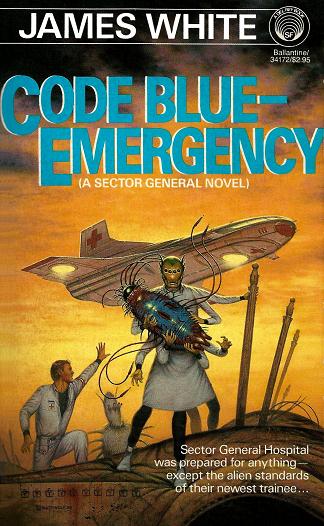
Code Blue -- Emergency
By James White
Cha Thrat was a warrior-surgeon. As her people had been at peace for a very long time, the warrior part of her title was mainly an indication of status only. But Cha Thrat came from a very stratified society, with just three classes of people, serviles, warriors and rulers. As a surgeon, Cha Thrat was very traditional, which made her unpopular with her peers. But she was one of the best surgeons. So when an injured human was found in a wrecked craft, and Cha Thrat was on vacation in the area, it only made sense that she should attempt to put back together a gravely injured being, even though she was totally unfamiliar with human anatomy. But she did such a good job that the man's life and limbs were saved and his superiors were so impressed with her skills as a surgeon that she was invited to join the staff of Sector General, the huge multi-species space-hospital that served as a treatment facility for fifty-plus different species of beings.
Due to pressures at work, Cha Thrat felt obliged to accept the offer and shortly found herself in a completely alien environment, surrounded by strange and often fearsome-appearing creatures, gabbling in a bewildering variety of languages, and all part of the massive conglomeration that was Sector General. How she would ever find a place within this complex and confusing hospital remained to be seen, and even more disheartening was that she had to become a student again, required to take classes and attend lectures and start her professional life over. Further, it seemed everything she did upset her superiors and she found herself the talk of the hospital and banned from every ward, finally ending up working as a maintenance technician. She didn't give though because even maintenance techs are a vital and important part of the smooth running of the giant institution that is Sector General.
This was a good book, with Cha Thrat trying to adapt to a strange new environment and her fellows trying to adapt to her in return. White's aliens are always strange and interesting and following Cha Thrat struggles was quite engrossing and entertaining.
Cha Thrat was a warrior-surgeon. As her people had been at peace for a very long time, the warrior part of her title was mainly an indication of status only. But Cha Thrat came from a very stratified society, with just three classes of people, serviles, warriors and rulers. As a surgeon, Cha Thrat was very traditional, which made her unpopular with her peers. But she was one of the best surgeons. So when an injured human was found in a wrecked craft, and Cha Thrat was on vacation in the area, it only made sense that she should attempt to put back together a gravely injured being, even though she was totally unfamiliar with human anatomy. But she did such a good job that the man's life and limbs were saved and his superiors were so impressed with her skills as a surgeon that she was invited to join the staff of Sector General, the huge multi-species space-hospital that served as a treatment facility for fifty-plus different species of beings.
Due to pressures at work, Cha Thrat felt obliged to accept the offer and shortly found herself in a completely alien environment, surrounded by strange and often fearsome-appearing creatures, gabbling in a bewildering variety of languages, and all part of the massive conglomeration that was Sector General. How she would ever find a place within this complex and confusing hospital remained to be seen, and even more disheartening was that she had to become a student again, required to take classes and attend lectures and start her professional life over. Further, it seemed everything she did upset her superiors and she found herself the talk of the hospital and banned from every ward, finally ending up working as a maintenance technician. She didn't give though because even maintenance techs are a vital and important part of the smooth running of the giant institution that is Sector General.
This was a good book, with Cha Thrat trying to adapt to a strange new environment and her fellows trying to adapt to her in return. White's aliens are always strange and interesting and following Cha Thrat struggles was quite engrossing and entertaining.
Saturday, August 03, 2013
Fat White Vampire Blues
By Andrew Fox
Born and raised in New Orleans, Jules Duchon can't imagine being anywhere else. Fat and happy, Jules loves dining on the rich, cholesterol-laden blood of his hometown neighbors. It's why he has gotten so fat. Apparently even vampires can have weight issues. But something has to change because now Jules is starting to feel the effects of his fatty diet: shortness of breath and aching joints. Plus the love of his life, the woman vampire who made him, Maureen, wants nothing to do with him. He is just too fat to love.
But soon his weight isn't the only problem Jules has to deal with. There is a new, aggressive young vampire in town and he is muscling in on Jules' territory. In fact, he is trying to run Jules out of town, even going to far as to burn down Jules' house. Jules is forced to leave town, leading to an unfortunate incident with a real bitch, but comes back ready to face down Malice X, the mean new vampire and his gang of bullies. But to do so he'll need a little help from his friends, namely his plus-size ex-girlfriend and stripper, Maureen, and his sidekick from the good old days, a crossing-dressing homosexual vampire called Doodlebug. Together, they will stand and in the process maybe Jules will finally grow up.
I really enjoyed this book. It was funny and I liked that the vampires are the traditional, old-fashioned vampires. In fact, these vampires are so old-fashioned that they can't even talk to a priest without starting to roast a little:
For another review see http://shinybookreview.com/2011/03/08/fat-white-vampire-blues-title-says-it-all/
Born and raised in New Orleans, Jules Duchon can't imagine being anywhere else. Fat and happy, Jules loves dining on the rich, cholesterol-laden blood of his hometown neighbors. It's why he has gotten so fat. Apparently even vampires can have weight issues. But something has to change because now Jules is starting to feel the effects of his fatty diet: shortness of breath and aching joints. Plus the love of his life, the woman vampire who made him, Maureen, wants nothing to do with him. He is just too fat to love.
But soon his weight isn't the only problem Jules has to deal with. There is a new, aggressive young vampire in town and he is muscling in on Jules' territory. In fact, he is trying to run Jules out of town, even going to far as to burn down Jules' house. Jules is forced to leave town, leading to an unfortunate incident with a real bitch, but comes back ready to face down Malice X, the mean new vampire and his gang of bullies. But to do so he'll need a little help from his friends, namely his plus-size ex-girlfriend and stripper, Maureen, and his sidekick from the good old days, a crossing-dressing homosexual vampire called Doodlebug. Together, they will stand and in the process maybe Jules will finally grow up.
I really enjoyed this book. It was funny and I liked that the vampires are the traditional, old-fashioned vampires. In fact, these vampires are so old-fashioned that they can't even talk to a priest without starting to roast a little:
"Uh, forgive me, Father, for I have sinned. It's been . . . let's see . . . eighty years since my last confession; maybe eighty-five years. Lemme think here . . . uh, I have purchased pornography..." "Excuse me, my son. Surely you realize that smoking is not permitted in the confessional booth." Jules was slightly stunned at having been interrupted midconfession by the priest. "But I'm not smoking, Father."I also liked the way the author logically extended the traditional vampire power of transmogrification. Plus the book is just plain funny. And creepy. But most of all, a good, enjoyable read.
"I smell smoke."
Jules waved his arms around, trying to disperse the smoke, but his exertions only made his skin burn faster.
For another review see http://shinybookreview.com/2011/03/08/fat-white-vampire-blues-title-says-it-all/
Isle of Palms
By Dorothea Benton Frank
Anna didn't have a happy childhood. Her mom was a tad indifferent, her father conservative and busy, her grandmother harsh and judgmental. But the one thing Anna really cared about was the place where she lived, Isle of Palms. Close to Charleston, South Carolina, Isle of Palms was where Anna wanted to be. But after her mom died and her grandmother moved in, her father moved them away from the island. It left a hole in Anna's life and a yearning that took her years to gratify.
After being drugged and raped on a date in high school, Anna became pregnant. Her best friend Jim stepped up and married her. But Jim was a homosexual and the marriage soon floundered. Anna moved back in with her dad and began a career as a hair stylist, just plugging away at life, taking care of her dad and her daughter, coping but not really enjoying life. But after her daughter went off to college, Anna decided she wanted to move back to the Isle of Palms. She bought herself a little house, opened her own salon and met an exciting new man. And with the help of her best friend, some new friends, some old friends and even with the help of her stodgy old father, Anna is finally feeling like she has come home.
I enjoyed reading about Anna and her interesting and often funny life, like the night she and her new boyfriend got naked on the dock, then climbed into a boat because Anna felt too exposed on the dock. They both fell asleep and the boat drifted away from the dock and out to sea. Fortunately and unfortunately, they were discovered by the coast guard and had to resort to wearing garbage bags to cover their nakedness. It was a good story and I liked Anna and all her fun and annoying friends and family.
Anna didn't have a happy childhood. Her mom was a tad indifferent, her father conservative and busy, her grandmother harsh and judgmental. But the one thing Anna really cared about was the place where she lived, Isle of Palms. Close to Charleston, South Carolina, Isle of Palms was where Anna wanted to be. But after her mom died and her grandmother moved in, her father moved them away from the island. It left a hole in Anna's life and a yearning that took her years to gratify.
After being drugged and raped on a date in high school, Anna became pregnant. Her best friend Jim stepped up and married her. But Jim was a homosexual and the marriage soon floundered. Anna moved back in with her dad and began a career as a hair stylist, just plugging away at life, taking care of her dad and her daughter, coping but not really enjoying life. But after her daughter went off to college, Anna decided she wanted to move back to the Isle of Palms. She bought herself a little house, opened her own salon and met an exciting new man. And with the help of her best friend, some new friends, some old friends and even with the help of her stodgy old father, Anna is finally feeling like she has come home.
I enjoyed reading about Anna and her interesting and often funny life, like the night she and her new boyfriend got naked on the dock, then climbed into a boat because Anna felt too exposed on the dock. They both fell asleep and the boat drifted away from the dock and out to sea. Fortunately and unfortunately, they were discovered by the coast guard and had to resort to wearing garbage bags to cover their nakedness. It was a good story and I liked Anna and all her fun and annoying friends and family.
Nennonite in a Little Black Dress
By Rhoda Janzen
The author reminisces about her life after her husband left her and she was injured in an auto accident. Feeling somewhat at loose ends and slowly recovering from her injuries, Janzen went to stay with her parents. Her folks were traditional Mennonites, not to be confused with the Amish and their rejection of modern conveniences. Mennonites use electricity, drive vehicles, have telephones, computers, dishwashers, etc. But they are conservative and early in her life, Janzen decided it was not for her. She chose a different path, a more worldly path, one that included marrying a homosexual, abusive man who eventually left her high and dry and in financial difficulties.
This book just kind of meanders along, revealing snippets of the Mennonite way of life. It is mostly entertaining and often amusing. The only real drawback is the author's extensive vocabulary that too often went over my head. For example: "Sure, from a ratiocinative point of view, the invention of angels on the wall seems an unlikely way to achieve virtue in praxis." I have no idea what this means and my spell checker didn't know either ratiocinative or praxis. Another example: "...my brothers don't follow events in the belletristic world..." Belletristic? Really? I looked it up ... which didn't help because I didn't understand the definition either.
So other than the annoying difficult vocabulary, I pretty much enjoyed her story.
For a better review see: http://www.nytimes.com/2009/11/08/books/review/Christensen-t.html?_r=0
The author reminisces about her life after her husband left her and she was injured in an auto accident. Feeling somewhat at loose ends and slowly recovering from her injuries, Janzen went to stay with her parents. Her folks were traditional Mennonites, not to be confused with the Amish and their rejection of modern conveniences. Mennonites use electricity, drive vehicles, have telephones, computers, dishwashers, etc. But they are conservative and early in her life, Janzen decided it was not for her. She chose a different path, a more worldly path, one that included marrying a homosexual, abusive man who eventually left her high and dry and in financial difficulties.
This book just kind of meanders along, revealing snippets of the Mennonite way of life. It is mostly entertaining and often amusing. The only real drawback is the author's extensive vocabulary that too often went over my head. For example: "Sure, from a ratiocinative point of view, the invention of angels on the wall seems an unlikely way to achieve virtue in praxis." I have no idea what this means and my spell checker didn't know either ratiocinative or praxis. Another example: "...my brothers don't follow events in the belletristic world..." Belletristic? Really? I looked it up ... which didn't help because I didn't understand the definition either.
So other than the annoying difficult vocabulary, I pretty much enjoyed her story.
For a better review see: http://www.nytimes.com/2009/11/08/books/review/Christensen-t.html?_r=0
Friday, July 19, 2013
Florabama Ladies' Auxiliary & Sewing Circle
By Lois Battle
Bonnie Duke Cullman lived a life of comfort and privilege. Until her husband revealed that they were facing bankruptcy and that he no longer wished to be married to her. So Bonnie had to leave her cushy lifestyle behind and set out to make a new life for herself.
Fortunately for Bonnie, her daddy, Duke, is a man of influence and connections and, calling in a few favors, got Bonnie a job as a councilor at a small college in Florabama. And her clients are a group of women who lost their jobs at a local mill when the mill suddenly closed.
At first terrified and ill-prepared to reenter the workforce after decades as a well-to-do married woman, Bonnie soon settles into her new job and gets to know some of the women who have turned to her for guidance and advice. There's Hilly, outspoken and fiery, who manages to find a job as a waitress and to fall in love with her new boss. Ruth, quiet and a bit of a doormat, dreams of being a teacher but fears she is too old and too stupid. There is Ruth's whiny grown daughter who isn't above thievery and abandoning her children. As for Bonnie, she starts out shaky and scared but finds out she is more than capable of standing on her own two feet.
This was an OK read. It was mainly about Bonnie, Ruth and Hilly and not so much about the sewing circle. The other women are peripheral to the story and their trials and tribulations are only touched on briefly. Also the story just kind of peters out at the end.
Bonnie Duke Cullman lived a life of comfort and privilege. Until her husband revealed that they were facing bankruptcy and that he no longer wished to be married to her. So Bonnie had to leave her cushy lifestyle behind and set out to make a new life for herself.
Fortunately for Bonnie, her daddy, Duke, is a man of influence and connections and, calling in a few favors, got Bonnie a job as a councilor at a small college in Florabama. And her clients are a group of women who lost their jobs at a local mill when the mill suddenly closed.
At first terrified and ill-prepared to reenter the workforce after decades as a well-to-do married woman, Bonnie soon settles into her new job and gets to know some of the women who have turned to her for guidance and advice. There's Hilly, outspoken and fiery, who manages to find a job as a waitress and to fall in love with her new boss. Ruth, quiet and a bit of a doormat, dreams of being a teacher but fears she is too old and too stupid. There is Ruth's whiny grown daughter who isn't above thievery and abandoning her children. As for Bonnie, she starts out shaky and scared but finds out she is more than capable of standing on her own two feet.
This was an OK read. It was mainly about Bonnie, Ruth and Hilly and not so much about the sewing circle. The other women are peripheral to the story and their trials and tribulations are only touched on briefly. Also the story just kind of peters out at the end.
Sunday, July 07, 2013
Bad Monkey
By Carl Hiaasen
Andrew Yancy is an ex-cop. Not because he wants to be but because he did something really stupid: he sodomized his girlfriend's husband in public with a vacuum cleaner. That got him kicked out of the sheriff's department. Luckily for Yancy he was able to get a new job as Health Inspector of the local restaurants. Unluckily for Yancy, he discovers conditions in restaurant kitchens are so unwholesome and disturbing that he has totally lost his appetite and has become gaunt and skinny. For his own sake, he needs his old job back before he wastes away to nothing. Rescue appears in the form of an unattached arm hooked by an angler. Because, despite the appearance that the owner of the arm was the victim of a shark attack, Yancy is certain that the arm's owner was murdered. If he can prove it he just might be able to get his old job with the sheriff's office back. But, since he is a character in a Hiaasen novel, Yancy is going to come up against a lot of weirdness including an ex-girlfriend who will resort to arson to win Yancy back; a sexy but a tad bit perverse new girlfriend who likes to do it on the autopsy table; a voodoo witch; a Medicare scammer and his wife; and the title character, the bad monkey who used to be a movie star but is now bald and addicted to fried foods and tobacco.
I really liked this story. Very readable, frequently funny with strange and unforgettable characters, including Driggs, the bad monkey. There really was nothing I didn't like about it including the ending where justice is served and all the bad guys get what they have coming to them. In fact, I think this is probably one of the most enjoyable of the Hiaasen's novels I have read.
For another review, see: http://www.nytimes.com/2013/06/18/books/carl-hiaasens-bad-monkey-features-a-cast-of-oddballs.html?_r=0.
Andrew Yancy is an ex-cop. Not because he wants to be but because he did something really stupid: he sodomized his girlfriend's husband in public with a vacuum cleaner. That got him kicked out of the sheriff's department. Luckily for Yancy he was able to get a new job as Health Inspector of the local restaurants. Unluckily for Yancy, he discovers conditions in restaurant kitchens are so unwholesome and disturbing that he has totally lost his appetite and has become gaunt and skinny. For his own sake, he needs his old job back before he wastes away to nothing. Rescue appears in the form of an unattached arm hooked by an angler. Because, despite the appearance that the owner of the arm was the victim of a shark attack, Yancy is certain that the arm's owner was murdered. If he can prove it he just might be able to get his old job with the sheriff's office back. But, since he is a character in a Hiaasen novel, Yancy is going to come up against a lot of weirdness including an ex-girlfriend who will resort to arson to win Yancy back; a sexy but a tad bit perverse new girlfriend who likes to do it on the autopsy table; a voodoo witch; a Medicare scammer and his wife; and the title character, the bad monkey who used to be a movie star but is now bald and addicted to fried foods and tobacco.
I really liked this story. Very readable, frequently funny with strange and unforgettable characters, including Driggs, the bad monkey. There really was nothing I didn't like about it including the ending where justice is served and all the bad guys get what they have coming to them. In fact, I think this is probably one of the most enjoyable of the Hiaasen's novels I have read.
For another review, see: http://www.nytimes.com/2013/06/18/books/carl-hiaasens-bad-monkey-features-a-cast-of-oddballs.html?_r=0.
The Ocean at the End of the Lane
By Neil Gaiman
The little boy lived in a small town in England in a large house with his parents and his sister. Due to an economic downturn, his parents decided to take in a boarder, meaning the boy had to give up his room and move in with his sister. The boarder was an opal miner who came to England to invest his own and his friends' money. Instead he gambled it all away. He then stole his landlord's car and drove to the nearby outskirts of town to a pond and killed himself. The dad received a phone call informing him of the whereabouts of the car and he and his son walked there. And that is where the boy met Lettie Hempstock, a girl who lived on the farm where the pond was located. And Lettie Hempstock took the boy to places that he never should have been and accidentally caused the boy a lot of unnecessary problems, including being deliberately almost killed by his own father.
If you read the reviews about this book, you will find widespread acclaim about what a wonderful story it is. I may be the only person to review it who was not enchanted by this odd and disturbing tale. Not being of a philosophical mind set nor caring much for mythology, there was much about the book that just didn't appeal, especially the Hempstocks, the three godlike women at the center of the story. I mean, what are they doing there, on a farm in rural England? Just hanging around pretending to be human? I didn't get it. What I also didn't get was why a father who never abused his children would suddenly attempt to murder his only son. That just seemed out of character to me. Some may say he was under evil influences and maybe so. That just didn't ring true to me.
It's an OK story but not a keeper.
The little boy lived in a small town in England in a large house with his parents and his sister. Due to an economic downturn, his parents decided to take in a boarder, meaning the boy had to give up his room and move in with his sister. The boarder was an opal miner who came to England to invest his own and his friends' money. Instead he gambled it all away. He then stole his landlord's car and drove to the nearby outskirts of town to a pond and killed himself. The dad received a phone call informing him of the whereabouts of the car and he and his son walked there. And that is where the boy met Lettie Hempstock, a girl who lived on the farm where the pond was located. And Lettie Hempstock took the boy to places that he never should have been and accidentally caused the boy a lot of unnecessary problems, including being deliberately almost killed by his own father.
If you read the reviews about this book, you will find widespread acclaim about what a wonderful story it is. I may be the only person to review it who was not enchanted by this odd and disturbing tale. Not being of a philosophical mind set nor caring much for mythology, there was much about the book that just didn't appeal, especially the Hempstocks, the three godlike women at the center of the story. I mean, what are they doing there, on a farm in rural England? Just hanging around pretending to be human? I didn't get it. What I also didn't get was why a father who never abused his children would suddenly attempt to murder his only son. That just seemed out of character to me. Some may say he was under evil influences and maybe so. That just didn't ring true to me.
It's an OK story but not a keeper.
Tuesday, July 02, 2013
The Fresco
By Sheri S. Tepper
Aliens have discovered Earth. It is quite a mixed bag of aliens, though. Some want to help us. Some want to eat us. But the ones who want to help us mainly want human beings to straighten out and be good neighbors to each other. It seems that neighborliness is the requirement for joining the galactic union. But neighborliness doesn't come easy for human beings. So the friendly aliens go about imposing their vision of proper human society upon the Earth. Jerusalem vanishes and now no one can fight over it 'cause it ain't there no more! Oppressive Muslim males suddenly find their women changed into ugly old men. And towards the end of the book, alcoholics can no longer tolerate booze, one sip makes them vomit. Human don't so much learn to be neighborly as have it forced upon them by the aliens as the aliens infiltrate the atmosphere with their invisible control mechanisms and chemicals. And that's the happy ending. The sad ending is leaving humanity to deal with its own problems and being turned into game animals to be hunted by the bad aliens, with the added promise that the predator aliens would not be allowed to exterminate us. Take about being between a rock and a hard place. Mind control versus being hunted for sport.
I did enjoy this book a lot. I thought the nice aliens were interesting even if rather creepy with their mind control and their parasitism. One race of aliens implants their eggs in the bodies of host animals and it turns out middle-aged, conservative men make ideal hosts. Those are the good aliens. The bad aliens are just a bunch of blood-thirsty killers who want to turn the Earth into a giant game park with humans as their main target. As they point out, there is a surfeit of humans on the Earth and they would be doing us a favor by thinning the herd.
Tepper imposes a new order on the world, taking away freedom of choice and using mind control to keep people from realizing what they have lost. It's a creepy and frightening vision, and one that doesn't appeal to me. So I didn't find her happy ending to be very happy but I still enjoyed the story even if I don't agree with her solution for humanities many ills.
For another review, check out http://www.bewilderingstories.com/issue160/fresco_rev.html.
Aliens have discovered Earth. It is quite a mixed bag of aliens, though. Some want to help us. Some want to eat us. But the ones who want to help us mainly want human beings to straighten out and be good neighbors to each other. It seems that neighborliness is the requirement for joining the galactic union. But neighborliness doesn't come easy for human beings. So the friendly aliens go about imposing their vision of proper human society upon the Earth. Jerusalem vanishes and now no one can fight over it 'cause it ain't there no more! Oppressive Muslim males suddenly find their women changed into ugly old men. And towards the end of the book, alcoholics can no longer tolerate booze, one sip makes them vomit. Human don't so much learn to be neighborly as have it forced upon them by the aliens as the aliens infiltrate the atmosphere with their invisible control mechanisms and chemicals. And that's the happy ending. The sad ending is leaving humanity to deal with its own problems and being turned into game animals to be hunted by the bad aliens, with the added promise that the predator aliens would not be allowed to exterminate us. Take about being between a rock and a hard place. Mind control versus being hunted for sport.
I did enjoy this book a lot. I thought the nice aliens were interesting even if rather creepy with their mind control and their parasitism. One race of aliens implants their eggs in the bodies of host animals and it turns out middle-aged, conservative men make ideal hosts. Those are the good aliens. The bad aliens are just a bunch of blood-thirsty killers who want to turn the Earth into a giant game park with humans as their main target. As they point out, there is a surfeit of humans on the Earth and they would be doing us a favor by thinning the herd.
Tepper imposes a new order on the world, taking away freedom of choice and using mind control to keep people from realizing what they have lost. It's a creepy and frightening vision, and one that doesn't appeal to me. So I didn't find her happy ending to be very happy but I still enjoyed the story even if I don't agree with her solution for humanities many ills.
For another review, check out http://www.bewilderingstories.com/issue160/fresco_rev.html.
I'd Like to Apologize to Every Teacher I Ever Had
By Tony Danza
Tony Danza is famous for his acting career. Not for his teaching ability. But it turns out that Danza had always had a yen for teaching, this despite the fact he himself was a rather indifferent student. So when A&E wanted to do a reality TV show about teaching, with Danza in the starring role, he was enthusiastic. That's how Danza came to teach English for a year at a large Philadelphia high school, Northeast High. Danza's goal was to highlight the importance of teachers and schools to the future success of America's students.
But what he found out was that no matter how dedicated and skillful and compassionate the teachers may be, if they are not backed up by the community and, especially by the parents, they are fighting a losing battle. It is up to the parents to stress the importance and benefits of education and to make sure their kids are at school every day and doing the required work. Which is not the case in some homes in America where it seems everything is more important that education.
I enjoyed this book, for the most part. I did find that Danza seems to center the conversation on himself a lot. Even his students quickly caught on to the fact that Danza loves to talk about himself, using this tendency to derail the lessons. Don't most students love it when the teacher starts gasbagging? You don't learn much but you don't have to pay attention either. But other than that, this was a pretty good read and quite informative on conditions in U.S. schools these days.
For another review see http://www.cleveland.com/books/index.ssf/2012/09/tony_danzas_id_like_to_apologi.html.
Tony Danza is famous for his acting career. Not for his teaching ability. But it turns out that Danza had always had a yen for teaching, this despite the fact he himself was a rather indifferent student. So when A&E wanted to do a reality TV show about teaching, with Danza in the starring role, he was enthusiastic. That's how Danza came to teach English for a year at a large Philadelphia high school, Northeast High. Danza's goal was to highlight the importance of teachers and schools to the future success of America's students.
But what he found out was that no matter how dedicated and skillful and compassionate the teachers may be, if they are not backed up by the community and, especially by the parents, they are fighting a losing battle. It is up to the parents to stress the importance and benefits of education and to make sure their kids are at school every day and doing the required work. Which is not the case in some homes in America where it seems everything is more important that education.
I enjoyed this book, for the most part. I did find that Danza seems to center the conversation on himself a lot. Even his students quickly caught on to the fact that Danza loves to talk about himself, using this tendency to derail the lessons. Don't most students love it when the teacher starts gasbagging? You don't learn much but you don't have to pay attention either. But other than that, this was a pretty good read and quite informative on conditions in U.S. schools these days.
For another review see http://www.cleveland.com/books/index.ssf/2012/09/tony_danzas_id_like_to_apologi.html.
Saturday, June 22, 2013
Spin
By Robert Charles Wilson
Tyler Dupree lives in a small house on the grounds of a mansion owned by E.D. Lawton, a mover and shaker in the world of aerospace. Tyler's mom is Lawton's housekeeper and also serves as a kind of surrogate mother to Lawton's two kids, Jason and Diane since their mother is an alcoholic. The Jason and Diane are fraternal twins and about the same age as Tyler. The three are pretty good friends. Tyler has a serious crush on Diane, but she is not that responsive to his feelings. Both Jason and Diane are very intelligent and E.D. intends to bring Jason into the aerospace business.
One night when Tyler, Diane and Jason were outside playing, the stars vanished. A brief flare of starlight and then nothing but blackness. Data transmission that relied on satellites failed. Even the moon was gone. But the sun rose the next day like nothing had changed.
Before much longer, it was understood that the Earth was enclosed in a pocket of slow-time. Outside the black spin membrane, time passed normally. Inside it passed much, much slower. So slow, that outside the sun was aging rapidly, soon to go through its death throes, which would engulf the Earth in its expanding body, destroying all life. The Earth only had about fifty years of normal life left for its inhabitants.
So a plan was hatched, led by Jason Lawton, now an adult and working for his father, to seed Mars with life. Then, as conditions improved on Mars, relative to the slower time on Earth, humans would travel there, hopefully to survive and thrive. Amazingly the plan worked, the success made apparent by the arrival on Earth of a human being from Mars, Wun Ngo Wen. Martian civilization is hundreds of thousands of years old and highly advanced. Wun may have a solution to the crisis facing the people of Earth. But just as Wun arrives on Earth, another spin membrane appears, but now it is surrounding Mars.
This story is told in a series of flashbacks, interweaving the story of Diane and Tyler as they are trying to escape from their pursuers. Who exactly is chasing them and why isn't made clear until quite a bit later in the book. The enclosure of the Earth by the spin membrane sent Diane off on a spiritual quest that resulted in her marrying a religious fundamentalist. Jason becomes a brilliant scientist but becomes ill with a form of multiple sclerosis. Tyler goes off to medical school and becomes a doctor, ending up working at E.D. Lawton's aerospace firm and as personal physician to Jason and to the man from Mars, Wun. He never gets over his love for Diane and she refuses to leave her fanatic of a husband.
The story is frequently depressing, as society starts to break down and everyday life becomes more dangerous and precarious. None of the characters have happy lives, not even the man from Mars, who lost his wife and children in a terrible flood (back on Mars). Diane is married to a nut, Tyler can't shake his obsession with Diane, and Jason's MS doesn't respond well to treatment. Plus, I felt the story was a little too long and a bit tedious. But I did really like the ending. So, given that, I rate it a fair read.
For another review, see: http://www.davidlouisedelman.com/book-reviews/spin/.
Tyler Dupree lives in a small house on the grounds of a mansion owned by E.D. Lawton, a mover and shaker in the world of aerospace. Tyler's mom is Lawton's housekeeper and also serves as a kind of surrogate mother to Lawton's two kids, Jason and Diane since their mother is an alcoholic. The Jason and Diane are fraternal twins and about the same age as Tyler. The three are pretty good friends. Tyler has a serious crush on Diane, but she is not that responsive to his feelings. Both Jason and Diane are very intelligent and E.D. intends to bring Jason into the aerospace business.
One night when Tyler, Diane and Jason were outside playing, the stars vanished. A brief flare of starlight and then nothing but blackness. Data transmission that relied on satellites failed. Even the moon was gone. But the sun rose the next day like nothing had changed.
Before much longer, it was understood that the Earth was enclosed in a pocket of slow-time. Outside the black spin membrane, time passed normally. Inside it passed much, much slower. So slow, that outside the sun was aging rapidly, soon to go through its death throes, which would engulf the Earth in its expanding body, destroying all life. The Earth only had about fifty years of normal life left for its inhabitants.
So a plan was hatched, led by Jason Lawton, now an adult and working for his father, to seed Mars with life. Then, as conditions improved on Mars, relative to the slower time on Earth, humans would travel there, hopefully to survive and thrive. Amazingly the plan worked, the success made apparent by the arrival on Earth of a human being from Mars, Wun Ngo Wen. Martian civilization is hundreds of thousands of years old and highly advanced. Wun may have a solution to the crisis facing the people of Earth. But just as Wun arrives on Earth, another spin membrane appears, but now it is surrounding Mars.
This story is told in a series of flashbacks, interweaving the story of Diane and Tyler as they are trying to escape from their pursuers. Who exactly is chasing them and why isn't made clear until quite a bit later in the book. The enclosure of the Earth by the spin membrane sent Diane off on a spiritual quest that resulted in her marrying a religious fundamentalist. Jason becomes a brilliant scientist but becomes ill with a form of multiple sclerosis. Tyler goes off to medical school and becomes a doctor, ending up working at E.D. Lawton's aerospace firm and as personal physician to Jason and to the man from Mars, Wun. He never gets over his love for Diane and she refuses to leave her fanatic of a husband.
The story is frequently depressing, as society starts to break down and everyday life becomes more dangerous and precarious. None of the characters have happy lives, not even the man from Mars, who lost his wife and children in a terrible flood (back on Mars). Diane is married to a nut, Tyler can't shake his obsession with Diane, and Jason's MS doesn't respond well to treatment. Plus, I felt the story was a little too long and a bit tedious. But I did really like the ending. So, given that, I rate it a fair read.
For another review, see: http://www.davidlouisedelman.com/book-reviews/spin/.
Labels:
fair read,
fiction,
science fiction,
Wilson (Robert Charles)
Naked
By David Sedaris
A collection of humorous essays recounting David's childhood and young adulthood.
To say David was an odd kid is an understatement. His mother, who comes off as sarcastic and cold, nevertheless let her quirky son be himself, despite the many visits from concerned teachers, worried about his tics and strange obsessions, like licking light switches.
You can't say David Sedaris was just your average kid. I don't know if his life has been as funny as he portrays, but I did enjoy these often amusing and frequently rather disturbing stories.
For a better review, see: http://www.nytimes.com/books/97/03/16/reviews/970316.16seligmt.html.
A collection of humorous essays recounting David's childhood and young adulthood.
To say David was an odd kid is an understatement. His mother, who comes off as sarcastic and cold, nevertheless let her quirky son be himself, despite the many visits from concerned teachers, worried about his tics and strange obsessions, like licking light switches.
You can't say David Sedaris was just your average kid. I don't know if his life has been as funny as he portrays, but I did enjoy these often amusing and frequently rather disturbing stories.
For a better review, see: http://www.nytimes.com/books/97/03/16/reviews/970316.16seligmt.html.
Tuesday, June 18, 2013
Killing Kennedy: The End of Camelot
By Bill O'Reilly & Martin Dugard
This very readable book looks at the life of John Kennedy, focusing mainly on his presidency and his assassination. The prose is bit over-heated at times, but gets its point across in a clear and easy to understand style. Many intimate details of John and Jackie's lives are included, including their sex lives.
The book also discusses Kennedy's presidency and his relationships with his brother Robert and his vice-president, Johnson.
So, even though it is a bit on the sensational side, it is still a very informative and well-laid out look at the life and death of one of America's most popular presidents, John Kennedy. It was a good read.
This very readable book looks at the life of John Kennedy, focusing mainly on his presidency and his assassination. The prose is bit over-heated at times, but gets its point across in a clear and easy to understand style. Many intimate details of John and Jackie's lives are included, including their sex lives.
The book also discusses Kennedy's presidency and his relationships with his brother Robert and his vice-president, Johnson.
So, even though it is a bit on the sensational side, it is still a very informative and well-laid out look at the life and death of one of America's most popular presidents, John Kennedy. It was a good read.
Thursday, June 13, 2013
The Revenge of the Radioactive Lady
By Elizabeth Stukey-French
When Marylou was a young woman and pregnant, she given a radioactive concoction to drink by her doctor, Wilson Spriggs. She was not told it was radioactive, she was told it was a vitamin supplement and she drank it. She and hundreds of other pregnant women were unknowingly dosed in a secret study. (This actually happened to real women in the USA.) Years later her daughter, with whom she pregnant when she was dosed by Spriggs, developed cancer and died. At that time Marylou still did not know about her exposure to radiation but she did find out about it much later when the secret study was revealed. Her anger at the callous young physician who dosed her with poison grew and festered.
Now an old lady in her seventies, Marylou has discovered that Dr. Spriggs is living in Tallahassee, Florida. So she moves into a house just a few blocks from where Spriggs is living with his daughter and her family. Marylou is out for blood: Dr. Spriggs must admit his guilt and accept his punishment. Dr. Spriggs must die.
But how to kill him? Marylou, going by the name Nancy Archer (the giant woman in the old movie, Attack of the 50 Ft. Woman),
can't quite figure out how. After all, she is a frail old woman. Then she hits on the idea of insinuating herself into her enemy's family, with the view to gaining access to the old man. But in the process, she comes to know Spriggs' family much better than she ever intended and nothing seems to turn out the way she envisioned, starting with the fact that Dr. Spriggs has Alzheimers and his memory is failing.
I enjoyed this novel very much and read it in one sitting. Dr. Spriggs lives with his daughter and her husband and three kids, all teenagers and the two oldest have Aspergers. So things are pretty tense, what with the mom coming unglued, and teenage angst aggravated by Aspergers, and the dad kind of checking out all together and the youngest daughter feeling lonely and neglected and also carrying all the responsibility of being the "normal" one. So when Marylou sticks her nose into this stressed out family's business, all hell pretty much breaks loose. Just a really fascinating and thoroughly enjoyable read.
For a better review, see http://www.nytimes.com/2011/02/13/books/review/Willett-t.html?_r=0
When Marylou was a young woman and pregnant, she given a radioactive concoction to drink by her doctor, Wilson Spriggs. She was not told it was radioactive, she was told it was a vitamin supplement and she drank it. She and hundreds of other pregnant women were unknowingly dosed in a secret study. (This actually happened to real women in the USA.) Years later her daughter, with whom she pregnant when she was dosed by Spriggs, developed cancer and died. At that time Marylou still did not know about her exposure to radiation but she did find out about it much later when the secret study was revealed. Her anger at the callous young physician who dosed her with poison grew and festered.
Now an old lady in her seventies, Marylou has discovered that Dr. Spriggs is living in Tallahassee, Florida. So she moves into a house just a few blocks from where Spriggs is living with his daughter and her family. Marylou is out for blood: Dr. Spriggs must admit his guilt and accept his punishment. Dr. Spriggs must die.
But how to kill him? Marylou, going by the name Nancy Archer (the giant woman in the old movie, Attack of the 50 Ft. Woman),
can't quite figure out how. After all, she is a frail old woman. Then she hits on the idea of insinuating herself into her enemy's family, with the view to gaining access to the old man. But in the process, she comes to know Spriggs' family much better than she ever intended and nothing seems to turn out the way she envisioned, starting with the fact that Dr. Spriggs has Alzheimers and his memory is failing.
For a better review, see http://www.nytimes.com/2011/02/13/books/review/Willett-t.html?_r=0
Wednesday, June 12, 2013
Cycle of Fire
By Hal Clement
Dar was on a delivery mission when he ran into trouble and was forced to make a crash landing. He managed to land safely but his aircraft was defunct. He removed his cargo, a bag of books, and proceeded to continue his mission on foot.
Dar lived on a large planet with two suns. The two suns created a cycle of conditions in which the planet gradually became too hot. So Dar's people packed all their knowledge away in the coldest spot on their planet, under the glaciers, safe for when the cycle reversed and the planet began to cool off and became more moderate again. This cycle meant that almost everyone faced certain death, including Dar, except for a few individuals, the Teachers, who resided with the books of knowledge under the glaciers.
Dar was making his way across a brutal, uninhabited and increasing hot landscape when he came across something he had never seen before: a human being. Nils Kruger was just a cadet when he fell into the mudpot and sank from sight. His fellow explorers assumed he was dead so they returned to their spacecraft and left without him. But Nils wasn't dead, he managed to drag himself out of the mudpot only to find he had been abandoned, left alone to survived on a hostile world. Through trial and error he managed to find plants that were edible and get by. But he was all alone when his and Dar's paths crossed. Finding each other to be non-hostile and desirous of heading to the same place, Dar to place his precious books into safe storage and Nils to find a place where the temperatures were more moderate and bearable for a human, they traveled together, headed to the land of glaciers.
This was an OK story. It started out pretty good, with the two traveling together and getting to know and understand each other. The author doesn't go into much detail about the plants and animals they encountered, which was disappointing. Also I didn't find the circumstances of Nils being stranded very believable. Then in the last half of the book, the adventure part ends and the rest of the story was just not that interesting. And there was a lot of scientific stuff in the last half of the book about how the planet ended up with two suns that I didn't understand, it was just too technical. I just skimmed those parts.
Dar was on a delivery mission when he ran into trouble and was forced to make a crash landing. He managed to land safely but his aircraft was defunct. He removed his cargo, a bag of books, and proceeded to continue his mission on foot.
Dar lived on a large planet with two suns. The two suns created a cycle of conditions in which the planet gradually became too hot. So Dar's people packed all their knowledge away in the coldest spot on their planet, under the glaciers, safe for when the cycle reversed and the planet began to cool off and became more moderate again. This cycle meant that almost everyone faced certain death, including Dar, except for a few individuals, the Teachers, who resided with the books of knowledge under the glaciers.
Dar was making his way across a brutal, uninhabited and increasing hot landscape when he came across something he had never seen before: a human being. Nils Kruger was just a cadet when he fell into the mudpot and sank from sight. His fellow explorers assumed he was dead so they returned to their spacecraft and left without him. But Nils wasn't dead, he managed to drag himself out of the mudpot only to find he had been abandoned, left alone to survived on a hostile world. Through trial and error he managed to find plants that were edible and get by. But he was all alone when his and Dar's paths crossed. Finding each other to be non-hostile and desirous of heading to the same place, Dar to place his precious books into safe storage and Nils to find a place where the temperatures were more moderate and bearable for a human, they traveled together, headed to the land of glaciers.
This was an OK story. It started out pretty good, with the two traveling together and getting to know and understand each other. The author doesn't go into much detail about the plants and animals they encountered, which was disappointing. Also I didn't find the circumstances of Nils being stranded very believable. Then in the last half of the book, the adventure part ends and the rest of the story was just not that interesting. And there was a lot of scientific stuff in the last half of the book about how the planet ended up with two suns that I didn't understand, it was just too technical. I just skimmed those parts.
Saturday, June 08, 2013
Tuf Voyaging
By George R. R. Martin
Haviland Tuf was just a humble and none-too-successful trader when he and his spaceship were hired to haul a small group of adventurers out to where they were certain a huge treasure would be found. The treasure was a gigantic seedship, a remnant of Old Earth's once powerful Ecological Engineering Corps. Within its storage banks could be found tissues samples of beasts and plants from the four corners of space. Whoever grabbed this prize would be wealthy beyond imagining.
Of course, with such a huge prize in their grasp, it's not very surprising that the adventurers turned on themselves and even on Haviland Tuf. Dreams of wealth and power went to their heads and, after all the dust settled, so to speak, the only one left standing was Haviland Tuf and his two kitties, Chaos and Havoc. And with the might of the giant EEC seedship to back him up, Tuf was going to make a few changes, changes a lot of folks wouldn't much care for but that didn't bother Haviland Tuf or his kitties.
I really enjoyed the story of Haviland very much, so much that I read the book in one day. Haviland is a bit of an enigma, and I was left wondering. He is not a friendly guy, not convivial, but he is scrupulously honest and he dearly loves his cats. He is a strange duck but very interesting and I was sorry when I reached the end of the book. I would surely like to read more about Haviland Tuf. And his kitties.
Haviland Tuf was just a humble and none-too-successful trader when he and his spaceship were hired to haul a small group of adventurers out to where they were certain a huge treasure would be found. The treasure was a gigantic seedship, a remnant of Old Earth's once powerful Ecological Engineering Corps. Within its storage banks could be found tissues samples of beasts and plants from the four corners of space. Whoever grabbed this prize would be wealthy beyond imagining.
Of course, with such a huge prize in their grasp, it's not very surprising that the adventurers turned on themselves and even on Haviland Tuf. Dreams of wealth and power went to their heads and, after all the dust settled, so to speak, the only one left standing was Haviland Tuf and his two kitties, Chaos and Havoc. And with the might of the giant EEC seedship to back him up, Tuf was going to make a few changes, changes a lot of folks wouldn't much care for but that didn't bother Haviland Tuf or his kitties.
I really enjoyed the story of Haviland very much, so much that I read the book in one day. Haviland is a bit of an enigma, and I was left wondering. He is not a friendly guy, not convivial, but he is scrupulously honest and he dearly loves his cats. He is a strange duck but very interesting and I was sorry when I reached the end of the book. I would surely like to read more about Haviland Tuf. And his kitties.
Labels:
fiction,
good read,
Martin (George R. R.),
science fiction
Thursday, June 06, 2013
The Whispering Land
By Gerald Durrell
The true story of Gerald Durrell's trip to Argentina in the late 1950s to gather animals for his zoo in England. It took him eight months to get the animals he wanted and along the way he made many new friends among the locals, encountered rare and interesting animals and had a pretty good time of it, all in all. The only thing he wasn't able to get done was capturing some vampire bats. He even went so far as to sleep outside one night with his bare foot uncovered, hoping to entice the bats with his own vulnerable toes. The bats were certainly in the area but were not interested in his toes. Later on he reflected that it was probably for the best because if he had been bitten he would have most likely had to undergo a series of injections to prevent the development of rabies!
This was an enjoyable story, lots of critters, some adventure, and descriptions of exotic landscapes and of the many friendly and helpful people without whom his expedition would have been much more difficult and much less successful. While reading it, some fifty plus years after it was written, I couldn't help but wonder if the wild and untamed landscapes he describes have changed much over the decades and if the sleepy little villages are still sleepy and quiet and the abundant wildlife still abundant . . .
The true story of Gerald Durrell's trip to Argentina in the late 1950s to gather animals for his zoo in England. It took him eight months to get the animals he wanted and along the way he made many new friends among the locals, encountered rare and interesting animals and had a pretty good time of it, all in all. The only thing he wasn't able to get done was capturing some vampire bats. He even went so far as to sleep outside one night with his bare foot uncovered, hoping to entice the bats with his own vulnerable toes. The bats were certainly in the area but were not interested in his toes. Later on he reflected that it was probably for the best because if he had been bitten he would have most likely had to undergo a series of injections to prevent the development of rabies!
This was an enjoyable story, lots of critters, some adventure, and descriptions of exotic landscapes and of the many friendly and helpful people without whom his expedition would have been much more difficult and much less successful. While reading it, some fifty plus years after it was written, I couldn't help but wonder if the wild and untamed landscapes he describes have changed much over the decades and if the sleepy little villages are still sleepy and quiet and the abundant wildlife still abundant . . .
Wednesday, June 05, 2013
The Mystery of Mercy Close
By Marian Keyes
Helen is a private investigator, but, due to the economic downturn, business had dropped way off. She has moved out of her apartment and back into her old bedroom in her parents' house. Which she can't help but feel is a revolting development for a woman in her 30s. Plus she suffers from depression, for which she has been hospitalized in the past.
A local boy band is getting back together for a reunion concert. But one of the band members has disappeared and Helen has been hired to track him down. The concert is in about a week, so she doesn't have much time to locate him. But as she investigates the missing man, she finds nothing that points her in the right direction. And on top of that, her depression is getting worse, to the point where she is thinking of killing herself.
This was an OK read. The mystery was kind of interesting, as was Helen's relationships with her current and her ex-boyfriend. What I didn't particularly care for was all the stuff about depression. I would have enjoyed the book more if it had focused more on the mystery and less on Helen's mental problems.
Helen is a private investigator, but, due to the economic downturn, business had dropped way off. She has moved out of her apartment and back into her old bedroom in her parents' house. Which she can't help but feel is a revolting development for a woman in her 30s. Plus she suffers from depression, for which she has been hospitalized in the past.
A local boy band is getting back together for a reunion concert. But one of the band members has disappeared and Helen has been hired to track him down. The concert is in about a week, so she doesn't have much time to locate him. But as she investigates the missing man, she finds nothing that points her in the right direction. And on top of that, her depression is getting worse, to the point where she is thinking of killing herself.
This was an OK read. The mystery was kind of interesting, as was Helen's relationships with her current and her ex-boyfriend. What I didn't particularly care for was all the stuff about depression. I would have enjoyed the book more if it had focused more on the mystery and less on Helen's mental problems.
Subscribe to:
Posts (Atom)


.jpg)