Sunday, June 13, 2021

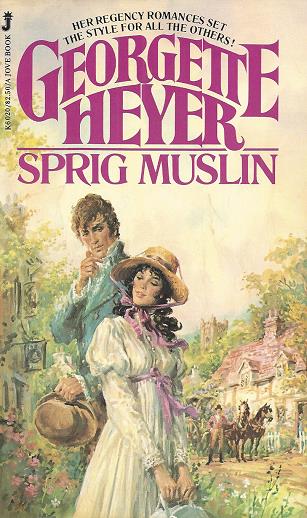
Sprig Muslim

By Georgette Heyer

A Regency Romance
Sir Gareth has given up on romantic love. His first love died tragically several years ago and Gary has never recovered from that loss. But he knows his duty to his family and has decided to ask Lady Hester to be his wife. Lady Hester is an old friend and Gary thinks she will make him a good wife who won't expect passion in their marriage. Little does he know.
On his way to propose, he comes across a maiden in distress. Amanda "Smith" is obviously a runaway who is in trouble. Gary befriends her and she tells him her story. Just sixteen, Amanda, only grandchild of a doting grandparent, is determined to wed Captain Neil, whom she has known all her life. He is home from the war to recover from a wound. And before he has to return to duty, Amanda wants to be married to him and accompany him overseas. Of course, the grandfather is opposed to this plan, believing she is much too young for such a serious step. Also, he wants his beautiful granddaughter to make a "better" match than a military man. 
So Amanda ran away, planning to get some sort of work to support herself. Her first attempt fell through when she showed up to be a governess. The mom immediately knew Amanda was a phony and sent her packing. When Gary found her, she was trying to get a job at an inn and was being told off by the landlord who thought she was a not a nice girl. 
Gary, seeing that Amanda is an innocent with no experience of the real world, offers her a ride, letting her think he will take to the next town where she hopes to get a job at another inn. But what he really does is take her to the woman he intends to propose marriage to, Lady Hester. Which makes Amanda enraged and determined to get away and carry on with her plan of forcing her grandpa into agreeing to her wedding her Neil.
Hester's family doesn't take too well to Amanda, even though Hester welcomes her and even loans Amanda a gown to wear to dinner. Too bad for Gary, though, for when Hester sees how he can't seem to take his eyes off of Amanda, she rejects his offer of marriage. Then Hester's Uncle Fabian, who is also visiting Hester's family's home, thinks Amanda is Gary's mistress and when she confides in him that Gary is holding her against her will, he offers her a ride and they sneak away early in the morning. Fabian is not planning to help her, he thinks she is an easy woman and he wants to seduce her.
When Gary discovers the two are gone, he sets off after them, to rescue Amanda from the licentious Fabian and bring her home safely to her grandpa. But Amanda is, to quote Gary, "the naughtiest little wretch I ever encountered." Gary doesn't really understand the lengths Amanda will go to get her way and will embroil Gary, a chance-met schoolboy named Hildebrand and Hester in her schemes.

This is one of my favorite Heyer novels. I think I first read this story when I was in junior high school. I have reread several times over the years.  I enjoyed it nearly as much as this time as I did the first time I read it. It's sweet and amusing and so satisfying. I just like everything about it. It's perfect!

Review by Laura A. Wallace at Austenprose.

Wednesday, June 09, 2021

Native Tongue


By Carl Hiaasen


The Amazing Kingdom of Thrills has made Francis X. Kingsbury of South Florida a wealthy man. But Francis, or Frankie the Ferret as he is known to some folks up north who would really like to track him down, has dreams of rivaling the big Florida amusement parks. So he is building a golf course next to his park. Never mind that he is tearing down critical habitat and uprooting native trees and plants. Never mind that his golf course plans to dump waste water near one of the few coral reefs in the area.

Still there are a few people who would like to keep a least a bit of Florida environmentally healthy. One of them is Skink, the ex-governor and current wild man who lives in the back country and eats road kill. The other is Joe Winder who likes fishing off that reef that Frankie's development is threatening and who happens to work for Frankie in the park's public relations department. 

When a park employee turns up dead under suspicious circumstances, Winder senses a cover-up that centers around the park's star exhibit: the last two living Blue-Tongued Mango Voles, who are in a captive breeding program intended to bring the voles back from the brink of extinction, similar to the Dusky Seaside Sparrow program at Disney World: Washington Post article.. (Frankie has a bug in his ear about Disney World and fancies himself a rival to the giant park in Orlando.) Unfortunately the two voles get kidnapped by an environmental group who wants to use them to blackmail Frankie into halting the golf course development. 


Another entry in Hiaasen's Florida saga, this one seemed more cohesive to me than some of his other novels. The plot is less convoluted and doesn't seem to have so many sidetracks that can make the reader feel a bit lost at times. Skink, of course, makes his usual appearance, acting in this story as a kind of deus ex machina, enacting justice on baddies and moving behind the scenes. 

I liked this story a lot. It was not so complex as some of his stories can be and everything wraps up very nicely. He even includes a fun afterword where we get to see how the various characters (who are not killed off) end up. Very enjoyable story.


Review by Publishers Weekly.


Monday, May 31, 2021

Venetia

By Georgette Heyer


Oh, the Wicked Baron: byword of the neighborhood. Subject of scandal and gossip and warnings to the local young ladies to take care when he is at home. Fortunately, Lord Damerel is rarely at home. So when Venetia decides to gather some berries, she is not worried about any unwanted encounters is she trespasses on Damerel's land. Dressed in a shabby old gown and wearing a sun sunbonnet and carrying her basket, accompanied only by her pet dog, Flurry, it not surprising that the Wicked Baron mistakes her for a farmer's daughter and not a member of the English nobility. And so he takes liberties with her that he might not, maybe, take with a woman of his own social class. Not to worry though, Flurry flies to her rescue only to be commanded to sit by Damerel. But when Venetia quotes Shakespeare to him, Damerel quickly realizes he has made a mistake: "Who are you? I took you for a village maiden—probably one of my tenants." Venetia responds, "Did you indeed? Well, if that is the way you mean to conduct yourself amongst the village maidens you won't win much liking here!" To which he fires back, "No, no, the danger is that I might win too much!" And so begins the courtship of two of Heyer's most appealing characters, the black sheep Damerel and the innocent but bold maiden Venetia. 


I really like this story. It is not a lively read and there are no thrilling scenes, no runaway romances, no duels at dawn. Just two adults falling in love, despite the obstacles Venetia's well-meaning friends and family members put the way.


Review by Austenprose.


A Civil Contract


By Georgette Heyer


When Adam Deveril's father dies unexpectedly, he finds out that his father, Lord Lynton, has died in debt with almost all the family lands mortgaged.  All his advisors feel Adam will have to sell off much of the family land, including Fontley, their ancient family estate, to pay off all the debts. 

But a close family friend suggests an alternative. Marry a wealthy woman! The friend, Lord Oversley, knows just the woman too. Jenny Chawleigh is the only child of an extremely rich businessman. Jonathan Chawleigh wants the best for his daughter, and to him, that means a husband who is a member of the English nobility. And although he was hoping for an Earl, he might be willing to settle for a Viscount, which is Adam's title now that his father is gone. If he approves of Adam, naturally. An added bonus: Jenny actually knows and admires Adam already, having met him, briefly, at the Overley's. She and the Overley's daughter Julia went to the same school and have a casual acquaintance. 

Marry Jenny, and her father would save Adam from ruin and save the family estate and enable Adam to provide for his teenage sister, Lydia. But the main problem is that Adam is deeply in love with Julia Oversley and has already asked her to be his wife. Given his current financial state, Julia's parents are refusing to permit the marriage to proceed. 

Despite his misgivings and his love for Julia, Adam allows himself to be persuaded to propose to Jenny. Jenny accepts his offer and Adam believes Jenny is just as ambitious as her overbearing father is. What no one knows is that Jenny fell head over heels for Adam those few times she met him at the Overley's. And that she isn't ambitious or a social climber. She marries him because it is the only way she can help him. She also marries him knowing that his heart belongs to Julia but she is willing to live with that knowledge. 

Adam is a gentleman, but that is no guarantee that he will be a good husband. And poor Jenny can't hold a candle to the lovely Julia. The only thing she brings to this marriage is her father's vast wealth and her hidden love for Adam. 


This was an enjoyable read. It is a quiet story of two people learning to care for each other despite all the differences in their backgrounds. There is not a lot of excitement, no dramatic love scenes, just Adam learning to respect and understand his prosaic little bourgeois wife. And Jenny learning to adapt to the ways of her spouse and to the ways of the nobility in 19th century England.


Review by Sunita on Dear Author.


Friday, May 28, 2021

The Great Time Machine Hoax


By Keith Laumer


Chester W. Chester IV has inherited an estate which also contains a powerful experimental computer. Problem is that the the estate is burdened with a massive amount of tax debt and is due to be liquidated. So before that happens, Chester and his friend Case are taking a look around the place. They are especially interested in the computer.

It is a very powerful computer and has been quietly growing more powerful, as Chester and Case soon discover. It has spread itself wide and far, on the sly, expanding its hardware and manipulating society for its own benefit. Case gets the idea that they could use the computer to create realistic 3D vignettes that the public would be willing to pay good money to see. But these two goofs don't understand the power of this computer, because instead of creating the vignettes, it actually creates reality. Which becomes almost fatally clear when it conjures a scene of primitive humans who then rush out of the viewing area and capture the two men and Genie who is the human computer interface that the computer created from a drop of Case's blood.

Chester and Genie are locked away in cages and Case is forced to fight one of the primitives, a huge giant of a man.  While Case is taking on the giant, Chester and Genie manage to get free and run back to the arrival base and yell for the computer to bring them home, fully intending to return to get Case. But when they return it is not the same place as it was when they left. It's similar but slightly different. Genie gets captured by the police and locked up and Chester returns to base but still can't get back to the where he started. Now he is in a new location and the locals have lots of plans for him and they won't let him have access to the arrival base unless he agrees to do as they wish. Meanwhile Genie is stuck in jail and who knows what is happening to Case, battling the giant, primitive man.


This is fun and exciting story and very entertaining. Laumer is at his best when he is telling a humorous and action-packed tale. I suppose he is best known for his Retief stories. This story is similar to the Retief stories, just without Retief. There's dumb cops, mean thugs and self-involved bureaucratic types just like in the Retief stories.

I've read this story three or four times over the years and enjoyed every time.


Wednesday, May 26, 2021

Day by Night


By Tanith Lee


On a planet where one side is in eternal darkness and the other in eternal day, two societies built on similar patterns are unaware of the other society's existence. In both, the struggling masses are ruled by a technological elite who call themselves princes and princesses. Life for the masses is brutal, harsh and deprived. Life for the elites is luxurious beyond belief.

Princess Vel and her brother Prince Velday are young elites, living in ease and excess on the lightside of the planet. But a friend of theirs, Prince Ceedres, is living in poverty due to the failure of his estate, getting by sponging off his friends. Ceedres wants to marry Vel and thus gain access to her wealth and her estates. Even though Vel actually does loves Ceedres, she also knows he doesn't love her, he wants her wealth. When she refuses to marry him, he frames her for attempted murder of himself, and as punishment, Vel's portion of the family estate is awarded to Ceedres and she is sent to live among the workers.

Meanwhile, on the darkside, is Princess Vitra and her brother Prince Vyen. Vitra is creating the story of Vel, Ceedres and Velday, who she believes are characters she has created. She doesn't know the lightsiders are real and not made from her imagination. Vitra, Vyen and Prince Casrus have a similar story to that of the lightside characters, with slight differences. Vitra and Vyen are the ones whose estate has failed and they have hatched a plot to seize Casrus' property by framing him for assaulting Vitra. The plot works and Casrus is exiled to hard labor with the rest of the working poor and Vitra and Vyen are awarded his estate for their own.

How is it that two separate sets of young elites on opposites sides of the world are living such similar lives? It's like some godlike force is playing with their lives, letting the evil ones prosper and sending the innocent to perdition. But why?


This was quite a good story. Especially once Vel and Casrus are cast out of their comfortable lives of wealth and privilege and forced to confront the reality of the struggle of the working people. The different ways they cope with their circumstances is very gripping. However, the ending is rather lame, I think: deus ex machina. 


Review by James Nicoll Reviews.


Thursday, May 20, 2021

The Piano Teacher


By Janice Y. K. Lee


The story of two young women in Hong Kong, living ten years apart, Trudy in 1941 and Claire in 1952.

Claire is a young newlywed English woman who has come to Hong Kong with her husband, Martin. Being a British colony, there are plenty of British people to socialize with. But Claire feels a bit isolated and when she is offered a job teaching piano to a wealthy local couple's child, she accepts it. It's not that she needs the money, but it just gives her something to do. The couple, Victor and Melody Chen and their daughter Locket, are Chinese but sophisticated and worldly. Their chauffeur is an Englishman, Will Truesdale, which is very unusual at the time for a British person to work as a servant for Chinese family. Claire becomes fascinated by Will, who is quite a bit older than she is and lets him make her his mistress.

Flashback to 1941 and Trudy Liang. Trudy is a captivating and vital woman of mixed heritage, part European and part Chinese. She is the only child of a wealthy Chinese businessman. Her father doesn't live in Hong Kong and Trudy is left to her own devices. She takes up with Will Truesdale and they become lovers. But this is 1941 and the Japanese are about to embark on a quest for Asian domination which will lead them to bomb Pearl Harbor and set off World War II. One of the casualties of their egomania will be the British colony of Hong Kong. By January of 1942, Hong Kong is under Japanese control and, typical of their conduct throughout the war, their are cruel, vicious and inhumane. Trudy becomes a liason between the Japanese and the colony and the unwilling mistress of a Japanese VIP, Otsubo. Will Truesdale ends up in a prison compound with many other non-Chinese, including a British man who is in possession of some knowledge the Japanese want, the location of the Crown Collection. This is a collection of Chinese artifacts the British have acquired and is extremely valuable and was stashed away when it became obvious that Hong Kong was in danger.

The connection between Claire and Trudy is the man, Will, who they both loved but whose love did not benefit either of them.


I enjoyed this story, especially as it informed me about a subject I had never given any thought to: the fate of Hong Kong in World War II.

The story of Trudy is certainly the most captivating part of the novel. I don't even really understand why the story of Claire was included except perhaps as a vehicle for exposing the misdeeds of the characters during the Japanese occupation. So even though Claire seems kind of pointless, it was a really good read.


Review by Publishers Weekly.


Friday, April 30, 2021

The Green Brain


By Frank Herbert


What if you could get rid of all the nasty bugs and replace them with "better" bugs? That is the idea behind The Green Brain. 

So the Chinese are the first to embrace the idea and are eager to spread the effort to the rest of the world. But what they are not revealing is that their effort to rid China of "bad" bugs and replace them with modified bees has resulted in massive crop failures. 

So Brazil has been implementing the Chinese plan and wholesale extermination of insects has been undertaken. But the insects seem to be fighting back. Deep in the jungle, the insects have created a brain, a brain to guide them in their fight to survive against the poison onslaught from the human world. 

A group of investigators enter the jungle trying to track reports of giant insects and of organized attacks by insects. But it doesn't go well for them at all. Almost everyone at their camp gets killed when the insects launch an attack against the camp. Three of them manage to get to an amphibious vehicle and land it in a river they hope will get them back closer to civilization. The vehicle was seriously damaged in the insect attack and is nearly defunct. The three people have to cope with the muggy heat, the lack of food, the dangers of the river and continuing attacks by the organized insects. But all the insects want is to bring the people to the green brain so it can try to talk sense to the humans, that their wholesale insect slaughter is endangering all life on the planet.


This book dates from the 1960s. Hopefully we now know that insects are vital to the ecology of the planet and an attempt to exterminate them all is just foolishness. So the whole premise of the book is rather silly. But besides that, most of the story is concerned with the three survivors traveling down the river and that part of the story was boring. So all in all, not a great read.


Catseye


By Andre Norton

Troy Horan is a war refugee. His family was evacuated from their home planet to another planet and never were able to return home. Now Troy is alone, everyone else in his family died in an epidemic that swept the ghetto, called the Dipple, were they all lived. Troy is just a teenager and every day he goes to the labor center in the hopes of snagging a job as a laborer. This day he gets a job working for a pet store.

He feels lucky to get this job and tries to do his best. But something fishy is going on at the pet store and it seems to center around the five animals from Terra (Earth): two house cats, two foxes, and a kinkajou. Troy discovers that the animals are telepathic and that he can communicate mentally with them. He feels connected to the five creatures. 

One terrible night, Troy, returning to the pet shop, finds a door that should be locked isn't. Entering the premises, he also finds the door to the owner's apartment open and his boss is inside and dead. He also finds the five Terran animals on the loose. But then Troy is found with the dead man by one of the employees who jumps to the conclusion that Troy killed him. Troy flees, accompanied by the animals. They escape in a vehicle. 

But where can they go where they will be safe? Troy thinks of one place, the Wild. On this planet, much of it is preserved in its natural state where no cities or roads exist. This might give Troy and the animals a chance to survive. But instead the vehicle crashes in a forbidden zone, Ruhkarv. Ruhkarv is an ancient ruin, mostly underground with a very bad reputation. A few years before, an exploration party there went insane and killed each other and themselves. Since then, the place has been sealed off by force fields. But when Troy's stolen vehicle went down, it skipped over the force field and landed inside the boundaries of Ruhkarv. Now he and his five animal companions are stuck in a frightening and puzzling alien underground city and are being pursued by the authorities, by the local forest rangers and by the dead man's henchmen.  


I first read this book a long time ago, when I was just a kid. I remember liking it a lot them. But the only thing I really remembered about the story was the time the main character spent in the underground city. So reading decades later was almost like reading it for the first time. It was a pretty good read but I think I liked it better when I was young.


April Lady


By Georgette Heyer


Nell is the beatiful young wife of one of the wealthiest lords in Regency England. Giles is quite a bit older than Nell, who is still in her teens. Nell's family is not well off and she has been spending the generous allowance that Giles gives her a bit too freely. But that is not the reason why she can't pay her bills. She can't pay her bill because she has been giving a lot of money to her brother, Dysart, who, like their father, is a gambler and, like their father, not lucky. 

It's not surprising that Giles might think that Nell married him because of his wealth. How else to explain her spendthrift ways and her standoffishness? Giles knows she gives money to her improvident brother and he has laid down the law forbidding her to continue to do so. What Giles doesn't know is Nell's mother has explained to her that men of their class often take mistresses and that Nell mustn't be a clingy, emotional wife and not take offense if Giles strays. Plus Giles' little sister artlessly informed Nell that Nell was much prettier than Giles' mistress. What Giles also doesn't know is that Nell loves him very much and is distant because she believes that is what is expected of a Society wife.

So when Nell discovers a large bill she forgot she owes, she feels she cannot tell Giles about it because it will only confirm his suspicion that she married him for his money. Thus she launches on a frantic effort to raise the money on her own with the help of her gambler brother Giles and hindered by Giles' little sister, Letty, who is busy hatching plots of her own.


I first read this book decades ago and loved it from the first. I have reread it many times and enjoyed it each time. But this is the last time. It is time to pass on my copy to another reader who enjoys the novels of Georgette Heyer.


Review by She Reads Novels.


Beauvallet


By Georgette Heyer


Nick Beauvallet is the scrouge of Spanish shipping during the days of Queen Elizabeth I. A man of daring whose motto is Reck Not, the Spanish fear him as a witch. How else to explain Nick's extraordinary luck? 

Now Nick is going to test his luck to the utmost. He dares to sneak into Spain itself to find the woman he has fallen in love with, Dominica. A beautiful maiden, Nick captured her when he destroyed the Spanish galleon she was traveling on from the Spanish colonies in the New World to her home in Spain. 

Dominica at first resisted her attraction to Nick but, when it became clear he was a man of honor and not the brutal pirate the Spanish believed him to be, she admitted she returned his feelings. As a man of honor, Nick returned Dominica and her ailing father to Spain under cover of night and promised he would return and claim her to be his bride. But if the Spanish capture him, it will certainly mean torture and death at the stake. But Reck Not, Nick dares all.


I first read this story a long time ago. I wasn't that impressed with at the time. I suppose I was expecting something along the lines of Heyer's Regency Romances. This is not that kind of romance. But this time, I quite enjoyed this romp of a novel. Nick Beauvallet is definitely the star of this story and his love interest is third place at best, the second place is held by his charming and capable manservant, Joshua Dimmock, with his fabulous mustachios that he willingly sacrifices to help Nick escape his Spanish captors. 

Review by She Reads Books.


Wednesday, March 31, 2021

The Fly on rhe Wall


By Tony Hillerman


John Cotton is a political reporter for a newspaper in a large Midwestern city. He works out of the statehouse along with several other reporters from various other media outlets. 

It's election season and the governor is running for reelection. Roark seems like a competent and honest politician but he is facing a challenge within his party by Senator Clark, who has his eye on the governorship. Any scandal within state government would be a black eye for Roark and give Clark a chance to  become the nominee instead. 

One evening, while Cotton is finishing up work in the capitol press room, another reporter comes in and claims to be working on a really big story. The reporter, McDaniels, is drunk and tosses his steno pad carelessly down on his desk and leaves the press room. But McDaniels shortly ends up dead, of an apparent accident, tumbling over a railing and falling to his death.

Cotton is curious about the big story McDaniels was working on and finds the steno pad which had fallen down between the McDaniels' desk and the wall. Reading the man's cryptic notes, it appears McDaniels was investigating discrepancies in some highway projects. But it all seems to Cotton to be minor stuff and not something anyone would be willing to commit murder to cover up.

Then one night, at a poker game with friends, one man asks to borrow Cotton's car to run an errand. But the man is run off a bridge by a truck and the car plunges into the river, killing him. At first, Cotton assumes it was just an unfortunate accident. But then Cotton comes home soon after to find a fake bomb in his house and receives a threatening message telling him to stop investigating the highway story or be killed.

Fearing for his life, Cotton flies off to New Mexico, only to be tracked down by a hired killer while on a fishing trip. He manages to elude the killer and returns home, desperate to figure out what McDaniels was working on that someone is willing to commit two murders to keep hidden. 


This was a pretty good mystery story with a surprising twist at the end. It is also an interesting look at politics and corruption that is very relevant today. Towards the end of the story, Cotton explains why he believes political reporting is vital to the voting public:

"'You fault Gene Clark for having no political philosophy. Well, I've got one. I believe if you give them the facts the majority of the people are going to pull down the right lever on the voting machine. A lot of them are stupid. And a lot of them don't give a damn. And some of them have closed minds and won't believe anything they don't want to believe. But enough of them care so if you tell them what's going on they make the right decisions.'" 

 
Fifty years later, his description of the voting public still stands.


Monday, March 22, 2021

Duchess in Disguise


By Caroline Courtney


A Regency romance


Things are not good in the de Villiers household. First father died and now mother is dead and elder brother is now in charge and he has a gambling addiction and is deeply in debt plus the debts inherited from an improvident father and a foolish mother. If something doesn't happen, the three siblings will lose the family home. 

A letter arrives that just may save the day. The de Villiers name is ancient and honorable and a wealthy lord, a Duke, is interested in allying himself with the de Villiers family and wishes to wed Miss de Villiers, sight unseen. Problem is, Miss de Villiers is already in love with a worthy but not at all wealthy local man. So the youngest sibling, Clorinda, who is only seventeen, volunteers to marry the wealthy lord instead and save the family honor and the family home. 

So Clorinda is bundled off to London wearing her dead mother's old clothes and is immediately married to the Duke. He installs her at his mansion in the country and heads back to his hedonistic life in London. Naturally, Clorinda is not happy with this arrangement. So she hatches a plot to win the Duke's love. She will go to London to live with her sister, who is now also married, and with the very generous allowance the Duke set her up with and with a new hair style and fancy new clothes, and a false name, charm the Duke and make him fall in love with her. Complications ensue.


This was a good story, despite how silly it sounds. It is just a light and fluffy regency romance story, but sometimes a person just needs something light and fluffy. I enjoyed it. 


Dutch Uncle


By Marilyn Durham

A Western


Jake Hollander is a gambler with a past in law enforcement. He was settled in San Francisco but is now headed by stagecoach to El Paso, Texas. At one of the stops along the way, in various improble ways, he ends up in charge of two orphan Hispanic kids. Their mom was taking them to a boom town in New Mexico but she died on the journey. Jake is told to take the kids to the New Mexican town and deliver them to the address on an envelope found in the woman's luggage. 

When the three arrive, the address turns out to be a whore house and then the stagecoach leaves without Jake and another stage to El Paso isn't due for a month. Jake gets a temporary job as town sheriff, talked into it by an acquaintance from his days as a lawman and noted gun in Kansas. 

As Jake spends time in the tiny town, he renews his friendship with the Kansas acquaintance and his sister who are publishing the local newspaper. He also starts to build a relationship with the two kids, one of whom, the boy, Paco, has become very fond of Jake. In the process, Jake becomes embroiled in his old friends' problems and in trying to locate any family for the two orphans and in the various troubles plaguing the town. On top of all that, Jake's assaulted and robbed of his money belt containing his life savings. Things go from bad to worse when the orphans' father shows up and the only thing he cares about is the stolen money he left in the dead woman's possession.


I did enjoy this story very much. I did not like that the author kills off one of the orphans. I also thought that the strategies the author uses to tie Jake to the town and the two kids were rather contrived. And I found Jake's love interests in the story rather disappointing. But overall it was a good story, well worth reading.


There There


By Tommy Orange


Are group of people of Native ancestry come together for a big powwow in Oakland, California. They are all connected in various ways, some of which they are aware of and some of which they are not. 

Unfortunately some of them are not interested in the actual powwow. A drug dealer of Native and Hispanic origin owes dangerous people money and he and his associates have heard that the powwow will be giving away cash prizes. So they have a plan to attend the powwow and take the cash. 


The stories of the lives of the various people who come together for the powwow were interesting. These are people who have struggled and fought poverty and addiction and are working to overcome adversity and who are  heading to a hopeful outcome only for the reader to see it all brought to disaster because of a gang of hapless drug dealers. Some people find this sort of juxtaposition compelling and dramatic. I didn't. I frankly hated the violent and cruel ending. It spoiled the whole book for me.


Wednesday, March 03, 2021

The Way West


By A. B. Guthrie, Jr.


The story of a wagon train headed from Missouri to Oregon back in the 1840s.

Lije Evans was a farmer in Missouri with a loving wife and a teenage son. The three of them work hard and have a good life. But Lije is having second thoughts. He feels like he is just breaking even, not improving. So when folks start talking about immigrating to Oregon, which was currently part of the United Kingdom, Lije came to think maybe he should try his luck there. The word was that the land there was rich and productive and a man could get ahead if he was willing to put in the work. 

Lije talks his wife Becky into selling the farm and going west, even though Becky is happy in their little home on their Missouri farm. So off they went, sold the farm, loaded up their wagons, bought their provisions and headed to Independence, Missouri to form up a wagon train and brave the trials of the trails. They face the typical wagon train problems, accidents, deaths, natives, arguments, bison, heat, bugs, dust, river crossings, steep trails, lack of water, the usual. Actually, not too many people die in this story. One man dies of sickness, a woman has a miscarriage, a child dies of snakebite, a native gets shot by a settler. That's about it unless I am forgetting someone. 


This was a fairly good read. Not very exciting, and to someone who grew up in the 1950s, familiar territory. Lije is the main character with him moving up from traveling in the train to becoming the wagon train leader. Secondary characters are his son, his dog Rock and lastly his wife Becky. Rock gets more text than Becky does. Her main function is to tell Lije what a good guy he is. In fact, women in this story are mostly only there to cook and clean and take care of the kids and keep their menfolk happy. Their trials and tribulations are only touched on lightly. Not surprising for a book written in the 1940s.

Also not surprising for a book written in the 1940s is Guthrie's depictions of the natives encountered which he dismisses as lazy, dirty, heathen, ignorant, thieving savages. Near the end of the book, as the settlers are traveling by boat downriver, they pass a native cemetery. One of the settlers remarks about so many good indians, a reference to the old saying, the only good indian is a dead indian. 


If you have never read a story of the wagon trains headed west in America, this will probably be a very interesting story. But as a child of the 1950s, this story didn't tell me anything I wasn't already familiar with. I think the author touches too lightly on the suffering endured by the settlers and romanticizes it all a bit too much.  It did win the Pulitzer Prize for fiction in 1950. It is also one novel in a series that Guthrie wrote about settlers headed to Oregon, which I didn't know until I looked up the Wikipedia page about the book: Wikipedia. 


Monday, February 15, 2021

The Bone Is Pointed


By Arthur W. Upfield


First, a note about the title. "Pointing the bone" is a kind of magic the native people in the story use to curse their enemies to death: death by suggestion. 

Detective Napoleon Bonaparte aka Bony comes to the outback to investigate the disappearance of a jackeroo (ranch hand) Jeffery Anderson. He was out riding the fence line on the Lacy station, Karwir, and failed to return home. His horse came back riderless. Karwir is a large station (what Americans would call a ranch) and although they searched as best they could, no trace could be found of Anderson. But the owner of the station, called Old Lacy, wants to know what happened to him. Enter Bony to solve the mystery of a disappearance that is several months old.

After such a long span of time, not much in the way of trace evidence remains to be investigated. But Bony does his best, spending much of his time scouring the land searching for the minute clues that will lead him to the answer. His investigations cause the local native people to turn against him and they place a curse on him called pointing the bone. This is where they will an enemy to death mainly by informing the target that the curse has been placed on him. It really only works with people who believe it will work. Unfortunately, Bony, due to his native blood, is one of those who believes even though he tries to convince himself he doesn't believe in curses. Will he be able to solve the mystery before the curse does its deadly work?


Fascinating story, not for the mystery, really, but for the picture of life on Australian sheep and cattle stations in the 1940s. Bony, of course, solves the mystery which turns out to be not that mysterious. The only thing I really didn't care for was the silliness involving the curse. I thought Bony was above those kind of superstitions. 


Monday, February 08, 2021

Their Eyes Were Watching God


By Zora Neale Hurston


Janie Crawford never knew her mother or her father. She was raised by Nanny, her grandmother. Her grandmother was born into slavery and her mother was raped by a white man. Her mother left Janie with Nanny and disappeared. Nanny worried about Janie's future, concerned that she would end up like her mother. So when Janie grew up a beauty, Nanny decided it would be best if Janie married right away and thus be under the protection and rule of her husband. And so she convinced Janie to marry Logan Killicks. But Logan was a hard man and he slapped Janie around. When a sweet talking man, Joe Starks, came around, Janie gladly left Logan and went off with Joe to start a new life in a town being constructed in Florida. 

Joe opened a grocery store in the town, Eatonville, and built a two story house and soon became the mayor of Eatonville and a big deal in the tiny town. But Joe was a jealous husband and criticized Janie and they gradually became estranged, although their marriage lasted twenty years until his death from kidney disease. 

Now Janie was a wealthy widow and she had lots of men hanging around hoping to get a chance at her. But she was not interested. Until Vergible Woods, aka Tea Cake, arrived in Eatonville. He charmed her and amused her and won her and she left Eatonville with him. He was a guitar player and a gambler and field hand and he made friends everywhere he went. Sometimes she doubted him, but eventually she realized he was the love of her life and she was willing to follow him to whatever crazy location his travels took him.


Overall, I like the story. However, I did skip some of the men's conversations. I would read a couple paragraphs, but it was all big talk and BS and I just don't have the patience for such nonsense. I suppose it was meant to be humorous or illustrative of the man-talk of that time but it was just annoying. Other than that, I did enjoy the story, although the dialect sometimes required a couple of readings to understand the language. I was glad Janie found her true love after her two disappointing marriages.


See also a review by Kirkus Reviews.


Sing the Four Quarters


By Tanya Huff


When Princess Annice was 14 she persuaded her dying father, the king, to decree that she could become a Bard. This made the her brother, Prince Theron, the king-to-be, angry because he wanted to wed her to the prince of the neighboring kingdom to create an alliance with that kingdom, Cemandia. So when he became the king, Theron decreed that Annice was no longer a royal princess and that if she ever bore a child without his permission, she would be committing treason.

So Annice goes on to become a Bard, one of those special people who can command the nature spirits of air, water, earth and fire. In Annice's case, she can command all four kinds of spirits when most Bards can control only one type of spirit. 

She loves her life, traveling the land and performing her Bardic functions. Until she discovers she is pregnant. And the father of her child, a one-night-stand, has been arrested for treason and has been hauled to the capitol in chains. From what she knows of the man, Pjerin, Duc of Ohrid, she is certain he did not do the crime he is accused of, even though he has admitted it. So she sneaks into the King's castle and frees Pjerin. Pjerin tells her that he knows he admitted to the treason but also knows he didn't do it and he doesn't understand what strange force compels him to admit to actions he didn't do.

Together Annice and Pjerin travel back to Ohrid to unravel the mystery of his false confession, both hunted by the king's guard, Pjerin for conspiring with Cemandia to invade the kingdom and Annice for bearing a child without the king's permission. 


This was a fairly good story. It starts out pretty slow and doesn't really become more interesting until Pjerin and Annice set out on their journey to Ohrid. Until then, it's not that exciting.  

It's the first book in a four part series. It was not interesting enough to entice me to read the rest of the books in the series. Although I will say, unlike many series, this book stands alone quite well, with no really annoying cliffhangers.


Enchantment


By Orson Scott Card


Ivan Smetski never knew he was Jewish until his father decided the family need to leave Russia, and, based on their Jewish ancestry, immigrate to Israel. However, immigrating to Israel was just the excuse to get out of Russia. In reality, the father's goal was America.

Before Ivan left Russia for America, he spent some time at his cousin Marek's farm. One day, while wandering around the nearby woods, Ivan stumbled upon a Sleeping Beauty, a princess on a pinnacle. But as he approached her, he saw she was being guarded by some kind of hidden monster. As he was just a lad, Ivan had to leave the sleeping princess behind. 

Once in America, Ivan went to become a scholar of ancient Russian languages and fairy tales. He returned to Russia to do research and decided to visit cousin Marek's farm again. He remembered the Sleeping Beauty in the forest and found his way back to the site. She was still there, asleep and still being guarded by the monster which turned out to be a giant bear. Ivan managed to defeat the bear and wake the princess with a kiss. 

The princess, Katerina, took Ivan back to her land, thousands of years in the past. She had been cursed by an evil witch, Baba Yaga, who wanted to acquire Katerina's father's kingdom. And now Katerina and her father were relying upon Ivan to defeat Baba Yaga and save the kingdom. But the only way Ivan can do that is to return to the present with Katerina, now his wife (in name only) and enlist the help of his father and mother in defeating the evil witch.


I really enjoyed this story, it's just wonderful. Ivan is a sweetheart as are his amazing mother and loving father. Lots of surprises, one of which is cousin Marek who turns out to be an ancient weather god. And Baba Yaga is a formidable foe who almost succeeds in her evil designs.  


For another opinion see this review by Kirkus Reviews.


Sunday, January 31, 2021

The Dream Walker


By Charlotte Armstrong


Early 1950s, in the depths of the Red Scare in the United States, what better revenge is there than to frame an upright and respected man by smearing him as a part of the Communist conspiracy? This is the idea Ray Pankerman came up with to pay back John Marcus for exposing Pankerman's financial ties to the Communist Party. He enlists three other people in the plot: Kent Shaw who is in it for the money and for the thrills, Cora Steffani, two-bit actor who is in desperate need of cash, and Darlene Hite who is under the mistaken belief that she is performing in a publicity stunt.

Cora assembles her "audience" and goes through her act, going into a trance and waking up and relating a strange dream where she is walking on a beach and encounters a famous person and they briefly talk. The person, Josephine Crain, a successful and respected performer, verifies that she was approached on the beach by a woman who looked like Cora.

Cora pulls her act several times, each time going into her trance and waking to recite her story of approaching some respectable and well known person and while at the same time being in her apartment in New York City, each incident verified, with qualifications, by the other persons.

Of course, it is a scam. The dream walker is a woman who resembles Cora, Darlene Hite. It is all orchestrated by Kent Shaw, with codes and secret signals. Cora's best friend, Olivia Hudson, can't understand why her friend is pulling what she is positive is a scam. 

Then someone turns up dead, someone connected to Darlene. And now the four plotters know they are in too deep to turn back.


This is not a tale of the supernatural. The "dream walking" is a scam to frame an innocent man. It all blows up in the plotters faces when one of them takes it too far and murders a witness. But it is quite intriguing to watch the plotters carry out their scam and fool the police and the press and, in Cora's place, her closest friends as to how they are doing it. Plus there is also a rather soapy love story included. An enjoyable read.


Saturday, January 30, 2021

Genesis


By Poul Anderson


Computer technology has advanced to the point that people can upload their minds into machines and thus "live" forever if they so desire. Eventually most people choose to do so and humanity dies out while human/machine minds  spread throughout the galaxy. Artifical intelligence combines with the human minds and Earth is left behind, a relect of a time long past.

One artificial intelligence is left in charge of Earth called Gaia. Millions of years go past. Life on Earth adapts as the planet changes over time. The sun begins to age and enters its period of decline. 

A notion takes hold among the hybrid intelligences that span the universe. They have the power to restore the sun and protect Earth, the birthplace of humanity. Yet Gaia has done nothing to protect the Earth from the dying sun and life is fading away on the planet as it gets hotter and hotter. When asked to take steps to stop Earth's decline, Gaia refuses, claiming there is much information to be gained by watching the planet and the sun die. 

So the extraterrestrial intelligences send an emissary to examine Gaia and understand why it is refusing to preserve life on Earth. The emissary, called Wayfarer, contains, among other things, the mind of Christian Brannock, a man from back in the days when humans were first exploring the solar system. While Wayfarer examines Gaia's data, Christian will explore Gaia's studies of history through the simulations it has created. And a third aspect is a robot, Brannock, who explores the actual surface of the world. They eventually stumble upon Gaia's secret: it has recreated human beings and is trying to inspire them to save themselves from the dying Earth. 


The most interesting part of this story was that of the robot Brannock exploring the world. But that part of the story is just a very limited. The major part is the story of Christian and Laurinda who fall in love as they experience the various simulations Gaia takes them through. I wasn't particularly moved by that, though. Overall, it was just too much talk and not enough action.


Review by Publishers Weekly.


Tuesday, January 26, 2021

Web of the Chozen


By Jack L. Chalker

Bar Holliday is a scout for Seiglein Corporation. His job is to look for likely planets for humans to live on. He finds a planet but there is a large spaceship orbiting the planet. It is one of seven colony ships that set out hundreds of years ago looking for new worlds to establish new societies. Holliday enters the ship and finds it deserted and figures the people must be on the planet. 

He lands his ship on the planet but can find no sign of people although there are thousands of large, ugly, kangaroo-like herbivores everywhere. He returns to his ship only to find it encased in a hard, white shell. He tries to melt the shell with his gun but it stops working and then his clothing and equipment crumble away to nothing. He's stranded, nude and locked out of his ship.

He starts to feel really hungry and begins to gorge on the local plants. His hunger overwhelms him and he can only stop when he is gorged. Long story short, he changes into one of the ugly herbivores that infest the planet. 

These creatures are the human colonists, transformed into these strange beasts by a virus that was engineered by the artificial intelligence computer that operated the ship that brought them there. The computer, called Moses, was just doing what he thought was best for them. They are extremely healthy, long-lived, peaceful and self-sufficient. But because of their high reproduction rate, they have filled the planet to capacity. And because their lives are so easy and unchallenging, they are degenerating into the herd "cows" they appear to be.

Bar Holliday refuses to accept his fate and graze and screw and poop and sleep like the herd does. He has a plan, a plan to get back in his ship and warn the folks back home what the computer Moses has done to the humans in its care.

But as the poet says, "The best laid plans o' mice an' men Gang aft a-gley." And do Holliday's plans go awry! Instead of rescue, Seiglein Corporation sends destroyers that lay waste to all life on the planet. Bar Holliday has a motto though: "Noboby beats Bar Holliday." Holliday will make Seiglein pay very dearly indeed.


This was a pretty good book. Although the author's idea of an ideal race of beings is more than a little peculiar. He makes them blind and gives them hooves instead of hands and turns them into weird cows. The most exciting part of their day is taking a poop, I'm guessing.

Anyway, this is the last Jack L. Chalker book I will ever read. His ideas just don't appeal to me. 


War of the Maelstrom


By Jack L. Chalker


Book Three of the Changewinds series. 

The book opens with Klittichorn and the Storm Princess plotting their attack against Boolean and Sam, the Storm Princess' identical twin. Sam is beginning to understand her power over the storm and is standing up successfully against the Storm Princess.

Crim/Kira is concerned about Sam's state of mind so he/she takes her to see Etanalon, a healer/shrink/sorcerer. She has Sam look into a magic mirror which helps the girl see herself clearly and she comes away more steady in her thinking and purpose. 

Klittichorn is again hunting for Charley and Boday, thinking to use them to against Sam. Halagar, the hunk Charley is smitten by, is supposed to guide them to Boolean, along with the third rank wizard, Dorion, who is in love with Charley. But Charley is with Halagar until her slaps her around one day. Halagar betrays them and joins Klittichorn's side, turning Charley into a camp whore, until Shadowcat tears his throat out, dying in the process but freeing Charley from her enslavement to Halagar. Charley escapes and is found by Dorion.

Sam gets sent to a plantation to do farm work again but then gets sent on to a penal colony to be wife to four convicts. Once again she under a spell than makes her willing and compliant. Klittichorn's agent and his gang is on her trail and Crim/Kira show up in time to warn Sam and fight off the attackers. Boolean finally makes an appearance and reveals the truth of his and Klittichorn's past. They also realize that Klittichorn's goal isn't mere conquest. What he is really after is attaining divinity and Boolean and company may have to die fighting him to prevent the madman from becoming a god.


This was an OK story. Sam and Charley both spend most of time under some kind of potion or spell that makes them meek and compliant. And naked most of the time. Really makes me wonder about the author's feelings about women. Most of the story is about the characters' struggles just to get somewhere. Anyway, happy ending. But Charley sure does get the short end of the stick. I won't say what happens to her, but in my opinion, it sucks. 


Friday, January 15, 2021

Vengeance of the Dancing Gods


By Jack L. Chalker


Book Three of the Dancing Gods series.


Macore starts out this tale by trying to steal a demon gem which results in the demon placing a spell on him that causes him to attempt to break into Ruddygore's vault and ending up trapped in the Magic Lamp. Meanwhile, Joe and Tiana are bored of being worshipped as gods and want some time off. So Ruddy enlists them and Marge, Macore, and Poquah on a mission to stop the Dark Baron and Dacaro the wizard who are causing problems on Earth. But first they must visit the oracle to receive his prophecy about their mission. Naturally they have lots of strange adventures on the trip to see the oracle and there is a lot of body switching. Joe ends up briefly as a nymph and Tiana becomes a mermaid. 

The Baron was stripped of his magic abilities by Ruddy as punishment before being exiled to Earth but Dacaro is a skilled wizard and is becoming more skilled under the Baron's tutelage. They have established themselves as leaders of a religious cult and have a large congregation of fanatical and murderous followers. 

Ruddygore will not be able to accompany Joe and Marge and the others in their quest to stop the Baron and Dacaro. Macore's task will be to get them past the guards and the guard dogs and the security equipment and into the Baron's stronghold in the forests of northern California. They will be joined on the way by two people from Earth, a New York pixie named Gimlet and a Catholic priest, Father O'Grady, who knows how to perform exorcisms but who has a serious drinking problem.


This was a more interesting story than the first two books in the series. The gang has lots of strange adventures in the first part of the book before they ever get to Earth. There are lots of body changes, so many that I lost track of who looked like what.

But the story bogs down a bit when they get to Earth. Chalker just skips over nearly all of their travels from west Texas to Northern California, a lost opportunity for some fun, in my opinion. But the story picks up again when they take on the two bad guys and their adherents. There is more body switching and Ruddygore makes a surprise entrance at the end.


Thursday, December 31, 2020

Demons of the Dancing Gods


By Jack L. Chalker


Book Two of the Dancing Gods series finds the Dark Baron routed in his battle with Ruddygore. The Dark Baron's true identity is still unknown. 

The sorcerer's council is having a big meeting and all the council members will be there, including the Dark Baron. Ruddygore wants Joe and Marge to be there as he tries to figure out which member of the council is the Dark Baron.

Joe and Marge have gone through some changes since the first novel. Joe has been bitten by a were and now changes into whatever creature is nearest during the full moon. Marge has totally changed into some kind of fairy creature, lost about six inches in height, grown some wings, turned into a Playboy caricature of woman and goes around totally nude except for a bit of jewelry and is no longer celibate. 

Ruddygore wants them to infiltrate a powerful witch's castle and get him access to the castle. Ruddygore believes the witch is one of the Dark Baron's allies. They do manage to get inside but soon run afoul of the witch who locks them up. Macore, the thief from the first novel who is now working for Ruddygore, manages to get them free, along with another prisoner, Boquillas, a council member who has been missing for several months. 

Oh, and Joe has a love interest, Tiana, a barbarian warrior princess. Tiana was on the run from the man who killed her father and she spent most of her childhood hiding on Earth. But now she is back and looking to take her father's kingdom away from the powerful sorcerer who killed him. 


This was an okay read, although a bit boring at the beginning. But once Joe and Marge leave the sorcerers' convention, it becomes a lot more interesting, with a shocking and touching final battle between Ruddygore and the Dark Baron. 


The River of the Dancing Gods


By Jack L. Chalker


One night a trucker picks up a hitchhiker on a Texas highway. The trucker, Joe, and the hitchhiker, Marge, end up lost when Joe takes the wrong turn. They stop at what looks like it might be a rest stop only to be approached by a portly older well-dressed man. The man, Ruddygore, claims that if Joe continues on with his trucking, he will soon die in a fatal crash. If Joe wants to live, he must come with Ruddygore to another place, a different Earth. For some reason, Joe believes Ruddy and he and Marge join him on his magical ferry to cross the Sea of Dreams and come to a land where wizards and witches, demons and fairies, dragons and unicorns are real and where Ruddygore is one of the most powerful sorcerers in the world. 

Ruddygore needs a person from Earth to help him in his battle against the Dark Baron and a prince of Hell who trying to bring about the End Times, Armageddon. As a man from Earth, Joe's soul will be immune to the demon's powers, which will give Ruddygore a sneaky advantage in the coming conflict. Marge too will have that same protection.

Ruddygore uses his powers to change Joe into a muscle-bound barbarian and Marge into a young, sexy nymph. Back on Earth the two were just ordinary people in their thirties, a bit beaten down by life and hard luck, especially Marge who was definitely on the skids. 

There's a certain magic lamp that the Dark Baron and his demon prince are desperate to get their claws on as they want to use the powers of the genie of the lamp to win the coming battle. So this is Joe and Marge's first big task Ruddygore needs them to perform. Get the lamp before the enemy gets it. 


This was an OK read. I had just finished reading a couple of Chalker's Changewind novels and the resemblance is quite apparent. As in that series, two normal people are pulled into a world of magic and stripped of their past and thrust into new, dangerous situations. According to Google, the Dancing Gods series predates the Changewinds series. Maybe Chalker returned to that theme in the Changewinds series because he had more he wanted to say about two normal people in such an different and unnatural setting. The similarities between the two series is quite striking. Especially his tendency to have main female characters naked and tarted up for most of the story.  They can't just be pretty or cute, no, they have to be sex pots or nymphomaniacs and butt naked except for some jewelry or tattoos. Makes me wonder about Chalker. Not that it matters, he's dead now.


Thursday, December 17, 2020

Swan Watch


By Budd Schulberg


Budd and his wife Geraldine bought a house on Long Island that was a riverfront property. Wasn't long before they discovered that a pair of swans lived nearby on the river. As is generally true, these swans were aggressive. Locals warned them that swans could be dangerous and advised them to steer clear of the pair. 

But Budd decided to embark on a campaign of gaining the swans' trust. He began by feeding the two birds bread. His campaign worked, although it did take some time. But eventually he got the birds to take bread from his hand. The male was the bravest of the two and let Budd get the closest to him. But the female remained a bit wary. 

Eventually the two swans built a nest and raised a brood of baby swans, seven in all. The cygnets all fledged and were ultimately driven away by their parents in due time. The mated pair stayed on the river year round and the next spring again hatched a brood of baby swans. But this time things did not go well and all the cygnets were victims of predation by a new arrival to the river, the black backed gull.

The book ends with the author wondering about the ability of these two swans to successfully raise their offspring to adulthood with this aggressive new predator on the scene, the black backed gull.


The swans the author was enamored of were mute swans, a non-native species originally from Europe which now considered invasive. This is what Cornell University has to say about mute swans in New York:

Some mute swans are very aggressive and territorial and will chase off and sometimes kill other waterfowl species that enter their territory. With the swan’s large breeding territories in wetlands, they displace many native birds for breeding habitat. Swans tend to be most aggressive during the nesting and brood-rearing stages.

Schulberg's true story about this pair of mute swans dates from the 1970s and I suppose that was before the birds were considered an invasive species. So maybe the arrival of the predatory black backed gulls was not really a bad thing, although he clearly felt it was.

Whatever their ultimate fate in the United States, I did enjoy this short story about Budd Schulberg and the mute swans.


Saturday, December 12, 2020

Riders of the Winds


By Jack L. Chalker

Book Two of the Changewinds series finds the two main characters, Sam and Charley once again in peril and separated. Sam gets found by a winged man and Charley and Boday get captured by raiders and sold off at a slave market. All three women's minds are tampered with using magic and potions, Charley and Boday to be obedient slaves and poor Sam's memory is completely removed and she is brainwashed into believing that being a field hand is a wonderful to life for her.

Eventually Charley and Boday are liberated by Dorion, a third rank sorcerer who is working for the wizard Boolean. The two women are still somewhat controlled by the enslavement magic but at least they are once again on the road to Boolean, facing the adversaries sent against them by Klittichorn, the horned sorcerer. 

Sam is also liberated from her enslavement, although she is so brainwashed she was happy to be a slave. She is rescued by a Navigator, Crim and his alter ego Kira, both of whom were sent by Boolean. 

In the process of their travels, all three women undergo changes. Charley and Boday lose their distinctive body art and tattoos. Charley goes completely blind and acquires a seeing eye cat, Shadowcat. Sam, due to the labor demanded of a field hand, becomes physically fit but remains fat because of the curse put on her in the first book. After all she has gone through, Sam begins to gain confidence in herself and her ability to survive.

The lands the characters travel through are part of a vast confluence of worlds. The author explains it thus: 

 Akahlar intersects with thousands of worlds, but the only common points are the hubs, the points of greatest force and power. The rest are compressed around the hubs and only intersect at certain random intervals. But when they do touch, they are worlds touching round worlds—so that the actual point of overlap is very narrow.

A shadow man also lays out the goals and possible consequences of Klittichorn and his ally the Storm Princess to Sam after she has been freed from her life of hard labor:

"She [the Storm Princess] and all her armies cannot overthrow the Akhbreed sorcerers in their hub citadels or hope to match the great armies of the rulers. She needs the power of true sorcery behind her, and that Klittichorn brings. He has convinced her that he shares her dream, but he does not. For if the power of the Akhbreed sorcerers is somehow halted, and if the Akhbreed themselves are destroyed, there will be no controls. Instead of all hating the Akhbreed, the thousands of races will begin to suspect and hate and then war with one another. And out of this chaos will come the only remaining, untouchable source of great power, which will be Klittichorn. This he believes, but he, too, is wrong. To destroy the Akhbreed and their sorcerers he must loose the terrible changewinds themselves, the only things against which no Akhbreed sorcerer has power. He will loose them by the score and the Storm Princess will guide them."

"Is that—possible?"

"Kittichorn thinks so. She thinks so. He has somehow managed to summon many small changewinds to the places he commands, although how this is done is a mystery, and she has managed to shape and turn them. But those were small, and one at a time. To control great ones, all at once, and all over Akahlar—that is something reason says cannot be done. Reason and experience also tell that such an event, done all at once, would create such an instability that the worlds themselves would collapse upon each other, that the changewinds would roam unchecked and over vast areas, and none would be safe. Such weight alone might draw all of creation down to the Seat of Probability and to oblivion. All that has ever existed, all that exists, and all that can or will exist will be no longer."


 War of the Maelstrom is the next book in the series. I liked Riders of the Winds more than I did the first one, which gives me hope that the third book will be worth reading.


Thursday, December 10, 2020

Lost Dorsai


By Gordon R. Dickson


What is a Dorsai? The Dorsai are the people of the planet of the same name. Their specialty is producing elite mercenaries, so much so that Dorsai is a synonym for mercenary throughout the inhabited planets of the Dorsai universe. 

So then what is a "lost Dorsai?" The author explains, "It (the term lost Dorsai) was reserved for those of Dorsai heritage who seemed to have chosen their life work, whatever it was, and then—suddenly and without explanation—abandoned it." The lost Dorsai of the title is Michael, who, "had graduated from the Academy with honors; but after graduation he had abruptly withdrawn his name from assignment and left the planet [Dorsai], with no explanation, even to his family." Michael explains his feelings to another Dorsai, "When I graduated and had to face going out to the worlds as a fighting officer, I finally had to make that decision [about the 'killing part']. And so I did. I can't hurt anyone. I won't hurt anyone—even to save my own life, I think."

Michael's true love is music and he is a talented musician. He became a military band leader on the planet Ceta working for El Conde, the titular ruler of Nahar. He likes his job and is happy in his life. But all good things must come to an end and El Conde is facing a revolution and Michael finds himself the only thing that stands between the revolutionaries howling for El Conde's blood and certain death, as all of El Conde's soldiers have deserted, including the members of Michael's military band and all the workers at the fortress that El Conde and Michael are holed up in. 

Will Michael take up arms to protect himself and El Conde? Or will he stand by his refusal to harm another human, even if it means his own death and the death of that defenseless old man, El Conde?


I enjoyed this story more than I did that of the previous Dorsai story I recently read. For one thing, it didn't have as much politics and battles as the other book. It was more about a small group of people facing insurmountable odds with courage and loyalty to each other. 

Still, even though I did like the book, I have no intention of reading any of the other books in the Dorsai series. Two was enough.


Monday, November 30, 2020

Dorsai!


By Gordon R. Dickson


Donal Graeme was an odd boy, a condition he never outgrew. But he graduated from military school and went on to a career as an officer, as was the tradition of both his family and the planet he lived on, Dorsai. 

Donal always seemed to know what was going to happen long before it became apparent to even the most experienced of people. He used his intuition to place himself where it would advantage his objectives the most. He made a lot of enemies, but he also won some devoted allies. 

Eventually he rose to the one of the highest positions in the galaxy which put him up against one of the master manipulators, a man he had first encountered straight out of military school. And in the middle of it all was Anea, a woman who stole Donal's heart at first glance but who despises him with all her might.


I found this book quite boring. It is mostly battles and politics with a very tiny bit of romance thrown in. I just skimmed most of the battles scenes and the political mumbo jumbo. And even though it is not a long story, just a little over 200 pages in paperback, I just wanted it to be over. Tedious read.


Sunday, November 29, 2020

The Importance of Being Ernestine


By Dorothy Cannell


When Ellie finds out her housekeeper is moonlighting as an assistant to a private detective, of course, she has to get involved too. So the two women set out to solve the mystery of the vengeful maid while the private detective is out of town. 

Lady Krumley fired a maid she accused of stealing a valuable piece of jewelry. The maid, Flossie, denied it and died cursing the Krumley family. Over the years, various Krumleys have died in strange and peculiar ways. So Lady Krumley wants to track down Flossie's daughter, Ernestine, in hopes of doing right by the girl and lifting Flossie's curse on the family. 

So posing as decorators, Ellie and Roxie, infiltrate the Krumley family home, Moultty Towers, and attempt to figure out why so many members of the family have met untimely ends.


This was a fun silly murder mystery and I enjoyed it quite a bit.


Review by Publishers Weekly.


Hard Eight


By Janet Evanovich


Stephanie is off on another adventure, this time to help out a neighbor who posted a bond for her daughter and now the daughter has gone missing and the neighbor is in danger of losing her home that she used as collateral for the bond. 

The missing woman, Evelyn, has a creepy landlord who suspects she stole a valuable artifact from him. And he thinks Stephanie knows where Evelyn is hiding and proceeds to threaten Stephanie with all kinds of dirty tricks, including leaving the body of Evelyn's estranged spouse in Stephanie's apartment. Of course Stephanie's car gets destroyed, a running gag in the Stephanie Plum novels.

Morelli and Stephanie are on the outs in this story and so she turns to the implacable Roger for help. She is going to have to pay a price for his help, but the price is one she had been rather looking forward to paying.


This was a fun and exciting story, if a bit gruesome at some points. Things get a bit rough, there's some torture and some dismemberment. But the wacky characters go a long ways to lighten up the story a lot.


Rogue Queen


By L. Sprague de Camp


The people of Ormazd live in a stratified society. The actual rulers are the members of the councils, the nominal rulers are the Queens, which are figureheads and also the only ones able to give birth. Then there are the workers, sterile females (or sterile males in some societies) who are the laborers and the soldiers. And finally, a few fertile males, the drones, whose only role is to service the Queen.

Come to this strange society are a group of offworlders, intent on tracking down the survivors of a previous expedition. Although the people of Ormazd are superficially similar to humans, they lay eggs instead of giving birth to live babies. All the eggs are laid by the queens only. 

Iroedh is a worker/soldier and a bit different. For one, she likes studying history and antiquities. For another, she has become close friends with one of the Queen's drones, Antis. She and another soldier are sent to liaison with the alien humans. The council is hoping the humans will use their offworld technology to help them overcome an aggressive neighboring community. But while she is a the human camp, Iroedh finds out that her dear friend, Antis, is due to executed and replaced by younger, more able drones. So she hatches a plot to rescue him by blackmailing one of the humans into using their helicopter to effect a jailbreak.

Her plan actually works and Antis is rescued and he and Ireodh later join the humans on an expedition to consult a local oracle. But the expedition finds themselves on the run when they are attacked by a gang of rebel drones, barely escaping with their lives. As Ireodh and Antis travel with the humans and learn more about their ways, they start to wonder about the very foundations of their own society. And the knowledge they gain reveals how they have all been abused and fooled by their selfish and cruel leaders.


Even though this story was written in the 1950s, it still makes for quite a good read. Some of the technology is a bit dated, but so what? It still was quite an adventure with lots going on in such a short novel. 


Saturday, November 28, 2020

A Nun in the Closet


By Dorothy Gilman


A mysterious benefactor has left his 150 acre estate to the Sisters of St. Tabitha cloister. The abbess sent the two Sisters to take possession of the property that she felt were best equipped to cope with the outside world, Sister John and Sister Hyacinthe. 

When the two Sisters arrive at the property, they find a large Victorian house and barn that seem abandoned. But this is a house of secrets, the first of which is the wounded man hiding upstairs. 

He refuses to tell the two his name or how he came to be suffering from gunshot wounds but he asks for sanctuary before he collapses. The nuns decide to honor his request and set about patching him up and hiding him from nosey visitors, of which there is an unending stream. Some are obviously looking for the wounded man but others seem to be looking for something in the house, including the local sheriff. It isn't long before Sister John discovers a suitcase full of cash and Sister Hyacinthe 50 pounds of what she assumes is powdered sugar (it's not sugar). 

It's pretty apparent that the mysterious benefactor was either a gangster or an associate of gangsters. And those gangsters want their drugs and their money and the wounded man disguised as a nun hidden upstairs. But the Sisters can't call in the police because the sheriff is obviously not to be trusted. Good thing a camp of friendly hippies and their guru are willing to step in to help when the cops can't be trusted. 


This was a good story, even if a bit dated. Set in the early 1970s, with all the concerns of those days that haven't gotten any better in nearly 50 years, but the story is filled with an optimism that we could really use these days.