Thursday, June 29, 2017

Holidays in Hell

By P.J. O'Rourke

O'Rourke sets off the discover life in some of the trouble spots and places of interest around the world:

  • A Ramble Through Lebanon
  • Seoul Brothers
  • Panama Banal
  • Third World Driving Hints and Tips
  • What Do They Do for Fun in Warsaw?
  • Weekend Getaway: Heritage USA
  • The Post-Marcos Philippines
  • Christmas in El Salvador
  • At Sea with the America's Cup
  • Intellectual Wilderness, Ho
  • In Whitest Africa
  • Through Darkest America: Epcot Center
  • Among the Euro-Weenies
  • Thirty-six Hours in Managua
  • Through Darkest America, Part II
  • Mexican Border Idyll
  • The Holyland—God's Monkey House
Even though written in the 1980s, O'Rourke's tour still has a lot of interesting points to make about these modern times. I admit, at times I found it a bit boring. But even though dated, it is still an important look at the trouble spots and troublesome spots around the world.

Written during the era of President Reagan, O'Rourke's disdain for the Republican Idol comes through loud and clear:
"The last time an old, sick, addled American president (Roosevelt) sat down with a Soviet leader who'd had great press ("Uncle" Joe Stalin), half of Europe was given away."
Now the USA has another "old, sick, addled" president, Donald Trump, who is also no match for a dangerous, tyrannical Russian leader, Vlad Putin.
O'Rourke is a conservative Republican. I wonder what he thinks of the latest addition  to the senile president lineup?

For another review, see http://www.roadjunky.com/897/holidays-in-hell-by-pj-orourke-travel-books/


Thursday, June 15, 2017

The Bachelor Home Companion

By P.J. O'Rourke

O'Rourke gives "advice" on the bachelor lifestyle, addressing such items as:

  • House Cleaning
  • Home Ownership
  • Cooking
  • Entertaining
  • Home Decorating
  • Home Repair
  • Lawn and Yard Care
  • Children
Much of this book reminded me of something you would find in MAD Magazine. This is not to say it is bad, quite the opposite. It is very funny and enjoyable. To quote just a few of the jokes:

"Bill Clinton was only a microscopic polyp in the colon of national politics, and Hillary was still in flight school, hadn't even soloed on her broom."

"Plus a home gives you something to do around the house. Furthermore, there is no real satisfaction in pissing out of somebody else's window."

"Don't cook steaks in the toaster, even little ones. I've tried this and the fire department comes."

"Stay away from goofier kinds of lettuce. Any lettuce that comes from the store in a form that can't be thrown from third base to home is too exotic."

"The next best vegetable is the jalapeno pepper. It has the virtue of turning salads into practical jokes."

"But yogurt does make good shaving cream."

"Eggs: When something starts pecking its way out of the shell, the egg is probably past its prime."

Tuesday, June 13, 2017

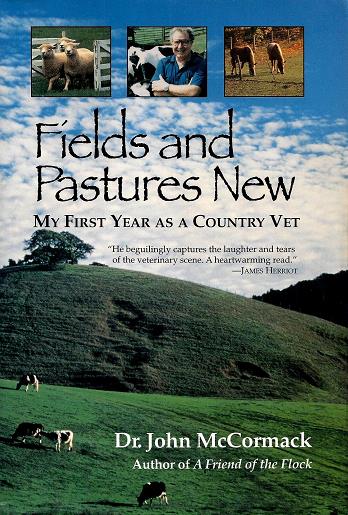
Fields and Pastures New

By Dr. John McCormack

The setting is the early 1960s and John McCormack and his wife and children have moved to rural Alabama for John to start his career as a private practice veterinarian.  This would be a first for the locals too because there had never been a veterinarian in their area before.
Since it was a rural location, a lot of his work would be with farm animals and farmers. Folklore was quite important to these people and folk remedies were the order of the day, with the vet often being called in only when all else had failed. People also relied upon an untrained local man, Carney Sam, who, just like them, subscribed to strange and mostly worthless folk remedies to treat their ailing animals. Like rubbing turpentine on a horse's belly to treat kidney problems. The thinking was that the turpentine would be absorbed through the skin and travel to the kidneys. Total rubbish, but those sorts of treatments were very popular.
But Dr. John is a modern veterinarian and his methods relied upon proven, scientific knowledge. They weren't foolproof, of course, but they were certainly much more effective than the strange and useless cures inflicted upon the poor, suffering critters they were meant to treat.
So rural, backward Alabama got itself a fancy new vet and before long, it was  clear that the community was very lucky to have Dr. John in their midst. And it was clear to Dr. John and his family that they had found themselves a warm and welcoming new home.

This was an interesting read, the memoir of  a young vet establishing himself in his new location, coping with the backwards farmers and the less-trying doctoring of the local dogs, cats and other pets in addition to the work with livestock. The author has real feelings of affection for his neighbors and clients and he and his wife and kids become a greatly appreciated part of the community.

For another review, see https://www.kirkusreviews.com/book-reviews/john-mccormack/fields-and-pastures-new/.

Wednesday, May 31, 2017

Slaves in the Family

By Edward Ball

Edward Ball's ancestor came to America and started plantations near the Atlantic coast, growing rice. They used slaves from Africa to do the plantation work.  At one point, the family owned several plantations in the same area of South Carolina.  They owned thousands of slaves. They also fought to keep their slaves in the Civil War.
Knowing this, Ball set out to connect with the descendants of those slaves that he was able to track down by perusing family documents and historical records. In several cases, he was able to find these people and give them the information he was able to gather about their ancestors and from their family lore piece together more of the story of their ancestors' history, even to the probable location their African origins.
Not surprisingly, he also figured out that his ancestors had mixed race children from informal liaisons with their female slaves. Ball was able to track down some of the descendants of these relationships, people who are distantly related to himself.
He encountered some anger but he also gave people a better understanding of their own personal history and this valuable information was welcomed by the families.

This was a very informative read as it goes quite deeply into the slave-owning experience of the author's own family. And his interviews with the descendants were touching to read. It's a long book and I must admit I got a bit bored with it towards the end. But I do feel it is a worthwhile book to read.

For another review, see http://www.thedailybeast.com/if-you-only-read-one-book-about-the-legacy-of-slavery-slaves-in-the-family.

Tuesday, May 30, 2017

The Statement

Pierre Brossard chose the wrong side in World War II. He was a Nazi collaborator and was responsible for the murder of at least fourteen Jewish people. He has been on the run for decades, helped out by a shady association of Catholic clergy who see no problem with helping out a mass murderer because, "the Church's law of asylum supersedes...the laws of the civil authority."
But now someone is on Pierre's tail. Driving up a isolated road, Pierre is waylaid by an assassin. But Pierre is too canny and shoots the killer first. He then flees to his Catholic refuge.
But this murder brings to the front the question of Pierre's real character. All along, the church claimed to believe that Pierre was truly repentant of his war crimes. But now that he has killed again, doubt arises and the church moves to distance itself from him. The word goes out and Pierre finds that he is no longer as welcome at his old haunts as he used to be.
Meanwhile, the police are actively involved in tracking Pierre down after decades of letting it slide. His face is in the newspapers and he is running for his life. facing down and killing a second man who came gunning for him. But the question he needs to ask himself and fails to do is how these killers know his routine and the locations of his hiding places. Because, although the killers want the world to believe Pierre is being hunted by Jewish avengers, this is not the case at all. Even though that is what Pierre fervently believes, his guilty conscience prevents him from seeing the simple truth.

This was an OK read. I found it a bit dull, to be honest.  I also found the ending unsatisfying.

For another review, see https://www.kirkusreviews.com/book-reviews/brian-moore/the-statement/.

Paradise News

By David Lodge

Bernard's aunt is dying and she wants to see her brother before she dies. The aunt, Ursula, lives in Hawaii and Bernard and his father, Jack, live in Britain. Jack, who is rather frail, is not eager to undertake such a long trip. In fact, he has never flown on an airplane before and is rather alarmed by the whole idea. However, the thought that the estranged sister has money does much to reconcile Jack's family to the idea.
Bernard is a part time teacher and he has the time to escort his dad on the long trip. Bernard is a bit of a black sheep as is Ursula. Ursula married against the advice of the family. Bernard is an ex-priest who lost his faith and is regarded as a failure by the family.
Bernard bought a package tour for himself and his dad because it was the cheapest travel option and they end up traveling with a small group of their fellow Brits whose activities form a sort of backdrop to Bernard's story.
Arriving in Hawaii, not even there for one full day, Jack, used to British traffic patterns, steps in front of a car and gets hit. He is not gravely injured, but his hip is broken and he will be stuck in the hospital for quite a while. Meanwhile Ursula has taken a turn for the worse and she is also confined to her bed.  The reunion is delayed for the time being.
With his dad and his aunt in the hospital, Bernard is left to his own devices and he gets to know the woman who knocked his dad down with her car, Yolande. Yolande is at a turning point in her life. Her husband has left her for another woman (younger, of course) and Yolande is fighting the divorce, mostly because she is angry. She is attracted to Bernard and escorts him to some of the local tourist attractions. They end up in a relationship and she helps him with some of his personal problems.
Jack and Ursula eventually get to meet at Jack's hospital and they confront some issues and misunderstandings from their childhood and both find comfort in the reconciliation.
Soon Jack is well enough to travel home and they leave the islands behind, with hope for the future.

This was an entertaining story. Bernard is a good guy and the story ends very nicely.  And it is nicely amusing too, not hilarious, but just sweetly, mildly amusing.

For another review, see https://www.kirkusreviews.com/book-reviews/david-lodge/paradise-news/.

In a Sunburned Country

By Bill Bryson

Australia: perhaps the most exotic place in the world. Full of flora and fauna found nowhere else on our planet, some of which is dangerous and/or toxic. Much of it is inhospitable, uninhabited and pretty much unexplored. Parts of the interior have never been closely surveyed and may possibly contain unknown  reserves of mineral wealth.
Australia is nearly the same size as the continental United States but sparsely populated, with most of the people living in cities on the  southern and eastern coasts.  The coasts have the best climate, with lush forests and land suitable to grow crops. The interior is desert of the harshest, most deadly kind.
Bill Bryson has a love affair with Australia, despite its much touted dangers. He set off on a tour of the civilized places, visiting some of Australia's most outstanding and amazing attractions. Throughout his trip he finds the people welcoming and helpful and the natural wonders simply amazing. He rarely has a harsh word to say and is looking forward to returning in the future.

I enjoyed the book a lot. Bryson has a lovely sense of humor and doesn't mind poking fun of himself. I laughed out loud several times as Bryson describes some of the predicaments he gets himself into.
But besides the humor, Bryson's descriptions made me long to visit Australia some day. If I could, I would go there without hesitating, eager to see all the sights that Bryson does such an excellent job describing.

For another review, see https://www.publishersweekly.com/978-0-7679-0385-1.

Monday, May 15, 2017

Middlesex

By Jeffrey Eugenides

Callie was born a male. But due to his lack of testicles and minuscule penis, he was misidentified as a female. So his parents, believing he was a girl, raised him as a girl. Which was fine. He was a very pretty little girl and did all the girly things most little girls do. But then when he didn't go through the usual transformations that occur to most young teen girls, his parents decided to take him to a specialist in New York City.  The doctor recommends to the parents that Callie have surgery to remove his undescended testicles and put him on hormone therapy and  let him live out his life as the female he has been raised to be.
But Callie reads his medical file and suddenly his life makes sense: his attraction to girls, his budding mustache, his gangly body, his height.  And he runs away to California.
But before we get to this point in the story, we have to delve into Callie's antecedents. We have to learn about his grandparents, brother and sister, who fled Europe to the safety of America. We have to follow them as they get married (to each other!), have two kids and settle in Detroit. Then there is their son, Milton, who marries a cousin, Tessie and who gives birth to two sons, one of whom is Callie who they think is a girl. It takes almost 200 pages for the story to even get to the moment of Callie's birth. Then we have to read about her childhood before we get to the meat of the story, Callie's struggle to understand the truth about himself.

This book is really a family saga and is more concerned about the story of the whole family than it is about the story of Callie's sexual identity.  I wanted the story of Callie, not the story of the whole family. Two hundred pages into a five hundred page novel and Callie is only briefly touched on, which was rather annoying. For me, the story didn't really get that interesting until it focused more on Callie and less on her family.
Also, this novel is described, by some, as a comedy and as a comic epic, as hilarious, funny, playful. I didn't find it to be any of those things.
For another review, see http://www.thedailybeast.com/articles/2012/11/29/american-dreams-middlesex-by-jeffrey-eugenides?source=dictionary.

The story of Callie reminded me of David Reimer. He was a boy whose penis was accidentally removed as a baby and who, as a result, was castrated and raised as a girl until he rebelled and reclaimed his male identity. I wonder if Eugenides based his novel on David's tragic story.

The Passage

By Justin Cronin

A new virus has been discovered in a South American jungle. The bad news: it kills most. The good news: those who survive are changed into super-beings. The further bad news: they become remorseless, bloodthirsty killers. In other words, they become vampires.
So the government, with dreams of deathless superhuman soldiers decides to take this virus and engineer the vampire-ness out of it and retain the superhuman-ness. To do so, they require human subjects: men on death row whom no one will miss.
But all they get are more vampires. Finally, they think they have refined the virus to what they want. They think the reason they keep getting vampires is that the test subjects are too old, too flawed, too evil. They decide they need an innocent child, a homeless child with no family, who, like the condemned men, will not be missed. That is how they acquire Amy, who they heartlessly inject with their vampire virus. But they are wrong that no one will miss Amy. Two people who have encountered her have an instant bond with the little girl: a nun and  the FBI agent who brought Amy to the secret government facility in Colorado.
So Amy gets injected with the vampire virus and becomes ill and slowly begins her transformation into superhuman. Meanwhile the 12 convicts/vampires are exerting their superhuman powers on the people of the facility resulting in a disaster: The vampires get loose and bring down Armageddon on the world. Most people die but lots of people become vampires too. The surviving people live in hiding and in isolated locations as they fight to survive the vampire onslaught.
And then there is Amy. What can she bring to the struggle of humanity vs vampire? For in her case, the scientists were right. She has the strengths and vitality of the vampires but without their craziness and thirst for blood. She may be humanity's best hope, if she is up to the job.

This was a really long book: 891 pages. Parts of it were really interesting and parts just seemed like they could have been condensed quite a bit. I know I skipped through some of the later part of the story. This is a bloody story. People are slaughtered, torn to shreds. Animals are slaughtered, torn to shreds.  Characters that you start to care about are killed. A pet dog is killed, pointlessly, I thought. Just to be cruel, it seemed to me.
This book is the first in a trilogy. It is an interesting story but just too bloody for me. Once the author killed off that poor dog, I knew I wouldn't be reading the next book in the trilogy. Plus it is just too damn long.

For another review, see http://www.thedailybeast.com/articles/2010/06/24/justin-cronins-the-passage-reviewed-by-lizzie-skurnick.

Wednesday, May 10, 2017

Long Hot Summoning (The Keeper's Chronicles #3)

By Tanya Huff

Diana Hansen has just graduated from high school and now she is, at last, a Keeper. As a Keeper, Diana, along with her older sister Claire, who is also a Keeper, has to maintain the balance between Light and Darkness. Mainly they have to keep the powers of Darkness from taking over the normal world.
Diana's first summons as a Keeper is to a shopping mall. Some strangeness has been spotted at the Erilking's Emporium, a gift shop. Upon arrival at the mall, the first clue that something is up is the excess number of minivans in the parking lot. Sure enough, Darkness is trying to sneak into the world and is doing so by creating a mall identical to the real mall in the Dark realm. It is to this counterfeit mall that Diana, her angel cat Sam, and Claire must enter and put a stop to the foul plan. In the process, they are helped by King Arthur and his merry band of mall elves who are a group of homeless teens who somehow got sucked into the Dark realm and have been transformed into elves, which is some kind of side effect of being too long on the Dark side of things.
Meanwhile, back home, Claire's boy friend (husband?) and her elderly cat Austin are facing problems of their own. Namely, an ancient Egyptian mummy who is surreptitiously draining the life force from all around her in order to restore herself back to life.

This was a fun and enjoyable read. The book is quite amusing, with lots of silliness, fantasy and adventure. I did feel a bit lost at times, not having read the previous two books in the series, especially at the beginning. It never really explains why the cats can talk or why the cat Sam used to be an angel or why he stopped being an angel. Or even what the whole deal is with the cats. This is one of those series where it really helps to have read the previous stories. But even feeling a bit lost at times, I still liked the book a lot.

For another review, see: http://www.errantdreams.com/2014/06/review-long-hot-summoning-tanya-huff/.

Sunday, April 30, 2017

Billionaire Blend

By Cleo Coyle

A new customer at Village Blend ( a New York City coffeehouse) has the baristas abuzz. Handsome billionaire Eric Thorner has been coming in and quizzing the staff on their knowledge of coffee. Manager Claire Cosi finally gets to meet him and dazzle him with her encyclopedic knowledge of all the ways coffee can be prepared. It turns out Eric has a proposition for her. But before she can find out what his proposition is, his car, parked outside, explodes, killing his chauffeur and heavily damaging the coffee shop and hurting him and Claire too.
Even though she is hurt (but not badly) Claire has the presence of mind to tend to Eric and call 911. Eric is hustled off to the hospital and Claire is left to deal with the disaster that has put the coffee shop out of business for the foreseeable future.
But the tech tycoon steps up and arranges for the shop to be speedily repaired, including the addition of an awesome new coffee machine, the Slayer (http://slayerespresso.com). And he explains what he wanted from Claire before the blast: he wants her to develop a special coffee made of the most delicious, subtle and expensive coffee beans in the world.
But who wanted Eric dead? Claire has a large bump of curiosity and the chance to tackle a new mystery plus make some much need cash has her putting her concerns aside and embarking on new adventure, traveling the globe with Eric and Matt (her ex-husband) searching for the perfect coffee bean and solving the many mysteries in Eric's life.

This was an OK read. I have nothing against it. It was quite acceptable. But it never really grabbed me the way I would like a book to do.

For another review, see https://www.kirkusreviews.com/book-reviews/cleo-coyle-2/billionaire-blend/.

Sunday, April 23, 2017

Give Up the Ghost

By Juliet Blackwell

Mel Turner is a building contractor. She does a lot of renovation work. She also has the dubious ability to see ghosts.
Andrew Flynt is the proud owner of a renovated Victorian mansion. The mansion's insides were completely gutted and modernized. But in the process of renovating the house, a ghost became aroused and upset and made life difficult for the Flynts. So they decided to sell the house. But the ghost keeps scaring potential buyers away.
Flynt hired a psychic to help him with the problem and the psychic, Chantelle, told him the ghost didn't like the changes and she gave him a list of things that needed to be restored to put the ghost to rest. Thus the hiring of Mel Turner.
The first thing Turner decided to do was pay a visit to Chantelle. But when she arrived at Chantelle's apartment it was only to find her dead with her brother kneeling beside his sister's body.
And Mel Turner's new renovation project just got a lot more complicated.

This was a fairly good read. It really got my interest for the first half of the book. But then it just seemed to drag on and on and I was getting tired of it. But I think the first part was stellar, I just wish it held up better.
For another review, see  https://suspense.nightowlreviews.com/v5/reviews/roxanne-reviews-give-up-the-ghost-by-juliet-blackwell.

Sunday, April 16, 2017

Kitchens of the Great Midwest

By J. Ryan Stradal

Eva Thorvald is a gifted chef with an exquisite palate. She throws occasional private dinners which have very long waiting lists and cost thousands of dollars per person. This is her story.
It starts out with Eva's mother deserting baby Eva and her father, Lars. Lars soon dies and Eva is adopted by Lars' brother Jarl and his wife, Fiona.
In grade school, Eva was picked upon and bullied. She got her revenge in a very unusual way and then ran away to her cousin, Braque, Braque is in college and has just discovered she is pregnant when Eva shows up.
Eva's refined palate and passion for food leads her to a career in the food industry. In the course of time, her life intersects with lots of other people as she finds her niche in the world of fine cuisine. Yet, at the end of the book, Eva is eating mac and cheese, broccoli and drinking beer with Pat Prager's Lutheran peanut butter bars for desert. And that suits her just fine.

Even though this is the story of Eva, the book jumps around a lot and the story switches from one perspective to another, with Eva's story set off to the side. There are so many characters and their lives intersect in many different ways. I had to make a list to keep track of them all. Still, it was a really interesting story and very unforgettable.

For a better review, see https://www.nytimes.com/2015/08/09/books/review/kitchens-of-the-great-midwest-by-j-ryan-stradal.html?_r=0.

Tuesday, April 11, 2017

Girl Waits With Gun

By Amy Stewart

It's the early 1900s and Constance, Norma and Fleurette are out for a ride in their buggy when a car smashes into it, injuring both Constance and Fleurette. Unfortunately, the man driving the car was a thoroughly unpleasant person. He claimed the women ran into his car and he refused to pay for the repairs to the buggy.
Constance tracked him down to his office in the factory his family owned. She found him surrounded by his gang of toughs but that didn't stop her from demanding payment.
She may have been in the right, expecting him to pay for the repairs. But he is of another mind and thus begins a trying time for the three women with harassing letters, bricks thrown through the windows of their farm house and threats to kidnap the youngest one, Fleurette, who is only eighteen. Their house is broken into, their furniture and knick-knacks smashed, and a fire started in the kitchen in an attempt to burn down the house.
Constance goes to the sheriff and he and his deputies try their best to keep the women safe from the gang. The sheriff even goes so far as to arm the three women with pistols and teach them how to use them safely. And working together, Constance and the sheriff will attempt gather enough evidence to put Mr. Evil Factory Punk and his gang of toughs behind bars for a good while.
The three women live in an isolated farm house they inherited after their mother died. The two older sisters are in their thirties and the youngest is a mere teenager. Since there is no man in their lives, the gangsters view them as easy targets. But Constance is made of stern stuff and she refuses to knuckle under to the threats and scare tactics.

This was an interesting story, based loosely on the real Constance Kopp, who was one of the first women to be a sheriff's deputy. The sheriff was so impressed with her during the course of that terrible year when she and her sisters were under attack, that he offered her a position as deputy and she accepted.
However, I was rather disappointed because, once again, I was fooled by the blurbs which claimed the book was "romping, hilarious" and "funny" and that it had "humor." What the blurbers consider to be funny and what I consider to be funny must be vastly different. I didn't find the book the least bit amusing. This is not to say it was not a good and interesting story and I enjoyed it very much. But funny? No.

For another review, see https://www.kirkusreviews.com/book-reviews/amy-stewart/girl-waits-with-gun/.

Monday, April 10, 2017

Miss Julia Delivers the Goods

By Ann B. Ross

Things are all upset at Miss Julia's house. Hazel Marie is ill and she has ended her long-time relationship with J.D. Pickens. He just won't pop the question and she is sick and tired of waiting. In fact, she is so sick she ends up in the hospital.
Miss Julia is pretty sure Hazel Marie's problem is "female matters." After all, Hazel Marie is well into her forties. However, it turns out to be the exact opposite. Hazel Marie is not in menopause, she is pregnant!
Once she finds out she is pregnant, Hazel Marie is determined to hide her fallen condition from the judgmental folks in their town, even if she has to move to Florida. The one thing she refuses to do is reconcile with Pickens or even let him know his is going to be a daddy.
Meanwhile, Sam, Miss Julia's husband, has had his old house broken into and some papers relevant to a book he is writing stolen. And the originals  of the papers at the court house have gone missing too. What doesn't make sense is why anyone would want such papers dealing with criminal cases from decades ago.
So Miss Julia has two crises to solve and spends most of the novel accomplishing very little beyond wondering what can be done to make things right.

This was a boring story. Feels like the author has run out of things to say about her characters. As I said above, very little happens beyond Miss Julia and crew wondering what they are going to do to keep Hazel Marie from leaving and how they are going to get the star-crossed lovers back together. The missing papers plot line has nothing to do with the Hazel Marie plot line and comes off a mere filler. Disappointing.

Lincoln in the Bardo

By George Saunders

Based on an actual event, the death of Abraham Lincoln's young son, Willie.
After his body is placed in a crypt in the cemetery, Willie's spirit leaves his body and meets the other denizens of the cemetery, the spirits of the dead who have chosen to linger on Earth rather than pass on to their ultimate fate. Since Willie is an innocent child, the spirits expect he will soon pass on, as most little ones do.
But then Lincoln comes to visit his dead son and Willie, who doesn't quite understand he is deceased, lingers to be with his father.
Actually, the spirits inhabiting the cemetery also don't seem to understand they are dead. They think they are merely ailing and refer to their coffins as sick-boxes. There are spirits who have been there for many decades who still don't get they are dead. But they all are anxious to tell young Willie their life stories.
So Willie lingers because his father keeps returning to his dead son and eventually Willie comes to know he is dead and communicates that knowledge to the other spirits, causing much consternation and mass exodus of spirits ensues as the realitzation they are all dead finally sinks in.

This was an interesting story, especially as it includes excerpts from books about Lincoln. Although I did read that some of those references are not real.

For another review: https://www.theguardian.com/books/2017/mar/08/lincoln-in-the-bardo-george-saunders-review.

Saturday, April 01, 2017

Eater

By Gregory Benford

Earth is under attack! A billions-of-years-old intelligent black hole has come to reap the planet, with no regard for the life upon it.
Just as this threat emerges, Dr. Ben Knowlton, astrophysicist, is in the midst of a consuming personal tragedy: his beloved wife Channing is dying of cancer.
Putting tragedy aside, Ben, along with other experts, gather to develop a defense against the relentless Eater. But what can puny humans do to stop Eater's inexorable advance?

This was an OK read. It is of the "hard science" genre of science fiction, a bit too technical for me.

Friday, March 31, 2017

Love Me

By Garrison Keillor

Larry is just an ordinary guy living in Minnesota. He wants to be a novelist. And he succeeds. His novel is a big hit. He's famous, acclaimed, money pouring in. Now he wants to take advantage of it all and move to New York and work for the New Yorker. But he's married and his wife refuses to leave Minnesota. She is not interested in the advantages that New York offers. So she stays in Minnesota and Larry goes to New York.
New York is everything Larry wanted. He loves life in the city. He loves his apartment, especially the terracer. He loves being at the New Yorker. Only two things are messing it up for him. He's got writer's block and his wife is adamant about staying in Minnesota.
The years pass. His writing career is in the toilet. He is drinking too much. He is chasing after women. His wife is leading her own life. He ends up writing an advice column for a newspaper. It isn't until he thinks his wife is becoming attached to someone else that he finally returns home to Minnesota.

I enjoyed this story quite a lot. It got my attention from the very start, always a good sign. It has some fun and rather silly bits and the advice column stuff is really great, maybe one of the best parts of the whole thing. One of the advice-seeking letters is from a famous George:

"I grew up in Midland, Texas, and went to Yale though I am no reader and married a fine woman who supported me through my Lost Weekend years when I goofed around in the oil business and got high as a kite on weekends and went around making a fool of myself. With the help of dear friends, I was able to sell my bankrupt company at a handsome profit and then obtain a major-league baseball franchise and get public financing for a ballpark, whereupon I sold the team for a fabulous profit. What a lucky duck. Now that I'm off the sauce, I am considering taking a stab at politics (my dad was a politician though not a very good one, IMHO,) but I hate hanging around with dull people who yak about the fine points of public finance or Whatever! And my wife says, "Why don't you try writing? You have so many good ideas." What do you think?"


And since I included the George letter, I want to also include Larry's rant about Republicans:

"...Bullet-headed ideologues devoted to prisons and sterile office parks and McMansion developments and pumping oil and destroying the Alaska wilderness to power their SUV's while taking away funds for homeless children sleeping in doorways to pay millions to fat-cat farmers and ranchers firmly attached to the right hind teat of federal welfare." 

 The only thing I didn't care for in the whole story was the ending, which was depressing and disappointing. Oh, well.

Monday, March 27, 2017

Ellen Foster

By Kaye Gibbons

Ellen has it rough. She is only nine years old when her mother dies of an overdose of heart medicine. Her father is an abusive drunk. Ellen fantasizes about killing him and is finally forced to run away when he starts making sexual advances.
She finds a temporary home with her art teacher, but is soon taken and placed with her grandmother on her mother's side.
The grandmother is a mean old woman who hates Ellen's father and blames Ellen for the mother's death.  Ellen tries to be a good but the grandmother is unyielding. Ellen's father dies and even that doesn't improve the grandmother's feelings towards her granddaughter. However, the old woman is soon dead too.
Ellen is next placed with her maternal aunt but things don't get any better. The aunt and her daughter are not welcoming and things come to a head one Christmas when the only gift Ellen receives is a package of drawing paper. Although it is exactly what she said she wanted when her aunt asked her what she would like for Christmas, Ellen had a childish fantasy that her aunt and cousin would realize they loved her and buy her some nice presents. After an angry confrontation, her aunt kicks Ellen out. Ellen sets off to find the love and acceptance that has been lacking all her young life.

This was a pretty good story.  From the beginning of the story, Ellen has apparently found the family she has been craving as she describes her life with "new mama." She has her own bedroom, nicely decorated. There is plenty of good, wholesome food and new mama treats Ellen and the other kids in the house with love and patience and kindness. The house is kept clean and tidy, the kids are also clean and properly dressed, everything is orderly and disciplined and new mama seems to be the real deal. But is she a real person or just the fantasy figure of a little girl desperate for a loving home?

See also https://www.kirkusreviews.com/book-reviews/kaye-gibbons-6/ellen-foster/.

Sandcastles

By Luanne Rice

Honor's marriage was in trouble but it seems only she knew it. She kept her unhappiness to herself but it affected her work. A talented painter, her spark was now gone and she blamed her husband, John.
When they first fell in love, John was everything she thought she wanted. He too was a talented artist who constructed ephemeral sculptures built from rocks, sticks and things he found in the environment. He was quite successful and traveled to locations around the world to create his sculptures.
But then the babies arrived and as her family grew, Honor found herself turning away from her husband, yearning for a more settled lifestyle.
Honor and their daughters accompanied John on one of his sculpture trips, this time to Ireland. John built a large sculpture located on a cliff. But a local man began vandalizing John's work and John threatened to kill him in front of witness. Then one rainy night, John confronted the vandal on the cliff top and the man was killed. John's oldest daughter Regis was there too and saw everything. John ended up in prison when he pleaded guilty, sentenced to six years.
So the six years go by and John is out of prison and wanting to reconnect with his wife and children. He turns up in their home town and his three daughters are thrilled to have him back in their lives. But his wife is not thrilled. She is still angry about what she sees as his failings and about what happened in Ireland.
Having their father locked up for six years has traumatized his three daughters. The worst off is Regis, who can't remember what happened that fatal night. The girls are also anxious for their parents to get back together, but Honor is not ready to accept John back into their lives. She is very distant and remains so until her daughters' crises forces John and Honor to confront their differences.

I didn't like Honor and her three daughters. The daughters are all loons and Honor is pissed at John for being himself, the same person he was when she fell in love with him.  I also didn't much care for the emotionalism of the characters and the needless drama they create. Also, it doesn't take a brain surgeon to figure out pretty quickly that (spoiler alert) Regis was the one who caused that man's death and that her father took responsibility for it to protect her. I  guessed it by the end of Chapter 3. So no big shocking reveal for the reader who knows way before she and her brainless family does that she is the killer.
I found this story boring. It didn't appeal to me. It wasn't suspenseful, the mystery is not mysterious and the whole lot of them come off as either stupid or unstable. I was glad when it came to its predictable conclusion.

For another review, see http://www.curledup.com/lrsandca.htm.