By Naomi Alderman
It's a world turned upside down when women suddenly develop the power of the electric eel: the power of the electric shock. Now gangs of electrified women roam the streets, looking for wayward males to torture and even murder. A new religion is born, with a new leader, Mother Eve. The scriptures are rewritten, with the women elevated and the Holy Father now the Holy Mother. And the men are running scared, plotting in back rooms and with deposed tyrants to take back their ancient reign over womankind. But the women are not going to bow down again, even if they have to bring the whole world crashing down.
Sounds like an exciting premise, but overall it was a pretty dull read. It heats up toward the end but mostly it just drags along, repeating over and over that, once the women have the power, they become just like their overbearing and cruel former masters, the men.
The author is probably right about how the women become abusers just like their former abusers, since enormous power does corrupt all except the most centered and strong-willed. And that the men would not take their new status lightly. But somehow, the story just never grabbed me.
Sunday, May 20, 2018
Eternals
By Neil Gaiman
Graphic novel based on the Marvel comic book series by Jack Kirby. A bit hard to follow if you are totally unfamiliar with that series, which I was. So my summary may be a bit off.
As I understand it, back at the beginning of life on Earth, there were these giant robots/gods/ aliens called Celestials who came here and created two sets of beings, the Eternals and the Deviants/Changing People. The Eternals were perfect and immortal. Even if totally destroyed, they would be reassembled. The Deviants were mortal and able to change their appearance, but mostly they look monstrous. When apes evolved into humans, the humans were enslaved by the Deviants until freed by the Eternals or by the Celestials, I'm not sure which. And the Deviants retreated underground. The Eternals role on Earth is to protect, preserve and repair. What exactly they are supposed to protect, preserve and repair, I'm not sure. The Earth? Humanity? All life on Earth? Does that include the Deviants? Beats me.
Anyway, and this is where I got really confused, there's is this kid, Sprite. He has a TV show and he is really famous and popular. And he is immortal. I think he is one of the Eternals. Anyway, he was created a kid and he remained a kid and has been an eleven-year-old boy for a million years and he is sick of it. He wants to be a man in a man's body with all that the entails, mainly sex. So, somehow (if it was explained how, I missed it) Sprite causes all the Eternals to forget who they are and now they all believe they are mere humans living ordinary human lives. The effect of this is that Sprite is the only one who knows the truth and that he is now human (why & how did he become human?) and mortal and will finally achieve his dream of becoming a real man. Except it doesn't quite work out that way.
One of the Eternals has retained snippets of memory and knows that he is not a mere man. Dismissed by others as some kind of nut, Ike Harris (Ikaris) has managed to locate Mark Curry (Makkari). Now he has to convince Makkari that he is an Eternal, which turns out to be pretty easy when Ikaris ends up in the hospital under Makkari's care and Makkari can see for himself how quickly and unnaturally Ikaris heals, totally unlike a normal person would.
Ikaris gives Makkari a few leads on the whereabouts of some other unaware Eternals and Makkari sets out to rouse them. Ikaris is kidnapped from the hospital by a couple of Deviants. The Deviants, who can look human, are trying to figure out how to kill an Eternal and they are using every method they can think of, finally blasting Ikaris to atoms. They think they have succeeded, but they don't know that he is being reassembled by machinery at the Eternals' deserted base in Antarctica.
The two Deviants travel to San Francisco where they dig up a Celestial who was buried there a long time ago as some kind of punishment. They are thinking or hoping the Celestial will be on their side against humanity and the Eternals, once they get it reactivated. It will reactivate when exposed to sunlight, apparently. Does this have something to do with the Sprite plot? I'm not sure. I know he shows up at the San Francisco location and gets captured by the two Deviants.
Meanwhile Makkari and the reassembled Ikaris don't want the Celestial reanimated. So they also show up at the SF location and Makkari has some kind of melt down and the robot alien god Celestial thing stands up. But that is all it does. It just stands up.
Then a horde of Deviants show up at the base in Antarctica, to challenge the few Eternals who have regained their memories and their powers. Makkari stands up to them and earns their respect, I didn't really get that part. And the head Eternal tracks down Sprite and kills him for causing a lot of the troubles.
This was a really disjointed story, too much going on, and if you are not familiar with the back story, pretty confusing.
Labels:
fair read,
fantasy,
fiction,
Gaiman,
science fiction
Vicious
By V.E. Schwab
Two college boys, Eli and Victor have a secret project. They want to become EOs: people with Extra-Ordinary powers. Their research led them to try a dangerous experiment and Eli ended up dead, but only briefly. When he was revived, he revived with an extra-ordinary ability: he automatically healed from any injury. As time passed, it became apparent that he was ageless too. But despite his apparent resurrection, Eli felt he not the same person, that something basic was missing. He became convinced that people brought back from death were unnatural and wrong and he set out on a new mission in life. He would hunt down and kill all those revived from a near death experience who came out of it with an extraordinary ability.
But before Eli left college to go hunting and murdering, there was Victor. Victor had been the first to undergo the experiment, but in his case it didn't work. So he tried again, against Eli's wishes. He enlisted the help of his ex-girlfriend (and now Eli's girlfriend) but the procedure didn't go as planned. The girlfriend ended up dead and Victor, framed by Eli, in prison for her murder. But Victor did get a super-power out of it, namely the ability to inflict or remove pain. Which meant his time in prison went fairly well for him, since everyone was terrified of him. Except for his cellmate, Mitch, who became his follower. Once the two of them were out of prison, Victor got another follower, Sydney, a young teen girl on the run from Eli and Eli's partner in murder, Sydney's older sister, Serena.
Both Serena and Sydney were EOs. They had both drowned together and been brought back. Serena's power was her voice. Whatever she told anyone to do, they would do it. Even to killing themselves, if she told them to. Sydney's power was the gift of life. She could bring the dead back to life. Serena met Eli when he tracked them down, planning to kill both the girls. But Serena simply told him not to kill her and he couldn't. Eli explained to Serena what he was doing and she agreed with him. The next victim was to be her little sister, Sydney. But Sydney escaped with a bullet wound to her arm.
That is when Victor found her, on the roadside, bleeding and running away from Eli and Sydney. And when Victor understood the possibilities of Sydney's gift, he knew she would be a powerful ally against Eli and Serena. Because she hated Eli almost as much as Victor did. Together, with the faithful Mitch, they would attempt to bring down two ruthless killers who believed themselves to be on a mission from God to rid the world of those like themselves and Victor and Syndey.
This was a pretty good story. I enjoyed it, although it is kind of hard to tell who really are the bad guys. Eli and Serena are totally certain that the EOs are an affront to nature, based on what they perceive to be lacking in themselves. And, towards the end of the story, Victor admits to himself that he has no real feelings, he just pretends to have them:
I am looking forward very much to the next book in the series, Vengeful.
Two college boys, Eli and Victor have a secret project. They want to become EOs: people with Extra-Ordinary powers. Their research led them to try a dangerous experiment and Eli ended up dead, but only briefly. When he was revived, he revived with an extra-ordinary ability: he automatically healed from any injury. As time passed, it became apparent that he was ageless too. But despite his apparent resurrection, Eli felt he not the same person, that something basic was missing. He became convinced that people brought back from death were unnatural and wrong and he set out on a new mission in life. He would hunt down and kill all those revived from a near death experience who came out of it with an extraordinary ability.
But before Eli left college to go hunting and murdering, there was Victor. Victor had been the first to undergo the experiment, but in his case it didn't work. So he tried again, against Eli's wishes. He enlisted the help of his ex-girlfriend (and now Eli's girlfriend) but the procedure didn't go as planned. The girlfriend ended up dead and Victor, framed by Eli, in prison for her murder. But Victor did get a super-power out of it, namely the ability to inflict or remove pain. Which meant his time in prison went fairly well for him, since everyone was terrified of him. Except for his cellmate, Mitch, who became his follower. Once the two of them were out of prison, Victor got another follower, Sydney, a young teen girl on the run from Eli and Eli's partner in murder, Sydney's older sister, Serena.
Both Serena and Sydney were EOs. They had both drowned together and been brought back. Serena's power was her voice. Whatever she told anyone to do, they would do it. Even to killing themselves, if she told them to. Sydney's power was the gift of life. She could bring the dead back to life. Serena met Eli when he tracked them down, planning to kill both the girls. But Serena simply told him not to kill her and he couldn't. Eli explained to Serena what he was doing and she agreed with him. The next victim was to be her little sister, Sydney. But Sydney escaped with a bullet wound to her arm.
That is when Victor found her, on the roadside, bleeding and running away from Eli and Sydney. And when Victor understood the possibilities of Sydney's gift, he knew she would be a powerful ally against Eli and Serena. Because she hated Eli almost as much as Victor did. Together, with the faithful Mitch, they would attempt to bring down two ruthless killers who believed themselves to be on a mission from God to rid the world of those like themselves and Victor and Syndey.
This was a pretty good story. I enjoyed it, although it is kind of hard to tell who really are the bad guys. Eli and Serena are totally certain that the EOs are an affront to nature, based on what they perceive to be lacking in themselves. And, towards the end of the story, Victor admits to himself that he has no real feelings, he just pretends to have them:
So it kind of boils down to a battle between monsters. But Victor has Mitch on his side and Mitch is clearly a good guy. Sydney brings a dying dog back to life and adopts it, which makes her a good guy too. But Victor is most definitely in much the same league as the deadly Eli and Serena.Victor didn't feel guilt, or fear, or even a sense of consequence, not like normal people. All those things had been dead—or at least dulled to the point of uselessness—for years. But he'd trained his mind to reconstruct those feelings from memory as best he could, and assemble them into a kind of code.
I am looking forward very much to the next book in the series, Vengeful.
Labels:
fantasy,
fiction,
good read,
Schwab,
science fiction
Thursday, May 17, 2018
A Separate Development
By Christopher Hope
Harry Moto is of an age to graduate from school and go on to college. He has a group of friends but isn't really that close to any of them. On the night of what would be here in the United States senior prom, Harry and a girl are caught making out by one of the teachers. This teacher, a man who has taken a dislike to Harry, runs to Harry's parents and rats him out. So Harry comes home to yelling and incriminations and ranting and raving ( the novel is set in the late 1950s and early 1960s) and his parents acting like hysterical fools. So he runs away.
Harry has a problem, though. Living in South Africa during apartheid, Harry has kinky black hair and an swarthy complexion. His parents are both white but his grandmother was swarthy like Harry. And Harry's parents never got around to registering him as the son of white parents. So he is often accused of or mistaken for being of mixed blood.
At this time in South Africa, it was in fact illegal for non-whites and whites to have sexual relations. People could go to jail for breaking the so-called Immorality Act. Since Harry looked mixed, without papers, there was very little he could do to earn a living. Just to get by, Harry accepted his mixed looks and passed himself off as mixed to be eligible to do the jobs considered suitable for non-whites: delivery boy, cab driver, bus boy. He lived this way for years but eventually crossed paths with the police and ended up rotting in jail just for not looking white enough, basically.
What a disappointment this novel was, and all because of the lying blurbs: On the front of the book, "A wildly funny novel." From the back: "Make the reader ... hoot with laughter." "bitterly funny."
I didn't find anything about this story to be funny, not even 'bitterly funny." Rape, murder, child abuse, mutilation, unfairness, hatefulness, discrimination, it is anything but funny.
I wanted to read a funny story, something to take my mind off things. This was not that story. In fact, about half way through, I stopped reading it for several weeks. Then when I picked it up to finish it, I started to get the feeling the story wasn't going to end happily and that made me impatient to finish with it. I pretty much just skipped through the last two chapters. Reading about poor, innocent, unlucky Harry being beaten and tortured by his jailers for the crime of being a white man with darker skin was not what I wanted to be reading. This is not a funny story, this is a tragedy. Don't read this book thinking you will be amused unless you are the kind of heartless creep that laughs at the suffering of others.
If I had gone into this book knowing it was a tragedy not a comedy, I might have liked it better. Instead I was hugely disappointed, thanks to the lying blurbs and reviews.
Hundred Miles to Nowhere
By Elisa Korenne
Living in New York City, musician/singer Elisa Korenne was a typical New Yorker, working, enjoying her friends and her activities and relishing life in the big city. But then she was invited to be a visiting artist for a month in a small western town in Minnesota with the odd name of New York Mills. The offer came with free housing and a nice stipend.
Doing a little research about Minnesota (which she had initially confused with Missouri, good grief), Elisa decided she wanted to experience the outdoors. Her contact in Minnesota gave her the name of a man who might be willing to take her canoeing and camping. And that is how she met the man she would eventually marry, Chris Klein.
Elisa and Chris hit it off and started dating and soon the subject of living together came up. Chris visited Elisa in NYC after the month in Minnesota was over. They talked about Chris moving there, but that would mean leaving the family business. Plus Chris doubted that any NY firm would be interested in hiring him. Since a lot of Elisa's work involved traveling to various gigs around the country, it made more sense for her to move to Minnesota.
But could a big city girl find happiness in the isolation and lack of amenities living, as the title says, a hundred miles to nowhere? Could she learn to cope with the quiet? With the peculiar neighbors? With the long, cold winters? Or would she discover that Minnesota has its own vibrancy and charm and a place for a Jewish singer/songwriter from the Big Apple?
This was a pretty good memoir. Elisa finds her place in the country, surviving vicious dogs, wacky neighbors, brutal weather and a sloppy, sometimes selfish boyfriend who eventually becomes her husband.
Wednesday, May 02, 2018
Pearls Before Swine : The Ratvolution Will Not Be Televised
A collection of daily and Sunday comic strips dating from April 2004 to January 2005. It includes the first mention of the crocodile fraternity ZZE, the infamous Zeba Zeba Eata, whose single goal in life is tricking Zebra, their next door neighbor, into becoming dinner.
Here is a typical Sunday strip from the collection.
Thursday, April 26, 2018
Hyperbole and a Half
By Allie Brosh
The author is a blogger and cartoonist and the book contains some of her online work and some new stories. She writes about her life and her childhood and her dogs with accompanying illustrations. Her drawings of herself are crude and simplistic. But her drawings of her dogs are very evocative and true.
Most of her essays are very funny. But she does address her struggle with depression and poor self image. She beats up on herself a lot.
I wasn't familiar with her blog when I got this book. I had read that the book was very funny and so I wanted it. When I saw her drawing of herself, I couldn't figure out what I was looking at. First I thought it was some kind of shark/human hybrid with a yellow shark fin sticking out of its head. Then, as I got a little further in the book, I thought maybe she drew herself with a yellow dunce hat. It took quite a while before I realized that it was her hair in a pony tail and that the fuchsia part was a dress. Her drawings of herself and her sister are grotesque but funny. But I loved the drawings of her dogs. So charming and funny. And I really liked her funny stories. The ones about depression and identity not so much.
Wednesday, April 25, 2018
Pen Pals
By Olivia Goldsmith
Jennifer worked on Wall Street. But now she works in prison because she let herself be talked into taking the fall for her boss, Don and her fiancé, Tom. They had assured her that she would probably never do any jail time and that she would be well compensated when it was all over. Don told her, "These charges are going to be dropped. And even if you do go to trial, you aren't going to be found guilty of anything. Trust me." And Jennifer never questioned it. Tom reinforced what Don said, promising her that, "Nothing is really at risk. It never is in cases like this. Even if you are convicted — which is virtually impossible — we'll have an appeal before the judge can pound his gavel." She believed him, after all, because "Tom was not only a Harvard undergrad and Law Review at Yale, he was also much more than her brilliant attorney. He was her beloved fiancé." And she bought it all, joking, "I only regret that I have but one life to give for my firm."
So instead of all the promises made her, Jennifer finds herself doing three to five years for insider trading and to make matters worse, there will be no appeals. Tom has also informed her that they are no longer engaged to marry because, "...under the circumstances . . .You know my family — it would be very bad publicity for them if I was involved with . . . a convict. . ."
So Jennifer is stuck in circumstances she never envisioned when she agreed to the two men's scheme. Their promises were all empty and now she is on her own in a strange and dangerous new world. How will the pampered Wall Street princess cope with life in the dirty, depressing and degrading women's prison?
This was a pretty good read, although the opening premise of the book is more than a little hard to swallow. Jennifer is portrayed as some kind of hot Wall Street wheeler-dealer. How could she be that savvy and not know that her boss and her fiancé were giving her a sucker's deal?
But never mind that. The real story is Jennifer's timely arrival at the prison just in time to help protect the inmates from the effects of the prison management being transferred from the public to the private sector, with plans by the new management to turn the prisoners into virtual slaves, working to generate revenue for their new bosses, while being paid nearly nothing for their labor.
Sunday, April 22, 2018
Night of the Mary Kay Commandos
Bloom County comic strips from the late 1980s. Breathed looks at some of his favorite issues: political incompetence, corporate greed, animal welfare and human stupidity. And he introduces Ronald Ann, the character he built a new comic strip around called Outland.
The main thrust of this collection is Bill and Opus running for the presidency against George Bush and Mike Dukakis. It is a very political collection and not one of my favorites. I've never been a big fan of Bill the Cat. Anyway, here are a couple strips I lifted from online:
Humans, Bow Down
By James Patterson, Emily Raymond and Jill Dembowski
So the robots have taken over and most humans are dead, defeated in the war between the humans and robots. The remaining humans work as humbled servants to their robot masters and those who wouldn't are held in enclaves, living in squalor and poverty.
Two misguided kids from the Reserve, as the enclave in this story is called, make their way into the former city of Denver, now under robot control, looking for fun and mischief. One of them chances upon an unlocked sports car and he steals it and talks the other, the girl, called Six, into taking it back to the Reserve. As it turns out, not unsurprisingly, this is a really dumb idea and before much longer the robot cops are at the Reserve led by one young detective, a robot "woman" known as MikkyBo. Mikky is an idealist and is shocked when her fellow cops open fire on a group of teen kids, killing several. Turns out they were just doing what their boss & Mikky's ordered. Although Mikky doesn't know it yet, the robot leaders have decided on a final solution for the "human" problem: extermination.
So, in its innocence, Mikky thinks it can track down the two car thief teens and bring them to justice, and that will defuse the situation. But Mikky ends up in the hands of a secret band of humans being led by the man who was the creator of the robots. And he is planning on using Mikky as a secret weapon against the robot overlords.
Despite its rather silly premise and that it seems to be aimed at Hollywood moguls looking for another teen flick similar to the Hunger Games to produce, I found this book surprisingly readable and quite enjoyable.
Labels:
fiction,
good read,
Patterson,
Raymond,
science fiction,
young adult
Friday, April 20, 2018
Get Fuzzy : Groovitude
By Darby Conley
A daily comic strip featuring Rob Wilco and his two pets, Satchel, the dog and Bucky, the cat. Although these pets are more like really stupid or very innocent small humans than animals. Satchel is mainly the butt of Bucky's stunts and Bucky provides most of the drama, with his craziness and wild schemes.
I was not familiar with the strip since I haven't bought a newspaper since the 1990s. I found the idea of dogs and cats conversing with humans a bit strange. Snoopy never spoke out loud, nor did Garfield. They had thought bubbles but no actual voice. Not only do this dog and cat talk, but Bucky is supposed to clean out his own litter box and Satchel sometimes does the cooking, although his concoctions are apt to appeal more to dogs than humans, like his cake with liver frosting. I would have liked to post that comic strip on here, but my scanner is not currently available due to computer problems. So instead here are a couple strips I found online:
``````````````````````````````````````````````````````````````````````````````````````````````
Lost in a Good Book
By Jasper Fforde
A continuation from the first book, The Eyre Affair, in which Thursday Next killed arch-criminal Acheron Hades and imprisoned Goliath Corporation operative Jack Schitt in Poe's poem The Raven.
Now married to her lover from the first story, Landen, and pregnant with their baby, Thursday finds herself being hunted by persons unknown and the Goliath people demanding that she free Schitt from Poe's famous poem. When she refuses, Goliath agents go back in time and erase Landen when he was just a toddler, promising to bring him back when she brings back Jack Schitt. But not only do they want Schitt, they also want the Prose Portal, the device that enables humans to enter the word of the written word. And its inventor, Thursday's Uncle Mycroft.
This was a weird story, just like the first one. All this jumping about in time and in and out of books is more than a little confusing. At one point in the story Thursday is shot dead, but comes back, thanks to time travel, but I really didn't understand that part. A lot of this story doesn't make much sense, but that is part of its charm, I think.
Anyway, I enjoyed the story and am looking forward to the next in the series, The Well of Lost Plots.
Labels:
fantasy,
Fforde,
fiction,
good read,
science fiction
You'll Grow Out of It
By Jessi Klein
Jessi shares her life and talks about her transition from administrative assistant to comedy writer and stand-up performer. From miss to ma'am. From single girl to married woman. From never wanting children to desperate for a baby and willing to endure the torture of fertility treatments. From childless to new mom. From loser to Emmy award winner. But never from wolf to poodle. (Klein has a theory that girls are born either a wolf or a poodle. Poodles are effortlessly feminine. Wolves are not.)
This was an enjoyable book even though I came into it not knowing who Jessi Klein is. I thought the reviews of the book made it sound interesting and funny. It was interesting though not all that funny. Mildly amusing at most although I will admit I don't have an East Coast sense of humor. Nor do I have access to non-free TV so I was frequently looking up references to see what she was talking about and because of that I learned what a blouson top is.
Here is a review by Kirkus Reviews.
Thursday, April 19, 2018
Whippoorwill
By Sharon Sala
Set in the territory of Kansas, after the Civil War but before the turn of the century, the story brings together a cast of characters to the dusty town of Lizard Flats, all of them coming for one reason: to see the preacher from back East, the Reverend Randall W. Howe.
Rev. Howe is headed West to make a new life for himself and put aside his lustful ways and rededicate himself to his holy calling. He was invited to Lizard Flats to perform the marriage of the town's two leading citizens, banker Alfonso Worthy and his wealthy, widowed, eager bride Sophie Hollis.
Headed to the town, among others, is Henry Wainwright, a grizzled trapper, bringing the body of his partner, Parson Sutter, whose last request was to have burial presided over by a real preacher. And there are Hetty and Charity Doone and Wade James, seeking a reckoning with Rev. Howe, who took Charity's innocence. Also headed to Lizard Flats are Miles Crutchaw and Truly Fine, who want to get married. Miles is a miner who has struck pay dirt and Truly is the saloon whore who is the light of his eyes. Another couple desiring to be married by the preacher are Joe Redhawk, a gunman, and Caitlin O'Shea, a young Irish girl. Redhawk rescued Caitlin from captivity by a half-blind Arapahoe brave. And finally there are the Jessups, Isaac, Minna and their adolescent son, Baby Boy. Isaac and Minna have decided it is about time Baby Boy got a real name and they want the preacher to christen him and make it official.
Meanwhile, back in Lizard Flats, Eulis Porter, town drunk and Letty Murphy, town whore, are about to spoil everyone's big plans when the lusty Reverend Howe dies in Letty's bed. Fearing she will be hanged because of the preacher's death, Letty talks Eulis into helping her. Together they will hide the body in a newly dug grave and, with a bath, shave and wearing the preacher's garments, they will try to hoodwink everyone and pass Eulis off as the Reverend.
This was quite the tale. I found it a bit hard to keep track of all the characters and had to make a list. But it was well worth it. The story is amusing, heartbreaking at times, and with overtones of tragedy but mostly is it just hugely entertaining. Well done!
Saturday, April 14, 2018
Skylark
By Sheila Simonson
Two women are on holiday in London, England. One of them strikes up a friendship with a waiter from Eastern Europe. They go to see a play together but on the ride home via the Underground, the waiter, Milos, is attacked and knifed. A fellow passenger's shopping bag is also stolen, a bag that was similar to one that held a manuscript written by Milos, supposedly a translation of a Shakespeare play into his native language. As it later turns out, it was actually an eyewitness account of atrocities committed by the govenment of Milos' native land.
When the police suspect one of the women, Lark, of being the attacker, Lark and the other woman, Ann, embark on a quest to find out the truth, protect Milos from further attempts on his life, and clear Lark of suspicion. And maybe get a little sightseeing in at the same time.
This was an interesting story and fun to read about fellow Americans coping with cultural differences between the British and the Americans. Plus an interesting and different mystery.
Tuesday, April 10, 2018
Reincarnation Blues
By Michael Poole
Milo has lived thousands of lives. So far he has been unable to obtain perfection and pass on into perfect harmony with the Universal Oneness. But Milo is rapidly approaching the limit: 10,000 lives. If a soul is not able to perfect itself after 10,000 lifetimes, it is destroyed.
His first life ended in childhood. As he lay dying, he was visited by Death. Death appeared as a beautiful young girl. Death, or as she preferred to be called, Suzie, admired young Milo. She thought him resourceful and brave. And she sought him out in the land between life and eternity, a place were newly dead souls pause to wind down and take stock before jumping back into life. And so their attachment began, Milo and Suzie, and it lasted through and beyond Milo's thousands of lifetimes. It lasted through his repeated failures to achieve perfection. It lasted even when Suzie decided she would no longer be Death and she began to fade away.
Together, Milo and Suzie will face great suffering and deprivation. Will Milo finally be able to overcome his past and take the ultimate step into perfection?
The story follows Milo through some of his key lifetimes and explores his failures and his successes. Although his past lives were never good enough to win through to the ultimate goal of nirvana (although I don't think the word nirvana is ever used in the story). Three of the most important stories are set in the future and one in the time of Buddha where Milo is one of Buddha's followers. He ends up killing the Buddha. A mercy killing, but murder nonetheless. Perfection not attained.
In one of the stories set in the future, Milo as a promising young student is accused of rape by a disturbed young woman and is sent to prison. While in prison he discovers he has special powers, one of which includes the ability to heal the minds of his fellow prisoners resulting in them becoming peaceful and productive. Just as he is beginning to make a real difference in the lives of the inmates, he is told the woman has recanted and he is free to go back home. But he doesn't want to leave the work he has started with the inmates and resists. He is then shot with a stunner and transported against his will back home. The stunner destroys his special abilities and Milo drifts into a life of idleness and alcoholism. Then his accuser pays him a visit. She tells him she is sorry, that she was mentally ill but has undergone treatment and is doing quite well in her life. The injustice of it all hits Milo very hard and he commits suicide after she leaves.
This story was pretty typical of the tone of the stories. Most of them are kind of sad and depressing. I also found the book kind of preachy. But the stories are very interesting and thought-provoking, if a little to grim for me.
Labels:
fantasy,
fiction,
good read,
Poole,
science fiction
Thursday, April 05, 2018
Pearls Before Swine : BLTs Taste So Darn Good
By Stephan Pastis
Another funny comic strip collection featuring Pig's enormous stupidity and lots of puns.
========================================================
Wednesday, April 04, 2018
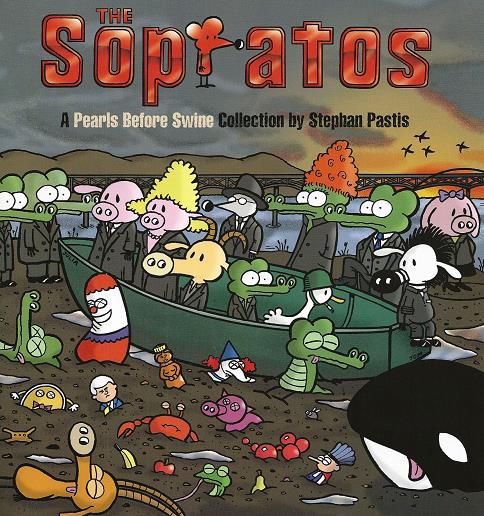
The Sopratos
A Pearls Before Swine Collection. Featuring Stephan's twisted sense of humor and plenty of puns.
````````````````````````````````````````````````````````````````````````````````````````````````````
A very amusing and enjoyable comic strip collection!
Friday, March 30, 2018
Fire and Fury
By Michael Wolff
Wolff proposed writing a book on Trump's first year in the White House and was given an amazing amount of access to Trump's people. It's possible that they thought Wolff was going to do a puff piece on Trump and his administration. But instead Wolff wrote an exposé, revealing the craziness, backstabbing, leaking and inexperience of those trying to cope with one of the most unpredictable, childish and ignorant presidents in American history. Even though Trump denied talking to Wolff, sources back up his claim that he did, in fact, talk to Trump, either in person or on the phone.
No one can deny that this administration is probably one of the most unstable ever, do to the poor leadership ability of this president. Top officials come and go, often fired by the callous, uncaring and rude Trump via Twitter tweets. No one can deny that Trump's picks seem designed to burn their departments to the ground rather than improve their function and government. And, finally, no one can deny that Trump turns this way and then that, changing his mind hour by hour so that no one really knows (including Trump himself) what he wants.
Does the author really understand what is going on in the White House? It sure seemed so to me. The book was published in January 2018. Towards the end of the book, Wolff says that factions within the White House were pushing for CIA's Mike Pompeo to replace Rex Tillerson as Secretary of State. And in mid March 2018, that is exactly what happened.
It also seems pretty clear to me that Michael Wolff knows what he is talking about. And that Trump and gang are probably as awful as Wolff portrays them. Though, to be honest, Wolff's book is more like a gossipy Hollywood tale than fact-driven portrayal.
Politifact has a fact-check on the Wolff book: http://www.politifact.com/truth-o-meter/article/2018/jan/09/fact-checking-read-fire-and-fury-michael-wolff/ (Most of the fact-checks are minor things like wrong dates and misspellings.)
Here is a review by The Guardian.
City of Illusions
By Ursula K. LeGuin
He found himself in the forest. He had no memory of anything and was as helpless as an infant. Fortunately he was found by a kind family who took him in and taught him to be a man again. They called him Falk.
Falk stayed with them until he was competent to be on his own. Though he loved them, he knew he had to leave, to head west, to find out who he was and why his mind was stripped of all memories. And so he set forth, going to Es Toch, the city that might have all the answers.
He encountered other people, none as kind or friendly as those who took him in. Many were dangerous and hostile. He was briefly enslaved but managed to escape with the help of another slave, a woman who claimed to know how to get to Es Toch.
Their journey together was difficult and the woman became very ill and almost died but she was true to her word and led Falk to Es Toch. But once there, she betrayed Falk and handed him over to those who had stripped his mind of all knowledge. These his captors are his only hope, though, of discovering why his mind was tampered with and his only hope of finding his lost self.
The first part of the story where Falk is traveling across a wild and sparsely populated Earth was much better than the second. Once he gets to Es Toch, the story got less interesting as he becomes a passive captive in the hands of his enemies. He spends his time trying to figure out the truth about his captors and their plans for him, a mostly mental exercise: rather boring to read about.
Here is a review by Kirkus Reviews.
Subscribe to:
Posts (Atom)