Sunday, December 30, 2018

Sabella or The Blood Stone

By Tanith Lee

Sabella lives alone in her dead mother's house on Novo Mars. Novo Mars bares a striking resemblance to Mars, being dry and bleak and barren and reddish in hue, but not as red as Mars.
Sabella chooses to be alone because it is safer for everyone if she does so. Sabella is a vampire of sorts. She drinks the blood of men she seduces, she is inhumanly strong and fast, she cannot bear the sunlight. But she is not undead, she does not sleep in a coffin, she has a reflection and garlic, holy water and crosses are no big deal.
Sabella was just a normal kid until the day she crawled into a cave. In the cave is where she found the blood stone that she wears constantly on a chain. When she is hungry, the stone is clear. When she has fed, it is ruby red.
She had no one to teach her how to be a vampire. She killed people at first but gradually learned how take just so much but not too much. Then she back slid and killed a young man who had a big brother. Big brother is at Sabella's door and he is big and he is strong and he is determined to find out what happened to his brother. Sabella may have finally met the only man she cannot seduce and bend to her will. And he may be her only salvation from the life of degradation she has fallen into.

This is about the third time I have read this story and it is still a gripping and thrilling read even after all this time. I first read it back when it originally came out in the 1980s. I don't consider the story to be fantasy, because Sabella's condition has a scientific explanation, not a supernatural one. I think that is one of the reasons I like the story so much, because it is logical.

This Pen for Hire

By Laura Levine

Jaine lives in Los Angeles and makes her living as a writer. She specializes in resumes and copywriting. Her latest customer, Howard, doesn't want a resume or an ad written. No, he wants a love letter, a letter persuasive enough to convince its recipient to go on a date with him.
Howard is no prize. He works in insurance and still lives with his mother. The woman he is crushing on is a beautiful aerobics instructor, Stacy. Jaine is no stranger to the LA scene and she is more than certain that Stacy is not going to date a man like poor Howard. So Jaine's letter to Stacy implies that Howard is related to Rupert Murdoch. And Howard gets his date!
But (of course there is a "but") when Howard arrives at the apartment to pick up his date, he finds Stacy dead, her head bashed in with a Thighmaster. And of course the police are sure he is the killer.
Jaine feels guilty that her letter may have gotten Howard into trouble. So she proceeds to do a little investigating on her own. She easily finds out that Stacy had several lovers, one of whom was married. Also, one of the women Stacy worked with was dumped for Stacy. And there's the woman who wanted the apartment that she was promised before Stacy stole it from her.
So there are plenty of suspects. But which one is the killer? Turns out the killer was right under Jaine's nose all along. And that Stacy was murdered for the most prosaic reason of all.

This was an OK read. Although I did guess the identity of the killer pretty quickly but not, I will admit, the reason why Stacy was killed.
The story is mildly amusing although I did find the main character's constant put downs of herself a bit tiring.

Review from Kirkus.


Midnight Crossroad

By Charlaine Harris

Welcome to Midnight, Texas. A small town with a small population of folks, all of them a tad different from most people.
New to this small community is Manfred Bernardo. Manfred is a sometime psychic. He does most of his work online or via telephone. Most of the time he just makes it up. Occasionally he actually has a true psychic flash. Occasionally.
So this hole in the road town has a resident witch, a vampire, an assassin, a were-person, an angel, an ex-white supremacist and a serial killer. Of course, Manfred doesn't find this all out right away. But he soon figures that the leading lights of Midnight are more than they appear. It all begins with the body of a young woman, a young woman who has been missing for several weeks and of whom her friends and family are willing to commit murder to track down her killer.

This was a pretty good story, a bit spoiled by the fact that I saw the TV show version first, so no surprises in the plot. The only surprise, really, is that the book characters seem quite a bit less sure of themselves and less powerful than their TV counterparts.

Review from Kirkus Reviews.


The Road to Ruin

By Donald E. Westlake

The Dortmunder gang is once again trying to pull off a successful heist, although, given their past record, it seems a vain hope.
So one of the gang members has come up with a very tempting opportunity. A very wealthy man has become a social pariah (because of his financial shenanigans that cost a lot people a lot of money) and can't find enough people to take care of him and his household.
The gang has inside information, including that the man, Monroe Hall, has a fabulous collection of very valuable cars. The plan is the gang members will get hired on as Hall's servants and, when the time is ripe, they will steal the cars.
It's a beautiful plan that can't go wrong. Except it does. Unbeknownst to the Dortmunder crew, a group of disgruntled investors and workers have a plan to grab Monroe Hall and extort all their lost monies out of him. Working at cross-purposes, the second group manages to screw everything up for everyone, including Monroe and his faithful wife, Alicia.

This was an typical & entertaining Dortmunder story. I was really hoping old John would finally come out on top, but, as per usual, John Dortmunder gets nothing for all his hard work. It was interesting seeing the gang of crooks trying to act like ordinary workings stiffs. Some of them even seemed to actually enjoy their new roles, a first step on the road to redemption? Nope.
I usually do enjoy Westlake's stories and this one was quite enjoyable too.

Review from Publishers Weekly.


Thursday, December 13, 2018

Wild : From Lost to Found on the Pacific Crest Trail

By Cheryl Strayed

After her mother died and her marriage ended, Cheryl Strayed knew she needed to do something. What she decided to do was hike the Pacific Crest Trail from California to Washington, alone.
Never having done an overnight hike before, Strayed was not quite prepared for the experience. First of all, her backpack was way overloaded. Second, she found out later after many, many painful miles that her boots were too small. Third, she learned that wild animals are not the biggest threat, rather it was men. Attractive and young, she fortunately only encountered one man with questionable intentions. (She got lucky in that regard.) She saw lots of wild creatures, but they were as timid of her as she was of them. (Once again, she got lucky.) Fourth, she learned that she didn't budget quite enough money for the trip. When one of her resupply drops didn't contain the cash she was expecting, she didn't have a backup plan or even a credit card.
So basically she went off half-cocked but by the end of the hike she was a lot stronger, a lot slimmer, a lot more experienced and a lot more at peace with her life.

This was a pretty good read. I liked reading about the hiking. But not so much the story of her emotional troubles. It just seemed to me that she brought a lot of that on herself.
I'm sorry her mother died so young. But the way Strayed trashed her life because of that did not sit well with me. Especially the way she sabotaged her marriage to a man she describes as loving, caring and understanding.
Just weird.


Critters : Adventures in Wildest Suburbia

By A.B.C. Whipple

From the inside flap of the book jacket: "Squirrels in the bird feeder, raccoons in the garbage, Canada geese on the lawn, rabbits in the garden, deer in the orchard—during forty years in the suburbs A.B.C. Whipple has coped with them all, even including a skunk that decided to winter in his cellar."

That makes it sound like it is going to be a really fun and amusing book, but no. It is more like a zoology text book, with the amazingly (and boringly) in depth descriptions of the habits and life cycles of these common creatures.
In the chapter about the cellar skunk, we get a lecture on "aposematic coloration", info on skunk diet, skunk mating habits & the chemical composition of skunk spray (key word: butylmercapton).
In the chapter on raccoons, we explore the origins of the washing behavior, their mating habits, their diet, a bit of their history in North America & rabies.
Similar topics are touched on in all the other chapters about all the other animals.
The author can't just tell an amusing tale. No, he has to educate the reader. Which is fine if you are in the mood to be educated. Not so much if you just want a light, amusing read.

Friday, November 30, 2018

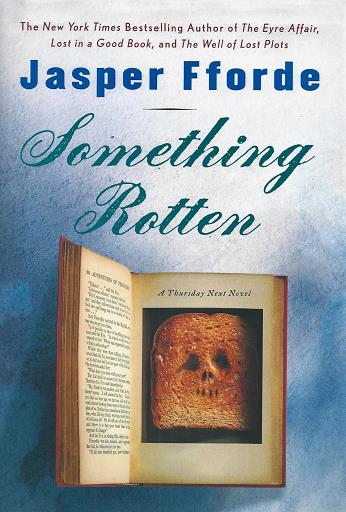
Something Rotten

By Jasper Fforde

The fourth novel in the Thursday Next series. In this book, Thursday is now back in the real world with her toddler son, Friday. She is still part of Jurisfiction but, needing money, she goes back to work for Special Operations, a branch of law enforcement.
Thursday wants to get her eradicated husband, Landen, back. She also needs to track down Yorrick Kaine, an escapee from an unknown book. Kaine has risen to high position in the government and has even higher ambition. If Kaine succeeds, he will start a war that will bring about Armageddon.

Wikipedia has a really informative entry that does an excellent job of explaining the universe of the Thursday Next stories. It is helpful even to those who have read the first three books in the series. The novels can be a bit overwhelming there is so much to keep in mind. Thursday's Britain is not our Britain and then there is the world of books and all its characters and creatures that sneak in and out of Thursday's world.

I did enjoy this story and parts of it were quite funny. The story line seemed a bit more straight forward than some of the earlier stories. For the most part, I didn't feel as lost as I sometimes did in the other books.


The Storied Life of A.J. Fikry

By Gabrielle Zevin

A.J. is the owner of a small bookstore. He lives in the apartment above the store.
Ever since his wife died, A.J. has been very depressed. So depressed that he occasionally gets very drunk. One evening he is passed out drunk and someone comes into the apartment and steals a very valuable, very rare first edition book of poetry.
At about the same time, a woman abandons her young child in A.J.'s bookstore. The toddler has a note from the mom explaining that she wants her little daughter to grow up in a home that values reading and books. And that she can no longer take care of the girl, whose name is Maya.
And so Maya enters in the lonely, sad middle-aged man's life. He accepts the responsibility of raising Maya and it enriches and expands his life in ways he never imagined.

I truly loved this sweet, gentle story. Although A.J. seems live under a dark cloud in the beginning, the arrival of Maya lets in fresh air and sunshine.

Book review by the Washington Post from 2014.


The Lost Continent: Travels in Small-Town America

By Bill Bryson

Bryson returns to the United States after living in the UK. Feeling a bit nostalgic, he takes off on a road trip to visit some of same places he visited with his parents as a kid and to visit places that he had always wanted to visit but never had.
Bryson is usually quite amusing and this book lives up that in being a humorous read. But he must have been in a bad mood when he wrote it because he really beats up on America, only rarely finding a good thing to say beyond praising the scenery occasionally.

I did enjoy the book, but I wish he could have been a little less snarky about his homeland.

See the New York Times book review from 1989.


Friday, November 23, 2018

Time Salvager

By Wesley Chu

James is a time salvager. His job is to travel back in time and save artifacts and technology from the brink of destruction.
Time salvagers are required to adhere to a strict set of protocols. The main one of which is to never bring a living person from the past into the future. Dire consequences if anyone does such a thing.
James lives in a time of decay and depression. His forays into the past to rescue lost tech is helping to keep mankind safe if not exactly thriving.
Time travel takes a toll on the salvagers, both physically and mentally. James is one of the most experienced and valuable salvagers but he is suffering from exhaustion. He really needs to take some time off to rest and recuperate. But on his latest foray, he is smitten by an attractive and intelligent young woman and saves her from her doom and brings her back to his timeline.
This woman is a scientist and she was supposed to die in a terrible explosion. Her knowledge could be the key to saving Earth from a deadly environmental catastrophe.
But James has broken the first rule of time travel and has put himself and the scientist in the crosshairs not only of his own employer but of that of a ruthless and cruel corporation that will stop at nothing to get to him and to her.

Kind of a boring story. James rescues the woman and hides her in a tribe of outcasts living in the ruins of Boston. And he makes many trips into the past to gather the equipment she needs to conduct her experiments to solve the environmental crisis that has enveloped the world. None of that was really very interesting.
The last part of the story features a lot of battles and strife, most of which I skipped. I am not interested in the details of battles. I find that sort of thing to be the so boring.
So even though this book is the first in a new series, I probably will not bother to read the next in the series.

Wednesday, October 31, 2018

Clouds of Witness

By Dorothy L. Sayers

Lord Peter Wimsey has to save his brother the Duke from the hangman. Gerald is accused of killing his sister's betrothed, Denis Cathcart. Wimsey is an amateur but gifted detective and is quite capable of unraveling the puzzle of this murder. But it would certainly be a lot easier if his brother and sister would stop lying about their actions the night of the murder.
Both Gerald and Mary were doing things they probably should not be doing. But, because of the way they were raised, they both lie to protect their loved ones. As it turns out, Mary has become disenchanted with Denis and was planning to elope with another man the night the murder occurs. When she and Gerald stumble across the dead man's body, Mary assumes her lover has killed Denis and Mary starts immediately telling lies to protect him.
As for Gerald, he was in the bed of another man's wife, which he refuses to reveal to the investigators, claiming he was merely out for a walk for several hours after midnight in the pouring rain. Of course he is disbelieved. But he refuses to tell anyone the truth to protect his wife and to protect his girl friend.
So it is up to Wimsey to discover the truth about his sister's actions and his brother's actions and to discover the truth about Cathcart and his apparent murder.

This was an OK read. I thought Mary and Gerald were both a couple of dopes who caused a lot of problems due to their constant lies, especially those of Mary.
Also, at the end of the book Wimsey gets roaring drunk, which, to me, seems totally out of character. Very disappointing behavior.

All the Light We Cannot See

By Anthony Doerr

Pulitzer Prize for fiction, 2015.

Set in France in World War II, the story centers around a young blind French girl, a young German radio engineer and a priceless diamond gem called the Sea of Flame.
The girl, Marie-Laure, is staying with her father and his brother. Her father has been entrusted with the Sea of Flame by the museum he worked for. He was given the diamond to hide it from the coming Nazi occupation. It is inside a clever tiny puzzle box shaped like a house. At one point, the father is summoned back to Paris but is arrested by the Germans and put in a work camp.
Marie-Laure and her uncle become involved in the resistance as the uncle has a radio hidden in the attic of his house and they use this radio to send vital information to the Allies. But then the uncle is arrested and locked up.
Meanwhile, in Germany, the young boy who has a genius for building and repairing radios, Werner, is an orphan living in a group home with his younger sister. The town they live in is a mining town and Werner's future seems destined to be a miner like his father, a destiny he is anxious to escape. When he is given the chance to attend a military school, he welcomes it, even though his sister is violently opposed.
Life is hard at the school, but Werner prefers it to the thought of returning back to the mines. He eventually is sent to fight in the war, as Germany begins to falter in its attempt to conquer Europe. This is how he ends up in the same town where Marie-Laure is living.
Also in this town is a German officer. He knows about the Sea of Flame and its legend. The legend is that any one who owns the diamond will lose everyone they love but will live forever. He has been tracking the diamond across France and desperate to find it because he is dying of cancer.
The tide turns against the Germans and the Allies start bombing the town where Marie-Laure is living all alone in her uncle's house. He is in prison and there is no other adult to tell her about the leaflets the Allies dropped warning the residents to flee before the bombing starts. She survives the first round of bombs but before she can escape, the German officer comes looking for the diamond, which he has traced to her father.
Marie-Laure hides in the attic where the radio is. The entrance to the attic is hidden but she knows that the German will eventually figure it out. Meanwhile, she is slowly dying from thirst. As a last gasp, she sends out a cry for help over the radio. Her message is received by Werner.
Werner and another soldier were in a cellar with their radio equipment when the bombing started. The building above them collapsed and they were trapped in the cellar. The radio was damaged, but Werner managed to get it working again in time to hear Marie-Laure's message. They also manage to finally dig their way out of the rubble and Werner sets off to help the girl whose voice he heard over the airwaves.

This was an OK read. Long, but most of the chapters are short.

Review by The Guardian.


Tuesday, October 23, 2018

Calypso

By David Sedaris

A collection of stories about David's life in England and at the Sea Section, his beach house in North Carolina. He lives with his partner, Hugh Hamrick, when at home in England. But when they go to the Sea Section, all the family is invited to be there too.
Sedaris comes from a large family, with four sisters and one brother. At the time of this book, his mother and a sister are both deceased. The mother died when David was in his twenties but his sister died recently, from suicide. His father is living and in his nineties.
David talks about all his family members, including Hugh's family, Hugh's mom and sister and compares them to the Sedaris family, to neither's advantage. I think he finds Hugh's family a little irritating and that they find him and his family a little wild, maybe.

After reading this book, I would think most people would be reassured that their own relatives are not as weird as they thought. The Sedaris family is weird but in a way that is familiar to anyone who has family. His sister who killed herself was mentally ill. My aunt was mentally ill. His father is a man of wealth who lives in squalor because he refuses to spend money to hire someone to help him at home. My other aunt also lived in squalor, with stuff piled everywhere. Like David's sister, we have suicide in our family too. David's mom was an alcoholic. My cousin was addicted to drugs and had to go to rehab.
Just normal, bent American families.

A review by Sarah Crown in The Guardian.


Thursday, October 11, 2018

Alternate Routes

By Tim Powers

Sebastian Vickery used to be a Secret Service agent until one day when he overheard something he wasn't supposed to hear. Now he is hiding out, working for a taco truck / taxi service company in Los Angeles.
Things are weirder than normal in LA and weirdest of all on the freeways. The almost constant traffic on the freeways generates some kind of spectral energy field that the Federal government is tapping into to gather intelligence. This field enables them to communicate via radio with the dead and milk them for data and to track those still living and  connected to the deceased.
One of those deceased is Vickery's wife, who committed suicide on the freeway, using her husband's gun. Now this secret government agency, the TUA (Transportation Utility Agency) is using her to track down Vickery. They coerced the dead wife into revealing Vickery's location and the TUA sent two agents to kill him. But another TUA agent, Ingrid Castine, arrives just before the two killers to warn Vickery. She didn't get there soon enough and she and Vickery get in a shootout with the two agents. After killing one of the agents and knocking the other one out, both Vickery and Castine are fleeing for their lives.
Meanwhile, Los Angeles is on the verge of a major catastrophe due to the TUA and its demented chief, Emilio Terracotta, and their contacts with the deceased people. Terracotta has been possessed by a dangerous entity from the other side that wants to unite the two realities, with possibly apocalyptic results.

This was a fairly good read. For me, it was a little too much of an action story, which made it less appealing to me. Also, I found the tone of the novel a bit depressing, especially its depiction of the "afterlife." It isn't clear if the ghosts or "deleted persons" as the TUA refers to them, are the souls of the dead or just a bit flotsam cast off by the deceased. Their lot in death is certainly heartrendingly sad.

Review by Publishers Weekly.

Saturday, October 06, 2018

The Good Daughter


By Jasmin Darznik

The story of Jasmin's Iranian grandmother and mother. Both women suffered under the unfair rule of selfish and uncaring men and a patriarchal, overly religious society.
The grandmother, Kobra, lived with her husband and his mother. The husband was a gambler and the family's fortune ebbed and flowed with his wins and losses. Kobra had three kids, two sons, one of which died as a toddler and a daughter, Lili.
Lili's father wanted his daughter to be educated so she attended school. When she was about thirteen, she attracted the unwanted attention of a man. The man proceeded to ask to marry Lili, even though she was just a kid. In Iran, a girl was considered old enough for marriage once she had her first menses. So Lili ended up married to Kazem, a grown man.
Kazem turned out to be a brute and he beat Lili. After she gave birth to her first child, a daughter named Sara, Lili decided she could no longer tolerate being married to Kazem.
Unfortunately, in Iran at that time, a divorced woman was considered to be little more than a prostitute. Also, any children born to a married couple belonged to the father and not to the mother. Lili was forced to give up baby Sara.
But giving up Sara gave Lili the opportunity to leave Iran and travel to Germany to further her education. She attained a degree in midwifery. She also eventually married an European man and they moved to Iran.
Lili tried to maintain a relationship with her daughter, Sara, but Sara's father and his family poisoned her mind against her mother. Lili then gave birth to another daughter, Jasmin.
The political situation in Iran was becoming unstable. This was shortly before the time of the Iran hostage crisis in 1979. Lili and her husband left Iran and moved to California. Jasmin was only about three years old at the time.
Growing up in America, Jasmin didn't know about her mother's past. She didn't know Lili had been divorced, she didn't know she had a half-sister named Sara. She accidentally came across an old photo showing her mother and Kazem on the day they were married and naturally wanted to know what the deal was. But Lili refused to talk about it, telling her it wasn't any of Jasmin's business. Lili must have had second thoughts about it and she sent her daughter ten audio tapes, describing her life in Iran and her first, failed marriage and the child she left behind.

This was an OK read. When ever I read one of these Middle Eastern memoirs, it always seems to me that the women are just as much to blame for the oppression they suffer under as the men and the laws that oppress them. The women go along with it, they accept the abuse as their lot in life and they actively fight against the changes that could make their lives better, like education, like ending female circumcision, like ending child marriage. So many prefer to stay with the old ways, the old religion.

Kirkus Reviews has a review of the book.

Friday, September 28, 2018

How to Build a Girl

By Caitlin Moran

Johanna is fourteen year old and lives in poverty in Wolverhampton in the UK. Her parents live on welfare and they have four other kids beside Johanna. Her dad drinks to excess and has pinned his hopes on a career in music, a career that is going nowhere fast.
Johanna is not happy and decides to reinvent herself. Amazingly she gets a job writing music reviews and starts calling herself Dolly Wilde and dressing all in black, with a top hat and lots of eyeliner.
Her new career throws her in with a fast group of people and, before much longer, she is drinking alcohol daily, smoking cigarettes, having sex and even using the occasional illegal drug.
She falls in love with one of the performers she is reviewing and the crush lasts two years, unrequited, because he is very busy with his career and his travels. Since she can't have him, she hooks up with one of the other reviewers at the magazine she works for and loses her virginity to him. Their affair lasts until the day she overhears one of his posh friends refer to her as his "bit of rough".
Eventually, she is successful enough to leave home and move to London and have her own apartment.

I don't really know what to make of this story. I found her behavior to be outrageous. Her parents seem not to care at all about the trouble she may be getting herself into. Booze, drugs, smoking, promiscuous sex just seem like a recipe for disaster. Somehow, though, the worst thing that happens to her is a urinary tract infection.
Beside that though, I just didn't find the story all that interesting. It was OK, I guess.

The New York Times has a review.

Princess

By Jean P. Sasson

A memoir from a member of the Saudi royal family, a minor princess who goes by the fake name of Sultana in the book to hide her identity and protect from government wrath.
Sultana was born into wealth and influence. Although she certainly enjoyed the wealth but, due to her gender, she was deprived of influence. Although she was a passionate child and was not above throwing a tantrum to get her own way, it often did not work for her any more than it worked for any women living under a repressive Muslim regime.
As she grew up, she observed many instances of the imbalance in Saudi society: women beaten and murdered, divorced on a whim, unbridled male lust preying on little children, child abuse, child marriage, men chasing after child brides and putting aside their first, second & third wives, women locked away in darkness as a kind of perverted punishment for wanting to live like modern women, women servants preyed upon by their male employeers.
Sultana sees it all and chafes against the restrictions. But when her turn comes, she willingly accepts the arranged marriage and marries a man she barely knows and proceeds to bear children to him, children she has no legal right to, according to the archaic laws of her land.
But when the husband turns away from her and wants to take second wife, she runs away with the children and millions of dollars. She forces him to sign a contract guaranteeing her rights before she is willing to come home with the children.
Needless to say, such drastic actions destroy what little harmony there existed between herself and her husband. But her marriage was pretty much dead from the moment he decided he needed a second wife. So kudos to her for getting him by the short hairs.

This was an OK read. I was hoping for a little more rebellion from Sultana, but she pretty much does what is expected of her: marries young, has kids, stays behind closed doors and really doesn't do much to fight for women's rights in Saudi Arabia. Her only real rebellion comes when she gets angry at the husband for wanting to bring a second wife into the family. Maybe that was a big step for a woman in her society.

Publishers Weekly has a review.

Tuesday, September 18, 2018

Heechee Rendezvous

By Frederik Pohl

Third book in the Heechee series, this one finds Broadhead in his last days and mostly referred to in the book as Robin. He is happily married to his second wife and they are tremendously wealthy. But all his wealth is not enough to stave off death, as his body is slowly breaking down, despite the many transplants he has had.
Meanwhile, the Heechee have just been told about the human adventures in space and they are alarmed. The Heechee hid themselves out of fear of a race of immaterial beings they call the Assassins. The Assassins destroy all technological societies that they find and are in the process of attempting to change the universe to suit them better than the current universe. However this will take them billions of years.
The Heechee are worried and frightened that all the human activity will attract the attention of the Assassins and bring destruction down not only on humanity but on the Heechee too. The Heechee emissary and his crew are racing to prevent this from happening. The first human-crewed ship they encounter is that of Wan and his passenger, Gelle, Robin Broadhead's first wife, whom he believes has been dead for thirty years. Instead, she was stuck in a black hole where time passed extremely slowly until she was found by Wan.
When Robin finds out this first wife is alive, he is in a pother what to do about it. He loved and missed his first wife but he also dearly loves his second wife, Essie. Meanwhile, his body is giving out on him, a fact he hides from everyone until it is too late. Which totally solves his wife dilemma.

This was an OK read. I found myself skipping much of the parts that deal with Robin and his aches and pains and his dialogues with his computer-generated companion, Albert. Albert gets to stick his two cents worth into the story with several short interruptions that too often deal with subject matter a bit too esoteric for me to enjoy:
The energy density of black-body radiation goes up as the cube of the temperature—that's the old Stefan-Bolzmann [sic] law—but the number of photons goes up linearly with the temperature, too, so effectively it's a fourth-power increase inside the kugelblitz. At one Kelvin it's 4.72 electron-volts per liter. At three million it's three million to the fourth power times that—oh, say about 382,320,000,000,000,000,000,000, 000 ev/liter.
 I mean, really. I don't need to know that or read that. But a lot of science fiction writers like to stick that kind of stuff in their stories. Just goes over my head though. I usually just skip those parts.
Also, I thought kugelblitz was a term made up by the author. Turns out it is not. A kugelblitz is a "black hole" made of light. Huh? Nevermind!

Kirkus Reviews has a review.

Monday, September 17, 2018

Witch World

By Andre Norton

The first Witch World story

Simon Tregarth is a man on the run and is facing certain death. So when a fellow offers him a one-way route to a new life, but with no return, Tregarth accepts.
The man leads him to a strange stone gateway that leads to a different world, a world, the man promises, "in which his spirit, his mind—his soul if you wish to call it that—is at home. " But the catch is, "there is no return—and only a desperate man chooses an irrevocable future."
Once through the doorway, Tregarth does find himself in a strange new world. Escaping from being hunted himself, he is catapulted into another hunt. The hunted is not Tregarth, but is a woman dressed in rags and being trailed by men on horseback.
Tregarth, who has a handgun, helps the woman escape her hunters. The woman was on a spy mission and she takes Tregarth back to her home country and introduces him to the leaders of her country, Estcarp.
The woman, who will not give her name, is a witch as are the leaders of her country. They are all women and they are all witches. They govern by consensus and by magic. They all keep their names secret, it is part of their belief that knowing someone's name gives them power over the named person.
The witches are worried. Something is rotten in the world of Estcarp and it has all started in the land of Kolder. Kolder, which has technology strange to the other lands of Witch World. Kolder, which has the ability to turn enemies into weapons to use against their homelands. Kolder, who will find in Simon Tregarth an outworlder who is able to stand against their technological "magic."

This is the first book of Norton's Witch World series. In Witch World, the women of Estcarp are the bearers of magic. To keep their magic abilities, they must remain virgins, because they believe once a woman is deflowered, she loses her powers. Their technology is mainly medieval, with strange exceptions (excluding the technology of their enemy, Kolder).

This was an OK read. The story centers around Tregarth, who was a soldier and a mercenary back home, and who continues that roll on Witch World. The story mainly follows him on his campaigns as he fights for Estcarp.
It's a fun introduction to Norton's style of storytelling and contains many of her trademark themes: ancient alien tech; mysterious ruins that reek of evil; strange, magical abilities; seemingly ordinary people who are not ordinary; creepy, dangerous, evil creatures; foggy marshes and moor; underground installations of unknown origin containing peculiar machines; and loners fighting against the status quo.

Tuesday, September 11, 2018

The No.1 Ladies' Detective Agency

By Alexander McCall Smith

The first book in the No.1 Ladies' Detective Agency series, this one gives the backstory of Mma Ramotswe, the chain of events that led to her setting up as a detective.
After her father died, as his only child, Mma Ramotswe inherited all his assets that, once liquidated, enabled her to buy a house and small office building and a vehicle.
Naturally, the detective business didn't take off right away, but, due perhaps to the novelty of a woman detective, Mma Ramotswe did get a few good and fairly straightforward cases. She tracks down a missing husband, exposes a couple of con men twins, and helps a father discover what his teenage daughter is doing in her spare time.
Her most serious case, though, is that of a missing child. Her inquiries lead her to turn down the case as being too dangerous and sensitive to handle. But eventually she stumbles onto the solution to the mystery, with the help of her suitor and friend, Mr. J.L.B. Matekoni, the owner and chief mechanic of Speedy Motors garage.

I finally got around to reading the first book in this series. The first book I read was the seventh in the series. Like that book, this was an entirely enjoyable and gentle mystery story, completely absent of any murders, the only death being that of a poor fellow who got eaten by a crocodile. The story is enhanced by its exotic location, Botswana on the continent of Africa and containing part of the Kalahari Desert.

Review by The Guardian.