Saturday, December 17, 2022

Skeleton Man


By Tony Hillerman


Back in the 1950s, two airplanes collided over the Grand Canyon of Arizona. Over a hundred people died in the crash and debris and human remains cascaded over the northern stretch of the Grand Canyon near the confluence of the Colorado River and the Little Colorado River. This story is based on that real disaster.


So in the story, a man aboard the plane had a briefcase full of cut diamonds handcuffed to his wrist. His remains were never found, but tales of a detached arm with a handcuffed case attached circulated throughout the local area. The man had a fiancée and one of the diamonds had been cut to his specifications and he intended to give it to his fiancée for an engagement ring. His fiancée was pregnant and they were looking forward to a happy life together. However, his wealthy parents were opposed to the marriage and when the baby was born after his death, his family refused to acknowledge the baby and cut her out of his will.

Fifty years later, the daughter has come to the Grand Canyon area, determined to locate either the diamonds or her father's arm & its attached case. Because tales of diamonds have reached her ears, raising her hopes that she can finally prove she is her father's legitimate heir and exact her revenge on the people who treated her mother so meanly.

Cowboy Dashee's relative tried to pawn a large diamond for $20.00 that the police believe he got in a robbery of a trading post.  Cowboy's relative, Billy Tuve, has a story of having been given the diamond by an old man down in the canyon in exchange for an army surplus trenching tool. In order to clear his name, Cowboy wants Tuve to take himself and also officer Jim Chee down into the canyon where he encountered the old man. Billy doesn't want to because it is a sacred site for his people but he finally agrees and the three of them are joined by Chee's fiancée, Bernadette.

But the dead man's daughter is also on the rim of the Grand Canyon. She had hoped to get Tuve to guide her into the canyon but she ran afoul of the man hired to stop her from reaching her goal. So now five people are all in the canyon looking for the old man, the diamonds, the briefcase and the arm, but without Tuve, who managed to slip away and disappear.


This was an OK story. Not a lot of action for most of the story, but it picks up quite a bit in the last third, with the two groups of people in the canyon hunting for the same treasure. At the end, Chee and Bernie get married and go to live in his shabby old trailer down by the river. Hillerman giving Jim Chee a long delayed happy ending.


Here is a review by Publishers Weekly.


Wednesday, December 14, 2022

The Grand Sophy


By Georgette Heyer


Charles Rivenhall inherited a large fortune when his great uncle died.  Which was fortunate for his parents because his father, Lord Ombersley was a gambler and a spendthrift and his careless ways had put the family into serious debt. Charles took over the family finances from his father and pretty much became the boss of them all, including his mother, his father and his several siblings. 

Charles is engaged to a worthy but rather cold and very proper woman, Eugenia. Their wedding had been delayed due to a death in Eugenia's family. 

Lady Ombersley's brother arrives unexpectedly at the Rivenhall home in London. He has been in France and now he has to travel to Brazil and he wants his daughter, Sophy, to stay with his sister while he is gone. He describes Sophy as a dear little soul who won't cause any trouble. He also wants his sister to find an eligible suitor for Sophy as he feels it is time for her to be married. 

Turns out Sophy is not quite the demure little miss her father seems to see her as. She is twenty years old and has been without a female companion ever since her governess died a few years ago. And at five foot nine, she is also not a little miss. She has a strong character and is a bit of a force of nature, sweeping all before her. She loves managing things and people and when she gets a good look at the Rivenhall family, she moves to set everything she sees as wrong to right, willy nilly. Good luck to anyone who gets in her way! 


This is probably one of Heyer's most funny and enjoyable stories. I must admit that I don't think I would like Sophy in real life, as she seems a bit mental. I mean, at one point she shoots a friend in order to further her plans for the Rivenhall daughter, Cecelia, who has fallen in love with the wrong man. Sophy certainly is one of Heyer's most unforgettable characters, that is for sure. I wonder if Heyer ever knew anyone like that in real life.


Here is a review by Laurel Ann Nattress on Austenprose.


Friday, December 09, 2022

The Empty Chair


By Jeffery Deaver


Book 3 in the Lincoln Rhymes series.

Lincoln, who is quadraplegic, is in North Carolina for a surgical procedure he hopes will restore some of his lost function to his hands. But the local sheriff comes asking his help to find a murderer and the two young women he grabbed. 

Mary Beth McConnell is a college student studying archaeology and doing a little digging down by the river when she was taken by Garrett Hanlon, a sixteen-year-old kid with a reputation as a peeping tom and he is known for having an obsessive interest in insects. In the process of grabbing Mary Beth, Garrett killed Billy Stail, local high school boy, and is also being blamed for the death of a deputy who was injured investigating the murder site. Shortly after taking Mary Beth, Garrett grabbed another, young woman, Lydia Johansson, who had stopped by the murder site to place a sympathy bouquet of flowers.

Lincoln and his team agree to look into the matter and it turns out to be a real rat's nest of complications and betrayal and double dealing where almost no one can be trusted and everyone lies. 


I enjoyed this story a lot. But there is a trend in modern stories where no one is telling the truth and no one can be trusted and everyone is double-dealing. It's a trend I really don't like. It's really annoying to find out the good guys are actually the bad guys. Most of the good guys in this story turn out to be the bad guys, and the bad guys are the good guys. I guess the message we are being given these days is that you can't trust anyone, the age of paranoia. 

But even though I thoroughly dislike that trend, this was still a gripping and exciting story. However, I wasn't familiar with the Lincoln Rhyme character and even though I enjoyed the story, I doubt I will be reading another in this series.


Here is a review by Publishers Weekly.


Wednesday, December 07, 2022

Hidden Pictures


By Jason Rekulak


Mallory Quinn became addicted to prescription pain relievers after being injured in a car crash. She hit rock bottom and overdosed in the back of an Uber and ended up in rehab. Now she's been clean for about a year and a half and is starting her first job in a long time as a full time babysitter for an upper middle class family living in a small, rural town. 

Caroline and Ted Maxwell and their child, Teddy, seem to be a lovely family. Their large house features a full-size swimming pool and a pool house that had been remodeled into an tiny home for the new babysitter. It will be the first time Mallory has lived alone in a long time. It will be a test of her commitment to staying off drugs. 

Of course, things are never quite as good as they appear. Teddy has been drawing pictures, pictures that become more and more skilled and more and more strange over time. In one picture, a man appears to be dragging a woman's body through the woods. In another it looks like the woman is at the bottom of a hole as the man stands above looking down. Teddy claims his invisible friend, Anya, tells him what to draw.

After listening to the local gossip, Mallory becomes convinced that Teddy is channeling the spirit of a woman who vanished back in 1948 who used to live at the house where the Maxwells now live. And the woman, Annie, was an artist who used the pool house as a studio. So Mallory begins looking into Annie's past, helped by her new friend, a local man, Adrian, because she is worried that Teddy is being damaged by Anya. And Teddy's parents just keep dismissing her concerns. But her and Adrian's investigations lead them in a totally unexpected direction. 


This was an interesting mystery/thriller/ghost story. At some point, Adrian and Mallory figure out that the spirit hanging around Teddy communicates by drawing because the spirit doesn't speak English and that Anya means mommy in her language. Which then leads them to a better understanding of the communication they received from her via a spirit board which they had first dismissed as gibberish.

I was totally not expecting the direction the story takes in last part. Frankly, I missed some clues the author gives that reveal the Maxwell family is not what they appear to be. It's always a pleasure to be surprised by the ending of a novel. For quite a while, I was beginning to think the evil doer in the story was actually Mallory, who lies to her new friend Adrian about her past. Which was a pretty good red herring. 

The novel includes Teddy's/Anya's drawings and it really adds a wonderful dimension to the story. They start out as typical little kid drawings but change into skilled artistic images that are just a pleasure to experience. Well done to the artists, Will Staehle and Doogie Horner.


Here is a review by Kirkus.


Wednesday, November 30, 2022

The Quiet Gentleman


By Georgette Heyer


Napoleon is locked up and it is time for the British fighting men to come home. One such is Captain Viscount Desborough, Viscount no longer upon the death of his father, the Sixth Earl of St. Erth. 

Desborough, aka Gervase, was not liked by his father who favored Gervase's younger half-brother, Martin. Martin has grown up to be a spoiled brat who always thought Gervase would not survive the war and that he, Martin, would be the Earl when their father died. So when that didn't happen, Martin had a hard time adjusting to the reality and deeply resented his elder brother's ascension to the title. 

So Gervase has returned home to the family estate to take up his position as the Seventh Earl. But it soon becomes clear that someone is trying to remove Gervase from this position and all the clues seem to point to young Martin. 


This was an OK read. It's not one of my favorite Heyer romances, as the culprit is pretty clear from the get-go. The real villain is oddly portrayed as a really decent guy and it seems so completely out of character for this man to be capable of so callous a murder. 

Heyer did write a lot of murder mysteries and I have read some of them. But I have not enjoyed them as much as I liked her Regency romances. Too much of her murder style leaks into this story which taints it, in my opinion.


Here is a review by Deb Barnum from Austenprose.


Lore of the Witch World


By Andre Norton


A collection of seven Witch World short stories.

  • "Spider Silk" Dairine was a refugee from hard times who survived a shipwreck as a young child and found a home among the folk of Rannock in Estcarp. The war is now over but the terrors of that time left their mark upon Dairine. What horrors she may have seen she does not recall. But her mind has closed her vision to the world around her and she is blind. Despite her handicap, over the years she became a talented weaver of cloth. Her skill came to the notice of a captain of Sulcar, an ocean-traveling nation of traders. The captain showed her a scrap of very finely made silk fabric and wondered if Dairine had the skill to attempt to weave something similar. But even though she was skilled, she was not that skilled, nor was any human weaver. Because this beautiful piece of silk was not woven by human hands but by the spider women of Usturt. But the spider women are hostile to humankind and will not willingly share their knowledge of weaving their beautiful silk fabric. Yet to Usturt Dairine must go, will she or nil she.
  • "Sand Sister" Born to the Tor people of the Tormarsh, Tursla was not like the other children. But to a people declining in population, even one unlike the others is vital to the community's continuance. When a girl reaches a certain age, she is expected to take part in a fertility rite where she is impregnated by one of the village men. Tursla did not take part in the ritual but still claimed to have been impregnated even though she knew she had lain with no man. But she was filled, filled with knowledge after a visit to a holy site deep in the marsh. And this knowledge will enable her to step in to save the life of an outsider that the desperate villagers have marked for human sacrifice in the belief that it will restore fertility to their people and prevent their slow slide into extinction.
  • "Falcon Blood" Tanree is a sailor, born and bred. But her home, the ship, the Kast-Boar, was caught in a storm and broken on a reef on an unknown shore. The only survivors are Tanree and the Falconer, a mercenary from a tribe where the men view women as untrustworthy creatures fit only for the bearing of children. But the Falconer has a broken arm and if he and Tanree are going to survive, they are going to have to work together despite his distaste for her gender.
  • "Legacy From Sorn Fen" After the war was over, opportunities were abundant for an ambitious man to improve his lot in life, given the sad state of affairs in the land. One such was Higbold. And when a certain magical item came to his notice, Higbold saw no reason not to claim the item for himself. What he didn't know was the item was given as a reward for a kind and gallant service performed to ease the passing of a damsel in distress. Higbold is going to pay a price for his thievery.
  • "Sword of Unbelief" Jervon and Elys from earlier stories not in this collection are featured in this story of a battle between Elys and an ancient and evil god who has captured Jervon and is slowing draining him of his life force. 
  • "The Toads of Grimmerdale" After the war was over, a time of chaos overtook the lands and crimes and lawlessness where everywhere. Hertha, a well-born young woman, became a victim of this chaos when her camp was overrun and she was assaulted. But when her family discovered she was pregnant, she was told she must submit to an abortion or be cast out. She chose to be cast out. She just wants two things, a healthy baby and revenge on the man who raped her. She doesn't know who he was and never saw his face. But she did see a distinctive piece of equipment he wore, a find gold and jewel-encrusted bowguard. So when Hertha sees a man wearing that same bowguard at the inn where she is working, she is certain he is the one who assaulted her. The inn lies near a place of the Old Ones, the magical denizens who used to dominate the land but who have mostly gone away. The Toads of Grimmerdale are of such magical stock and Hertha goes to them, asking for their help against her enemy. Of course, there will be a deadly price to pay for such questionable help.
  • "Changeling" The follow-up to "The Toads of Grimmerdale" finds Hertha on the road once again, traveling to confront the Toads, who as punishment for her forfeit, have cursed her newborn baby with bulgy toad eyes and blotchy, discolored skin. 
I really enjoyed the stories in this collection. I think my favorites are the last two, but I liked them all. The only one I liked the least was "Sword of Unbelief" which was rather slow compared to the other stories. 

Monday, November 28, 2022

The Pilgrim of Hate


By Ellis Peters


A festival is being put together to celebrate the transfer of the remains of a saint to her new home four years previously. It's an occasion that is drawing many pilgrims to the Shropshire area. Five of them draw Cadfael's interest. There is Matthew and Ciaran. Matthew attends on Ciaran and Ciaran has taken a vow to walk with a heavy cross around his neck and with bare feet. Ciaran comes to Cadfael to have his sore feet attended to. 

Another group that captures Cadfael's interest are Alice, Melangell and Rhun. While traveling to Shropshire, they joined up with Ciaran and Matthew and Melangell has become enamored of Matthew. Matthew returns her regard but will not leave Ciaran. Rhun has a bad leg and has come to Shropshire to pray at the coffin of the saint. But he comes to Cadfael for some help sleeping, as their long journey on foot has aggravated his bad leg. 

Meanwhile, politics sticks its ugly face into their lives of the monks of the Abbey of St. Peter and St. Paul, as two factions struggle for control of England. And emissaries are sent to ask for loyalty, requiring leaders  to switch sides or remain loyal. And of course there is a murder.


This was an OK story. Cadfael doesn't actively investigate the murder, even though he does solve the mystery. I also didn't understand why one of the characters had to travel under an alias. 


In God We Trust : All Others Pay Cash


By Jean Shepherd


A collection of humorous stories about a kid's life in a Midwestern industrial city in the 1930s, written in the 1960s. The stories are supposed to be fiction but are loosely based on the author's childhood in Hammond, Indiana. 

The main character, Ralph Parker, returns to his hometown of Hohman, Indiana and pays a visit to a local bar where an old friend of his now works as bartender. Together they chat and recall the good old days as kids roaming the streets of a very grimy city where the main industry is steel production. Pollution often figures prominently in his descriptions of his Hohman. 

The first story tells of a young boy's desire for an air rifle and how he finally gets one, only to nearly shoot his own eye out.

Next, Ralph desperately wants a Little Orphan Annie secret decoder pin. Little Orphan Annie was one of Ralph's favorite radio programs and it was sponsored by Ovaltine, a malt beverage mix. To get the decoder pin, you had to send in a proof of purchase from several containers of Ovaltine. But Ralph's mom never buys Ovaltine. 

The next story is the tale of a blind date when Ralph is fourteen years old. It doesn't go quite as he thought and he finds out something rather devastating about himself.

The next story is a fish story. It's a bit strange, more odd than amusing.

Next is maybe one of the most famous stories in the book, the Leg Lamp Story. Although he never names the soft drink, it's Nehi. And at one point it did feature a woman's stocking-clad leg on its label. I don't know if the Leg Lamp really was a prize offered by Nehi in a contest, but I wouldn't be surprised if it was. 


All in all, the stories are interesting and mildly amusing and a look back at time nearly a hundred years ago.


Sunday, November 06, 2022

Life Among the Savages


By Shirley Jackson


Shirley Jackson is a famous author, know mainly for her horror stories and novels, such as the short story The Lottery and the novels The Haunting of Hill House and We Have Always Lived In the Castle. But she also wrote in a lighter vein about being a mom to a large family, Life Among the Savages in 1953 and Raising Demons in 1957.

Life Among the Savages begins with the family moving from New York City to a small rural town in the northeastern United States. Jackson tells the story of adapting to a more restricted life and also bringing two more kids into the world. Actually, the story ends with the arrival of the fourth child, Barry. 


Reading these stories, one senses that life was not quite as jolly as Shirley Jackson paints it to be. In fact, there are clear hints that this setting was the seed that grew to be her famous horror novels and stories. Still, I did find the family stories to be interesting if not the laugh fest I was rather hoping for. 


Here is a review by The Guardian.


Thursday, October 27, 2022

Real Ponies Don't Go Oink!


By Patrick F. McManus


A collection of McManus' humorous short stories about his life as a sportsman, spouse and stories from his childhood. 


McManus is at his best when he recounts stories of his childhood. This book does have a few of these but mostly the settings are those of his adult life. They are also amusing but just not as funny as his tales of life as a youngster. 


Publishers Weekly has a review of Real Ponies Don't Go Oink! 


Wednesday, October 26, 2022

My Old Kentucky Home


By Elliot Paul


In about 1908, Elliot Paul, fresh out of college, moved from the northeast to Louisville, Kentucky to take on an engineering job. He lived in a boarding house while there and became quite close to some of the other boarders and to the family that ran the boarding house. He may have actually become a little too involved in their lives, but he was young and inexperienced and he got caught up in their drama. He also experienced the thrill of jazz music and became a lifelong fan of jazz and of jazz musicians. And he fell in love with a beautiful Spanish woman who was a bit older than he was. She kept him at arms length, romantically, but was quite happy to use him to help keep her slightly loony mother entertained. And the son of the boarding house owner happily introduced him to the various whore houses in town. 


This was actually an enjoyable read. Though it certainly has its racist moments. Not just about blacks but also a Jewish man. But the author does address the unfairness of discrimination later in the book: 

I tried to understand how a man like Bud, one of the advance guard of an advancing people, and one who wished everyone well, could enter so thoroughly into his small foster-son's experience and not worry himself sick about the boy's future. At that time, I was sure that if I were a Negro I would kill myself, and miss a wonderfully good time rather than face the hourly indignities to which a black man was subjected. It is one thing to acknowledge that another kind of man can throw a boomerang farther than one could hope to do, or add figures faster, or find more small talk for women's entertainment. But how would it feel, I asked myself, again and again, to have another race assume superiority, and impose their assumptions on me, denying my fundamental equality as a man, however young?


Kirkus has uploaded a review of the book dating from when it was first published in 1949. It does cast some doubt on the truthfulness of Eliott's narrative. Find it here: Kirkus Reviews.


Wednesday, October 19, 2022

Powder and Patch


By Georgette Heyer


Poor Philip Jettan. Both the girl he loves, Cleone,  and his own father view him as a country bumpkin. He doesn't dress right, he doesn't fight right, he doesn't dance right, he just doesn't measure up. Goaded by their criticisms and by an ignoble defeat in a duel by a man he dismissed as a painted puppy, Philip leaves England and goes to Paris in order to learn the airs and graces his father and Cleone claim they want him to acquire.

So off to 1740s France to study the ways of the French nobility. In the process, however, Philip discovers he has knack for it. He becomes the darling of French high society and learns to dress well and dance well and fight a duel well. After some adventures in France, he soon comes back to Cleone and his father, the painted puppy they thought they wanted. But somehow, Cleone views the changes with disfavor, thinking that Philip is no longer a manly man, but has been transformed into a vain, shallow and weak dandy! Little does she know that underneath that beautiful, dainty exterior beats the heart of the country bumpkin she used to know. And then some.


This was an OK read, if a tad unbelievable. Here is a fellow who is more interested in cows than in society manners who transforms himself in the space of less than a year into an expert at everything high society values, including learning to speak French like a native and becoming expert at fencing. I actually felt kind of sad for Philip who becomes the darling of French society by putting aside the country life he loved for the superficial trappings that really mean very little in the long run. All for the love of a girl who didn't value his true worth because he wasn't polished enough. 

Another thing that I really didn't like was the constant appearance of French throughout the book. I don't comprehend French. Maybe English people of Heyer's generation were familiar enough with French to understand what Philip is saying every time he spouts French. But that's not me and probably not most people who read her books over fifty years later. At one point she includes a poem by Philip that is twelve lines long and entirely in French with no English translation except for the title, "To the Pearl that Trembles in her Ear." Seems a tad pretentious to me. Or maybe just snooty.


Here is a review by Lucy Bertoldi on Austenprose.


The Nonesuch


By Georgette Heyer


Sir Waldo Hawkridge is known as the Nonesuch. In his time, the early 1800s, this was a man who was an accomplished and talented and admired all-around sportsman, good at everything the upper classes considered a worthy pursuit. Like boxing, hunting, fencing, horsemanship. It also helped that Waldo was tall, good looking, personable and extremely wealthy. The whole package, as the saying goes.

Ancilla Trent, a humble governess, did not approve of men who spent their time pursuing sports. So when she got to meet Waldo and found out what a good-hearted and genuine person he was, it was a bit confusing for her. He was totally not what she pictured a sportsman to be. And bit by bit, she lost her heart to Waldo, even though, as a mere governess, she was not on the same social level as he. 

But Waldo didn't care who society thought was the appropriate mate for a man of his wealth and standing. He thought Ancilla was the only woman for him. But when he began to pursue her in earnest, she spurned him. But why? Then he discovered that she knew about what his friends called "Waldo's brats." Oh, dear!


This was an OK read. Not as engaging as some of Heyer's romances. At over 240 pages, it a bit on the long side and really doesn't cover much ground other than two adults meeting and falling for each other. And clearing up a slight misunderstanding before true love triumphs. And the bad behavior of Ancilla's teenage student, Tiffany Wield, beautiful, selfish, wealthy and very spoiled.  Really not much of a plot there at all. But it is still quite a pleasure to read and enjoy, even if not as dynamic as some of her stories. 


Here is a review by Marie Burton on Austenprose.


Friday, September 30, 2022

False Colours


By Georgette Heyer


Christopher "Kit" Fancot come home to London unexpectedly from his diplomatic service on the continent only to find his poor mother very upset about the disappearance of his twin brother, Evelyn. Adding to her distress is the knowledge that her debts may be part of the reason Evelyn has vanished. 

After their father, the Earl of Denville, died, his wife's debts should have been paid out of his estate. But Lady Denville failed to disclose just how much money she owed. For try as she might, she never learned how to be prudent with money. So her debts fell upon the Earl's heir, the older twin, Evelyn. 

Unfortunately, the estate is in trust until Evelyn turns 25 because his father thought his son was too flighty and careless to be in charge of the fortune he would inherit. However, if he showed he has settled down by marrying a suitable young woman, the trust would be ended and he would have access to the funds needed to pay off his mother's debts. Toward that end, Evelyn proposed and was accepted by Cressy Stavely.

Neither Evelyn nor Cressy is in love with each other. We know why Evelyn has proposed. We find out that Cressy is very unhappy in her father's house since he remarried. Her stepmother doesn't like Cressy and life has become uncomfortable for Cressy. Anxious to break away from a bad situation, Cressy is willing to get married if that is what it takes.

Kit is informed by their mother that Evelyn is supposed to attend a dinner at Cressy's house in order to meet her family and gain the approval of the Dowager Lady Stavely, her grandmother. So if Evelyn is a no-show, it will mean the end of the engagement and Lady Denville's financial problems will continue to mount. Kit jokes that he could step in for Evelyn as they are identical twins and Lady Denville loves the idea. She talks Kit into it, when she explains how important it is to both her and to Evelyn, who is finding the lack of control of his inheritance dispiriting and humiliating.

Kit makes it through the dinner and the plan is for him to travel to the ancestral home in the country and thus remain in seclusion until Evelyn turns up or can be located. But events conspire to thrust Kit and Cressy together and Kit finds he is falling in love with Cressy and she with him. Meanwhile, no trace of Evelyn is found, until he shows up one night. He informs Kit and Lady Denville that he can't marry Cressy because he has fallen in love with another woman! 


This was a fun read, watching Kit and Lady Denville trying to succeed in hiding his true identity from everyone. I did enjoy the book but of Heyer's romances, it is not one of my favorites. But it is still a good read.


Here is a review by Laurel Ann Nattress on Austenprose.


The Dirty Dozen


By E. M. Nathanson


It's World War II and the US military has come up with a plan: Select twelve military prisoners, some slated to be executed, and train them in behind-the-lines operations and sneak them into Europe to wreak havoc on the Nazi war machine. The man in charge of training these prisoners is Captain John Reisman, a man with an extensive military and mercenary experience. His job is to turn these thugs, murderers, rapists and thieves into the reliable and trustworthy soldiers they never were. His method involves rigorous physical training and gradually gaining their trust. He helped in this task by a young lieutenant whose specialty is psychological warfare. 


What a disappointment this book was! I was expecting a story of a group of  reformed villains, working together to sabotage the German war effort. Instead, 97% of the book is about Reisman's training of these criminals. Their secret mission only takes up about 15 pages at the end of the book. I kept reading and kept reading and I was getting puzzled as to when the story of the mission would appear. True, it was interesting reading about the prisoners being trained. But 500 pages of it? Too much! The story I wanted was just a footnote to the rest of it.


Here is a review by Kirkus Reviews from 1965.


Riders of the Storm


By Julie E. Czerneda


Book Two of Stratification 

Aryl Sarc and the other outcasts of the Yena Clan set off to find a new home. They stumble across the remains of an old village and find it is well stocked with provisions that will help them survive the winter. They also discover the original inhabitants were slaughtered, as their bones litter the ground. Still, with winter coming on, they have little choice but to stay in the abandoned village known as Sona. 

This was a much better read than the first book, Reap the Wild Wind.  I found that first book a bit confusing. This one just held together better and didn't have as big a story to tell as the first, although it is just as long, over 400 pages in the paperback version. I was so discouraged by the first book that I let the second sit for years before tackling it. But it was much easier to read and more enjoyable. I might even go so far as to get the third book in the series, Rift in the Sky. 


The Invisible MAD


Edited by Albert B. Feldstein


Excerpts from MAD Magazine dating from the 1960s and 1970s. Includes:


  • Will Success Spoil Charlie Brown?
  • The MAD Library of Extremely Thin Books
  • Spy vs Spy
  • Advantages of the Suburbs for Kids
  • Don Martin cartooons
  • Dave Berg's The Lighter Side of Friendship
  • Mission: Ridiculous
  • MAD's Medical Mother Goose
  • More Announcements for Everything
  • MAD's Snappy Answers to Stupid Questions
  • Air Pollution Problems of the Future
  • You Know You're Really Getting Old When

A fun read, with lots of content, a trip to the humorous past for the young and the old.


Tuesday, August 30, 2022

Dead Man's Ransom


By Ellis Peters


Once again, murder visits the quiet abbey that Cadfael calls home. Times are uncertain and small skirmishes are breaking out as King Stephen and Queen Maud vie for control of England. In one of the skirmishes, the local sheriff, Gilbert Prestcote has been wounded and captured by the Welsh and a young Welshman has been captured while taking part in a raid into the English territory. A prisoner exchange is arranged, with Gilbert to exchanged for the boy, Elis ap Cynan. But the exchange is called off when the sheriff is smothered to death in his sleep.

It seems there are three main suspects in the sheriff's death. Elis has fallen in love at first sight with the sheriff's lovely young daughter, Melicent. But the sheriff hates the Welsh and will probably not allow Elis and Melicent to be together. Another is Maurice, a crazy old man who holds a grudge against the sheriff because of something that happened before Gilbert was even born. And there is also Anion, who blames Gilbert for hanging his half-brother for killing a man in a drunken brawl a couple of years ago. But actually, there is a fourth person who may have wanted the sheriff dead. It will be up to Cadfael to straighten out the tangled threads of this mystery.


It's odd, but this story has a lot in common with the other Cadfael story I read not long ago, The Leper of Saint Giles. A young man who wants to marry a girl he can't have. A young woman promised in marriage to a man she doesn't want. A man accused of murder who is completely innocent. A missing piece of jewelry that may point the finger at the real killer. And, of course, Cadfael's keen powers of observation to discover the clues to the truth. 

But I didn't enjoy this story quite as much as the Leper of Saint Giles. Mainly because politics and battles are an important part of the story, two subjects that don't appeal very much to me. Still, it was a pretty good read. 


Here is a review by Publishers Weekly.


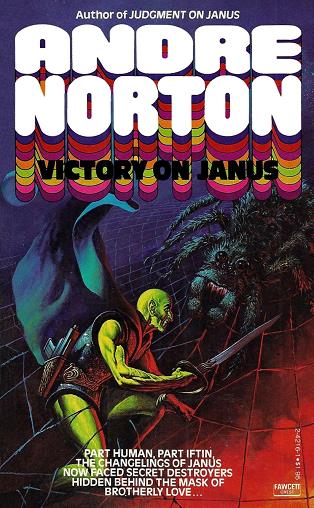
Victory on Janus


By Andre Norton


Sequel to Judgment on Janus.

Ayyar (the former human Niall Renfro) and his Iftin companions awake from their winter hibernation to the unwelcome knowledge that the forest they call home is under attack. They hurriedly pack up what they can and flee. Trying to figure what is going on, they are surprised to discover that not only are the settlers attacking the forest, but they have been joined by the men from the spaceport who have brought in heavy equipment and blasters to destroy all the possible hiding places of the Iftins. Investigating further, the Iftins discover that robots disguised as Iftins have been attacking and murdering humans, obviously the work of their old enemy, THAT WHICH ABIDES.  Which is devastating news because they believed THAT had been nullified when the flood poured over its lands. 

But THAT is active once again, sending its Iftin-looking robots against the humans settlers. And also once again against the native people of Ift, the green-skinned forest dwelling Iftins. Once again Ayyar and his Iftin companions must take on THAT to save the forests they need to live and to save the humans from being used as pawns against the Iftins by THAT WHICH ABIDES.


This story is pretty much a repeat of the first book, Judgment on Janus. The Iftins, mainly Ayyar, sneak into THAT's desert and face various enemies and finally discover how to defeat their enemy.  I did like that the enemy turns out not to be some implacable ancient evil, but simply a machine whose programming has gotten a bit messed up.


The Abominable Snow MAD


Edited by Albert B. Feldstein


Excerpts from MAD Magazine from the 1970s.

Featuring

  • The Milking of the Planet that Went Ape by Arnie Kogen, art by Mort Drucker
  • Cartoons by Don Martin
  • The Shadow Knows by Sergio Aragones
  • The Lighter Side of Weekends by Dave Berg
  • Howard at the Mike by Frank Jacobs, art by Jack Davis
  • MAD Interviews a Typical Liberal Family by Lou Silverstone, art by Paul Coker Jr.
  • Distinctive Wedding Announcements by Frank Jacobs
  • Spy vs Spy
  • The MAD Christmas Hate Book by Al Jaffee
  • A MAD Look at Tarzan by Don Edwing, art by Jack Davis
  • and more
This was a fun book to read, especially for an old fogey who was an adult in the 1970s. I think MAD was at its best in the 1960s and 1970s. 

Here are some excerpts from the book --


From The Shadow Knows


From Dave Berg


From Dave Berg


From Distinctive Wedding Announcements