Wednesday, January 31, 2018

Morality for Beautiful Girls

By Alexander McCall Smith

Things are changing at the No. 1 Ladies' Detective Agency. The biggest change is that the agency is moving into a room at  J.L.B. Matekoni's garage, Tlokweng Road Speedy Motors. For another, Mma Ramotswe, founder of the agency, has given her assistant Mma Makutsi a raise and a promotion from mere assistant to assistant detective.
Mma Makutsi even ends up managing the garage and the detective agency. Mma Ramotswe has to leave town on a case and J.L.B. has become overwhelmed with guilt about something in his past and has lost interest in the garage and is under the care of a doctor after some persuasion and management by Mma Ramotswe.
Mma Ramotswe is out of town of a case brought to her by an  important government man who is worried about his brother. The brother, recently married, manages the family farm and the government man thinks his new wife wants the farm for herself and is trying to poison her husband.  So he arranges for Mma Ramotswe to pay a visit to the farm to see if his suspicions are correct.
Meanwhile, back in town, Mma Makutsi is managing both the agency and the garage and seems to be doing very well. The two apprentice mechanics seem to enjoy being under her eye and business is booming.  She also has an important to case to investigate all on her own. The owner of a beauty pageant ran into a little disgrace with the previous contest when one of the girls turned out to be an unsavory character. So this time, he wants the No. 1 Ladies' Detective Agency to do some sniffing around and make sure the five finalists are upstanding and virtuous.

This was a pretty good read, if a little thin on plot. Three of the story lines are left open-ended. Mma Makutsi makes her recommendations about the beauty contest girls but we are not told definitely that her judgments are correct. J.L.B.'s guilty secret is not revealed. And the story of a little lost boy who appears only briefly is only hinted at and made not plain. So those unfinished plot lines were quite annoying.
But despite the obvious cliffhangers designed to lure the reader into opening the next book in the series, this was still an enjoyable read. Reading one of these No. 1 Ladies' Detective Agency books is like taking a little mini-vacation to a foreign and different land. They are a breath of fresh air.



Tuesday, January 30, 2018

How to Murder Your Mother-In-Law

By Dorothy Cannell

Mother-in-law trouble.
Ellie has invited her husband's parents, Magdalene and Elijah, to visit and to celebrate their wedding anniversary. Ben, the husband, warned her that his parents weren't all that keen to celebrate their anniversary, but Ellie perseveres. She even invites a very old friend of Magdalene's, Beatrix, to dinner, only to find out that the Beatrix and Magdalene have not been on speaking terms for forty years. When they were young adults, Beatrix talked Elijah into skinny dipping and Magdalene has never forgiven her for doing so.
Magdalene is the cliché mother-in-law, overly critical and nitpicking at Ellie. Having her in the house is a real burden for Ellie. But it turns out that Ellie is not the only one having mother-in-law troubles. Beatrix lives with her son and his wife. Beatrix is a bit eccentric. At one point she puts hair remover in the shampoo bottle without bothering to tell anyone. She also accidentally cooked her granddaughter's pet goldfish.
Two other friends are dealing with difficult mothers-in-law. Pamela and her husband live with his mother and she calls all the shots. The husband has to turn his paycheck over to his mother and she gives him a small allowance. She also requires that no one speaks during meals, among other overbearing and controlling behaviors.
Ellie's other friend Eudora's mother-in-law is a thorn in her side. Eudora is the vicar of the local church and a nonsmoker. Her mother-in-law is an atheist who constantly pokes fun of the Bible and, despite Eudora's requests not to, continues to smoke her cigarettes in the house, evenutually sparking a small fire in the house.
The friends get together one evening and jokingly plot ways to murder their mothers-in-law, all in good fun. That is until one of the old ladies is pushed off a cliff, one is poisoned and one's brakes on her bike are tampered with. The four friends begin to doubt each other and, to make it worse, Ellie is being blackmailed.

I had a hard time getting into this story but it began to grow on me after awhile.  I guess what I didn't like was Magdalene being such a cliché and Ellie being such a doormat. But I warmed up to the story and by the end I quite enjoyed it.

Review from Publishers Weekly.

Friday, January 26, 2018

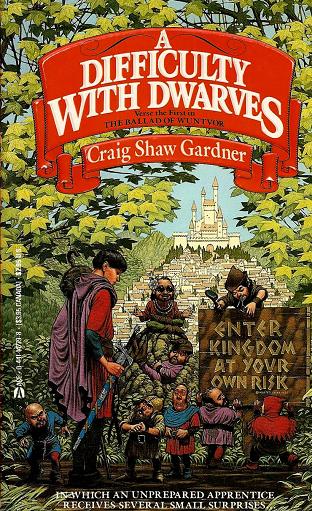
A Difficulty with Dwarves

By Craig Shaw Gardner

Ballad of Wuntvor, Book 1

Wuntvor, the apprentice to the wizard Ebenezum, is trying to help the wizard find a cure for his affliction, allergy to magic. Unfortunately, the allergy has spread to the other wizards and the demons of the Netherhells have not given up their assault on the world above. As a last resort, Ebenezum is sending Wuntor to the  realm of the dreaded Mother Duck, who, it is rumored, bakes intruders into bread. Of course Wuntvor will be accompanied by the usual motley crew he has attracted over the course of the previous three stories: A Malady of Magics, A Multitude of Monsters,  and A Night in the Netherhells.

The thing about this book is that it is all talk and no action. Wuntvor, who is portrayed as afflicted with acne, bad breath, poor posture and stupid nonetheless attracts a loyal following, for no apparent reason that I could see. And these followers love standing around and talking, talking, talking. Even the attacking demons spend most of their attacks talking. Even worse, the book ends with no resolution, with Wuntvor captured by Mother Duck. Book tries very hard to be funny, but mostly is just tedious.

Sunday, January 21, 2018

Too Fat to Fish

By Artie Lange and Anthony Bozza

The story of Artie's young life. Artie Lange grew up in New Jersey. His childhood was typical of the area until his father, Arthur, was paralyzed in a fall from a ladder. Arthur Lange died a few years later from complications of the paralysis. These years and the loss of his father hit Lange, in his early twenties at the time, really hard. While his mom and sister managed to cope and carry on, Lange began his slide into gambling addiction, alcoholism and drug abuse.
Lange attended college briefly but then got a job as a longshoreman. He was able to save a fair amount of money and start trying to develop a career as a stand up comic, traveling from New Jersey to New York to do his act in the comedy clubs and other venues and driving a taxi to support himself.
Artie Lange landed an audition for a new TV show, Mad TV. He moved to California and became an important member of the cast in a show that went on to last for several years. But the pressure of performing and committing to a schedule was too much and he tried to commit suicide. He ended up in the hospital and rehab and began a pattern of sobriety, then relapse, rehab again, over and over. Still he managed to maintain his career despite all his problems, performing in movies, doing stand up and working on the Howard Stern Show. He even managed to control himself long enough to perform for the troops in Afghanistan via the USO for a couple weeks. He fell off the wagon at an airport on the way home, unfortunately, getting drunk and causing a scene. Towards the end of the book, he describes his switch from cocaine to pain pills to heroine, all washed down by massive amounts of alcohol, and maintaining his huge size with a lifestyle that would turn most people into walking skeletons. He must have outstanding stamina.

I really don't remember why I wanted to read this book. I had it for two years before I got around to reading it. I wonder if I thought that it would be amusing. It has an amusing title and was written by a comedian. If that is the case, I was mistaken.
Artie Lange has had a life I wouldn't wish on anyone. Sure, he has had some great times and made some good money and helped his family out. But I bet they would have been just as happy if he had stayed a longshoreman or taxi driver and was sane and sober and gotten and settled and had raised a family as an ordinary fellow from New Jersey. God knows he has put those who care about him through hell. All that fame and money cannot make up for all that misery and unhappiness. And when I did a Google search, he apparently is still stuck in the drug abuse and rehab cycle, over and over. I hope someday Lange can get the help he needs to stay sober before he dies of abusing himself.
This is not a funny book. It was very frustrating to read as he wrecks his life with booze and drugs. You just want to shake some sense into him. It has such a feeling of hopelessness and I was not surprised to find out he is still in trouble. Sigh.

Review from Publishers Weekly:     https://www.publishersweekly.com/978-0-385-52656-2.

Thursday, January 18, 2018

The White Chip

By Nelson C. Nye

Banker Snude and a young woman, Serafina, believe the map she owns will lead them to a lost gold mine in the Superstition Mountains of Arizona.  The banker is partially funding the expedition and several other men are also funding it and coming along. Chuck was one of the men and he had the advantage of being familiar with the area.
One the way there they encounter bad guys and one man gets stabbed in the night by persons unknown. They find the mine and it is stacked to the ceiling with bags of ore, more ore than their little expedition can handle. They need to find help and they get the bright idea to hire a gang of smugglers, which turns out about as well as one would expect, dealing with criminals.  They get ambushed, the smugglers make off with the ore, but they manage to get it back only to discover when they get to Snude's bank that the smugglers switched the ore with rocks. In the process, more members of the expedition die.
Chuck, who has grown attached to Serafina, talks her into going back to look for the ore. He knows the smugglers must have stashed it until they could get together enough mules to pack it out. Taking the banker's mules, he and Serafina head back out and sure enough, they find the stolen ore. But nothing turns out the way Chuck had hoped, plus one of the peaks of the Superstitions has decided to be a volcano.

I read this story because my father was one of those hopefuls who went looking for gold in the Superstitions. Like everyone else, he found nothing. So the idea of gold hunters in the Superstitions has some nostalgia for me. Too bad the story turned out to be really stupid and boring. Total waste of time.

Monday, January 15, 2018

Green Darkness

By Anya Seton

Celia and Richard are newlyweds and very much in love. But when Richard brings his bride home to his ancestral manor in England, everything falls apart.
Richard turns cold and judgmental and Celia is bewildered and distraught. So much so that she has a kind of seizure and ends up in the hospital near to death. Richard, meanwhile, has locked himself in the manor's nursery room and is playing Gregorian chants on his record player, deaf to the pleas of his friends to come out.
Fortunately a friend of Celia's mother was visiting the newlyweds at the time. This friend, Dr. Akananda, is an Eastern mystic and he has diagnosed the problem as leakage from two young people's past lives in which a murder was committed and unavenged. Together the doctor and Celia travel into her past life to discover the secret that is ruining her's and Richard's marriage.

This was an OK read. Most of the story is about Celia of the past, who lived during the turbulent years after King Henry VIII died and before Queen Elizabeth I reigned. Quite and interesting time in history to read about, as Catholics in England first rejoiced at the ascension of Queen Mary and the grave disappointment at the failures of her reign. How accurate the author's depictions of this time are I don't know, not being a big fan of history myself. But she paints quite a detailed picture. Maybe too detailed, as I got rather tired of it and wanted to get back to Richard and Celia in modern times. But the majority of the book is about the olden days and modern days get short shrift.

Review by All About Romance:    https://allaboutromance.com/book-review/green-darkness/.

Saturday, December 30, 2017

Burning World

By Isaac Marion

This is the follow up to Warm Bodies. R and Julie are still together and R is living in the human compound, trying to become more human, with mixed results. M aka Marcus has wondered off to the woods to find himself.
Lots of zombies have moved into the human zone, as they make the slow transition from dead to barely alive to living. But someone has figured out that zombies can be trained to do simple tasks and has created zombie factories. And this group has decided it is going to run everything and is moving in on all the human enclaves and setting themselves up as the final authority. Anyone who resists is in danger as is anyone who tries to stop them from rounding up the zombies and the semi-zombies.
R and Julie run afoul of this corporate takeover of their compound and are forced to escape. In the process, they encounter Julie's dead boyfriend's brother and find out he is a pilot.
Pursued by the goons of the corporation, they return to the airport and take off in R's old home, the airplane. But their escape is only temporary and R is starting to remember some very disturbing things about his past and his strange connection to the corporation.

The first book was kind of cute and charming. This book is the opposite. It is grim and depressing and obviously the next in a series. It's an interesting story, but too dark in tone for my taste.

Warm Bodies

By Isaac Marion

R is a zombie. He "lives" in a plane at the airport. He has friend, M, who is also a zombie. They sometimes hang out together. He also has a zombie wife and two zombie kids. But that doesn't stop him from falling for a living, breathing girl, Julie.
One day, feeling a bit peckish, he heads into the city, looking for a bite to eat. He and his zombie companions are lucky enough to find a group of teenage humans out foraging. This is where he first encounters Julie and, for reasons unknown to himself, he saves her from the others and hides her in his airplane.
Julie, of course, is terrified, being held captive by a zombie. But, as they spend more time together, Julie begins to soften toward R. And R begins to feel more alive.
There is only one thing that may come between their burgeoning love: R ate her boyfriend's brain.

This was a cute idea. And it was just a few pages into the story that I realized I had seen it as a movie. I enjoyed the movie and that kind of spoiled the book for me. Also, the movie ending is more upbeat than the novel.  But  I did enjoy the novel too.


Monday, December 11, 2017

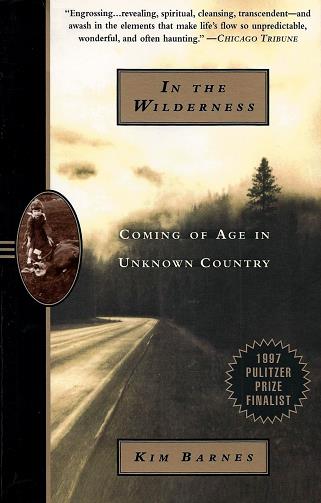
In the Wilderness

By Kim Barnes

Kim grew up in the logging communities of Idaho. Her parents had fled poverty from the southwestern states and settled in the woodsy towns and company towns of the logging industry. Her father worked as a logger and they were joined by other family members looking for a better life too. Kim's parents came from backgrounds of alcoholism, poverty, abusiveness, and failure.  Her father and mother found direction and solace by joining a Pentacostal church whose teachings helped them overcome the addictions inherent in their very DNA. The father became the demanding authoritarian figure he believed the Bible required him to be. The mother became the submissive, subdued and obedient servant she believed the Bible required her to be.
Raised to believe the inerrant truth of the Bible, Kim followed her parents' lead and tried to be the submissive, subdued and obedient daughter she was told the Bible required her to be. But then she became an adolescent and the family moved from the woods to town.  The pressures of teenage life and the urge to conform to her peers created conflict between Kim and her parents. She began to rebel. She no longer wanted to wear the long dresses, the knee stockings and the braids in her hair deemed proper for a girl her age. She wanted to be like the other kids and wear jeans, and shave her legs and wear makeup and go to parties. She didn't like being an outsider, like most kids, she wanted to be part of the group. Her anger about the restrictions of her parents' fundamentalist religion drove her to more extreme forms of rebellion, ending up with her running away from home. But she was soon back home and her parents gave her a choice: reform school or back to the woodsy community to live with the Pentacostal preacher and his family. She chose the preacher.
Once settled in with the preacher's family, Kim again conformed to behavior expected of her gender. Cook and clean, do the chores, be quiet, be submissive and obedient. But despite her best efforts, the preacher and his family turned against her and claimed she had brought demons into the home and that she was trying to seduce one of the men of the family.
So back home with her parents and little brother, once again Kim toed the line and tried to fit herself into the mold required of her. But, now moving into adulthood, she began to question the unfairness of it all. How she was made to feel sinful simply because she was female, simply because she was pretty. At eighteen, after graduating from high school, she moved out when her father wouldn't let her go on a camping trip with a group of teens from her school.  He gave her an ultimatum: if she left to go on the trip, she couldn't come back home to live. So she left and made her way in the world on her own.

This book describes way of a life that is pretty much anti everything I care about. They were deeply religious. They hunted and fished. They cut down the forest and damned the rivers, polluted the air and poisoned the water and saw nothing wrong with it. Their religion imposed ridiculous standards on people but completely failed to teach reverence for God's creation.
I found it hard to sympathize with her story and of how she went from one extreme to the other, from super-pious, super-religious (she even spoke in tongues and was a faith healer) to out-of-control, raging teen rebellion. I found it shocking how blind she and her family were to the destruction of the wilderness they supposedly loved and how gutless they seemed in their willingness to bow to the silly dictates of their extremist religion.
So even though I didn't have a lot of sympathy for her or her religion-addled parents, I still enjoyed the story and I am glad she was able to free herself in the end.

Kirkus Review: https://www.kirkusreviews.com/book-reviews/kim-barnes/in-the-wilderness/.


Sentenced to Prism

By Alan Dean Foster

Prism. A planet unlike any other. Life there is based on silicon, not on carbon: plants and animals with bodies of glass and minerals. A world of living gems. And the big corporation that has discovered it is eager to exploit its many wonders. They sent a team to the planet but have lost contact with them. Now they are sending Evan Orgell to the rescue, all very undercover and hush-hush. Because what they are doing is highly illegal and breaking several laws, keeping knowledge of a newly discovered planet hidden.
Evan is a highly confident man and his employers are also highly confident that they have equipped him with the best in survival tools, mainly the MHW, the Mobile Hostile World suit, a suit designed to be a mobile, completely equipped habitat, travel and defense garment. But the suit designers didn't know about the dangers of Prism.
So it isn't long until Evan finds himself, naked and afraid on the hostile surface of an alien planet. It was only a matter of days before the suit failed and he was forced to abandon it. Now he has no one to help him and no real understanding of the native life and its dangers. As he has discovered, the trace minerals that compose the human body are a smorgasbord to the denizens of Prism, as witnessed by the many organisms dining on the remains of the very team Evan was sent to rescue. Not only are all the people dead, but the base's equipment has been destroyed too, including communications, munched to death by invading plants and animals.
Fortunately, Evan is rescued by a kind, compassionate, highly intelligent Prism native, who takes him to his compound and who accompanies Evan on his trek to locate the beacon of what may be the only surviving member of the base team, lost, it seems, in the strange and inimical wilderness of Prism.

This is probably the third or fourth time I have read this story, which says a lot about how much I really, really like it. Every time I read it again, I like it just as much as the first time. The reason why is because of the charming and wonderful Prismites who rescue and aid Evan in his quest. I just love them. They are everything you would hope an intelligent alien people would be.

Tuesday, December 05, 2017

Trashed

By Derf Backderf

JB has dropped out of college and moved back in with his mom. But she has reminded him that he has to be either in school or working. The town where he lives doesn't have a lot of openings and the only job he can find is as a garbageman. And so begins his education in garbage, small town politics and the quirks of the trash-creating public.

If you have ever wondered what it is like being a garbageman, this book will give a really good glimpse of it. And it has lots of information about how garbage is handled (or not) in this country. It's pretty gross but very informative and amusing. And it is a quick read because it is a graphic novel.

Review from Publisher's Weekly: https://www.publishersweekly.com/978-1-4197-1454-2.


Sunday, December 03, 2017

Crosstalk

By Connie Willis

Briddey is a young woman who works for a cell phone company. Their biggest competitor is Apple. So the company, Commspan, is constantly trying to develop ideas that will appeal to consumers and enable the company to get the jump on Apple. Trent, Briddey's fiancé, also works for Commspan and he is working on a secret project that he hopes is going to impress his boss very much. What he hasn't told Briddey is that she is part of his secret project and the project is the reason why he wants the two of them to undergo a surgical procedure that will create an emotional bond between the two of them. They will be able to sense each other's emotional state and, supposedly, this will create greater closeness and trust in their relationship.
But Briddey gets much more than she bargained for, thanks to her Irish roots. Turns out the Irish have a telepathy gene and the surgery just activated hers. Now she is hearing the whole world and it is unbearable. Fortunately, the first person she hears upon wakening in the hospital is C.B., a coworker at Commspan and, it turns out, an old hand at telepathy. Together, they work toward enabling Briddey to cope with the mental onslaught. Eventually Briddey discovers that Trent's motives aren't exactly pure and unselfish towards her and that he is mainly interested in scoring points with the big bosses and advancing his career.

Usually I enjoy novels by Connie Willis. But not this one. It was just too chaotic. The poor main characters hardly ever have a moment to just be. They rush here, they rush there, they call, they text, they climb all over each other. It was a real rat race and just tiring to read. Also, the romantic plot is just the usual stuff: girl falls for boy, who is a jerk, girl finds new boy and realizes first boy is a creep and falls for second boy. Ho-hum.

See also, the LA Timeshttp://www.latimes.com/books/jacketcopy/la-ca-jc-willis-crosstalk-20161007-snap-story.html.

Friday, November 24, 2017

Vermilion Sands

By J. G, Ballard

A collection of nine short stories set in a luxury resort town on some extraterrestrial location. Wherever it may be, it is hot, dry and sandy, with strange plants and animals. Each story centers around the activities of some beautiful, warped woman and the men attracted to and affected by her. Of the women in the nine stories, most where crazy, several were murderous, some were conceited and vain and none of them were worth the trouble they caused. About four stories into the book, I began to think that the author has some kind of grudge against women, which was shown, perhaps, by this quote from the book:
"Made me realize how absolutely terrifying all women really are."
Speaking as a woman, these stories did not appeal to me. I began to tire of his view of women after about five stories in and was relieved to reach the end of this rather short book. His anti-women bias ruined the stories for me.

Wednesday, November 22, 2017

True Experiences with Ghosts

Edited by Martin Ebon

The editor gathered several ghost stories that he believed were true, unexplainable events.
One of the stories concerns Ocean Born Mary. According to the story and to information I found online, Ocean Born Mary was a real person. Her parents were traveling to America by boat when the boat was intercepted by a pirate. He planned to pillage the boat and kill all aboard, when he heard a newborn baby crying. Going to investigate, he found the captain's wife and her tiny baby, who was born on board the boat. He was charmed and promised to spare everyone is the new mother would name her baby Mary, after the pirate's wife. She agreed and the pirate left the boat. He later returned with a bolt of expensive green  silk cloth which he gave to baby Mary to made into a wedding gown when she grew up and married.
All this part of the story of Ocean Born Mary are true to that point. But then the author of the story, Louis Roy, starts making stuff up. He bought a house in the town where Mary spent her old age which he then claimed was haunted by her and by the pirate who befriended her. He claimed the house was built by the pirate and that Mary moved into it to be his companion and housekeeper. He claimed the pirate died and was buried there along with his pirate treasure. He further claimed many people had seen or experienced many uncanny and eerie things on the property and in the house, which he also claimed was filled with Mary's original furniture.
But there is a site online, by the local historical society, that totally debunks all of Roy's claims. The house was built by one of Mary's sons, not by a pirate. Mary never lived in the house, she lived in a nearby house with one of her other sons and, at the time, she was quite elderly, in her seventies. Her furniture was never in the house, since she never lived there. The pirate also never lived there and was never part of Mary's life beyond that first encounter. Roy made all the haunting nonsense up and charged people admission to the house and property. The details can be found at Henniker Historical Society website: http://www.hennikerhistory.org/obmary.htm.
Since this story was so thoroughly and easily debunked. it casts doubt on the veracity of the other stories in the book. I am inclined to believe it is all a bunch of made up nonsense. The one proven false story taints all the other stories, I am sorry to say.
But besides all that, it just wasn't a very interesting book. It cloaks itself in scientific & scholarly terms but, although the editor might have intended it to add weight to the book, it merely makes it dull.

Monday, November 20, 2017

The Yearling

By Marjorie Rawlings

Pulitzer Prize for fiction, 1939.

Ora and Ezra, know as Penny, with their only child, young Jody, are poor farmers in rural Florida. They have a lot of problems with their no-account neighbors, the Forresters who have been stealing their pigs.
One day, while out searching for the missing pigs, Penny gets bit on the arm by a rattlesnake.  So he shoots a doe and uses her liver as a poultice to draw out the poison. But the doe had a young fawn and Jody adopts the little orphan fawn. His parents understand his compassion but know that this will just lead to problems in the future.
Jody loves the little fawn and names him Flag. They grow up together. But Flag grows up a lot faster and, as predicted by the parents, having a growing deer on the property is just causing too many problems for a family struggling just to get by. Some hard decisions are going to have to be made, whether Jody is ready to make them or not.

I really enjoyed this story a lot, even given its heartbreaking elements. This is a sad story and one in which we wish the impossible could, for once, become possible. But it never does, it never does.
This novel is a tremendous read and well worth reading.

See also, Kirkus Reviews.

The Store

By T.S. Stribling

Pulitzer Prize in fiction, 1933.

This is the story of Miltiades Vaiden of Alabama of the 1880s. Vaiden was a Civil War veteran, former leader of the KKK and, since the South was freed, not prospering like he feels he should. He feels he is a Southern Gentleman of the Old South and he longs for those days to return, a time he thinks of as a kind of Eden. Of course, it wasn't an Eden for the slaves, but Vaiden is not accustomed to thinking of black people as human beings. They are property and as such have no equal standing with their former owners. A view that is held by 99.99% of the whites in the South at the time.
Vaiden was swindled by a store owner, Mr. Handback. When he sees an opportunity to swindle Handback and enrich himself in the process, he seizes upon it. With the result that Vaiden becomes wealthy and Handback is driven into financial ruin. The whole town knows what Vaiden did and holds it against him. But being rich has it rewards and he is eventually forgiven and welcomed back into the social ranks, especially after fixing up a mansion in town and making donations to the building of a fancy new church. He even ends up marrying the beautiful young daughter of the woman who left him at the altar when he was a younger man. Seems like everything is going his way, finally. Until his only child, his only son, is murdered at the hands of an enraged mob, a son he only found out about as he rushed to save him from the lynch mob.

The Store is the second book in the Vaiden triology.  It deals very frankly with the racism of the Old South. And lays out, in painful detail, white attitudes to blacks among them. Must reading for anyone who is ignorant of or dismisses the history of slavery in the United States.
But other than that, I am sorry to say that I found the book dull. It was a plain chore to finish it. I am not going to say it was a bad read, but it just didn't engage me the way I want when I read a novel. For one thing, it is a long book, almost 600 pages long. Frankly, I got bored with it and just wanted it to be over.
Also, one thing that annoyed me from the very beginning of the story was the author's constant ragging on Vaiden's fat wife. The author calls her fat, shapeless, overflowing, heavy, fleshy and on and on. He can never mention her without reminding the reader that she is fat. OK, we get it, she's fat! Give it a rest, man!
Here is something I thought was little funny. But whether the author was poking fun too, I don't know. Anyway, two white people are commenting on the odd names that black people choose. The name they are laughing at is Toussaint. Meanwhile their names are Miltiades and Sydna :-).

See also,  Reading the Pulitzer Winners for Fiction.


Thursday, November 09, 2017

The Egg and I

By Betty MacDonald

A fictionalized version of Betty's life on a chicken farm in western Washington state in the late 1920s.
Newlyweds Betty and  Bob pooled their money and bought a rural acreage, intending to get in the chicken egg business. The property did have a house and few outbuildings and an orchard of mixed fruit trees. The house, while sturdy, had no modern comforts, no electricity, no bathroom, no furnace, no indoor plumbing. All their water had to be hauled in and heated in a stove in the kitchen, said stove being their main source of heat for the house. (Betty never mentions a fireplace or other wood burning stove, so I assume there was only the kitchen stove.) Laundry had to be done by hand. All the hot water had to be heated on the kitchen stove. In the winter, all the laundry had to be dried inside, as winter there was mostly rainy. Plus Betty had to help Bob with his work on the acreage, building chicken houses, pens for livestock, clearing the land for crops and gardens and clearing the orchard of unwanted trees and brush. They got up at 4 AM and worked all day and Betty had all the housework and food preparation too. And it wasn't too much longer before there was a little baby to take care of also.
So it was a hard life, very demanding, but Betty tells her story with humor and self-deprecation. Unfortunately, some of her humor comes across as looking down on the locals, whom she describes as ignorant, unenlightened, and, in some cases, lazy and dirty. She especially singles out her next door neighbors, the Kettles. And she has harsh words for the local native peoples, about whom she says:
"...the more I saw of them the more I thought what an excellent thing it was to take that beautiful country away from them."
Oddly though, she goes on to comment about the devastation to the land caused by logging:
"On the way we passed barren ugly hills which had once been beautiful green mountains and saw mile after mile of slashings [logging areas], ugly, dry as tinder and inexcusable." 
Never seems to occur to her that if the native peoples she despised were still in charge of the land, the mountains would be pristine and green instead of stripped bare.

The book, which was written in the early 1940s, has an interesting passage about abortion:
"One day when Bob and I were driving to Town, a man hailed us. We stopped and he climbed on the running board and leaned into the car confidentially. 'Say,' he said, 'heard you was that way.' 'Yes,' I said, 'I am.' The man leaned in farther so his face was uncomfortably close to mine. 'Just say the word and I'll fix you up. Drop by some evening with six dollars and I'll fix you good as new. Not a thing to it,' he said winking at Bob. 'Took care of Mrs. Smith when she was six months along and got rid of three for my own wife at three months. Just a plain old-fashioned buttonhook. Nothing to it.'
'Oh, him!' said the girl in the doctor's office in town. 'His wife's in the hospital right now recovering from her last abortion. We get his work in here all the time,' and she laughed heartily. I didn't think it was funny. 'Why don't they stop him? Why don't they arrest him?'
The girl sighed and looked out the window. 'If it wasn't him it would be someone else. If they can't find someone else to do it they abort themselves. The hospital's full of 'em all the time. Buttonhooks, bailing wire, hatpins. God, they're dumb.'
Just a little reminder of what abortion was like back before it was a woman's right to choose.

Literay Ladies' Guide review: http://www.literaryladiesguide.com/book-reviews/the-egg-and-i-by-betty-macdonald-1946-a-review/.

Friday, November 03, 2017

The Sugar Queen

By Sarah Addison Allen

Josey is the only child of a successful entrepreneur. Her father revitalized the small town when he built built a ski lodge on the slopes of the nearby mountain. As a result, he was looked up to and admired by the townsfolk.
Josey was only nine years old when he died and her view of her father is a bit clouded by her childish hero worship of him. Now in her late twenties, Josey still lives at home, serving as a sort of companion to her elderly mother. As a child, Josey was a pill, prone to temper tantrums, stealing, and breaking things. She was so wild, her parents kept her home and hired tutors for her instead of sending her to school. But after her father died, Josey changed her ways and became quiet and submissive, blaming herself for her mother's seeming dislike of her only child. Josey's only act of independence and rebellion is a stash of goodies (candy, cookies, chips) hidden behind a panel in her closet.
One morning Josey wakes up to find a strange woman hiding in her closet. The woman, Della Lee, pleads with Josey to be allowed to hide in the closet and Josey gives in. In fact, she goes to Della's house and gets some clothes and stuff for her, nearly getting caught by Della's psycho boyfriend, Julian.
Della Lee continues to hide in the closet and gradually leads Josey into discovering some truths about herself, her father, her mother and about Della Lee too. Josey is finally able to face her dreams and enter into the life she has wanted for a very long time.

This was a good story, with a touch of fantasy, as is quickly revealed in the first few pages by this sentence about the South American maid that works for Josey's mother:

But the first day she was sent off to the market with a grocery list, she spent two hours crying on the front porch, her tears falling into the flower pots where mysterious South American tropical flowers later sprouted without explanation.

Publishers Weekly review: https://www.publishersweekly.com/978-0-553-80549-9.

Monday, October 30, 2017

Irresistible

By Mary Balogh

Sophie has a secret and unfortunately she is being blackmailed because of it. It isn't even her secret, it is her dead husband's secret. But to protect his reputation and his family, Sophie has been paying the blackmail.
She is not a wealthy woman and the blackmailer keeps demanding more and more money. She may even have to sell her modest home to buy his silence. She does sell her wedding ring and her pearls, the only valuable jewelry she owns.
Living quietly in London, she suddenly finds her social horizons expanding when the "Four Horsemen" reenter her life. Four friends of her husband, they had all fought in the war together but had gone their separate ways afterward. But they have all come to London for the season for various reasons.
Sophie always had a bit of a crush on one the four, Nathaniel. So now that she is a widow and he is looking for love in all the wrong places, it is not too long before they are in an intimate relationship. They have decided that no strings will be attached. She is lonely, he is lonely and together they will ease their desires. But Sophie's financial problems and her rather irrational scruples are going to ruin everything.

This was an OK read. I suppose sexual promiscuity was not all that rare back in the 1700s and 1800s.  People will do what people like to do, that is for sure, no matter how much religion and society may frown upon it. But reading about sexual antics does not appeal to me. I have enjoyed Regency romance novels since I was a kid, but these writers nowadays always have to thrown in detailed descriptions of sexual acts. Writers used to be able to tell a romance story without the characters ripping their clothes off and hopping into bed together. I miss that.

Dear Author review: http://dearauthor.com/book-reviews/overall-b-reviews/b-minus-reviews/review-irresistible-by-mary-balogh/.


Scepter of the Ancients

By Derek Landy

Stephanie was only twelve years old when her favorite uncle died and left her virtually all of his estate. Her uncle was a very successful author of novels of magic and monsters.
Her first night in the her uncle's house, a man broke in and tried to kill her, demanding a key from her, a key she knew nothing about. But Skulduggery Pleasant arrived just in time to send the intruder packing.
Skulduggery Pleasant isn't a normal guy. He is a skeleton and a mage and a detective. And right now he is on the hunt for a magical item, the Scepter of the Ancients. He believes that Stephanie's dead uncle knew something about it and maybe even had the scepter in his possession.
Some time in the past a war had occurred between the mages and a truce had been entered upon. But now someone is trying to acquire the Scepter and break the truce and bring about the end of the world as we know it.
All this magic and mages and wars are news to Stephanie and she is smitten. And thanks to the death of her uncle, she is now totally involved in a new world of magic and monsters and deadly threats and she loves it.

This was an OK read, a bit too juvenile for my taste, though. I was really hoping for something a lot more whimsical. But instead it was just another story of bad magicians vs good magicians. Teen and older kids would probably like it and enjoy the rather obvious jokes about Skulduggery being a skeleton.

Rated Reads review: http://ratedreads.com/scepter-of-the-ancients-skulduggery-pleasant-book-1/.

Sunday, October 29, 2017

Off the Grid

By C.J. Box

Nate Romanowski and his girl friend are living in a cabin on a ranch owned by a friend. They have no electricity and no telephone and are living "off the grid." This is because Nate is a wanted fugitive by the federal government. But when the girl friend has to call her gravely ill mother, Nate is back in the government's sights. And it isn't long after the girl friend goes off the visit her mother that the agents show up.
They have a deal to offer Nate. If he will do an investigation for them of a site in the back country of Wyoming, they will wipe his record clean and he can live like a normal person once again. So he agrees.
The feds want to know what is going on at an old abandoned ranch in the Red Desert of Wyoming. A gang of possible terrorists in up to something and they want Nate to take care of it. But when Nate tracks down the gang, it turns out he has more in common with the leader's plans and goals than he does with the people who sent him there.
Meanwhile, his old friend Joe Pickett, the game warden, has been given a heads up by the Governor that Nate might be headed for trouble. He sends Joe to the same area to figure out what the feds are up to as he feels they are overstepping their bounds and he doesn't like it.

This was a very interesting, exciting book as the reader roots for the good guys and hopes for the worst for the bad guys. And the terrorist plot is very scary and unsettling.

Publishers Weekly review: https://www.publishersweekly.com/978-0-399-17660-9.

Maisie Dobbs

By Jacqueline Winspear

Maisie Dobbs was a young teen when her mother died.  Her dad was devastated by his wife's death but he could see that Maisie was trying her best to replace her mom, keeping house, preparing meals, running errands. It was not the life he wanted for his daughter so her found her a job as a maid in the home of a wealthy lord and lady.
It wasn't long before her employers realized Maisie had a keen intellect that would be wasted in a life of drudgery. So they very generously provided for her to be educated, while continuing to earn her keep with her maid chores. She even eventually went to college.
Before she could start her new life as an adult, World War I broke out and she  trained as nurse and was sent to France.
Back in London after recovering from a serious war wound, Maisie decided to strike out on her own as an investigator. One of her first cases involved a man who was worried that his wife was cheating on him. It didn't take Maisie long to discover that the wife was not cheating but was visiting the grave of a man she had a crush on as a little girl. Maisie gave the husband some good advice about how to help his wife and bring their marriage back onto solid ground.
The dead man had become involved with a private asylum for gravely wounded soldiers. One of the requirements of the asylum was that those who entered it turn over their financial assets to the asylum to help cover the costs of running it. But when she visited the asylum, it seemed the residents were happy and contented and the man in charge seemed dedicated and compassionate.
But now her wealthy patrons' son was planning to enter the asylum and her patrons were worried that he was making a mistake handing his money over to the asylum chief.  Maisie enlisted a friend to enter the asylum and what he discovered was not the sanctuary it claimed to be.

This was a good story and the first in a series of 14 books (so far).

Kirkus Review: https://www.kirkusreviews.com/book-reviews/jacqueline-winspear/maisie-dobbs/.

Thursday, October 19, 2017

All Clear

By Connie Willis

The sequel to Blackout,  finds the time travelers stuck back in 1940s Britain in the thick of World War II. Their job now is to survive and hope that someday the people back in Oxford of the future will figure out their plight and send someone to rescue them. Surviving is the problem, with bombs falling on London and Britain, no place is truly safe.
Polly and Eileen have jobs as sales clerks. Mike finds them but he gets cut off from them trying in vain to find other time travelers in the area. Eileen discovers that Binnie and Alf are living on the streets after their mother died and she takes them under her wing. Both she and Polly get involved in Sir Godfrey's amateur theatrics and it nearly costs Polly her life. Mr Dunworthy, their boss from the Oxford Future comes back to save them only find himself trapped in the past too.
Now it is all upon a teenage boy in Oxford Future with a huge crush on Polly to try to locate them in time and effect a rescue. Before Hitler manages to blow them all to bits.

While not as exciting as the first book, still this is a good read, about missed connections and odd coincidences. And if you are smart enough and have a really good memory, (unlike me) you may be able to figure out the direction of the story. It is all laid out in the end and tied neatly together. Which makes for a tidy and slightly unsatisfying end, as one of the most interesting characters in the story **spoiler alert** doesn't make it out alive.

Check out The Guardians review: https://www.theguardian.com/books/2011/nov/16/all-clear-connie-willis-review.

The Chemist

By Stephenie Meyer

She was called Juliana until she found herself in the crosshairs of a corrupt government agency. Now she sleeps with one eye open and a pocketful of fake identities. Currently going by the alias Alex, she is a young, brilliant scientist, best at what she did for the government, but apparently someone decided she knew too much and needed to be silenced.
Alex hates her new life on the run, never trusting anyone, always looking for her assassin. So when her old boss tracks her down and promises to call off the dogs if she will do one last job for him, against her better judgment, she agrees, pressured by the desire for a normal life and by the even stronger desire to prevent a terrorist from releasing a virulent, deadly disease upon the nation.
Her old boss points Alex in the right direction and she is able to locate the terrorist. But he just doesn't look like the kind of man who would be a mass-murderer. In fact, he seems kind, gentle and basically decent. (Also very good-looking.)
So she kidnaps the man, Daniel, using her particular set of unique skills and interrogates him. But no torture she inflicts upon with her chemical potions is able to get him to confess where he has stashed the deadly disease. And he continuously denies any knowledge of anything about a disease, insisting he is a just an ordinary guy who teaches school for a living. The interrogation is interrupted by hired killer who crashes her torture session to rescue Daniel. Turns out the new guy is Daniel's black-ops twin brother Kevin whom Daniel thought was deceased. And he is highly upset that Alex is torturing his brother. In the struggle that follows, Alex's hidden defenses take Kevin (and his killer dog) down and she is able to secure him and his dog.
Like Alex, Kevin used to work for the government and then became a liability. His old boss and her old boss got together and hatched a scheme that would have the two of them efficiently eliminate each other. Poor Daniel was nothing but a pawn to lure the two of them in. But due to Alex's foresight, they both survive the encounter and put their heads together to take on the bad guys who are trying to take them down.

This was a gripping, exciting story. Alex is a very resourceful, highly competent heroine who, despite her diminutive size, comes out the victor, eventually. She usually is the one who saves the day in any deadly encounter. Together, she and Kevin are a match for anything their ex-bosses try to throw at them.  Yet, despite her deadly past, she and Daniel fall hard for each other, with brother Kevin looking on in disgusted bemusement.  So this is part thriller, part spy novel and part romance story and a really fun and engaging read.

Kirkus Reviews rated it "B for Badass": https://www.kirkusreviews.com/book-reviews/stephenie-meyer/the-chemist/.

Saturday, September 30, 2017

China Boy

By Gus Lee

They could see the writing on the wall: the Communists were winning. As rich Chinese people, they could stay and end up in a re-education camp. Or they could flee. So leaving behind the wealth, status and position they fled, ending up in San Francisco, California. And California was were Kai Ting was born, the only son of his mother and father.
But life in California was so different. For one thing, they were no longer wealthy. Accustomed to lives of wealth and influence, in America, that was no longer the case. Even though the father had a steady job, they could only afford a home in one of the roughest neighborhoods of San Francisco.
Life was hard for Kai. He was the only Chinese boy in his neighborhood. Also, he was small and garbled his words. The local street kids were brutal and he stayed inside with his mom and his sisters where it was safe.
But then his mother died and his father remarried. The stepmother was not a kindly or understanding woman and she was determined to destroy Kai's Chinese culture. She locked him out of the house all day, only letting him inside at night. This left him to the mercy of the cruel street kids and he was constantly being beaten and abused by them. His father was incapable of standing up to his new wife and the best thing he figured out to do was enroll his son in boxing classes at the YMCA.
Kai meets a group of caring and committed men at the YMCA. They see his struggle and they guide him into understanding himself and his place in the community and they give him the tools to stand up to the vicious characters in his neighborhood. The novel ends with Kai facing the worst of them and finally also fighting against his stepmother's abuse.

This is an OK story. There is a huge amount of boxing in the story. Lots and lots of boxing. The only thing that makes all the boxing bearable are the stories about the instructors at the YMCA. But even so, I was getting pretty tired of the boxing towards the last section of the book. Not a fan of boxing, nor reading about boxing. All the boxing sort of ruined it for me. I know, the boxing saved his life.  But if I had known the book had so much boxing in it, I wouldn't have bothered to read it.

Kirkus Reviews: https://www.kirkusreviews.com/book-reviews/gus-lee/china-boy/.


In the Fall

By Jeffrey Lent

Norman Pelham left his family's farm in Vermont to fight against the rebels in the Civil War. He suffers a head wound and is found in the woods by a runaway slave, Leah. Leah is young and beautiful and, for Norman, it is love at first sight. He takes her home to Vermont.
His mother and sister are not thrilled to that Norman has married a black woman, but they accept it. Norman takes over the farm and he and Leah have three kids, two girls and a boy.
There are no other black people in rural Vermont where the Pelhams live. Leah encounters a black man at a fair and she starts brooding about her past. She decides she needs to confront her past and try to locate her relatives she left behind. So she leaves the farm and heads down south. What she finds out disturbs her greatly and she returns home to Vermont only to commit suicide.
Her youngest child is wrecked by his mother's death and grows up to runaway from the farm, never to return. He enters into a life of crime as a bootlegger. But he comes to a bad end, never telling his only child, Foster, the truth about his past. Finding a letter in his father's effects, Foster learns that he has family in Vermont and travels to the farm, which is now being run by Norman & Leah's two old-maid daughters. Foster is totally surprised to discover that his grandmother was a black woman. Getting to know his two aunts and learning about the grandmother's death, Foster decides he will go down south and try to understand what was so terrible that his grandmother preferred to be dead rather than live with the truth.

This is really engrossing family saga. I kept hoping that things would work out for these sad yet worthy people and it was heartbreaking to see them suffer and fall. But young Foster is the one who uncovers the past and brings a measure of justice to the author of his grandmother's despair. Just a wonderful story, I enjoyed tremendously.

Publishers Weekly review: https://www.publishersweekly.com/978-0-87113-765-4.


The Last Laugh

By Lynn Freed

Three ladies on the cusp of seventy decide to leave their homes in California for a house on a Greek island. They want to escape the demands of their families and just kick back and enjoy being together.
But all three women have complicated lives, with lots of attachments and kids and grandkids, ex-husbands, ex-lovers, dead husbands and other hangers-on. Inevitably, their attachments follow them to Greece and bring with them all the old complications. Because, no matter where you go, you are always there.

I read this book partly because it was described as, "wildly funny,"  "hilarious," and "rich in humor." These people who describe books this way must be much more easily amused than I am. I didn't find the book to be funny, in fact, it became rather grim and disturbing towards the end, when one of the ladies kills someone.
But, even though it wasn't particularly funny, I still found it interesting, especially since I have that fantasy too, of traveling to Greece and staying on one of the islands.  The book cover is the other reason why I picked the book up, the building on the cover looks like something you would see in Santorini. The author certainly fed the fantasy, as she makes the islands & the people & the food very appealing!

Kirkus Reviews: https://www.kirkusreviews.com/book-reviews/lynn-freed/the-last-laugh-freed/.

Notes From a Small Island

By Bill Bryson

Bryson, originally from Iowa, lived (and maybe still lives) in Great Britain for many years. One of the things he enjoyed/enjoys doing is traveling around Britain and seeing the sights and hiking the trails and footpaths and viewing Britain from an American perspective.
Only a few pages into the book, Bryson describes how he spent his first night in Britain on a bench outdoors because he couldn't afford the rates at the only hotel open at that time of night. He got so cold he put on all his warmest clothes and even put a pair of flannel boxers on his head. Early the next morning, he got up and asked a local man if he knew of a restaurant that might be open. He did and directed Bryson to it, saying it was where the truck drivers ate and so would have good food. He then recommend to Bryson that, "You might want to take them pants off your head before you go in."
Bryson was smitten by British place names. He listed as "endearingly insane" towns such as Chew Magna, Prittlewell, Little Rollright, Titsey, Woodstock Slop, and Nether Wallop.
This book is a lot of fun. Bryson always amuses and he still manages to make parts of Britain sound appealing, even in the pouring rain. One of the best things about Bryson's travel tales is his great sense of humor and his ability to laugh at himself.

Kirkus Reviews: https://www.kirkusreviews.com/book-reviews/bill-bryson/notes-from-a-small-island/.

Friday, September 01, 2017

Artists in Crime

By Ngaio Marsh

The setting is 1930s Britain. Inspector Alleyn is on his way home from the Far East when he meets a talented female artist. He admires her work, she is not receptive.
Back home in Britain, he is called to investigate a murder at a country estate that just happens to be the home of the standoffish artist, Agatha Troy.
Miss Troy is running an artist colony out of her home and several artists are working together on their projects. The current project is a nude study featuring a young woman model. This woman is the victim  that has sent Alleyn to the scene. She was stabbed to death while posing for the artists, by means of an unlikely trap.
So Alleyn has to interview this collection of free spirits and try to determine which one of them had it in for the dead woman. It turms out the woman was a blackmailer with multiple victims among the group. Alleyn has to figure out who had enough and decided to finish her off to shut her mouth. But first he has to get past the red herring set up to point the police in the wrong direction. And keep his mind on his work while falling for the aloof and elusive Agatha Troy.

This was an okay read. I did find the police interviews with the suspects rather dull after a bit. And I wasn't surprised when the main suspect turned up dead. But the identity of the real killer came as a bit of a surprise, although a person cleverer than me probably saw the clues right away.

I do have a quibble with the story. One of the plot details features aspirin. The story implies that taking aspirin is similar to taking a sleeping pill. Now, I don't know about the aspirin they had in Britain in the 1930s, but aspirin here in the States is merely a pain reliever and does not induce sleep.
My copy of the book was published in 1980, but the original novel dates from the 1930s. I am wondering if the author used some other pain reliever common in Britain with the soporific side effect mentioned in the story and the publishers here changed it to aspirin, which would be more familiar to an American audience. Because it is hard to believe that a woman as smart as Ngaio Marsh would make such an obvious mistake about the effects of aspirin.

Wednesday, August 30, 2017

Bogmail

By Patrick McGinley

Roarty doesn't like the young man who has recently come to work for him at his pub. It all started when Roarty found out that the man seduced his teen daughter.
One night, after hours, Roarty comes into the bar with a heavy encyclopedia in his hands and sees his enemy bent over, unseeing. On an impulse, he smacks him in the head with the book and kills him instantly. The only blood spilled are a few drops from where the man's head bangs against a barrel.
What to do with the body? He decides to bury him in the local bog. He waits until very late at night and packs up a few of the man's belongings (the man lived in a room at the pub as does Roarty) and hauls him and the pack out to the peat bog and buries him.
He is quite pleased with himself until he gets a note in the mail demanding money.  The blackmailer, or bogmailer as he (or she) likes to call himself (or herself), has dug up the body and the pack and is threatening to tell the police unless Roarty buys his silence.
But who in this small Irish village is the bogmailer? Roarty reviews his friends and customers and finally decides it is the English fellow, Potter, who recently moved to the village.  He begins to plot against Potter, without really being sure that Potter is the bogmailer. Which is a bit of a shame because he really likes Potter.

This was pretty interesting during the first half of the story, but then I started getting bored with it and just wanted it to be done. Also, the book is touted as being hilarious & bawdy. I didn't find it to be so. Another strike against it is the enormous amount of unfamiliar words, including untranslated foreign phrases. I made a list:

  • Do shláinte, a chailleach! - a toast meaning, your health, woman.
  • Sláinte na bhfear agus go ndoiridh tú bean roimh oiche. Google translates this as, "men's health and keep you a woman before night." Yeah.
  • elvers - an eel
  • coulter - part of a plow? (not sure about this one)
  • lough - loch (a lake or a narrow arm of the sea)
  • syrinx - voice organ in birds, part of the larynx
  • terminus a quo - the earliest possible date for something.
  • slane - spade for cutting turf or peat
  • suggilation - post-mortem bruise
  • wethers - castrated ram
  • selvage - a zone of altered rock at the edge of a rock mass
  • yeld ewes - ewe that is not pregnant? Not sure about this one.
  • louping-ill - a tick-borne viral disease
  • grass tetany - livestock disease caused by lack of minerals in the diet
  • reactor cattle - cattle that have tested positive for disease? Not sure about this one.
  • ruamheirg - rusty colored water
  • cál leannógach - loud voices? Not sure about this one.
  • replevy - to take possession of goods under a replevin order
  • replevin - legally speaking, a procedure whereby seized goods may be restored to their owner
  • dulse - edible seaweed
  • anthelmintic - medicine used to expel worms
  • sloke - edible algae
  • sloc earraigh - algae that grows in the springtime? Not sure.
  • gillie - a man or boy who attends someone on a hunting or fishing expedition
  • rhotacism - is the inability to pronounce or difficulty in pronouncing the sound r
  • barytes - a mineral consisting of barium sulfate
  • orificium urethrae - where urine exits the urethra? Not sure.
  • poteen - alcohol made illicitly, typically from potatoes
  • trampcocks - piles of hay? Not sure.
  • bumf - useless or tedious printed information or documents, junk mail
  • sheepshairn - sheep dung? Not sure.
  • popply - bubbly, rippling, or choppy water
  • airt - compass point, quarter, direction
  • duibhean - a bird, cormorant
  • exiguity - leanness, meagerness, meagreness, poorness, scantiness, scantness 
  • Jansenist - Catholic theological movement, primarily in France, that emphasized original sin, human depravity, the necessity of divine grace, and predestination
  • sacerdotal - relating to priests or the priesthood; priestly
  • Chindits - special operations units of the British and Indian armies, which saw action in 1943–1944, during the Burma Campaign of World War II
  • Lollardism -  pre-Protestant religious movement critical of the Catholic Church
  • Rerum Novarum - encyclical issued by Pope Leo XIII on 15 May 1891, "revolutionary change"
  • De Senectute - "On Old Age" an essay by Cicero in 44 BC on aging and death
  • mensuration - the measuring of geometric magnitudes, lengths, areas, and volumes
  • numinous - having a strong religious or spiritual quality; indicating or suggesting the presence of a divinity
  • gliobach - Didn't find this one. Here is the sentence: "Good lord, have noticed that gliobach of sea fowl?" From the context, it would seem to be flock, but I couldn't verify that.
  • Gadus pollachius - Atlantic cod? Not sure.
  • heresiarch -  founder of a heresy or the leader of a heretical sect? They are talking about fish, I don't understand this one at all: "I had not thought of Gadus pollachius as a British heresiarch."
  • pelagic - fish that inhabit the upper layers of the open sea
  • pelagian - person who believes in the theological doctrine of Pelagius (These last four are some kind of erudite pun: Gadus pollachius, heresiarch, pelagic & pelagian. It's beyond me, though.)
  • cunt splice - a kind of knot in a rope
  • futtock plate - A plate (usually metal) attached horizontally near the top of the lower mast of a square rigged ship in order to secure the topmast
  • hypostasis - the accumulation of fluid or blood in the lower parts of the body or organs under the influence of gravity, as occurs in cases of poor circulation or after death
  • penumbra - partially shaded outer region of the shadow cast by an opaque object
  • litterateurs - person who is interested in and knowledgeable about literature
  • shebeen - an illegal bar or club where alcohol is sold without a license
  • gleety - mucous discharge? Not sure.
  • Die Davidsbündlertänze -  a group of eighteen pieces for piano composed in 1837 by Robert Schumann
  • deoch a' dorais - convivial night-cap, the last drink before departing
  • Hibernicis ipsis Hibernior - more Irish than the Irish themselves
  • Fünf Stücke im Volkston - "Five Pieces in the Popular Style" music composed by Robert Schumann in 1849
  • furcula - wishbone of a bird (Why couldn't the author just say wishbone?!)
  • climacteric - critical period or event
  • gauger - an exciseman who inspects dutiable bulk goods? Not sure.
  • spancelled - rope with which to hobble an animal, especially a horse or cow
  • blue till - till is material deposited directly by glacial ice and showing no stratification. As to blue till, I couldn't find it.
  • ombrogenous - a type of bog
  • soligenous - a bog  that receives water from rain and slope run-off
  • jackeens - mildly pejorative term for someone from Dublin, Ireland; a contemptuous designation for a self-assertive worthless fellow
  • scideens - couldn't find this one. Here is the passage: "'He didn't even call them potatoes. He called them...' 'Scideens.'"
  • innominate - not named or classified
  • terribilità - awesomeness or emotional intensity of conception and execution in an artist or work of art, originally as a quality attributed to Michelangelo by his contemporaries
  • coenobites - member of a monastic community
  • sodality - confraternity or association, especially a Roman Catholic religious guild or brotherhood
  • Timor et tremor - fear and trembling? Not sure.
  • timor mortis conturbat me - "fear of death disturbs me"
  • taurine - relating to, or resembling a bull
  • shanachie - teller of old tales or legends
  • odium theologicum - "theological hatred" —  the name originally given to the often intense anger and hatred generated by disputes over theology. It has also been adopted to describe non-theological disputes of a rancorous nature.
  • antinomies - contradiction between two beliefs or conclusions that are in themselves reasonable; a paradox
  • tow -  waste fiber left after processing the flax plant to spin linen, it may also sometimes refer to the waste from hemp and jute
  • cotta - surplice, a loose white linen vestment varying from hip-length to calf-length, worn over a cassock by clergy, acolytes, and choristers at Christian church services
  • outshot - a lean-to
  • wooden tester - a wood bed canopy? Not sure.
  • phimosis - congenital narrowing of the opening of the foreskin so that it cannot be retracted
  • soil pipe - sewage or waste water pipe
  • Benthamite - utilitarian philosophy of Jeremy Bentham, holding that pleasure is the only good and that the greatest happiness for the greatest number should be the ultimate goal of humans
  • jouking - a sudden, elusive movement, to dodge or duck
  • tolle lege - "take and read"? Not sure.
  • gal fiútair - couldn't find this one. Here is the passage: "'You only get it when the wind is north-east. Crubog calls it a gal fiútair. He says it's coal from Derry.'" I assume it means some kind of chemical odor.
  • jugged hare - a whole hare, cut into pieces, marinated and cooked with red wine and juniper berries in a tall jug that stands in a pan of water
  • palimpsest - something reused or altered but still bearing visible traces of its earlier form
No guarantee that any of these are correct. And all these unfamiliar words and foreign phrases just added to the chore of reading this not very interesting novel.

Tuesday, August 29, 2017

The Cosmic Rape

By Theodore Sturgeon

The hive mind. Draws its power from enormous numbers of members within the hive. But what happens when the hive mind meets up with what it has never encountered before in all its existence: the solitary intelligent minds of the human race?

Told in a series of vignettes of the lives of ordinary people, just going about their normal activities. Then in an instant, it all changes as people find themselves thinking, not as individuals, but as one united organism. Guess what, hive mind: a new sheriff is in town. And its name is Humanity.

This is just a weird story. The united humans attack and destroy the invading machines of the hive mind. Then they join the hive mind willingly, which apparently gives humanity ascendancy over the hive.
The first human taken over by the hive mind, a drunken bum, never gets to enjoy the rewards of the hive and spends the rest of his life in solitary misery and loneliness, supposedly because that is what he truly desires. Weird.

The Mist

By Stephen King

Summertime on the lake and a bad thunderstorm knocks down trees and power lines. Waking up to a changed world is bad enough, but what is that strange mist coming in across the lake? Doesn't look like any normal mist, so white and menacing. Never mind, the wife needs some odds and ends at the grocery, so head into town with the kid to the store. Question is, will you be able to get back home? Because the mist has arrived and it is full of terrors.

A gripping, scary story that illustrates the fragile grasp people may have on sanity and civility in a midst of a terrible crisis.

Camelot in Orbit

By Arthur H. Landis

Something is rotten on the world of Fregis (aka Camelot) and Kyrie Fern has been sent by the Galactic Foundation to straighten things out before the whole planet is destroyed. Kyrie Fern is an adjuster-manipulator who job is to restore balance. Passing as one of the native peoples and going by the alias of Harl Lenti, he is just the guy who has the ability to take on the hidden evil threatening to engulf the whole world.
Landing among the northern people, Harl gains the reputation of a hero and is thought to be the Collin, a mythic figure come to life to protect the north. As the evil from beyond slips its influence into the minds of many of the important lords of the north, the Collin is sent forth by the king to gather an army and, along with the king's daughter, confront the Kaleen, the Dark One, who trying to rule the whole world. Harl will use his superior technology, his understanding of human nature and his skill at warcraft to bring down a threat that could expand beyond the bounds of one planetary system. He will be helped in this by the strange and deceptive pug boo, Hooli. Disguised as a placid little creature similar to a koala bear, Hooli has ways and means beyond that of Harl and beyond that of even the Galactic Foundation.  But are Hooli's goals in line with those of Harl? Whatever they are, Hooli isn't going to make it clear anytime soon.

This was an enjoyable adventure story, with interesting people on an attractive alien world. I wish that the dottles, a six-legged riding animal, really existed. They sound amazing.

Me Talk Pretty One Day

By David Sedaris

A collection of David's stories of his childhood and into his adulthood, poking gentle fun at himself and his family, for the main part.

An enjoyable and amusing read, if taken with a grain of salt.

For a review, see https://www.publishersweekly.com/978-0-316-77772-8.

Zoo Vet

By David Taylor

David Taylor always knew he wanted to be a wild animal veterinarian. When he started out as a vet, there weren't many vets who specialized in treating wild animals. Most vets considered it to be a side job to their main practice of treating farm animals & pets. But after being in a regular veterinary practice, Taylor took the bold step of focusing solely on wild animals, mostly to be found in zoos. He took an especial interest in marine mammals, notably whales & dolphins.
Even though his greatest interest was in whales and dolphins, he still treated a wide variety of other creatures from snakes to great apes to camels, hippos and any other creature that became ill or injured in a zoo. He even treated humans on occasion!
He had an amazing career that took him on adventures all over the world, seeing, treating and learning about a great variety of creatures.

This was a very enjoyable book as the author takes us along on his adventures among the animals of the world.
However, there is one story where he claims he was driven around a city in France by a chimpanzee on a motorcycle. He claims the chimp obeyed all the traffic laws and maneuvered through city congestion without a hitch. I tried looking it up online and couldn't find anything about such a remarkable animal, which casts doubt on the story. The author pulling the reader's leg? Maybe.