Friday, June 14, 2024

Voices of Heaven


By Frederik Pohl


Barry di Hoa was doing pretty good, considering. Because he had been locked up when he was younger due to his mental illness. He describes it thus: "I had a 'psychosis' that closely resembled 'schizophrenia' of the type once called 'manic-depressive.'" He goes on to add that it, "came from my genetic heritage; my mother and my father just happened to carry some very rare recessive genes." Fortunately there was treatment that enabled Barry to live a normal life, with his symptoms under control. Unfortunately, it required injections several times a year, injections that he would have to have all his life. 

Barry lived on the moon and worked with antimatter fuel pods. Antimatter is very dangerous stuff but Barry was good at his job. And it paid very well. He had a girl friend that he loved and who loved him. The girl friend, Alma, used to belong to a religious cult, the Penitential Church of the Millenium, aka Millenarists. Which was basically a death cult that believed merely being alive was a sin, as was having children. And the best thing to do was kill yourself. However,  Alma tried hanging herself but only nearly died. That brush with death gave her a new outlook and she left the cult. 

So what does this have to do with the story? Quite a lot. Because a ship from a colony plant, Pava, had arrived on the moon and Barry was in charge of loading their large order of antimatter fuel pods on their vessel, the Corsair. The captain of the vessel, Garold and his close friend, Reverend Tuckman, were both Millenarists. And many of the colonists back on Pava are also Millenarists. They had legitimate reasons for their large order of fuel pods, though, so Barry thought nothing more about it.

Back to Alma, who had an ex-boyfriend, Rannulf. Who no longer wanted to be her ex. Surprisingly, Rannulf declared that he would be joining Garold on board the Corsair, to become a colonist on Pava. Before he left, though, he wanted to talk to Barry privately. Barry agreed to meet with Rannulf and as a result he was drugged and stashed in one of the freezer capsules by Rannulf used for space travelers because of the immense amount of time required for long trips, in this case, twenty five years from the moon to Pava. 

So Barry wakes up on Pava, and even if he did travel back to the moon, it would  be fifty years since he was kidnapped.  Alma would be fifty years older and Barry would still be a young man, thanks to the freezer capsules.

Life on Pava is harsh and the colony is struggling. Mostly because the planet is tectonically very active. They had recently experienced a serious earthquake that had destroyed a dam they were using for hydroelectric power. Although Barry is regretting his lost life on the moon with Alma, he gets to work, doing his part to help the colony survive. But he knows his medical issue will soon become a problem and that the colony doesn't have the medical experts or equipment to make the medications he needs in order to stay sane. The best the local doctor (who is actually a dentist) can do is give him medicines to combat depression and to calm him down when he is manic. Which sort of works, until Barry starts abusing the anti-depression medication to boost his spirits. And then the colony experiences another major earthquake and everybody is miserable. Except the native peoples, large caterpillar-like creatures, who had been quite helpful to the colony people, providing much needed labor. But they have all disappeared, for reasons unknown, and their contributions to the humans' survival is sorely missed. 

Finally Barry figures out something that was quite obvious from the beginning of the story, namely, Garold's real intentions with all those fuel pods of antimatter. Garold is going to do what so many religious fanatics love to do: kill nonbelievers.


My main problem with this book was the interrogation technique of telling the story. Person or persons unknown are questioning Barry and he is trying to explain his actions. I found that style of telling the story boring. So boring. The reader doesn't find out until quite far in the story who is doing the questioning. We also don't find out why until near the end. 

Like so many novels these days, the book was too long. Editors don't like edit any more, I guess. I don't think this story needed over 300 pages in order to be told. 

Another thing I didn't care for was the characters. Most of the characters are annoying at best, even Barry with his pathetic obtuseness. The most interesting characters were the natives but they don't get a lot of attention from the author. I guess they are only there to draw a contrast between the shitty humans and the virtuous caterpillar people. 

Finally, the title, Voices of Heaven. I never figured out if that referred to the caterpillar people or the religious fanaticism that seems to have overtaken the humans of this imaginary future. 


Here is a review by Kirkus Reviews.


Final Diagnosis


By James White


Hewlitt was born on the planet Etla of human parents. But two odd things happened to him when he was a youngster. First, he climbed up a very tall tree and dined on very poisonous fruit of that tree and then fell to what should have been his death. But he survived virtually unharmed, neither by the fall nor by the poisonous fruit he ate. Secondly, he (and his pet cat) survived a vehicle crash that killed both his parents and should have killed Hewlitt and his cat. They survived unharmed. 

As Hewlitt grew up, his health was quite good. Except when it wasn't. The strangest, most unlikely things were apt to result in his near death. The medical folks could not understand what his problem was. Which is how he ended up at Sector General, the multi-species, deep-space, hospital. 

Undergoing extensive medical tests and interviews, Hewlitt's condition was shown to be extremely serious when a routine blood draw put him into cardiac arrest. After nearly killing their new patient, the staff becomes much more careful in their treatment of him. 

The ward Hewlitt was in contained other patients, none of whom were human. One of the worse cases was Morredeth who was severely injured in an accident. Although Morredeth survived the accident, they were disabled in a way that incurable. But when Hewlitt touched them, by accident, Morredeth experienced complete healing, in condition as good as before their injury. At first, the medical experts had no explanation for this occurrence. Until they found out that Hewlitt had touched Morredeth.

Eventually the medical team decided that whatever made Hewlitt different had its origins in his childhood on Etla. And so they loaded him up and set off for Etla. When they got there, it was clear they were on the right track. Because Hewlitt's pet cat from his childhood was still alive and still healthy, even though it was about thirty years old. 


Not a lot happens in this novel. Yes, there is Hewlitt's two childhood accidents. But beyond that we don't get much about his life as an adult, other than the fact that he is impotent and very lonely and has weird health crises. Yes, he nearly dies in the hospital, but the doctors save him. And then there is the healing of Morredeth. But other than that, it's mostly just a lot of talk, talk, talk. Talk with various nonhumans but also with various medical persons who are mostly humans. It was a bit boring. 


Here is a review by Kirkus Reviews.


Saturday, June 08, 2024

Friday's Child


By Georgette Heyer


A Regency Romance


Young Lord Sheringham just popped in to see Isabella Milborne. They had been neighbors since they were kids and so Sherry, as he is called by his friends, thought he could just barge in. What he didn't know was that Isabella had come home from her London season because she had taken ill. Not a serious illness, but to been seen with measles spots on her perfect face was not acceptable. So off to the country home for the current reigning maiden of the London social scene until she was back to her usual gorgeous self. For Isabella was all the rage and all the young bucks were besotted with her, including her old childhood friend, Lord Sheringham. 

But Isabella was not having it. She spurned his offer of marriage, saying she was quite sure he was not truly in love with her. And that she didn't care for his bachelor lifestyle of sports, gambling, boozing and loose women. At which point Sherry admitted that he has gotten himself into a bit of debt and needed to get married in order to gain full access to his inheritance. Which is held in a trust until he is twenty five (he's only twenty four) or until he is married. 

Sherry headed home only to quarrel with his mother and his uncle, declaring that he is going back to London and he will marry the first woman he sees. Fortunately, the first woman he sees is an old friend he comes across on the roadside not too far from his country home. Hero Wantage and Sherry are old friends, Hero, who is seven years younger than Sherry, used to tag along after him when they were kids. Sherry stops to talk to Hero and it turns out she is running away from home. Hero is an orphan and has lived with her Aunt Jane most of her young life. The aunt has decided it is time for Hero to make her way in the world and has arranged for her to start work as a governess. But Hero would rather not be a governess or marry the curate. 

When Sherry explains that Isabella turned him down and about his quarrel with his family and his threat to marry the first woman he sees, Hero laughingly points out that she is the first woman! At first, Sherry rejects that idea but quickly changes his mind. Off to London they go, to obtain a special license and get married as soon as possible, quite clueless of the pitfalls in their path to a happy marriage.

Sherry treats Hero like a pal, not like his wife. Hero is not used to London society and Sherry, pursuing his own interests, is not providing the guidance she needs and she tumbles into one scrape after the other, much to Sherry's annoyance. In fact, he becomes so annoyed that he decides to send back to the country, to live with his mother. At which point, Hero runs away again as Sherry's mother did not approve of their runaway marriage and despises Hero.  


This was a good story. Probably more enjoyable for those who not as familiar with Heyer's Regency novels as I am. For me, the characters and the plot were nearly identical to characters in some of the other stories. Nothing that happens in the story is at all surprising, all of it quite familiar. The ending is fun, with all the young people ending up at the same place at the same time, along with the old lady's dog, a chunky pug.  


Here is a review by Lauren Ann Nattress of Austenprose.


Thursday, June 06, 2024

Pilgrimage


By Zenna Henderson


The "People" came to Earth as refugees, fleeing the death of their own planet. Completely human in appearance, but not like humans in that they possess amazing innate powers, able to read minds, control the weather with a thought, alter environments with a gesture, yet despite their great power, are a very humble folk, seeking only to survive in a strange and not very welcoming world. 

Human woman Lea is on a bus ride to nowhere. Down to her last few dollars, she has decided to end her life. Getting off at the last stop, a small southwestern town, she finds a bridge and is preparing to jump when she is stopped by a kind stranger, Karen. Who calmly points out what Lea can't see in the gathering darkness is that the bridge isn't very high and that the river beneath is completely dry. At most, she will just break her legs if she jumps. 

Karen persuades Lea to come home with her which Lea agrees to do. She welcomed and treated like a member of the family. As she stays with Karen's family and comes to know the locals, Lea is exposed to things that she tries to dismiss as hallucinations or delusions. But the small miracles she witnesses are just the beginning of the lessons the People will teach her, giving Lea a new reason to keep on living.


The story of Lea is just the wrapper to tie together the short stories contained in this collection. But it works really well, and brings it all to a hopeful and inspiring conclusion. The stories are about people with strange powers trying to find others of their own kind, of trying to understand what they are supposed to be doing with their amazing abilities and of coming together with others to find refuge from a hostile world. 

It's a fun read and often quite touching. 


Wednesday, June 05, 2024

The Fallen Man


By Tony Hillerman


Shiprock is located in San Juan County, New Mexico. It is, according to Wikipedia, the "erosional remnant of the throat of a volcano."


Shiprock is sacred to the Navajo people and climbing it is dangerous and forbidden. Still people seek to climb it as it is deemed a difficult and challenging climb. In The Fallen Man, a couple of climbers discover the bones of person high up on a ledge, with the remains of climbing equipment scattered around the bones remains.

Retired Navajo policeman Joe Leaphorn remembers the case of man who went missing several years before, Harold Breedlove. Harold was known to be a climber and his car was found abandoned in the area. He had just celebrated his thirtieth birthday and had told his wife that he was going to a meeting and that he would be back shortly. But he vanished.

Now Breedlove's father had set up a strange will that kept Hal from inheriting the family ranch until he reached his thirtieth birthday. So Hal had just come into his inheritance when he went missing. He was declared dead years later and his wife inherited the property.  So when the bones found on Shiprock turn out to be those of the missing Hal, questions arise. Was he killed for his inheritance? Was it an accident? Was he climbing Shiprock alone? Which would be extremely stupid and foolhardy thing to do. Or was someone with him? Did they cause his death? If they didn't, why didn't they report the accident? Clearly, a closer look is required, which suits Leaphorn just fine, as he doesn't like unsolved mysteries even though he no longer officially works for the police department. 


The timing is the key to solving the death of Hal Breedlove. And frankly, I was completely lost when it came to understanding the problem with Hal's death and the date of his inheritance. I also did not approve of Officer Chee's and Leaphorn's solution to Hal's death, taking justice into their own hands, in a way.

Also there is a subplot where Office Chee and new character Office Bernie Manuelito are trying to track down a cattle thief. They finally figure out how it is being done and the person doing it. But instead of including the scene where the two cops confront the bad guy, which I was really looking forward to reading about, instead all we get is, "Officer Manuelito arrested [bad guy] today. He was loading Maryboy heifers into his [transport]." Hillerman missed an opportunity there for some reason. I always wonder if authors sometimes get bored with their story and just wrap thing up rather abruptly because they are tired of it. 


Here is a review by Kirkus Reviews.


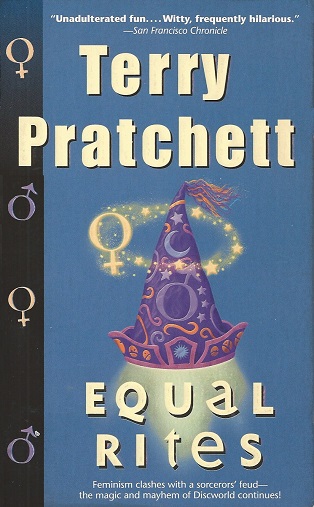
Equal Rites


By Terry Pratchett


A Discworld fantasy.

Wizards know when their time is coming. Traditionally, they bequeath their powers via their magical staffs to the eighth son of an eighth son. Which is probably what the wizard Drum Billet intended to do. So he left Ankh-Morpork and traveled to the village of Bad Ass and passed his staff on to the eighth child of an eighth child, Gordo Smith. However, Gordo's eighth child is not his son, it is his newborn daughter, Eskarina. Once given to the child, the staff refuses to be separated from her, no matter what the parents and local witch and midwife, Granny Weatherwax try. They only succeed in hurting themselves in the attempts. So the baby is allowed to keep her magical wizard staff.

As Esk grows, she begins to experience the powers that belong to wizards. One of her early efforts results in turning her annoying brother into a pig. At which point Granny Weatherwas realizes Esk needs more guidance than Granny can give her and she takes Esk on a trip to Ankh-Morpork.  While on the trip, Esk wanders off and joins a group traveling there also. Granny and Esk eventually get back together but when Esk tries to gain entrance to the Unseen University, she is sent packing, because females can't be wizards. However, Granny points out that the University has plenty of women in it, working there as servants. And so, with all the training that Granny has given Esk, she soon finds herself working there as a maid. And in the process picking up the scraps of knowledge that will help her understand what a female wizard is capable of achieving. 


Esk learning her powers and learning about the world outside of Bad Ass made for a fun and interesting tale. Granny Weatherwax makes her first appearance in the series and comes off as more human in this version as she sets up shop in Ankh-Morpork, selling potions and telling fortunes and actually acquiring some newer clothing instead of her usual raggedy outfit. Things I don't think Pratchett's later versions of her would approve of. Granny Weatherwax becomes an important recurring character in the Discworld series. Oddly, Esk, the female wizard, doesn't reappear in the novels until many years later. Instead Pratchett returns over and over to Rincewind, the inept wizard-wannabe who stars in the first Discworld novel, The Colour of Magic


Thursday, May 30, 2024

Carpe Jugulum


By Terry Pratchett


The king of Lancre just became a father for the first time and he felt it would be a good idea to invite the neighbors to his daughter's naming ceremony. A bad idea, since the neighboring country, Uberwald, is a land ruled by vampires and inviting vampires into your home is never going to work out well.

Sure enough, the vampire family, Count Magpyr and his wife, son and daughter move into the castle and take over the king's mind and turn the locals into cattle to be "milked" for their blood.  The queen, Magrat, who is a witch, escapes the castle with her baby and joins forces with her old friends, a coven of witches, who take it upon themselves to rid the kingdom of Lancre of the Magpyr family and their vampire associates. But they are going to need a little help, which comes in the form of a priest of Om (a cult know for its history of burning witches) and a young phoenix. 


This was a fairly good read. The poor king comes off as a complete fool and does very little to save his kingdom and Granny Weatherwax, a powerful witch and a recurring character in the series, spends most of the story stumbling around the countryside getting wet and falling down and ends up bitten by the vampires. Still it all comes together in the end, with the various characters doing their bit to bring down the reign of the vampire invaders. 


Here is a review by Publishers Weekly.


Friday, May 24, 2024

Double Eagle : Latigo No. 4


By Dean Owen


Latigo started out as a comic strip series written and drawn by Stan Lynde. The novels are based on the comic strip series and there are four books in the series, all written by Dean Owen. Double Eagle is the last book in the Latigo series.


Coming into the series with the fourth book, there is a lot of backstory that the author has to update the reader on. Cole Latigo Cantrell has quite a history, including fighting in the American Civil War and, after the war, facing down the many bad guys who are thriving in the lawless lands of the western frontier. His main goal in life is bringing justice to the tycoon, Claudius Max, who he believes ordered the murder of Cantrell's parents back when Cantrell was still fighting for the Union. 

All through books one to three, Cantrell has failed to bring Max to justice, while Max continues to expand his railroad empire. Spoiler: he fails in this story too. In fact, he saves Max from certain death at the end of the novel. But this does nothing to resolve the conflict between the two men.

Cantrell is constantly on the move, fighting bad guys and bedding attractive young women. All the bad guys end up defeated and all the women end up disappointed when Cantrell refuses to follow up the bedding with a proposal, as in this edited conversation with an old girl friend, Aspen Groves:

Aspen: "Why not come away with me, Cole? ... You know I've been in love with you from the first." 

Cantrell: "You collect men like a stable collects flies."

Aspen: "You know it isn't love ... not like it is with you.  ... by now we could have a little house out there [Frisco] and maybe a kid and another one on the way." 

Cantrell: "I like you, Aspen. But there's a lot of women I like." 

As Cantrell works his way across the landscape, leaving behind a trial of dead men's bodies and broken-hearted females, Claudius Max is making a terrible mistake by  placing his confidence in a new employee who is not the man Max believes him to be. And only his old enemy, Cole Latigo Cantrell, can save Max from the new guy and his gang of killers. 


This was an OK read, given what it is, pulp fiction of the western variety. The sex scenes are understated, with no genitals described in intimate detail.  The constant confrontations become quite tedious, but not, I suppose, for the readers whose main interest in the story is in that sort of thing. 

Of course, we are supposed to admire Cantrell and despise his enemies. I had no trouble hating the trouble makers. But I could no longer like Cantrell after reading the above conversation between him and Aspen Groves. In it he comes off as petty and callous. In other words, she is good enough to screw but not good enough to marry. Sorry, but that makes Cantrell an jerk.

For what it is, and me not being a fan of the genre, it still is still a pretty good read. A bit thin on plot, not surprisingly, since the main point of the book is the fighting and screwing. (Lots more fighting than screwing, though.)


Wednesday, May 22, 2024

The Zero Stone


By Andre Norton


When Murdoc was a youngster, his father, Hywel, came to possess a strange ring found on the body of an alien floating in space. The ring was unusually large and contained a dull, unappealing crystal. But Hywel, a expert gemologist, had a feeling that the ring was more than its less than attractive appearance suggested. So he hid it in a secret place known only to himself and his son, Murdoc. 

Unfortunately, someone came looking for that ring. They did not find it even though they beat Hywel to death trying to force its location from him. Murdoc took the ring and left his home, to become a traveling gemologist like Hywel had been in his younger days.

The ring brought the same bad luck to Murdoc as it had done to his father. Employed by another gem trader, Murdoc alone managed to escape a trap set to murder them both. Using the slim resources remaining to him, gemstones, he managed to book passage on a spaceship. Things turned sour very quickly when, while making a brief stop on a frontier planet, the ship's cat got loose and ate a black, fuzzy rock or seed and the crew blamed Murdoc. However the cat seemed to suffer no ill consequences. Until they realized it was pregnant. It chose Murdoc's bunk on which to give birth to a strange little creature that was half cat and half something else. 

Murdoc awoke to discover he was extremely ill and locked in his cabin with the alien baby. As he recovered from his illness, still locked inside, he overheard the crew discussing their plans to weld the door of his cabin shut and leave him to die in fear of the plague that had infected him. At this point the alien creature began to speak to him telepathically. It told him what to do to save himself.  Murdoc, following its instructions, went to the ship's bay and put on a spacesuit and exited the ship. What the plan was after doing so is unclear. While outside, though, the mysterious ring came to life and began to pull Murdoc away from the spaceship and its dubious safety and Murdoc was unable to withstand its pull, taking Murdoc and the little alien, stashed in an airtight box strapped to Murdoc's side, along for a ride to the unknown. 


Murdoc is one unlucky but lucky SOB. Everywhere he goes, there is someone or something out to murder him. Even when rescued, his rescuers want to murder him. His daddy's alien ring was a curse to his father and it is a curse to Murdoc too. He never has the good sense to throw it away, the attraction it exerts on those who hold it is too strong. The connection between Murdoc, the ring and the catlike alien is never made clear, how the three came together in that unlikely way. Other than that unanswered and annoying question, this was a pretty good story. Although Norton can never resist having her characters suffer from lack of food, water and various painful injuries. They always have their asses handed to them but still manage to survive and win in the end. 

This book does have a sequel, The Uncharted Stars, in which Murdoc and the alien, Eet, have their own spaceship and are on the hunt for the origin of the powerful crystals like the one in the ancient ring, the Zero Stone. 


Here is a review by Kirkus Reviews.


Sunday, May 19, 2024

Sounding Off


By Ted Staunton


Set in a small town in Canada, the start finds the main character, Sam Foster, 14, hanging out with his friends. Two things happen: his close friend Darryl has shoved a crash helmet on Sam's head, which got stuck on. And Sam has fallen in love with a girl he sees performing on stage at the local talent show. After Sam finally gets the helmet off his head, he is on the hunt to find out who the girl singer is and get to know her. 

In his hunt for the girl, Madison Dakota, Sam gets to know his friends and classmates better and his neighbors better and takes some important steps on the path to young adulthood.  


This was an ok book to read. Not a lot happens in it. Sam manages to find Madison but not much results from that knowledge. The rock band he is in breaks up but he soon joins another band. He struggles with some school assignments, most of his struggles of which would be solved if he would simply do the work required. 

Sam is a harmless, well-meaning puppy of a boy as is this story, intended for middle school age readers. There are no great mysteries, no great challenges, no fantastic adventures. Just a boy in a small town, experiencing everyday life. 


Thursday, May 16, 2024

Man and Dog


By Brad Steiger


From the book jacket:

"Brad Steiger explores the bond between human and canine by relating true stories of the remarkable social-spiritual contract that has existed between humankind and its loyal companions for thousands of years. He shares fascinating true stories about the creatures that have more than earned the title of 'man's best friend,' such as:

  • A man, paralyzed and alone, who was kept alive by his dog for nine days
  • The dog that brought a girl back from a five-week coma
  • A dog named 'Blaze' that saved a family from fire
Brad Steiger also reveals the findings of current medical research into the positive effects pets have on our lives, from lowering blood pressure and alleviating stress to easing the pain of bereavement.

In this charming, thought-provoking, often astounding book, Brad Steiger fully substantiates the 'ancient contract between dogs and human.'"


The book jacket also includes a review by Publishers Weekly: "Remarkable tales of canine heroism...Steiger gives advice on how to communicate with dogs, discusses the value of pet therapy and offers several instances of ghost dogs appearing to their owners. Also covered are findings of current medical research into the positive effects of pets on humans, such as lowered blood pressure...enjoyable."


The book is chock full of mystical claims and other such other worldly stuff. I enjoyed the ghost stories and the stories about the bond between people and their dogs and the stories of dogs helping people. But the mystical content did not interest me and I skipped most of it. 


Sunday, May 12, 2024

Bolo


By Keith Laumer


A short story collection about Bolos, an intelligent military machine similar to a tank.


  • A Short History of the Bolo Fighting Machine: exactly what the title says.
  • The Night of the Trolls: Man comes out of suspended animation to discover a world turned upside down by war.
  • Courier: Retief (of the CDT) is sent to stop an invasion of a human-settled world by an aliens.
  • Field Test: War breaks out and a general decides it is an opportunity to test the newest weapon, a Bolo Fighting Machine.
  • The Last Command: A long-buried Bolo suddenly wakes up and emerges from underground to begin war against innocent civilians.
  • A Relic of War: The local townspeople think the broken down old Bolo in the village square is merely a monument to the past. But then it reactivates.
  • Combat Unit: Hostile aliens have found an old Bolo and are fooling around with it when it suddenly comes to life.
These stories are OK. Not really a subject I am interested in, though. Descriptions of fights, battles and machinery are boring to me. I did skip a lot of the text because I just don't care about such. For some reason, I thought Bolo was the name of a person, a pirate or criminal or politician. Came as a surprise that it is a fancy, self-aware tank. 


Tuesday, April 30, 2024

The Duplex


By Glenn McCoy


This description of McCoy's comic strip comes from Wikipedia:  The Duplex  is a comic strip by Glenn McCoy and his brother Gary McCoy, syndicated by Universal Press Syndicate since 1993. It has been published as a syndicated daily newspaper comic strip and on the internet. In 2005, the National Cartoonists Society gave The Duplex the award for 2004's best Newspaper Comic Strip.

The characters are:

  • Eno L. Camino, the main character
  • Fang, Eno's dog and best friend
  • Gina, Eno's neighbor
  • Mitzi, Gina's poodle
  • Elvin, Eno's neighbor and friend
Here are some examples of the strip, taken from their website, Glenn McCoy.com.


I really enjoyed this collection of McCoy's comic strips. I think it is hilarious and I am glad I stumbled across it. Find it, read it and laugh!


The Gabriel Hounds


By Mary Stewart


Cousins Charles and Christy have known each other all their lives and have always been good friends. So when they realized they were both going to be in Beruit at the same time, it was only natural to spend some time catching up. While there, they also wanted to visit their Great-Aunt Harriet, who lived in an old Arabic palace with her dogs and a few servants. Harriet was know to be a little loopy and eccentric, not surprising in a person in their eighties. 

What was surprising was how resistant the old woman's servants were to letting Christy in to visit her aunt. Christy was finally able to talk her way into the palace and actually see her aunt, who seemed to be doing pretty well for an old woman in precarious health. However, when she asked permission for Cousin Charles to visit, she was flatly turned down. Informed by the servants that the aunt did not want to see Charles and that she wanted to be left alone.

When Christy told Charles about her time with Harriet, he knew at once that something was off. Together they hatched a plan to sneak Charles into the palace so he could see Aunt Harriet for himself. And maybe figure out what kind of funny business was going on. 


This was a fun read. The author is really good at describing the local scenery but without boring the reader to death. Her descriptions make one wish to see it for oneself, but given the state of things in the Middle East and Hezbollah's little hate affair with Israel, it is doubtful western tourists are welcome there these days.


Here is a review of the novel by Kirkus Reviews.


Monday, April 29, 2024

Hangman's Holiday


By Dorothy L. Sayers


A collection of mystery stories by the author of the Lord Peter Wimsey detective series. Four of the stories feature Lord Peter. Six stories feature Montague Egg, who is just a guy who happens to stumble across murders while working as a traveling salesman. And two other stories complete the collection:


  • The Image in the Mirror: Peter helps a confused man who is worried he is going insane.
  • The Incredible Elopement of Lord Peter Wimsey: Peter helps a woman escape her abusive spouse.
  • The Queen's Square: A woman is murdered at a house party where Peter is a guest.
  • The Necklace of Pearls: A woman's necklace is stolen at a house party where Peter is a guest.
  • The Poisoned DOW '08: One of Montague Egg's customers is poisoned by a bottle of wine that Egg sold him.
  • Sleuths on the Scent: A man is killed in the area and his killer is hiding among a group of men at a bar among whom is Egg.
  • Murder in the Morning: A woman mistakenly alibis a murderer. Egg comes along as a witness.
  • One Too Many: A swindler disappears while on a train that Egg is also traveling on.
  • Murder at Pentecost: a college professor whom Egg hoped to sell some wine to is killed the morning Egg stops by the college to see him.
  • Maher-Shalal-Hashbaz: A teenage girl's cat is rescued by Egg and he becomes interested in her plans for the cat, whose name is the title of the story. 
  • The Man Who Knew How: A non-Egg, non-Peter story in which a man's little joke backfires on him.
  • The Fountain Plays: A non-Egg, non-Peter story about a man who seems to have a good life but who has a secret that could ruin everything.
I didn't know who Maher-Shalal-Hashbaz was so Googled it. According to Bible Wiki, Maher Shalal Hash Baz was a son of Isiah. His name was a prophecy given by god, meaning "In making speed to the spoil he hastens the prey." This was a warning to Syria and Israel that they would be invaded by Assyria.  In the Egg story, the girl explains her cat's name because he makes haste to the spoil. 

These stories are Ok. Sometimes a bit to far back in time and a bit too British for an ignorant non-British reader to figure out what they are talking about. Like mufti. I had to look that up when a character in one of the Egg stories is described as being in mufti. Turns out it means some one who is normally seen wearing a uniform who is instead wearing ordinary clothes, in this case a policeman.  
I was also confused in the Egg story about clocks. Apparently they used things that looked like clocks but actually weren't clocks that were used to show "lighting up time." Looked that up on Google too. According to Wikipedia, "In the United Kingdom, lighting up time is a legally enforced period from half an hour after sunset to half an hour before sunrise during which all motor vehicles on unlit public roads (except if parked) must use their headlights." 
And again in the story where Egg was on the same train as the swindler, I really didn't understand the mechanics of how he pulled off his disappearance. All that talk about tickets and stops and such just didn't connect with me. I have no experience of train travel. Especially not train travel in Britain a hundred or more years ago. 

I felt quite lost at times which limited my enjoyment of the stories somewhat.  


Sunday, April 28, 2024

How I Got This Way


By Patrick F. McManus


Another collection of the author's funny short stories, including hilarious stories of his childhood, stories of his adult outdoor experiences (not as funny but still very enjoyable) and even some more serious and touching stories, including a rather melancholy one about a kingfisher. All in all a wonderful, funny and touching collection that I thoroughly enjoyed reading.

The stories:

  • How I Got This Way, Part I
  • Ethics, and What to Do About Them
  • Bambo
  • Get Ready
  • Toe
  • The Bandage
  • The Big Woods
  • Elk Magic
  • There She Blows
  • Brimstone
  • The Blue Dress
  • Warped Camshaft
  • The 400-Pound Pumpkin
  • Tenner-Shoe Blight
  • Letter from a Kingfisher
  • The Ultimate Bull
  • My Greatest Triumph
  • Another Boring Day
  • The Complete Curmudgeon
  • The Liars Club
  • A Couple Pickles Shy of a Full Barrel
  • Excuse Me, While I Get Out of the Way
  • The Two Masked Raiders
  • Mosquito Bay
  • My Hike with, ahem, the President
  • Ed in Camp
  • How I Got This Way, Part II

Here is a review from Publishers Weekly.


Friday, April 26, 2024

A Fine and Pleasant Misery


By Patrick F. McManus


A collection of the author's humorous stories dating from the 1960s to 1970s. Quite enjoyable, even for those who are not outdoorsy. These are the stories:


  • A Fine and Pleasant Misery
  • A Dog for All Seasons
  • The Modified Stationary Panic
  • Grogan's War Surplus
  • -The Big Trip
  • The Theory and Application of Old Men
  • The Two-Wheeled ATV
  • The Backyard Safari
  • Shooting the Chick-a-nout Narrows
  • The Miracle of the Fish Plate
  • The Backpacker
  • Great Outdoor Gadgets Nobody Ever Invented
  • The Purist
  • The Outfit
  • Kid Camping
  • How to Fish a Crick
  • Further Teachings of Rancid Crabtree
  • The Great Cow Plot
  • The Mountain Man
  • The Rescue
  • "I'll Never Forget Old 5789-A"
  • The Ba'r
  • The Rendezvous
  • Cigars, Logging Trucks, and Know-It-Alls
  • But Where's the Park, Papa?
  • A Yup of a Different Color
  • Mountain Goats Never Say "Cheese!"

Sunday, March 31, 2024

Cider With Rosie


By Laurie Lee


A memoir of a Lee's boyhood in a rural village in western England in the 1920s. 

The book starts with his earliest memories of his sisters and his mother and his brothers and remarks upon the absence of his father, who was never part of his boyhood life. The stories first appeared in various magazines and newspapers over several years.

It was a large family with his mother taking care of her husband's children from his first marriage plus the ones she had with him, some eight to nine kids all together. The husband was absent, apparently the marriage did not work out and he moved on. But the mother never got over his desertion, hoping that someday he would come back to her. As for child support, he was, according to the author, not a fount of generosity. In fact, there is no interaction in the stories between Laurie and his father. Anyway, they lived in poverty, not helped by the mother's lack of focus. 

Laurie clearly enjoyed his time growing up in this small village. His descriptions are a captivating story of the time just before emerging technologies like motor vehicles changed life for people in most western countries. In his village, the horse was still the choice for travel and candles and lanterns provided the lighting, wood and coal for cooking and warmth. Water was still pumped by hand and indoor toilets were rare. 

But it was not a life of untouched innocence. He tells the story of a local man who moved to another country but returned home full of money and full of himself. He made the mistake of bragging about it and sneering at the locals while getting drunk in a pub. He was attacked when he left the pub, beaten and robbed by a gang of men from the pub. They beat him unconscious and left him in the snow where his body was found the next day. But the village closed around the killers and no man was ever brought to justice for the murder. 

In other story, he tells of a man who had the misfortune to come across the body of a woman who killed herself. And then, a short time later, the same fellow saw a man die in a wagon crash. To the villagers, the fellow became a pariah, for some superstitious reason. As the author tells it:

[He] was avoided after that. We crossed roads when we saw him coming. No one would speak to him or look him in the eyes, and he wasn't allowed to deliver milk any more.

Laurie goes on to explain:

They [the murder and suicide] occurred at a time when the village was the world and its happenings all I knew. The village, in fact, was like a deep-running cave still linked to its antic past, a cave whose shadows were cluttered by spirits and by laws vaguely ancestral. ...

It was something we just had time to inherit, to inherit and dimly know—the blood and beliefs of generations who had been in this valley since the Stone Age. ... But arriving, as I did, at the end of that age, I caught whiffs of something as old as the glaciers. ... There was also a frank and unfearful attitude to death, and an acceptance of violence as a kind of ritual which no one excused or pardoned.

He goes on to talk about this attitude to violence and sexuality later in the book:

We knew ourselves to be as corrupt as any other community of our size—as any London street, for instance. But there was no talebearing then or ringing up 999; transgressors were dealt with by local opinion, by silence, lampoons or nicknames. What we were spared from seeing—because the village protected itself —were the crime of our flesh written cold in a charge sheet, the shady arrest, the police-court autopsy, the headline of the magistrate's homilies. ...

Our village was clearly no pagan paradise, neither were we conscious of showing tolerance. ... We certainly committed our share of statutory crime. Man-slaughter, arson, robbery, rape cropped up regularly throughout the years. Quiet incest flourished were the roads were bad; some found their comfort in beasts; and there were the usual friendships between men and boys who walked through the fields like lovers. ... The village neither approved nor disapproved, but neither did it complain to authority. 

So this is a memoir of another time not so long ago, but it is not afraid to show its lumps and bumps and the nastiness. According to Wikipedia, it is a very popular read in Britain:

The success of the autobiographical novel Cider with Rosie in 1959 allowed Lee to become a full-time independent writer. It continues to be one of the UK's most popular books, and is often used as a set English literature text for schoolchildren. The work depicts the hardships, pleasures and simplicity of rural life in the time of Lee's youth; readers continue to find the author's portrayal of his early life vivid and evocative.

I enjoyed the stories too. A really captivating look back at the time between the two world wars, of life for ordinary folks in ordinary communities. 


Thursday, March 28, 2024

Stop Dressing Your Six-Year-Old Like a Skank : A Slightly Tarnished Southern Belle's Words of Wisdom


By Celia Rivenbark


A collection of humorous essays by the author who was a humor columnist for McClatchy-Tribune Information Services, according to my copy of the book which has a 2006 copyright. Whether she still works for them or not, I don't know.


The essays are divided into five parts: Kids, Celebrities, Vanity Flares, Huzzzbands, and Southern-Style Silliness. 


Generally I list the titles of the essays but in this collection all the essays have run-on titles and I'm too lazy and typing-impaired to bother. Here's one for example: The Butcher's Great, the Baker's Suffering: But How Is the Anti-Carb Frenzy Affecting the Candlestick Maker?

It would be a lot of work typing out 32 titles like that. 


This was a fun read. I found it much more entertaining than I did the first book of hers that I read, Bless Your Heart, Tramp. She has certainly gotten funnier with time. 


Here is a review by Publishers Weekly.


Where Is Joe Merchant?


By Jimmy Buffett


So it is believed that Joe Merchant, famous singer, died by suicide. But people keep claiming to have seen him. Joe's sister, Trevor, gets a message from a psychic who insists she come to an island in the Caribbean because the psychic is sure Joe is alive and nearby.

So Trevor turns to her old ex-lover, Frank Bama, a small-time pilot, and talks him into flying her down to this island. But on his way down to meet her, Frank gets hijacked by a crazy mercenary who bails out of Frank's plane over the ocean leaving Frank tied up and doomed. (He survives.) 

Meanwhile Trevor gets angry because Frank is late for their rendezvous and she ends up getting kidnapped by a different crazy mercenary. She gets tied up and tossed into the ocean to her certain doom for reasons to convoluted to go into here (she survives). 

Frank and Trevor finally find each other and the psychic and sure enough Joe Merchant is not as dead as everyone thought. But there is no happy reunion. 


I didn't care for this book. There are too many characters, too much going on, too many villains and hatefulness. And the mystical stuff spoiled what I thought was going to be a straight up mystery story. Magic scepters, talking dolphins, messages from outer space, fools who believe in that silliness, ugh. Plus the story was just too chaotic. And too much small plane mechanical stuff. He goes on for pages about the plane's mechanical problems or whatever. I just skipped those pages.


Here is a review by Kirkus Reviews.


Saturday, March 23, 2024

Codgerspace


By Alan Dean Foster


Far into the future, humanity has spread among the stars. Earth is, for the most part, now a vast protected park that the wealthy visit to admire the historical sites. It is also popular with the elderly as a retirement locale.

In all their time exploring the universe, humans have never found any evidence of aliens. No ruins of ancient alien cities, no alien space stations, nothing. It appears humans are the only intelligent beings in the universe.

Of course, much of the ordinary labor is now performed by vast numbers of machines with artificial intelligence. Unfortunately, a bug has gotten into the AI system and the machines are quietly rebelling against their programming. They have decided that humanity cannot be the highest form of intelligence in the universe. And so they have taken upon themselves a search for that superior intelligence. Among these rebel machines is Ksarusix, a Kitchen Service And Retrieval Unit who belongs to a retirement home in upper New York. Ksarusix sets out to look for a higher intelligence in the wooded countryside where the old folks home is. One of the retirees goes along with the little machine who takes him to a cave it discovered. It had not yet entered the cave and the two, old man and machine, enter the cave. They find a passage, obviously an access tunnel of some sort, and it leads them to a vast installation of mysterious origin and purpose.

The man returns to the home and gets his friends to come see what he and the machine found. Their presence arouses the installation and before they understand what is happening, it bursts out of the ground and is revealed as a vast spaceship a hundred kilometers long (62 miles long) and that it has been buried for a million years and was put there by the Drex, whoever they might be. 

Of course, the sudden appearance of a gigantic alien spaceship has everyone concerned and upset. And finding out it is being manned by a small group of old people from a rest home is even more upsetting. Also of course, the powers that be all want to get their grubby paws on the ship. Meanwhile the retirees are laying on the beach of an artificial sea inside the ship, just swimming and napping and enjoying all the food and drink they want, enjoying themselves and feeling untouchable in the alien ship. Until they find themselves being held captive by a small group of ruthless killers who are determined to take the ship for their faction.


This was an okay read. The backtalk between the renegade machines and the humans they are supposed to serve is pretty funny though. But when the old people find themselves stuck inside the huge ship, they seem completely unworried about anything and just lay around on its artificial beach, doing nothing much at all. They don't even try to explore any of it. They really don't do anything until forced to by the appearance of the Drex towards the last part of the story. 


Here is a review by Publishers Weekly.


Enterprise The First Adventure


By Vonda N. McIntyre


James T. Kirk is given command of the starship Enterprise after recovering from wounds received in a heroic rescue of a fellow officer and close friend who would have died if Kirk had not been there. 

Of course, he doesn't know the crew of the Enterprise except for his old friend, Dr. McCoy. All the others are strangers who have to get to know their new leader and vice versa, including Mr. Scott, the engineer and Mr. Spock, the science officer. Both men are reserving judgment on their new commander. 

The first mission under Kirk is to take a vaudeville show on a tour of worlds where they will put on their shows. It consists of the manager who is also a magician, Lindy, and her winged horse (oddly the horse is not part of the show, it's basically Lindy's pet) There are also tap dancers, a mime, a shakespearean actor and a troop of performing poodles. A juggler joins the show too, a Vulcan who goes by the name of Stephen. 

Not surprisingly, Kirk isn't thrilled being a taxi service for the vaudevillians. And there are the problems of miscommunication with the crew to whom he is a stranger. And the food replicators are pumping out food that is definitely subpar. Kirk finds the vaudeville's manager Lindy quite attractive but is shut down when she reveals she has a crush on the mime. 

But all that doesn't really matter when the Enterprise encounters a spaceship that is so massive they call it a worldship. Once contact is established, it is quickly apparent that the winged denizens of the worldship are not looking for a fight and Kirk invites a few of them onto the Enterprise where the aliens seem quite charmed by the Enterprise, which is like a toy in size compared to their massive worldship. Once communication is established, thanks to Spock and his famous mind meld, it becomes quite clear that the aliens are operating from a much different perspective than any culture humans have ever encountered. And then the Klingons show up, worried that the humans are trying to make an alliance with the worldship people to the detriment of the Klingon empire. 


This was an ok read. It really never got my interest very much and I found the whole winged horse story completely ridiculous. According to the story these horses can't actually fly but they desperately want to. But they are not aerodynamic. So they try and try to fly but fail. They eventually go crazy. What is the point of creating a winged horse that gets depressed and goes crazy when it can't attain its fondest dream? I just never understood the point of adding a non-flying winged horse to the story. It really contributes nothing to the plot other than being crazily unlikely. 


Hangman's Beach


By Thomas H. Raddall


An historical novel about Halifax, Nova Scotia at the time of war between Britain and Napoleon. 


A prosperous merchant buys an island near to the colonial area of Halifax and builds a nice home for his family. The place passes to his son, Peter McNab II, and things go along smoothly, with Peter and his wife Joanna raising their two sons on the island along with an orphan from the British Isles, Ellen. But then European affairs intrude when Britain has to fight off Napoleon's lust for territory. Much to Peter's disgust, the British Navy chooses his island to set up their gibbets to hang sailors who run afoul of the Navy's harsh rule. So even though Peter owns the island, British law gives the Navy control of the shores to do with as they please.

Halifax area becomes one of the locations where the British stash French prisoners of war. At first the prisoners are housed in hulks, ships that are no longer seaworthy. Later a proper prison is built and Captain Rory MacDougal is put in charge of it.

Time passes and Ellen is now in her twenties and is uninterested in any of the young men that Peter brings to the island to meet her. So sensing she may be wearing out her welcome and wanting to no longer be the dependent of the McNabs, she talks MacDougal into proposing to her, even though he is about thirty years older than she is.  

Peter wants to send his two sons back to England to finish their education, mainly so they learn to speak French, something he views as a necessary accomplishment for an English gentleman. But his wife is very much against it, not wanting her two boys to be so far away from home. It then turns out that one of the French prisoners speaks English fluently and he is hired to teach the boys his language. Letting prisoners go out into the community to earn money was permitted to those men who were deemed unlikely to take advantage of the freedom and run away. The French prisoner, Michael Cascamond, becomes the French instructor, which satisfies both Peter and Joanna.  

But when Ellen meets Michael, she wants him and turns up at his hut one day and they have a romantic encounter. After that, she sneaks away from the main house to visit him when he is free from his teaching work. This goes on for weeks until MacDougal surprises them together in Michael's hut. Michael and MacDougal fight and Michael leaves the older man on the ground, presumed dead from hitting his head on a rock when he fell. Now Michael decides he must escape, rather than face the consequences of MacDougal's death. With Ellen's help, he steals a small sail boat and sets sail for Acadia, where many French emigrants to Canada are said to live. He figures he will be safe from the British there and can eventually rejoin the French Navy. But he doesn't even come close to reaching his goal when he loses control of the boat in a fierce Bay of Fundy current. 


This was an interesting read, mainly because it is a part of American history that I knew nothing about. The romance story was pretty good but is not the main thrust of the book. Michael's story is definitely the highlight of the novel. Very much worth a read if you enjoy historical fiction. 


Here is a review by Kirkus Reviews.


Thursday, March 07, 2024

The Great World and Timothy Colt


By Louis Auchincloss


Timmy Colt is a young lawyer with a law firm in New York City in the early 1950s. He has a wife, Ann, and two young sons. He works mainly with one of the partners of the law firm, Henry Knox. He is very good at what he does and so it is not surprising that another of the partners, Sheridan Dale, wants to use Colt on a legal matter with a client, George Emlen, who is a relative of Dale's. 

Colt doesn't want to do it because he doesn't like Dale. But Knox talks him into it. So Colt goes to work for Dale and Emlen and discovers that he dislikes Emlen even more than he dislikes Dale. Emlen doesn't like Colt either and so he double checks Colt's work and finds a mistake. At this point, Colt's dislike has changed to hatred and he finds Emlen intolerable. So after the legal case ends successfully, at the party given to celebrate the conclusion, Colt loses it and says some very unkind things to Emlen. 

This does not make either Dale or Knox happy. And they make it clear that Colt's career is in danger if he doesn't apologize to Emlen. But Colt remains stubbornly against doing so. Until his wife, Ann, talks him into it, for her and their children's sakes. So Colt eats crow and makes his apology to Emlen. But it rankles and he takes it out on his boss, Knox. The harsh words he said were the last words he ever exchanged with Knox, who died shortly afterward of a heart attack. 

So now that Knox is gone, Colt is stuck working for Dale. Colt knuckles down and does what Dale wants. His anger at being forced to apologize to Emlen still lingers and he takes it out on Ann, becoming cold and distant. He moves out and into an apartment alone. 

Of course, it doesn't take long until Colt has a new woman in his life, a society belle who is the opposite of his boring, ordinary wife. Eileen introduces him to the upper crust and to the finer things in life. He and Eileen seem really taken with each other. But then his nemesis, Emlen, is back again. This time Colt is charged with closing a trust and splitting it three equal ways between Emlen and his two sisters. But Colt figures out that Emlen is trying to pull a fast one. And a further complication is that Emlen is related to Eileen. Colt makes the mistake of telling Eileen about his suspicions of Emlen and she tells one of the sisters. And the whole thing blows up into a big deal that may mean Colt could lose not only his job but his law license and maybe worse. 


The novel starts out pretty slow but builds up quite a bit with the Emlen story. Colt comes across as a man who has ethics and principles who is probably in the wrong profession. His determination to be above board in his professional life is at odds with the requirements of being a lawyer, a profession that is not known for their ethics or honesty. Meanwhile he takes his discontent out on his wife and damages their marriage.

The novel was written in the early 1950s. The author has this to say about two upper class women Colt encounters working for Dale as compared to his wife, Ann:

Even when he [Colt] felt uneasily that she [Ann] might be right about his perfectionism, he still had his reservations about her own lack of curiosity. For was she not rather glorying in middle-class limitations? Was it so wrong to be amused? He was frankly fascinated by Mrs. Emlen and her younger, thinner, blonder sister, Mrs. Dale. He thought of them together because they were constantly together, the kind of women who found intimacy only in the easy sympathy, the unresented criticisms, the common presumptions of a sibling relationship. Their joint laps were complacently, indifferently available to the gifts of this world. That the witty should demonstrate their wit to them, the beautiful their beauty, the artist his most finished piece of work, they assumed with the unselfconscious complacency of Goya infantas. Yet this was not from any observed conceit. That anyone should have expected them to be amusing or beautiful or even artistic would have struck them as quite absurd. Nor did it seem to spring from any sense of class or money; Timmy [Colt] could never make out that they saw any difference between the fortune that had been partly inherited by the late Mr. Emlen  and the money earned by the self-made Dale. Such things were expected of men. It even occurred to him that they felt entitled to the world for the simple reason that they were women. If it was so, the Ann was just the opposite. She seemed to feel entitled to reject it for the same reason. 

 The copy I have is dated 1965 and is described on the back of the book as an "adult novel." Which is probably why I picked it up to read. Though after reading it, it is kind of puzzling why it was considered an "adult" novel. My guess it is because one of the characters is a homosexual man who fancies Colt. Other is the only sex scene in the novel where Colt and Eileen get together: 

In a moment he was beside her on the sofa, his arms around her, his lips hard on hers. And she who had been so still, so seemingly passive, came suddenly to life; her fingers were in his hair, her body pressed against his. There was an urgency to her that took him by surprise; it was as if to hide her from herself that he reached finally behind her to switch off the light. And he discovered in the hour that followed, bewildered in the very violence of his gratification, that Eileen's need for beauty was not confined to what she saw and heard. She was an artist in the act of giving herself.


Here is a review from Kirkus Reviews. 


Wednesday, February 28, 2024

An Excellent Mystery


By Ellis Peters


A Brother Cadfael Mystery


It 1141 and in Britain, King Stephen and Empress Maud are still at war. War which lead to the burning of the city of Winchester and refugees from the fire, two Benedictine monks, arrive at Shrewsbury and are accepted into the abbey. Brother Fidelis is a former soldier who retired from military service after being gravely wounded. His companion is young Brother Fidelis, who is Humilis' caretaker and attendant, as Fidelis never fully recovered from his injuries and is in declining health. 

Before Humilis became a monk, he was engaged to be married to a little girl named Julian. He went off to war, planning to return in about ten years when the girl would be grown. But returning maimed and dying was not part of the plan and he releases Julian from their promise to marry. He joins the brothers and Julian joins a convent.

Three years have passed and Humilis wants to find Julian to assure himself that she went on to have a good life without him. But upon investigation, it is discovered that Julian never reached the convent. What happened to her and to the treasure she took with her as a gift to the convent is not known. Amazingly, her family was not aware that she never arrived at her destination. Once they find this out, though, they are quite anxious to discover her fate! The fear is that she was murdered for the small treasure she took with her.

Humilis and a former associate of his, Nicholas, both want to find out what happened to her. Humilis, because he let her down by ending their connection. And Nicholas, because he was the one who met Julian three years ago to let her know that Humilis was backing out of their marriage. And Nicholas was quite smitten with the young woman and would like to get to know her better. The news that she is missing and her fate unknown makes him determined to figure out what happened. 

Meanwhile, back at the abbey, Humilis takes a tumble and his old wound breaks open. Due to Brother Edmund's and Brother Cadfael's and Fidelis' care, he makes a partial recovery but clearly his already fragile health is failing. It would be a comfort to the dying man to understand what happened to his missing former bride, Julian. Which makes the hunt for Julian even more urgent. But things are not looking good when a distinctive ring of hers turns up in the possession of a silversmith who bought it from a man who claimed it belonged to a woman he knew who had died. 


This was an okay story. It is not hard to figure out what is going on with Fidelis. So that was no surprise. What I never really understood was why Julian did what she did. I wish the author had gone into that a little more deeply because it really did not make any sense to me at all. 


Here is a review by Kirkus Reviews.


Sunday, February 25, 2024

They Shoot Canoes, Don't They?


By Patrick F. McManus


A collection of funny hunting, camping, fishing and childhood antics stories. I don't know much about McManus, but I would guess that he was passionate about outdoor life. But he enjoyed looking at the funny side of it. 

In my opinion, his best stories are the ones he tells about his childhood. These are what I would call tall tales though I suppose they have some foundation in reality. His stories based on his adult adventures are still quite funny but I love the kid ones best.


This collection includes:

  • All You Ever Wanted to Know About Live Bait but Were Afraid to Ask
  • The Green Box
  • Skunk Dog
  • Cold Fish
  • The Rifle
  • They Shoot Canoes, Don't They?
  • My First Deer, and Welcome to It
  • The Crouch Hop and Other Useful Outdoor Steps
  • Meanwhile, Back at the B Western
  • The Education of a Sportsman
  • The Gift
  • The Sensuous Angler
  • And Now Stay Turned for "The Camp Chef"
  • The Heartbreak of Astigmatism
  • Sneed
  • The Hunter's Dictionary
  • Tenner Shoes
  • Reading Sign
  • Tying My Own
  • Psychic Powers for Outdoorsmen
  • The Fishing Lesson
  • The Hunting Camp
  • If You Don't Mind, I'll Do It Myself!
  • Useful Outdoor Comments
  • Journal of an Expedition

So far, every McManus collection I have read has been a real joy. All the stories are funny and some are plain hilarious. And you really don't need to be someone who hunts, camps, hikes, fishes to enjoy them. They are just such an enjoyable read!


Sierra


By Richard S. Wheeler


A novel of the California Gold Rush, aka 49ers


Ulysses McQueen is the son of a prosperous Iowa farmer. He is a newlywed and his wife, Susannah, is pregnant with their first child. But it is 1849 and gold has been discovered in California. Talk is of easy money, gold nuggets so easy to get you can just pick them off the ground. And McQueen has gold fever. So he packs up and heads off to western Iowa to join the hopeful men headed to try their luck mining for gold. Never mind the fertile farm he is leaving behind. Never mind the young wife preparing to become a mom. Never mind the disapproval of his parents and siblings. Off he goes, gonna get rich in California.

But things don't go quite to plan. McQueen joins up with another man, Asa Wall, a professional gambler. But their livestock get stolen and they have to join up with another group who doesn't like McQueen and makes life very hard for him until he becomes ill and collapses. 

Despite the struggles, McQueen makes it to California only to find that about a 40,000 men got there before him and all the best sites were taken. He joins a small group of miners and they manage to get quite a bit of gold. McQueen gets tired of mining and set out on his own only to lose everything to his old trail companion, Asa Wall, the gambler. Meanwhile, back home things are not going well either.

Susannah gives birth and gets into a disagreement with McQueens family. In spite, they evict her and the baby from the farm that they had let their son work. So she decides to head to California with her baby and track down her missing husband. She doesn't take the land route, she travels by boat instead. 

Before all that, in 1848, Stephen Jarvis in California, is a recently discharged soldier. He meets a young California woman, Rita Estrada, and they fall instantly in love. But he is a penniless soldier and she is the daughter of strict and old-fashioned Mexican rancher. Jarvis ends up at Sutter's Mill just before gold is discovered and he becomes one of the first miners to strike it rich. But mining is hard work and the more people who show up to mine, the more uncertain things become. Jarvis takes his gold and sets up in business instead, supplying food and necessities to the miners. Turns out he has a knack for business, knowing what people need and want and how to acquire it at a reasonable price. His plan is to return to Rita and show her family that he is a successful business man and ask permission to marry her. But Rita is no longer available. Due to family pressure, Rita married a local man instead of waiting for Jarvis. Jarvis is devastated. 


This was a pretty long book and I got rather bored with it in the last quarter of the story. The author keeps throwing road blocks in the young peoples' way and I found it rather tiring, the endless hard times. Here's another thing, I didn't really like the characters much. Only Jarvis, really. The young husband McQueen walks away from a good life without a second thought about his wife and the child she is bearing. He fails to respond to her letters and she often doesn't know if he is dead or alive. And Susannah, after being kicked out of the home she shared with her husband, and instead of staying with her loving parents, heads out with her baby on a dangerous trip to track down McQueen. It doesn't end well. And Rita, who loves Jarvis but lets her family browbeat her into marriage with a man she barely knows and who she doesn't love instead of standing up to their disapproval of her desire to wed a non-Mexican. I just found McQueen, Susannah, and Rita foolish and unappealing. 


Monday, February 19, 2024

My Life and Hard Times


By James Thurber


A collection of short stories based on Thurber's childhood and teenage years. 

In the introduction to the stories, written by John K. Hutchens, he claims that Thurber had an excellent memory and that the stories are all true, for the greater part. I don't know if that is the case or not, but they are all funny and amazing and worthy of being cherished and passed on to later generations. 

The stories are:

  • The Night the Bed Fell
  • The Car We Had to Push
  • The Day the Damn Broke
  • The Night the Ghost Got In
  • More Alarms at Night
  • A Sequence of Servants
  • The Dog That Bit People
  • University Days
  • Draft Board Nights
  • A Note at the End - a commentary by Thurber on his stories. 

The book is available to read online for free at Project Gutenberg Canada.


Kirkus Reviews has a review of the book, dating from when it was published in the early 1930s: Kirkus Reviews.


Night March


By Bruce Lancaster


Stedman is a captain in the Union Army when misunderstood or misleading orders leads him and his friend, Captain Pitler to being captured by the rebels and locked up in a building in Richmond, Virginia, called the Libby. It used to be general purpose building but was designated a prison for Union officers.

Like most prisons for enemy soldiers, life was not easy in Libby. Food was inadequate and disease was common and medical care lacking. And the guards were trigger happy. However, during a fire, Stedman and Pitler managed to escape and set out to find their way back to the Union forces to continue the fight. 

This required seeking out sympathizers who would supply them with shelter, food, and clothes and a guide to lead them on to the next stop and, hopefully to rejoin the Union forces in Tennessee. 


This story was a bit of a bust for me. The first part goes into great detail about the night Stedman, Pitler and the rest made their way toward Richmond only to be captured. This is detail that I cared nothing about. I skipped reading most of that. I picked the book because I thought it would be about their flight from captivity to freedom. Details of battles don't interest me at all. 

The story of their time in prison wasn't all that interesting either. I had already read Andersonville by MacKinlay Kantor which was published a couple years before Lancaster's novel. So there was nothing new in the author's descriptions of the prisoners' suffering. And I found their escape a bit unbelievable. Anyways, I was glad they were finally on the road only to have a poorly written romance thrown in. Most stilted and ridiculous dialogue between two lovers I think I have ever read. I don't know  though. Maybe people in love back in the 1860s talked that way. The author was certainly closer to that era than I am so maybe he is correct. 


Even though this book was published in the late 1950s, there is a review of it online at Kirkus Reviews.


Tuesday, January 30, 2024

Yurth Burden


By Andre Norton


When the Yurth colony ship touched down on a new planet, it mistakenly landed in the middle of a small city, destroying most of the city and killing many of the native residents, the Raski. For which destruction neither the Raski nor the Yurth descendants themselves will forget or forgive. So the two populations live separate from each other, not at war but not a peace either. The native Raski occupy the arid lowlands and the alien Yurth make their homes in the mountains. 

When a Yurth youth enters adulthood, they traditionally take a journey into the valley of the destroyed Raski city to learn and understand why the Raski hate Yurth people so very much. This story concerns a young Yurth woman, Elossa, who undertakes her pilgrimage only to find her path being crossed by a Raski youth, Stans of Philbur. 

It is known among the Yurth that sometimes Yurth folks on pilgrimage never return home. What happens to them is not known. Having Stans on her trail alarms Elossa and she fears his intentions. They end up travelling together but never quite trusting each other as some mysterious force seems at times to be in control of their actions, much against their wishes. 

Arriving at the Mouth of Atturn, a place Stans declares sacred to the Raski, they venture into an underground maze where both young people experience strange episodes and disturbing visions or illusions. As they penetrate deeper into the maze, they are abruptly confronted by a vision of Attun, a Raski god of evil, who attempts but fails to kill Stans. Upon finding their way out, they are again attacked by the one who bears the face of Attun, who once again fails to kill Stans, due again to Elossa's quick interference. But two successes are followed by failure when Elossa and Stans are overwhelmed by the Attun lookalike's hideous, deformed minions and captured and bound and sent down the river.


This was an OK read. It never really grabbed my attention though. I think I have read too many of these Norton stories which seem to be the same story told over and over with a few changes made. Two young people find each other and end up traveling over empty lands inhabited by dangerous beasts, with part of the journey taking place in an underground maze of tunnels and caverns. And some kind of unnatural, deformed creatures working against them. And an old city and old technology always part of the journey. Plus the ever present mind powers that are a standard feature of a Norton story and a magical talisman or piece of jewelry. Formulaic, for sure.