Friday, October 04, 2024

Vita Nostra


By Marina & Sergey Dyachenko


Book One of the Vita Nostra trilogy


Sasha was a promising young high school student when she noticed a strange man is watching her whenever she is outside. Eventually the man approached her and gave her a task to perform. Every morning she had to get up early and go to the beach, strip off her clothes and go for a nude swim. If she didn't do as he said, there would be bad consequences to her family: "You will, Sasha. You will. Because the world around you is very fragile. Every day people fall down, break their bones, die under the wheels of a car, drown..." 

Sasha only has one person that she loves in her life, her mom. Sasha's dad is not a part of her life and she has no siblings. It's just Sasha and her mom. So she does what the strange man orders her to do. Of course, it doesn't end with the nude swimming. As graduation approaches, he forces her into attending a small college in a distant town, the Institute of Special Technologies.

Once she gets settled into the college, she comes to understand that all the students attending are there under the same threats she is. She gets to know one male student who stood up against the strange man. This kid, Kostya, reveals that the man is his father. Kostya did not want to attend this college either and as a consequence, his beloved grandmother died. And his father made it clear it was because Kostya was defying him. The two kids vow to kill the man, Kostya's father, if they ever are able to do so.

The texts and the rules of when and how to study them are different and strange and perplexing. But Sasha begins to absorb them and her perceptions of reality become affected. She is such a good student that she gets into trouble for reading ahead and experiencing frightening consequences. On one hand, her instructors applaud her achievements but then get angry when she gets too far ahead. She is constantly getting into trouble for that.

But outside of the studies and the feeling of oppression that envelopes the students, life there is typical of any college. Kids form cliques, kids pair up, kids test the boundaries, drink too much, smoke too much, hook up too much. Sasha is no different from the kids when it comes to college kid behavior. She gets involved with Kostya but then dumps him and finds a new boyfriend. But she and Kostya never lose their connection of their hatred of his father. 

As the college years pass and Sasha becomes an adult, she begins to understand just what the teachers are and what she is becoming. This is where the story gets even more strange. I would like to explain it but it sounds so ridiculous. All I can say is everything is words. Sasha is a word, Kostya is a word, all humans are words or parts of words. And that Kostya's father, the man who forced her into this situation, is not human. He is a text file? A program? A book disguised as a person?  It was all rather murky to me.


The book was really interesting even though the transformations the students are enduring are hard to comprehend. It's kind of a combination of Harry Potter and The Matrix. The students' understanding of the true nature of reality gives them powers, including the ability to manipulate time itself. But they don't perform spells (at least not in this book), their abilities arise from the perception of the true nature of things. Quite a start to a new series! 

The next book in the series is Assassin of Reality. 


Here is a review by Kirkus.


Monday, September 30, 2024

Sisters of the Confederacy


By Lauraine Snelling


Book Two of the A Secret Refuge series, a three-part series.


The story of two young women, Jesselynn Highwood, who goes by Jesse, and Louisa Highwood. Jesse, in Missouri, is passing as a teenage boy, trying to lead her people to Oregon to start a new life away from the Civil War and to freedom for the black members of her group. Louisa is in Virginia, helping her brother take care of several wounded Rebel soldiers in their home. The brother, Zachary, was gravely wounded in the war, having lost an eye and two limbs, but has recovered and has also put a stop to Louisa helping take care of the wounded at the army hospital. 

Jesse has all the weight of trying to shepherd her people and animals safely to Oregon while Louisa has all the irritation of being limited in what she is allowed to do since her brother returned home and put a stop to her work at the army hospital. Her situation is the opposite of that of Jesse's, who is overburdened, while Louisa is feeling put aside.

It takes the story quite a while to get Jesse's group headed west. Bored Louisa spends most of the story being upset at her brother but finally turns, with his help, to smuggling opium, a pain reliever that the army hospital has run out of and sorely needs but is no longer available. When Jesse finally gets her group attached to a wagon train and headed west, her masquerade as a boy is quickly discovered, not surprisingly. And back at Louisa's tale, her disabled brother has vanished without an explanation. Will it turn out ok for the two young women? The reader will have to read the third book in the series, The Long Way Home, to find out.


It's a good story although it gets off to a slow start. It has a lot of religious stuff in it though. I picked this book to read from a recommendation online and it did not mention how much of the book was about the main character's religion. I also did not notice that the publisher is Bethany House, a publisher that specializes in Christian publications. 

I'm not going to blame the book for being too religious. But most of the way through the story, it felt to me like it was a Christian tract disguised as a novel. That was before I noticed the publisher was Bethany House.

Also, the book is the second in the series of three. Probably should read the first book, Daughter of Twin Oaks, before starting on this one. I didn't and there is a lot that happens in the first book that is touched on in this story and that makes it sound much more exciting and dramatic than this one. Like how Twin Oaks burned and how Zachary nearly died. And how they got their horses away and safely hidden away from being taken by the military. 


Cold Mountain


By Charles Frazier


The story of Inman and Ada, two lovers separated by the US Civil War, who manage to find each other after years apart.

Inman, who fought on the Confederate side, was seriously wounded and had not yet recovered from his injury when he decided he was leaving the war and heading home. He wanted to see Ada again, even though he was not sure she cared for him. He set forth on a perilous journey from Raleigh, North Carolina to Cold Mountain, North Carolina, which is in the Blue Ridge Mountains, a distance of about 290 miles. He has many dangerous encounters and ends up captured by a criminal gang. Things go from bad to worse for Inman.

Meanwhile, back on Cold Mountain, Ada, the only child of her wealthy and indulgent father finds herself in charge of her father's large farm due to his sudden death. Pampered all her life and all alone, as local farmhands have all gone off to the war, Ada is wallowing in depression and loneliness barely able to survive until a caring neighbor sends young Ruby to help out. Motherless and deserted by her worthless father when she was only eight, Ruby is a graduate of the school of hard knocks and has learned how to live off the land and raise crops and livestock. Together, Ruby and Ada turn the farm into a productive enterprise, in the process giving each other the companionship neither woman really wants to admit they need. 

As for Inman, Ada thinks about him occasionally. The attraction between the two was certainly felt more strongly by Inman than by Ada. But as time passes, Ada begins to think more about him and the way he touched her hair and neck that one time. If Inman makes it back to Cold Mountain, Ada won't be turning him away. If he makes it back.


This was a pretty good story. But two thirds of the way through it, I stopped reading it after I read the part where Inman beats another man's head in. The man deserved it, but I just got tired of all Inman's struggles. I had to take a break. The book sat unread for nearly three weeks before I picked it back up again. It's not a fun book to read. And I enjoyed the story of Ada and Ruby much more than I did that of poor Inman. 

The book won the National Book Award for Fiction in 1997. It was the author's first published novel. It was also made into a movie that was nominated for several awards in 2003.


Review by Kirkus Reviews.


Saturday, September 07, 2024

Wanda Hickey's Night of Golden Memories and Other Disasters


By Jean Shepherd


A collection of humorous short stories by Jean Shepherd, mainly based on his years growing up in an industrial town in Indiana, eight stories altogether.


  • The Grandstand Passion Play of Delbert and the Bumpus Hounds — A large family of 'hillbillies' moves in next door to the author's family. Between the packs of angry dogs, the drunken parties, the shouting and the piles of junk and trash, the author's dad is almost at his wit's end when the Bumpus folks vanish in the night.
  • County Fair! — a trip to the county fair in the 1930s which revealed to me that county fairs haven't changed much in almost 100 years. One of the best stories and the most realistic story in the collection, I think.
  • Scut Farkas and the Murderous Mariah — a top battle, top as in the spinning toy. This one was a struggle for me, because I had no idea what the author was talking about, top battles? Also, basically a sports story of scant interest to  me who cares not for sports.
  • Ollie Hopnoodle's Haven of Bliss — loading up the family car for a trip to Clear Lake to spend a couple of weeks in a rustic cabin. An ordeal that many of us have had to endure in our lives. 
  • The Star-crossed Romance of Josephine Cosnowski — a Polish family moves into the neighborhood and one of the kids is a teenage girl about the same age as the author and she is undeniably attractive. Author asks her out on a date finds out a lot about the girl and her family and he gets cold feet.
  • Daphne Bigelow and the Spine-chilling Saga of the Snail-encrusted Tinfoil Noose — the author has a crush on his biology lab partner, Daphne, and works up the courage to ask her out on a date. He realizes he is out of his league when he arrives at Daphne's home and it is a mansion, with servants and a Cadillac and driver. 
  • The Return of the Smiling Wimpy Doll — the author, now an adult and living far from his childhood home, receives a package from his mom containing his childhood toys and he has a blast rediscovering these treasures from his youth. A really sweet story that made me sad because all my childhood mementos were thrown away by my mom when she moved and it never occurred to her to ask if I wanted any of it. 
  • Wanda Hickey's Night of Golden Memories — returning to the author's childhood and it is time for his high school's Junior Prom. Time for fancy clothes and figuring out who to date and how to get there and all the fun before and after Prom. A bittersweet story, as I never attended a Prom or a high school dance. 
All these stories are fun and bring back memories on one's own childhood and teenage days. Really, things haven't changed all that much since the 1930s, in many ways! 

Here is a review of the book by Kirkus Reviews.


Wednesday, September 04, 2024

Lost & Found


By Jacqueline Sheehan


Rocky's husband died of a sudden heart attack and she is having a very hard time coping with her grief. In order to give herself a breathing space, she leaves her home and moves into a rental house on a touristy island off the coast of Maine during the off season. 

Looking to occupy her time, she takes on the part time job of animal control officer. She deals with a lot of stray cats, problem raccoons and pets abandoned by the summer people. One of the animals she deals with is a Labrador retriever who is found seriously ill and crippled by an arrow in his shoulder. 

Rocky fosters the dog, which she names Lloyd. It seems to her, as a person who is dealing with grief, that Lloyd is dealing with grief too. When it turns out that the arrow that was in the dog's shoulder was a rather rare, handmade arrow, Rocky starts trying to track down where it came from, hoping to discover more about Lloyd and what happened to him. 

Meanwhile, Rocky gets to know some of the permanent residents of the island and starts to form some good friendships. If her obsession with tracking down Lloyd's past doesn't get in the way, that is. Oddly, she decides she wants to learn archery, using the same kind of homemade arrows as the one that Lloyd was shot with. This brings her into contact with a man on the mainland who teaches archery part time, Hill, short for Hillary. Is a romance blossoming? Or will poor Hill end up with an arrow in his leg? 


I sympathized with Rocky's grief and her desire to have some time alone to adjust to her new reality. I was happy when she found a friend in poor, wounded Lloyd. I was less interested in the mystery of Lloyd's previous owner. And I was not much interested in the teenager next door who is anorexic. And I was completely uninterested in Rocky's desire to become proficient in archery. Nor was I surprised to read that Rocky's elderly friend on the island didn't have cancer and instead was risking her life by not going to see a doctor about her belly pain. Because everybody in this story is a bit different. So parts of the story I liked but other parts I really didn't.


There is a follow up book, Picture This. 


Darwin's Radio


By Greg Bear


A new disease has popped up. Women are having miscarriages, losing extremely deformed fetuses. Further investigation leads researchers to conclude that some ancient component of human DNA has suddenly reactivated and is causing these miscarriages. 

As scientists and the medical community try to figure out what is going wrong, a huge divide emerges, with one group claiming it is some kind of sudden evolution. And the other group claiming it is a disease that must be stopped. 

A small group of the 'it's evolution' scientists go rogue, running from the US government that is tracking pregnant women and performing abortions because they claim the offspring are just disease carriers who pose a terrible risk to human survival. Naturally, since no one seems to know what is really happening, it causes massive social upheaval and riots. 


Greg Bear loves to delve into the science. Unfortunately, a lot of it is hard to follow, especially for a person who does not have fairly high level science knowledge.  I don't need the amount of detail he goes into to understand the story. He just goes on and on about DNA and genetics. It just adds a lot of pretty unreadable bulk to the story. My paperback copy was over 500 pages long. Naturally I did what I always do when authors are suffering from word diarrhea: I skip it. Minutia doesn't interest me.

Anyway, two of the 'it's evolution'  scientists, a man and a woman, get together and have a baby. They want to prove their thesis is correct by giving birth to a new version of human. They spend the rest of the story hiding from the Feds. 

The evolutionary changes that Bear images are odd. How they are suppose to improve the human race in its struggle to cope with overpopulation and environmental degradation are not explained. One of the changes he imagines is people have squid-like skin that changes colors as a form of communication. I expect all that is explained in the sequel, Darwin's Children. Which I will not be reading.


Here is a review by Publishers Weekly.


Right Ho, Jeeves


By P.G. Wodehouse


Berti and Jeeves are off to the country to visit Berti's favorite aunt, Dahlia Travers. She needs his help in a little matter of talking her spouse into a small loan, money that is vital to keeping her ladies' magazine going. Uncle Tom already gave her the money but she blew gambling in Cannes, France. She also wanted to enlist Berti as the guest speaker at a local grammar school event. He weaseled out of it by sending an old friend of his in his place, Gussie Fink-Nottle. Gussie, devoted newt fancier, has fallen in love with one Madeline Bassett, who just happens to be visiting at Brinkley Court, the country estate of Tom and Dahlia Travers. Gussie is quite happy to be going to Brinkley Court where he hopes he will be able to overcome his extreme shyness long enough to propose to Madeline. Berti neglected to mention the speech to the grammar school boys though. 

Aunt Dahlia gives Berti some news that sends him to Brinkley Court anyway. She tells him that a friend of his, Tuppy Glossop, who is also visiting at Brinkley, got into an argument with his fiancĂ©e, Angela, Dahlia's daughter and the engagement is off. The argument was about whether Angela was pestered by a shark while swimming in the ocean off Cannes. She claims it was definitely a shark but Tuppy holds that it was a submerged log or a flatfish. Angela fired back that Tuppy was a glutton and fat and out of shape. Feelings were hurt and the engagement called off. 

Bertie has a rather high opinion of himself and, instead of laying all these problems at the capable Jeeves' feet, declares he will handle it all by himself, namely Gussie's lack of a backbone, Angela and Tuppy's silly spat and Aunt Dahlia's need of more money from her tightwad husband. Because of Bertie's bungling, he ends up engaged to Madeline. Angela ends up engaged to Gussie. Tuppy, who despite Angela's slurs, is a real bruiser, is out to murder Gussie, for stealing Angela from him. And Anatole, Dahlia's fancy French chef is threatening to quit and go back to France, this also due to Bertie's bungling efforts. Finally Bertie admits the only one who can handle this mess is Jeeves, of course.


Though this plot is the same plot that make up many of Wodehouse's Bertie and Jeeves stories: young lovers unable to find each other or falling apart due to mistakes and misunderstandings, with the young women ending up, at some point, engaged to marry Bertie. And their jilted lovers out for Bertie's blood or a rival's blood, anxious to win back their lover. But not as anxious as Bertie is to escape his entanglements. It's the same basic plot but the complications that always crop up are hilarious and laugh out loud funny! 


Just a quick note to say that this book was first published in the early 1930s. Attitudes towards people of different races is dated compared to what we would like it to be these days. 


Also, this book can be read for free on the Project Gutenberg website. It is now in the public domain in the USA and no longer under copyright.


Tuesday, August 27, 2024

The Silver Queen


By Jane Candia Coleman


This is the fictionalized story of Horace and Augusta Tabor who, as a young married couple, had joined the many hopefuls heading west to make new lives for themselves, in the 1850s. Eventually they would come to own some of the richest silver mines in Colorado.

Horace and Augusta Tabor first settled on a farm in Kansas. But the unrest occasioned by the anger over slavery and a failed corn crop set Haw, as he was called, on a search for a new endeavor that would take them out of lawless Kansas. He decided the gold fields would be the making of him.

Off they went, Augusta now a mom to the only child she would ever have, Nathaniel, called Maxcy. The trail west was a trial, for sure, but they made it to Colorado intact and set out exploring the rugged mountains looking for the jackpot that would make Haw rich. Augusta struggled along with her husband, who was a bit of a dreamer, but she would have been happy to have an ordinary life. Mining for gold was not the jackpot Haw had hoped for. But they got by, helped out by Augusta's cooking and doing laundry for and selling supplies to the others in the gold fields hoping for the same dream. 

In the course of the years, they acquired several mines, none of which was particularly productive, of gold that is. But it turned out that some of the mines were very productive of silver, an ore Haw had overlooked in his dream of gold. Silver made all his dreams come true. In today's money, his fortune may have been in the $2 billion range. Certainly he was the wealthiest man of his day in Colorado.

But money was not good for the Tabor marriage. Haw had always had a tendency to stray and was perhaps a bit too fond of hanging around in saloons and bars. And his wife, Augusta was maybe a bit too stern, to apt to criticize. Haw had political ambitions and wanted her to be part of his effort to charm people and win supporters. He had a mansion built for her in Denver and she settled in to it and enjoyed her life there. But he was mostly absent, pursuing his political dreams and funding projects in Denver and Colorado. His relationship with a young widow, Baby Doe, who he set up in a suite in the hotel he owned, showering her with fine clothes and jewelry, became a scandal.

It was Augusta who pointed out to Haw that his behavior was not helping his political ambitions. If she thought that would bring her unfaithful husband back home, she was mistaken. The marriage ended in divorce and Haw married his pretty young mistress. But Augusta had taken care of herself financially, maybe she wasn't fabulously wealthy, but she had a very comfortable life. At her death, her estate was worth $1,000,000 in 1895, which is about $36 million in 2020 dollars. Things did not work out as well for Haw and Baby Doe, unfortunately. In 1890s, the value of silver started to decline drastically. Tabor lost everything but was appointed Postmaster, a position he held until his death in 1899.


Stupidly, I did not realize that the story I was reading was based on real people. I kept waiting for Augusta to have her moment of triumph over her ex-spouse, but that never really happened. She got old, he got old, even Baby Doe got old and they all died. That's when I finally understood that this story was about an actual marriage that fell apart because people change, circumstances change and love fades. I didn't get that revenge scene I was expecting but that is my fault for misunderstanding. It was a pretty good story. It's great to see someone's dream come true, but sad to see it all slip away.


Saturday, August 24, 2024

Some Girls Bite


By Chloe Neill


First book in the Chicagoland vampires series.


In this story all the creatures of our folktales and fairy tales and probably mythology are real and living among us. Including vampires, who have revealed themselves to the world for reasons that are suspicious or just not very clear. The Chicago vampires are divided into Houses: Cadogan, Navarre, and Grey. In addition to the housed vampires, another group of stray or unaffiliated vampires are called Rogues. It is Merit's misfortune to be attacked and nearly killed by a stray vampire one Chicago night. In order to save her life, an affiliated vampire, leader of House Cadogan, who just happened to be nearby, turned her vampire. Without her consent, but she was unconscious and unable to consent to the sudden change in her life.

Before being attacked, Merit was kind of a nerdy college student, working on her dissertation for her graduate work. But that is now all over, as the college doesn't accept vampires as students. Everything she worked for is over, all her plans erased and a new reality that Merit is finding very difficult to accept. She is rebellious and disinclined to cooperate, especially after being told she needs to join House Cadogan or become a Rogue. 

She begins to adapt to her new reality but doesn't really feel comfortable with her fellow Cadogan vampires who all seem to believe she should be thrilled to be included in their company, especially the guy who saved her life by turning her vampire, their leader, Ethan. Merit liked her life before and isn't all that grateful. But the vampires lay down the law, saying that she needs to swear loyalty to Cadogan and to Ethan. Or be an outcast and rogue. 

So she knuckles under and takes the oath and becomes part of Cadogan and swears to protect the house and its leader, Ethan. At which point the story became so boring I had a hard time finishing it.  And there is a serial killer plot that starts out pretty interesting until the guilty party confronts Ethan and blurts everything out without anyone hardly even needing to ask. Like the author got bored with the story too and decided to just wrap it up. 


This book reads like a sixteen year old teenage girl's fantasy about vampires. These vampires are all young (looking) and all beautiful and dressing in sexy black clothing and hanging out together like kids in a dorm. Which is basically what Cadogan House is, a fancy dorm for vampires. Also these vampires eat regular food and drink alcohol, only needing human blood as a supplement. Garlic doesn't bother them, nor does holy water, or crosses and they are not invisible in mirrors. Just really watered down vampires, designed to enjoy the perks of being vampires and human at the same time. Perfect teenage girl fantasy vampires. 


Friday, August 23, 2024

Retief to the Rescue


By Keith Laumer


Retief, a diplomat, is posted to the planet of Futheron, home of the Hithers and the Nethers, more unkindly known as the Creepies and the Crawlies. Futheron, or as the natives call it, Ynnezadoog. 

An explanation of life on Furtheron from the book:

"When Admiral Slizz reported that the newly explored world Ynnezadoog was potentially habitable, a full Survey Party was dispatched at once....The landing party was greeted by a heavy bombardment to which the admiral responded by hastily erecting the fortified camp which has now come to be called Furtheron City. The early discovery of valuable mineral deposits provided sufficient incentive to remain, in spite of the hostility of the place....the 'bombardment' is a natural phenomenon, due to an eccentric sort of vulcanism, and has been proceeding continuously for at least some millions of years. Investigations by Groacian geologists revealed that gas pressure within the porous crust constantly expelled particles from surface pores, these particles ranging in size from dust grains to multi-ton boulders. Once expelled and having fallen back to the surface, such an object tended to roll or slide downhill until it encountered an open pore large enough to admit it, in time wearing well-refined grooves which thereafter channeled later objects to the same orifice. These returning particles clogged the gas vents until re-expelled, the repeated expulsions occurring along the most convenient channels, in time smoothing and strengthening them until they attained the appearance of well-polished gun barrels. Having evolved under constant bombardment from an unknown source, they [the native peoples] not unnaturally developed a sense of hostility toward whomever it was who was attacking, as they imagined. Since the enemy could be anyone, mutual hostility became the norm. Thus spurring the growth of intelligence, while the natural conditions kept the population small and prevented  developments of any cooperative nature, such as organizing socially. We Groaci found conditions of complete anarchy here, and of course set about creating local government institutions in the hope of ameliorating the universal impulse to attack on sight any fellow Furtheronian—foreigners, of course, being exempt, since clearly they could not be at the bottom of an assault which predated their arrival by eons. In the end, we arrived at two major factions, which we not unnaturally called Hither and Nether, based on the location of the parley sites at which the protocols were hammered out. We appointed Lib Glip as Premier here aboveground, and one Barf, self-styled 'General' as the Nether Leader."

 And this is the world that Retief has arrived on and on which he will attempt to bring some kind of peace and order to a world that has never know peace and order. With no help from the resident Groaci, an expansionist race that has been competing with humankind ever since they discovered each other. 


This was an OK read. It has the usual silliness which is what I like about the Retief stories. Unfortunately, too large a section of the story is about the super tank that Laumer has written about in other stories, the Bolo, which is an idea he clearly absolutely LOVES. I don't, though. 


Thursday, August 22, 2024

Feet of Clay


By Terry Pratchett


Things are rotten in the city state of Ankh-Morpork. Which is nothing new in a city where the river is so polluted it is almost firm enough to walk on. That's just the status quo. 

The sole source of governance in Ankh-Morpork is the Patrician, Lord Vetinari. He rules with a firm hand and naturally he is resented. He has suddenly become very unwell and it is clear that he is being slowly poisoned. How he is being poisoned not known or who among the criminally ambitious of the city is resposible.

Naturally, the head of the city guard, Commander  Sir Samuel Vimes is in charge of the investigation of the attack on Vetinari. And it is a puzzler. No matter what Vimes and his people do, they can't figure out how the poison got into the Patrician nor can they figure out how he is still being poisoned, which it seems he is as his condition continues to decline. 

Meanwhile, back at the city guard headquarters, Captain Carrot, the over six foot tall dwarf and Constable Angua, the werewolf woman, have to investigate the murders of two elderly and seemingly harmless men, one the keeper of a museum devoted to Dwarf Bread who was beaten to death with a loaf of his own bread and the other a priest who was found with his head smashed in and with a piece of paper stuffed in his mouth containing a message written in the priest's own blood in an ancient script.


The phrase "feet of clay" is from the Bible and refers to a prophecy to a king in which the kingdoms of the world are described in terms of a statue. The top part of the statue is gold kingdom, next is the silver kingdom and so on down, each kingdom declining in value, till it gets to the feet kingdom which are of the worst value, clay. It's also come to mean that even the seemingly best people can have hidden or not so hidden flaws: feet of clay. 

But also feet of clay refers to the golems of Ankh-Morpork, who are animated clay statues who actually do have feet of clay. A Golem is an inanimate dummy that is brought to life through magic, something like the puppet Pinocchio from the fairy tale.  


Probably the best thing about this story is Vimes effort to bring more diversity to the city guard. Such as Corporal Angua, the werewolf woman. And Sergeant Detritus, the troll. And new recruit Cheery Littlebottom, a dwarf who startles Vimes by showing up to work wearing lipstick. Eventually the guard even includes a golem, Dorfl, who was freed from slavery by Captain Carrot and hired by Vimes to be a member of the city guard soon afterward. 

The city guard stories are some of my favorites of the Discworld series and this one does not disappoint. It's fun and the mystery of golems and of the poisoning of the Patrician, while not particularly puzzling, are still really interesting. And the Corporal Nobbs subplot is really amusing when Nobbs suddenly finds himself elevated to be among the elites of the city. This one is a definite keeper!


Wednesday, July 31, 2024

Hey! B.C.


By Johnny Hart


B.C was a daily newspaper comic strip starting in 1958. This is the first collection of the strips, copyright 1958 and 1959.

B.C. and his group are cave men trying to learn the ways of the world. There are also two cave women but unlike the cave men, who all have names, the cave women merely go by their description, the Cute Chick and the Fat Broad, sadly. (According to Wikipedia, this changed in 2016 with the cute one being named Grace and the ugly one Jane.) 

I loved the B.C. comics as a kid and as a young adult. Going back and rereading this first book in the series has been a real pleasure. Here are a couple strips from the book to enjoy.


Piccadilly Jim


By P.G. Wodehouse


Young Jimmy Crocker has been having too much fun and his antics have attracted the attention of the newspapers. So much so that, even though he is currently living in Britain, even the New York papers are reporting on this former New Yorker's peccadilloes. The latest is the knockout punch to the face of a well known young British member of the upper class, Lord Percy Whipple. 

Jim's stepmother is the one who moved Jim and his dad Bingley from New York City to London. Recently married to the dad, Eugenia is crazy to carve a place for herself and Bingley among the nobs. Her great ambition is having Bingley made a lord. But she fears that Jim's latest stunt has spoiled Bingley's chance of achieving that distinction. When Jim hears from his dad how upset the stepmom is, he decides he had best remove himself from the scene and so he heads off to buy a ticket to NYC. While doing so, he encounters and is immediately smitten by the sight of a lovely young woman, Ann Chester. Overhearing her talking to a friend, Jim finds out that, for reasons unknown to him, Ann despises Jimmy Crocker, she says he is a "perfect, utter, hopeless worm." He also figures out that Ann did not recognize him when they spoke briefly earlier. So he books passage on the same ship she will be returning to New York on and introduces himself to her as Bayliss. 

They arrive in New York as fast friends and while dining out together, Jim is recognized by an old friend and greeted by his real name. Naturally Ann is surprised and has questions which he dismisses by claiming no knowledge of this Jimmy Crocker and telling his friend that he is mistaken. Ann believes him. 

Speaking of Ann, her family has its problems too. Namely Ogden Ford. Ann lives with her uncle, Peter Pett. Pett has a wife with a son, this Ogden, who is fourteen and pain in his stepfather's side, sitting in Pett's favorite chair and smoking Pett's cigarettes. Pett wants to ship the boy off to boarding school. The mother refuses to discipline the lad and Ogden has become a spoiled, overweight brat.  Ann and Pett have hatched a scheme to deal with Ogden. They want to kidnap him and send him off to the care of a veterinarian who has had great success getting spoiled, fat pet dogs back in to shape and trained. As Jim becomes more involved with Ann, he gets drawn into the kidnap Ogden plan and soon moves into the Pett mansion.

As a society hostess and famous author, Mrs Pett loves hosting parties and having rising young artists as house guests. But she lives in fear of her precious Ogden being kidnapped, a not unreasonable fear, as Ogden has been kidnapped twice before. The arrival of a new house guest, Ann's new friend Bayliss and that of a new butler at the same time and a word in her ear by one of the other house guests, Lord Wisbeach, has her a bit on edge. So she hires a detective to do some detecting. Things become more and more complicated. Jim has still not revealed his true identity to the woman he has decided is the love of his life, Ann. Who is engaged to Lord Wisbeach, not because she cares for him but because it seemed like the right thing to do at the time. 


Wodehouse has certainly worked up a complicated plot here with Jim pretending not to be Jim. And his dad pretending to be a butler. And Lord Wisbeach, who is not a lord of any kind. And the detective pretending to be a parlor maid. And Ogden, who figures out the kidnapping scheme and is fine with it, as long as he gets half of the ransom. As he says, "I've got something valuable to sell, and I'm darned if I'm going to keep giving it away." 

But I didn't find it as amusing as some of Wodehouse's other novels. The machinations of Jim and Ann just can't compare to the mastermind, Jeeves.  I enjoyed the story and enjoyed seeing how Jim got himself out of the entanglement he created. But it never really made me chuckle.


You can read the book online for free at Project Gutenberg.


Tuesday, July 30, 2024

A Connecticut Fashionista In King Arthur's Court


 By Marianne Mancusi


Kat Jones, writer for a fashion magazine in New York, is attending a King Arthur's Faire in order to write an article on the new trend of medieval-style fashion. While there, she runs afoul of a fortune teller, who places a curse upon Kat. It takes effect almost immediately, where Kat is knocked down by a blow to the head. When she come to, she is no longer in the 2000s. No, she has been magically transported back to the land of King Arthur, and face to face with Queen Guenevere, Sir Lancelot and Merlin, the wizard. 

While Kat is not a scholar of English literature, she is somewhat familiar with the legend of King Arthur and the doings at Camelot. So she is a bit surprised to discover that Guenevere and Lancelot are not lovers, as they are portrayed in legend. In fact, Guenevere claims to view Lancelot more like a brother and that she is completely in love with her husband, King Arthur.  Which means Lancelot is there for the pickings, which Kat quickly does, finding Lancelot to be completely irresistible. And he seems to feel to same for her. 

It takes quite a while for Kat to figure out what is really going on. The breakthrough comes when she encounters the fortune teller who put the curse on her back in modern times. Kat was brought to the past by the fortune teller and Merlin to keep Lancelot and Queen Guenevere from getting together resulting in the Queen being put to death and King Arthur losing control of his kingdom. Kat was chosen because, according to the fortune teller, Kat is the only woman in all of time that Lancelot can fall in love with, keeping him from becoming involved with the Queen. Once the historic date of the Queen's execution for infidelity is safely passed, Kat will be free to return to the future.  But what about Lancelot? Kat is wildly in love with him but is the 21st Century the place for an early medieval guy like Lance? And is Kat willing to give up the very real advantages of modern life to live in the past with Lance?


This was an OK read. I didn't like the main character, who seems like a real dummy. She constantly uses modern phrases that anyone with half a brain would know that people in the past would not understand. It's not like she only does that a the beginning of the story. She continues to do it through out and them seems a bit surprised that people don't understand what she means. Also she is astonishingly vulgar and slutty. Maybe that is supposed to be funny? I didn't find it to be so.

I was more than halfway through the book before it began to arouse my interest. It was when I understood that there was a more serious plot than the "modern girl falls for medieval knight" plot. That the struggle to keep the Queen from being executed was also designed to keep Christianity from replacing the local pagan beliefs.

Also, having a better understanding than I did of the legend of King Arthur and Camelot would probably be helpful in enjoying this story. 


Here is a review by Publishers Weekly.


Saturday, July 27, 2024

In the Electric Mist with Confederate Dead


By James Lee Burke


The mutilated corpse of a young woman is found, stuffed into a metal barrel. Cherry LeBlanc was only nineteen when she was killed and dumped and it is detective Dave Robicheaux's job to solve her murder. And a movie star, in town to make a movie, also discovers the bones of a man while out boating. Dave, viewing the remains of the dead man, realizes he was a witness to the man's murder back in 1957, when Dave was a college boy. 

The movie star, Elrod, sometimes has mystical experiences and he shares with Dave his vision of a Confederate general and a warning the general wanted Elrod to give Dave. Of course, Dave dismisses Elrod's warnings until Elrod tells him something that no one, besides Dave himself, could possibly know. 

Before much longer, the Confederate general starts appearing to Dave too and gives him oblique advice that Dave doesn't know how to process. Dave tries to tell himself it's just his mind working through things but even his young daughter has seen the dead general though she doesn't realize he is not real.

So this Confederate stuff is woven all through the story and becomes part of Dave's struggle to bring justice to the two victims, Cherry LeBlanc and the man who was murdered back in 1957. 


The plots of a Dave Robicheaux novel are always rather tangled and hard (for me at least) to follow. But the ghost general sure added to the tangle, bringing an element of the supernatural that I didn't expect from a detective story. I really enjoyed his appearances, thought they added a lot to the story. 


Here is a review by Kirkus.


Making Waves


By Tawna Fenske


So Juli Flynn has it rough. She beautiful and smart and sexy and has naturally blonde, curly hair. Poor thing. Anyways, she feels she has it rough, mainly because she "the world's smartest woman" with an IQ of 186. She is fluent in several languages, proficient in several professions, but has never found her place in life, drifting from one thing to another. Then her beloved Uncle Frank passes away and Juli is in charge of scattering his ashes on a coral reef in the Caribbean. 

Problem is Juli is afraid of the ocean. She loved her Uncle Frank and has decided she will hire a boat and dispose of his ashes just as he wished. But first she is going take some motion sickness medicine but has a weird reaction to the medication. In her drugged state, she mistakes a private vessel as the one she hired to take her to her Uncle's chosen resting place. She climbs on board unseen and passes out in the stateroom. No one notices her until they are quite far out to sea. 

Turns out Juli has boarded a pirate boat (ship, whatever, I don't care). And the pirates are a strange lot, not nearly as piratey as one would expect. Turns out they are first time pirates, out to exact revenge on their boss who gave them all the shaft. They expect to intercept a ship belonging to the boss that they think is carrying a hidden cargo of diamonds. Discovering they have a stowaway does not make them happy. Luckily for Juli, these pirates are not really criminal types, despite their plan steal their former boss's diamonds. And Juli, being the world's smartest woman, soon has them all wrapped around her finger. Especially the captain, Alex, who, of course is virile and handsome and lonely and will eventually end up doing the deed with the heroine, Juli. Although the author chooses to draw their courtship out to the very end by making sure neither Juli or Alex has access to condoms for the few days they are stuck on the boat together. 

Even though they are not willing to consummate their relationship without protection, they still have a lot of fun working each other up, including a game of strip Battleship, which runs nine pages of excruciatingly lusty detail.

The plot gets a bit convoluted and involves some real pirates and some dildos and  Juli and one of the beginner pirates dressing up as prostitutes and other such madcap nonsense that is supposed to be hilarious.


Guess it's pretty clear I did not care for the book. I didn't find it funny. The plot is silly, and not in a good way. The characters were not appealing, no matter how hard the author worked to make them quirky and funny. Reading, it felt like the whole purpose of the book was to tantalize the reader with Juli and Alex almost having sex. This book is just one almost-sex scene after the other with a little plot woven in. Like a pornographic novel, where the plot merely serves the sexual activity. 


Friday, June 14, 2024

Voices of Heaven


By Frederik Pohl


Barry di Hoa was doing pretty good, considering. Because he had been locked up when he was younger due to his mental illness. He describes it thus: "I had a 'psychosis' that closely resembled 'schizophrenia' of the type once called 'manic-depressive.'" He goes on to add that it, "came from my genetic heritage; my mother and my father just happened to carry some very rare recessive genes." Fortunately there was treatment that enabled Barry to live a normal life, with his symptoms under control. Unfortunately, it required injections several times a year, injections that he would have to have all his life. 

Barry lived on the moon and worked with antimatter fuel pods. Antimatter is very dangerous stuff but Barry was good at his job. And it paid very well. He had a girl friend that he loved and who loved him. The girl friend, Alma, used to belong to a religious cult, the Penitential Church of the Millenium, aka Millenarists. Which was basically a death cult that believed merely being alive was a sin, as was having children. And the best thing to do was kill yourself. However,  Alma tried hanging herself but only nearly died. That brush with death gave her a new outlook and she left the cult. 

So what does this have to do with the story? Quite a lot. Because a ship from a colony plant, Pava, had arrived on the moon and Barry was in charge of loading their large order of antimatter fuel pods on their vessel, the Corsair. The captain of the vessel, Garold and his close friend, Reverend Tuckman, were both Millenarists. And many of the colonists back on Pava are also Millenarists. They had legitimate reasons for their large order of fuel pods, though, so Barry thought nothing more about it.

Back to Alma, who had an ex-boyfriend, Rannulf. Who no longer wanted to be her ex. Surprisingly, Rannulf declared that he would be joining Garold on board the Corsair, to become a colonist on Pava. Before he left, though, he wanted to talk to Barry privately. Barry agreed to meet with Rannulf and as a result he was drugged and stashed in one of the freezer capsules by Rannulf used for space travelers because of the immense amount of time required for long trips, in this case, twenty five years from the moon to Pava. 

So Barry wakes up on Pava, and even if he did travel back to the moon, it would  be fifty years since he was kidnapped.  Alma would be fifty years older and Barry would still be a young man, thanks to the freezer capsules.

Life on Pava is harsh and the colony is struggling. Mostly because the planet is tectonically very active. They had recently experienced a serious earthquake that had destroyed a dam they were using for hydroelectric power. Although Barry is regretting his lost life on the moon with Alma, he gets to work, doing his part to help the colony survive. But he knows his medical issue will soon become a problem and that the colony doesn't have the medical experts or equipment to make the medications he needs in order to stay sane. The best the local doctor (who is actually a dentist) can do is give him medicines to combat depression and to calm him down when he is manic. Which sort of works, until Barry starts abusing the anti-depression medication to boost his spirits. And then the colony experiences another major earthquake and everybody is miserable. Except the native peoples, large caterpillar-like creatures, who had been quite helpful to the colony people, providing much needed labor. But they have all disappeared, for reasons unknown, and their contributions to the humans' survival is sorely missed. 

Finally Barry figures out something that was quite obvious from the beginning of the story, namely, Garold's real intentions with all those fuel pods of antimatter. Garold is going to do what so many religious fanatics love to do: kill nonbelievers.


My main problem with this book was the interrogation technique of telling the story. Person or persons unknown are questioning Barry and he is trying to explain his actions. I found that style of telling the story boring. So boring. The reader doesn't find out until quite far in the story who is doing the questioning. We also don't find out why until near the end. 

Like so many novels these days, the book was too long. Editors don't like edit any more, I guess. I don't think this story needed over 300 pages in order to be told. 

Another thing I didn't care for was the characters. Most of the characters are annoying at best, even Barry with his pathetic obtuseness. The most interesting characters were the natives but they don't get a lot of attention from the author. I guess they are only there to draw a contrast between the shitty humans and the virtuous caterpillar people. 

Finally, the title, Voices of Heaven. I never figured out if that referred to the caterpillar people or the religious fanaticism that seems to have overtaken the humans of this imaginary future. 


Here is a review by Kirkus Reviews.


Final Diagnosis


By James White


Hewlitt was born on the planet Etla of human parents. But two odd things happened to him when he was a youngster. First, he climbed up a very tall tree and dined on very poisonous fruit of that tree and then fell to what should have been his death. But he survived virtually unharmed, neither by the fall nor by the poisonous fruit he ate. Secondly, he (and his pet cat) survived a vehicle crash that killed both his parents and should have killed Hewlitt and his cat. They survived unharmed. 

As Hewlitt grew up, his health was quite good. Except when it wasn't. The strangest, most unlikely things were apt to result in his near death. The medical folks could not understand what his problem was. Which is how he ended up at Sector General, the multi-species, deep-space, hospital. 

Undergoing extensive medical tests and interviews, Hewlitt's condition was shown to be extremely serious when a routine blood draw put him into cardiac arrest. After nearly killing their new patient, the staff becomes much more careful in their treatment of him. 

The ward Hewlitt was in contained other patients, none of whom were human. One of the worse cases was Morredeth who was severely injured in an accident. Although Morredeth survived the accident, they were disabled in a way that incurable. But when Hewlitt touched them, by accident, Morredeth experienced complete healing, in condition as good as before their injury. At first, the medical experts had no explanation for this occurrence. Until they found out that Hewlitt had touched Morredeth.

Eventually the medical team decided that whatever made Hewlitt different had its origins in his childhood on Etla. And so they loaded him up and set off for Etla. When they got there, it was clear they were on the right track. Because Hewlitt's pet cat from his childhood was still alive and still healthy, even though it was about thirty years old. 


Not a lot happens in this novel. Yes, there is Hewlitt's two childhood accidents. But beyond that we don't get much about his life as an adult, other than the fact that he is impotent and very lonely and has weird health crises. Yes, he nearly dies in the hospital, but the doctors save him. And then there is the healing of Morredeth. But other than that, it's mostly just a lot of talk, talk, talk. Talk with various nonhumans but also with various medical persons who are mostly humans. It was a bit boring. 


Here is a review by Kirkus Reviews.


Saturday, June 08, 2024

Friday's Child


By Georgette Heyer


A Regency Romance


Young Lord Sheringham just popped in to see Isabella Milborne. They had been neighbors since they were kids and so Sherry, as he is called by his friends, thought he could just barge in. What he didn't know was that Isabella had come home from her London season because she had taken ill. Not a serious illness, but to been seen with measles spots on her perfect face was not acceptable. So off to the country home for the current reigning maiden of the London social scene until she was back to her usual gorgeous self. For Isabella was all the rage and all the young bucks were besotted with her, including her old childhood friend, Lord Sheringham. 

But Isabella was not having it. She spurned his offer of marriage, saying she was quite sure he was not truly in love with her. And that she didn't care for his bachelor lifestyle of sports, gambling, boozing and loose women. At which point Sherry admitted that he has gotten himself into a bit of debt and needed to get married in order to gain full access to his inheritance. Which is held in a trust until he is twenty five (he's only twenty four) or until he is married. 

Sherry headed home only to quarrel with his mother and his uncle, declaring that he is going back to London and he will marry the first woman he sees. Fortunately, the first woman he sees is an old friend he comes across on the roadside not too far from his country home. Hero Wantage and Sherry are old friends, Hero, who is seven years younger than Sherry, used to tag along after him when they were kids. Sherry stops to talk to Hero and it turns out she is running away from home. Hero is an orphan and has lived with her Aunt Jane most of her young life. The aunt has decided it is time for Hero to make her way in the world and has arranged for her to start work as a governess. But Hero would rather not be a governess or marry the curate. 

When Sherry explains that Isabella turned him down and about his quarrel with his family and his threat to marry the first woman he sees, Hero laughingly points out that she is the first woman! At first, Sherry rejects that idea but quickly changes his mind. Off to London they go, to obtain a special license and get married as soon as possible, quite clueless of the pitfalls in their path to a happy marriage.

Sherry treats Hero like a pal, not like his wife. Hero is not used to London society and Sherry, pursuing his own interests, is not providing the guidance she needs and she tumbles into one scrape after the other, much to Sherry's annoyance. In fact, he becomes so annoyed that he decides to send back to the country, to live with his mother. At which point, Hero runs away again as Sherry's mother did not approve of their runaway marriage and despises Hero.  


This was a good story. Probably more enjoyable for those who not as familiar with Heyer's Regency novels as I am. For me, the characters and the plot were nearly identical to characters in some of the other stories. Nothing that happens in the story is at all surprising, all of it quite familiar. The ending is fun, with all the young people ending up at the same place at the same time, along with the old lady's dog, a chunky pug.  


Here is a review by Lauren Ann Nattress of Austenprose.


Thursday, June 06, 2024

Pilgrimage


By Zenna Henderson


The "People" came to Earth as refugees, fleeing the death of their own planet. Completely human in appearance, but not like humans in that they possess amazing innate powers, able to read minds, control the weather with a thought, alter environments with a gesture, yet despite their great power, are a very humble folk, seeking only to survive in a strange and not very welcoming world. 

Human woman Lea is on a bus ride to nowhere. Down to her last few dollars, she has decided to end her life. Getting off at the last stop, a small southwestern town, she finds a bridge and is preparing to jump when she is stopped by a kind stranger, Karen. Who calmly points out what Lea can't see in the gathering darkness is that the bridge isn't very high and that the river beneath is completely dry. At most, she will just break her legs if she jumps. 

Karen persuades Lea to come home with her which Lea agrees to do. She welcomed and treated like a member of the family. As she stays with Karen's family and comes to know the locals, Lea is exposed to things that she tries to dismiss as hallucinations or delusions. But the small miracles she witnesses are just the beginning of the lessons the People will teach her, giving Lea a new reason to keep on living.


The story of Lea is just the wrapper to tie together the short stories contained in this collection. But it works really well, and brings it all to a hopeful and inspiring conclusion. The stories are about people with strange powers trying to find others of their own kind, of trying to understand what they are supposed to be doing with their amazing abilities and of coming together with others to find refuge from a hostile world. 

It's a fun read and often quite touching. 


Wednesday, June 05, 2024

The Fallen Man


By Tony Hillerman


Shiprock is located in San Juan County, New Mexico. It is, according to Wikipedia, the "erosional remnant of the throat of a volcano."


Shiprock is sacred to the Navajo people and climbing it is dangerous and forbidden. Still people seek to climb it as it is deemed a difficult and challenging climb. In The Fallen Man, a couple of climbers discover the bones of person high up on a ledge, with the remains of climbing equipment scattered around the bones remains.

Retired Navajo policeman Joe Leaphorn remembers the case of man who went missing several years before, Harold Breedlove. Harold was known to be a climber and his car was found abandoned in the area. He had just celebrated his thirtieth birthday and had told his wife that he was going to a meeting and that he would be back shortly. But he vanished.

Now Breedlove's father had set up a strange will that kept Hal from inheriting the family ranch until he reached his thirtieth birthday. So Hal had just come into his inheritance when he went missing. He was declared dead years later and his wife inherited the property.  So when the bones found on Shiprock turn out to be those of the missing Hal, questions arise. Was he killed for his inheritance? Was it an accident? Was he climbing Shiprock alone? Which would be extremely stupid and foolhardy thing to do. Or was someone with him? Did they cause his death? If they didn't, why didn't they report the accident? Clearly, a closer look is required, which suits Leaphorn just fine, as he doesn't like unsolved mysteries even though he no longer officially works for the police department. 


The timing is the key to solving the death of Hal Breedlove. And frankly, I was completely lost when it came to understanding the problem with Hal's death and the date of his inheritance. I also did not approve of Officer Chee's and Leaphorn's solution to Hal's death, taking justice into their own hands, in a way.

Also there is a subplot where Office Chee and new character Office Bernie Manuelito are trying to track down a cattle thief. They finally figure out how it is being done and the person doing it. But instead of including the scene where the two cops confront the bad guy, which I was really looking forward to reading about, instead all we get is, "Officer Manuelito arrested [bad guy] today. He was loading Maryboy heifers into his [transport]." Hillerman missed an opportunity there for some reason. I always wonder if authors sometimes get bored with their story and just wrap thing up rather abruptly because they are tired of it. 


Here is a review by Kirkus Reviews.


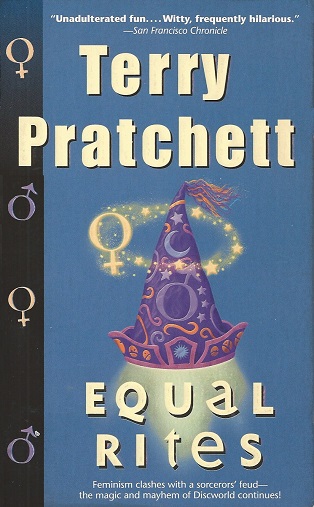
Equal Rites


By Terry Pratchett


A Discworld fantasy.

Wizards know when their time is coming. Traditionally, they bequeath their powers via their magical staffs to the eighth son of an eighth son. Which is probably what the wizard Drum Billet intended to do. So he left Ankh-Morpork and traveled to the village of Bad Ass and passed his staff on to the eighth child of an eighth child, Gordo Smith. However, Gordo's eighth child is not his son, it is his newborn daughter, Eskarina. Once given to the child, the staff refuses to be separated from her, no matter what the parents and local witch and midwife, Granny Weatherwax try. They only succeed in hurting themselves in the attempts. So the baby is allowed to keep her magical wizard staff.

As Esk grows, she begins to experience the powers that belong to wizards. One of her early efforts results in turning her annoying brother into a pig. At which point Granny Weatherwas realizes Esk needs more guidance than Granny can give her and she takes Esk on a trip to Ankh-Morpork.  While on the trip, Esk wanders off and joins a group traveling there also. Granny and Esk eventually get back together but when Esk tries to gain entrance to the Unseen University, she is sent packing, because females can't be wizards. However, Granny points out that the University has plenty of women in it, working there as servants. And so, with all the training that Granny has given Esk, she soon finds herself working there as a maid. And in the process picking up the scraps of knowledge that will help her understand what a female wizard is capable of achieving. 


Esk learning her powers and learning about the world outside of Bad Ass made for a fun and interesting tale. Granny Weatherwax makes her first appearance in the series and comes off as more human in this version as she sets up shop in Ankh-Morpork, selling potions and telling fortunes and actually acquiring some newer clothing instead of her usual raggedy outfit. Things I don't think Pratchett's later versions of her would approve of. Granny Weatherwax becomes an important recurring character in the Discworld series. Oddly, Esk, the female wizard, doesn't reappear in the novels until many years later. Instead Pratchett returns over and over to Rincewind, the inept wizard-wannabe who stars in the first Discworld novel, The Colour of Magic


Thursday, May 30, 2024

Carpe Jugulum


By Terry Pratchett


The king of Lancre just became a father for the first time and he felt it would be a good idea to invite the neighbors to his daughter's naming ceremony. A bad idea, since the neighboring country, Uberwald, is a land ruled by vampires and inviting vampires into your home is never going to work out well.

Sure enough, the vampire family, Count Magpyr and his wife, son and daughter move into the castle and take over the king's mind and turn the locals into cattle to be "milked" for their blood.  The queen, Magrat, who is a witch, escapes the castle with her baby and joins forces with her old friends, a coven of witches, who take it upon themselves to rid the kingdom of Lancre of the Magpyr family and their vampire associates. But they are going to need a little help, which comes in the form of a priest of Om (a cult know for its history of burning witches) and a young phoenix. 


This was a fairly good read. The poor king comes off as a complete fool and does very little to save his kingdom and Granny Weatherwax, a powerful witch and a recurring character in the series, spends most of the story stumbling around the countryside getting wet and falling down and ends up bitten by the vampires. Still it all comes together in the end, with the various characters doing their bit to bring down the reign of the vampire invaders. 


Here is a review by Publishers Weekly.


Friday, May 24, 2024

Double Eagle : Latigo No. 4


By Dean Owen


Latigo started out as a comic strip series written and drawn by Stan Lynde. The novels are based on the comic strip series and there are four books in the series, all written by Dean Owen. Double Eagle is the last book in the Latigo series.


Coming into the series with the fourth book, there is a lot of backstory that the author has to update the reader on. Cole Latigo Cantrell has quite a history, including fighting in the American Civil War and, after the war, facing down the many bad guys who are thriving in the lawless lands of the western frontier. His main goal in life is bringing justice to the tycoon, Claudius Max, who he believes ordered the murder of Cantrell's parents back when Cantrell was still fighting for the Union. 

All through books one to three, Cantrell has failed to bring Max to justice, while Max continues to expand his railroad empire. Spoiler: he fails in this story too. In fact, he saves Max from certain death at the end of the novel. But this does nothing to resolve the conflict between the two men.

Cantrell is constantly on the move, fighting bad guys and bedding attractive young women. All the bad guys end up defeated and all the women end up disappointed when Cantrell refuses to follow up the bedding with a proposal, as in this edited conversation with an old girl friend, Aspen Groves:

Aspen: "Why not come away with me, Cole? ... You know I've been in love with you from the first." 

Cantrell: "You collect men like a stable collects flies."

Aspen: "You know it isn't love ... not like it is with you.  ... by now we could have a little house out there [Frisco] and maybe a kid and another one on the way." 

Cantrell: "I like you, Aspen. But there's a lot of women I like." 

As Cantrell works his way across the landscape, leaving behind a trial of dead men's bodies and broken-hearted females, Claudius Max is making a terrible mistake by  placing his confidence in a new employee who is not the man Max believes him to be. And only his old enemy, Cole Latigo Cantrell, can save Max from the new guy and his gang of killers. 


This was an OK read, given what it is, pulp fiction of the western variety. The sex scenes are understated, with no genitals described in intimate detail.  The constant confrontations become quite tedious, but not, I suppose, for the readers whose main interest in the story is in that sort of thing. 

Of course, we are supposed to admire Cantrell and despise his enemies. I had no trouble hating the trouble makers. But I could no longer like Cantrell after reading the above conversation between him and Aspen Groves. In it he comes off as petty and callous. In other words, she is good enough to screw but not good enough to marry. Sorry, but that makes Cantrell an jerk.

For what it is, and me not being a fan of the genre, it still is still a pretty good read. A bit thin on plot, not surprisingly, since the main point of the book is the fighting and screwing. (Lots more fighting than screwing, though.)


Wednesday, May 22, 2024

The Zero Stone


By Andre Norton


When Murdoc was a youngster, his father, Hywel, came to possess a strange ring found on the body of an alien floating in space. The ring was unusually large and contained a dull, unappealing crystal. But Hywel, a expert gemologist, had a feeling that the ring was more than its less than attractive appearance suggested. So he hid it in a secret place known only to himself and his son, Murdoc. 

Unfortunately, someone came looking for that ring. They did not find it even though they beat Hywel to death trying to force its location from him. Murdoc took the ring and left his home, to become a traveling gemologist like Hywel had been in his younger days.

The ring brought the same bad luck to Murdoc as it had done to his father. Employed by another gem trader, Murdoc alone managed to escape a trap set to murder them both. Using the slim resources remaining to him, gemstones, he managed to book passage on a spaceship. Things turned sour very quickly when, while making a brief stop on a frontier planet, the ship's cat got loose and ate a black, fuzzy rock or seed and the crew blamed Murdoc. However the cat seemed to suffer no ill consequences. Until they realized it was pregnant. It chose Murdoc's bunk on which to give birth to a strange little creature that was half cat and half something else. 

Murdoc awoke to discover he was extremely ill and locked in his cabin with the alien baby. As he recovered from his illness, still locked inside, he overheard the crew discussing their plans to weld the door of his cabin shut and leave him to die in fear of the plague that had infected him. At this point the alien creature began to speak to him telepathically. It told him what to do to save himself.  Murdoc, following its instructions, went to the ship's bay and put on a spacesuit and exited the ship. What the plan was after doing so is unclear. While outside, though, the mysterious ring came to life and began to pull Murdoc away from the spaceship and its dubious safety and Murdoc was unable to withstand its pull, taking Murdoc and the little alien, stashed in an airtight box strapped to Murdoc's side, along for a ride to the unknown. 


Murdoc is one unlucky but lucky SOB. Everywhere he goes, there is someone or something out to murder him. Even when rescued, his rescuers want to murder him. His daddy's alien ring was a curse to his father and it is a curse to Murdoc too. He never has the good sense to throw it away, the attraction it exerts on those who hold it is too strong. The connection between Murdoc, the ring and the catlike alien is never made clear, how the three came together in that unlikely way. Other than that unanswered and annoying question, this was a pretty good story. Although Norton can never resist having her characters suffer from lack of food, water and various painful injuries. They always have their asses handed to them but still manage to survive and win in the end. 

This book does have a sequel, The Uncharted Stars, in which Murdoc and the alien, Eet, have their own spaceship and are on the hunt for the origin of the powerful crystals like the one in the ancient ring, the Zero Stone. 


Here is a review by Kirkus Reviews.


Sunday, May 19, 2024

Sounding Off


By Ted Staunton


Set in a small town in Canada, the start finds the main character, Sam Foster, 14, hanging out with his friends. Two things happen: his close friend Darryl has shoved a crash helmet on Sam's head, which got stuck on. And Sam has fallen in love with a girl he sees performing on stage at the local talent show. After Sam finally gets the helmet off his head, he is on the hunt to find out who the girl singer is and get to know her. 

In his hunt for the girl, Madison Dakota, Sam gets to know his friends and classmates better and his neighbors better and takes some important steps on the path to young adulthood.  


This was an ok book to read. Not a lot happens in it. Sam manages to find Madison but not much results from that knowledge. The rock band he is in breaks up but he soon joins another band. He struggles with some school assignments, most of his struggles of which would be solved if he would simply do the work required. 

Sam is a harmless, well-meaning puppy of a boy as is this story, intended for middle school age readers. There are no great mysteries, no great challenges, no fantastic adventures. Just a boy in a small town, experiencing everyday life. 


Thursday, May 16, 2024

Man and Dog


By Brad Steiger


From the book jacket:

"Brad Steiger explores the bond between human and canine by relating true stories of the remarkable social-spiritual contract that has existed between humankind and its loyal companions for thousands of years. He shares fascinating true stories about the creatures that have more than earned the title of 'man's best friend,' such as:

  • A man, paralyzed and alone, who was kept alive by his dog for nine days
  • The dog that brought a girl back from a five-week coma
  • A dog named 'Blaze' that saved a family from fire
Brad Steiger also reveals the findings of current medical research into the positive effects pets have on our lives, from lowering blood pressure and alleviating stress to easing the pain of bereavement.

In this charming, thought-provoking, often astounding book, Brad Steiger fully substantiates the 'ancient contract between dogs and human.'"


The book jacket also includes a review by Publishers Weekly: "Remarkable tales of canine heroism...Steiger gives advice on how to communicate with dogs, discusses the value of pet therapy and offers several instances of ghost dogs appearing to their owners. Also covered are findings of current medical research into the positive effects of pets on humans, such as lowered blood pressure...enjoyable."


The book is chock full of mystical claims and other such other worldly stuff. I enjoyed the ghost stories and the stories about the bond between people and their dogs and the stories of dogs helping people. But the mystical content did not interest me and I skipped most of it. 


Sunday, May 12, 2024

Bolo


By Keith Laumer


A short story collection about Bolos, an intelligent military machine similar to a tank.


  • A Short History of the Bolo Fighting Machine: exactly what the title says.
  • The Night of the Trolls: Man comes out of suspended animation to discover a world turned upside down by war.
  • Courier: Retief (of the CDT) is sent to stop an invasion of a human-settled world by an aliens.
  • Field Test: War breaks out and a general decides it is an opportunity to test the newest weapon, a Bolo Fighting Machine.
  • The Last Command: A long-buried Bolo suddenly wakes up and emerges from underground to begin war against innocent civilians.
  • A Relic of War: The local townspeople think the broken down old Bolo in the village square is merely a monument to the past. But then it reactivates.
  • Combat Unit: Hostile aliens have found an old Bolo and are fooling around with it when it suddenly comes to life.
These stories are OK. Not really a subject I am interested in, though. Descriptions of fights, battles and machinery are boring to me. I did skip a lot of the text because I just don't care about such. For some reason, I thought Bolo was the name of a person, a pirate or criminal or politician. Came as a surprise that it is a fancy, self-aware tank.