Friday, January 30, 2009

Grave Peril


By Jim Butcher

Book 3 of the Dresden Files series, this one finds Harry Dresden battling the baddies once again. Set in Chicago filled with spooks, vampires, wizards, demons, faerie, and other assorted supernatural beings, Harry is a wizard with a mission: keeping Chicago safe from those things that go bump in the night. He is ably assisted by a Knight of the Cross, Michael Carpenter, who wields a big, consecrated sword named Amoracchius.
The book starts off with Harry and Michael taking on a ghost who is stealing the life from the newborn babies in a hospital nursery. After they take care of that nasty ghost, they figure out that something or someone is riling up the spirit world and causing ghosts to become more active and much more dangerous. This person or entity is attaching a cruel, painful spell to the ghosts that pretty much drives them insane. Before long, this unknown starts to target Harry's friends and it becomes clear that someone is gunning for Harry himself and that this unknown wants Harry dead.
Harry sets forth to do battle, helped by Michael, having to fight off crazed spirits, dead wizards, vampires and his evil fairy godmother who wants to possess Harry for her own purposes. In the process, Harry pretty much gets his ass kicked.

Harry is up to his neck in trouble in this story, with his girlfriend in the hands of the vampires, his powers depleted in his battles with the enemy and with Michael having lost his holy sword due to Harry's bumbling. There is practically a battle in every chapter, described in gruesome detail, with Harry usually getting the worst of it. There are lots of interesting characters, including a talking skull that lives in Harry's lab and vampires that are really ghoulish. This is an action packed story full of creepy characters and plenty of blood and guts in which the author lives up to his name. I found the many characters interesting and the story compelling but for me, there were just too many fights and battles. Reading about people constantly getting attacked and beaten to a pulp just doesn't appeal to me. This book is plenty exciting but a little over the top for my taste. Still, if you like that sort of thing, then this book will not disappoint.

For another review see Publishers Weekly.

New Words

Margravine: the wife of a margrave, or a woman with the rank and responsibilities of a margrave, which is a lord or military governor of a frontier province in medieval Germany or the title of a prince of the Holy Roman Empire. '"The Vampire Court," Kyle said, a measured cadence to his words, "extends a formal invitation to Harry Dresden, Wizard, as the local representative of the White Council of Wizards, to attend the reception celebrating the elevation of Bianca St. Claire to the rank of Margravine of the Vampire Court, three nights hence, reception to begin at midnight."'

Sidhe: supernatural creatures of Irish and Scottish folklore, a powerful, supernatural race also called fairies. 'The sidhe lady was beautiful beyond the pale of mortals, her eyes bewitching, her mouth more tempting than the most luscious fruit.'

Thursday, January 29, 2009

The Miracle at Speedy Motors


By Alexander McCall Smith

Mma Ramotswe and her assistant Grace Makutsi are the two detectives of the No. 1 Ladies' Detective Agency located in Gaborone, Botswana. The lady detectives are not in the business of tracking down dangerous people. That kind of work they are glad to leave to the police. No, their investigations are of the domestic type, like their current case of a woman trying to locate her family. Mma Sebina's mother died with a secret and Mma Sebina believes the secret was that her mother adopted her and now she wants to locate her relatives. So Mma Ramotswe has to discover first, if the woman was adopted and second, where her family might be.
Another mystery is more personal to Mma Ramotswe and Grace Makutsi. Someone has sent them an unsigned letter that says: "Fat lady: you watch out! And you too, the one with the big glasses. You watch out too!" Mma Ramotswe is not the kind of person to step on other people's toes so she is at a loss to understand who would send her a threatening letter. She even begins to fear she is being followed as she goes about her investigations.

So the story goes, composed of small yet fascinating situations and minor mysteries that Mma Ramotswe manages to handle with grace and composure, including her husband getting swindled by a crooked doctor making promises of a cure for their crippled child. Visiting with The No. 1 Ladies Detective Agency is a sweet escape and makes for very pleasant, escapist reading. I enjoyed this novel a lot.

For another review see Mostly Fiction Book Reviews.

New Words

Vade mecum: a handbook; a concise reference book providing specific information about a subject or location. 'They had not invented the term, having found it in the pages of her vade mecum, Clovis Andersen's The Principles of Private Detection.'

Kudu: large African antelope. '"But her eyes are quite big, aren't they? Have you seen them, Mma Ramotswe? They are big, like the eyes of a kudu."'

A Kudu:

Wednesday, January 21, 2009

The Case of the Missing Books


By Ian Sansom

Israel Armstrong went to school to learn to be a librarian, his dream job. Working in a bookstore as he has done for years is not his vision for himself. He gets a position as librarian at a village library in Ireland. He knows this will be quite a change for him, a born and bred Londoner. But the new job turns out to be an even greater challenge than he ever thought.
First off, the library is closed. Instead it is a mobile library or bookmobile. It isn't even a nice bookmobile since it has been sitting neglected in a barn. It doesn't even have any shelves for the books. Next, it turns out all the books, some 15,000 volumes, have disappeared. Israel's boss expects him not only to get the bookmobile up and running, get shelves installed, locate all the overdue books but also expects him to track down all the thousands of missing books and since Israel has signed a contract he is pretty much stuck. Further, he is living in a converted chicken coop, the locals are hostile and smug, and Israel is a bit of a boob.
Israel's adventure goes bad from the start, with the ferry running late, his ride never showing up, the library closed down, his pushy boss who won't let Israel out of his contract and finally a hostile driver who bullies Israel into climbing in the skylight of the old bookmobile and in the process soiling his clothes and bumping his head. It just goes downhill from there as he gets bashed and pushed around and his wallet burned up and his glasses broken and various injuries to his person and the locals are all being a bunch of jerks.
In the end Israel is shown the solution of the mystery of the missing books and it turns out it really wasn't a mystery since every one but Israel already knew where the books were and I suppose were laughing their heads off at the poor fool's struggles to get their library up and running.

I didn't care for this novel. Israel lets himself be bullied by a bunch of heartless and unsympathetic local yokels. He is attacked, housed in a chicken coop with chickens in it, threatened by various people and generally treated really foully. Israel is a doormat who lets people run roughshod over him and jerk him around and generally make a complete ass of him. I kept waiting for him to stand up to the creeps surrounding him. It just seemed like people were being mean simply because he was a stranger in town. I got really tired of reading about Israel being abused. I guess the abuse is supposed to be funny but it wasn't funny to me. I didn't like the spineless Israel, I didn't like his hostile boss and his bully driver, I didn't like the hateful locals, I found none of it to be amusing, and I just didn't like this book.

For another review see The Guardian.

New Words

Craic: fun and enjoyment. "His new life in Ireland was supposed to be overflowing with blarney and craic."

Pantechnicon: a large moving van (especially one used for moving furniture. "When the ferry finally arrived in the grey-grim port of Larne, hours late, and disgorged its human, pantechnicon and white-van contents onto the stinking, oily, wholly indifferent harbourside, Israel had a bad feeling, and it wasn't just his headache and the sea-sickness."

Tardis: The TARDIS (Time And Relative Dimension(s) In Space) is a time machine and spacecraft in the British science fiction television programme Doctor Who.

Blaggarding giving someone a hard time. "The man coughed again, and spat on the pavement. 'They're blaggarding you, you know.'"

Ex-libris: Latin, literally "from the books." A bookplate printed with the owner's name or initials; a book that has been discarded from a library. "'Old librarians never die,' said Norman. 'They just become ex-libris.'"

Pavlova: this is a dessert that is made primarily of a baked meringue shell that is then filled with various fruit. "He may well have been a touring Romany musician; he was certainly enjoying his vast, Grauballe pavlova."

Theosophists Theosophy is a philosophy that holds that all religions have a portion of the truth. "Presbyterians might as well have been theosophists as far as Israel was aware, and they may have practised child sacrifice and believed in every kind of impossible thing, but he liked their style."

Furze: a prickly evergreen shrub. "Israel wasn't entirely sure he knew what a furze was but he started rootling around under a couple of likely looking bushes, ripping his hands on their yellowy spiny branches."

Geg: a funny person; a fun time. "'That's not funny at all. I'll tell you what that is: that is hilarious. You're a geg, d'you know that?'"

Bogeys and dote: Bogeys is snot; dote is a cute person, usually a baby. "'And Charlie with the bogeys - he's a wee dote, isn't he?'"

Waney-edge: An unsmoothed, natural wavy edge on a plank, which could be covered by tree bark. "'D'you have any waney-edge?' asked Ted, who was poking around in a pile of logs."

Rodden: a narrow, little road. "'And when you're done, look, it's back down here and left down the rodden there, and you'll be back at the farm in ten minutes.'"

Echt, pleached, espaliered, cordoned, and tanalised: Echt means genuine, not fake or counterfeit or a reproduction. To pleach is to unite by interweaving, as branches of trees. Espaliered is when a tree or shrub is trained to grow flat against a trellis or wall. To cordon a tree is to train and prune it to grow in a pattern or along a trellis or other support. Tanalised wood is wood that has been treated with preservatives. "The trees that flanked these curious, echt sculptures had been variously pleached, espaliered , and cordoned, giving them the appearance of having been shaped out of old scraps of tanalised timber rather than having actually grown up naturally from the earth."

Trilby hat and Boiler suit: A trilby hat or trilby, is a soft felt men's hat with a narrow brim and a deeply indented crown. Traditionally it was made from rabbit hair felt, but now it is sometimes made from other materials. A boiler suit is a coverall; a one-piece garment with full-length sleeves and legs like a jumpsuit, but usually less tight-fitting. "He was wearing a trilby hat, and a boiler suit over a three-piece suit, and he was working very slowly and with deep concentration with what looked like a cooking spatula, shaping and moulding a concrete bust, like one of the huge heads Israel had seen in the garden."

Shloer and Banoffee pies: Shloer is a line of non-alcoholic sparkling drinks, mostly grape juice available in the United Kingdom. Banoffee pie is a dessert made from bananas, cream and toffee served in a pastry or cookie crumble base. "Christmas was only a week away, and there was a tree, and decorations and much sipping of Shloer and wine and beer and at the point at which the desserts were being served -- a range of pavlovas and banoffee pies to rival those in any mid-range provincial pub or bistro -- Zelda swept out of the kitchens and through the room as if on the crest of a wave, hair high and erect, chatting to guests, laughing with them, dangling mistletoe as she went."

Saturday, January 17, 2009

Rabbit Redux


By John Updike

Rabbit is up to his usual low standard in this, the second novel about Rabbit Angstrom. Not only does he slap his wife and his sometime girlfriend around, he brings a drug dealer into his home that he shares with his thirteen year old son, Nelson. Rabbit also lets a drug addict move into the house, a young teen girl, who becomes Rabbit's on again off again girlfriend. Influenced by the dealer and the addict, Rabbit begins smoking marijuana during their bull sessions in the evenings, all this in front of his son.
The novel starts out about ten years after the first novel, Rabbit, Run. Rabbit is now working at the same factory his father has worked at for decades. Jan, Rabbit's wife, is working at her father's car dealership and she has gotten involved with a fellow employee and has moved out of Rabbit's house and in with her lover, leaving Rabbit to care for their son.
A guy from work introduces Rabbit to a rich teenage girl who has run away from home and needs a place to stay. Rabbit is attracted to the girl and agrees to let her stay at his house. Somehow her drug dealer boyfriend Skeeter, who is running from the law, also ends up at the house. Rabbit, Skeeter, and the girl spend their evenings getting high and listening to Skeeter lecture Rabbit on the plight of the black man, all under the impressionable eyes of Rabbit's son.

I still hate Rabbit and I didn't like his house guests any better. Rabbit is a lousy husband and a lousy father and it was unsettling reading about Rabbit's willingness to expose his child to such unsavory behavior and characters. Rabbit and his friends and their antics were disgusting and I felt sorry for his kid being exposed to that filth. Unsurprisingly in the end it all goes up in smoke. I guess Rabbit had a good time and maybe that is all that matters to him. Still, as much as I despise Rabbit, Updike tells a pretty engrossing story, even if most of the characters in it are unsympathetic. I just hope Rabbit takes a turn for the better in the next novel, Rabbit Is Rich.

For another review see Kirkus Reviews.

New Words

Redux: Of a topic, redone, restored, brought back, or revisited.

Hectographed: a type of printing process. 'The menus are in hectographed handwriting. Nelson's face tightens, studying it.'

Ofays: a white person; white, white-skinned. 'He knows he can never make it intelligible to these three ofays that worlds do exist beyond these paper walls.'

Pawprints of Katrina


By Cathy Scott

This is the story of the pet rescue efforts following Hurricane Katrina in New Orleans. When people were evacuated after the city flooded, they were not allowed to bring their pets and were forced to leave them behind, abandoned and left to fend for themselves. Many of these animals drowned, starved or were injured and didn't survive. A fortunate few were rescued by animal shelter employees and volunteers who entered flooded and abandoned neighborhoods in search of pets. Thousands of pets were rescued due to the efforts of these dedicated people but only about 15% were reunited with their families. This is because the animals had no ID tags to help the shelters track down their people. Apparently, many of the dogs left behind were what are called "yard dogs," not really a part of the family, just left outside to bark at strangers and protect the house, so the people who owned these dogs didn't care if they got them back or not. And of course, there were many, many abandoned cats. According to this book, some 100,000 to 250,000 animals were left behind in the New Orleans area and only some 20,000 were rescued. The shelter people did the best they could working under difficult and dangerous conditions, often trying to rescue animals that had become wary and wild after weeks of being on their own.

It's a sad and harrowing story, reading about the struggles to save abandoned pets. Many were saved and many more weren't and because of that new laws have been enacted to provide protection and shelter for pets during an emergency. But, as the book points out, owners need to make provision for their animals and especially make sure the animal has some form of identification, whether it is tags or a ID chip placed under the animal's skin. If you are going to have pets, you need to be responsible and provide for your pet's safety, just like you would for your children. Pets are dependant upon their owners; even the toughest and meanest yard dog needs a responsible and caring owner.

I found this book to be informative and enlightening and made me realize I should get an ID chip for my cat. Although he is strictly an indoor cat, if we ever had to evacuate and he got lost in the melee, the only chance we would have of getting him back is if he has an ID chip. If you care about animals, then you will probably get a lot out of reading this book.


Friday, January 16, 2009

Child of a Dead God


By Barb & J.C. Hendee

Magiere is being plagued by dreams about a castle high in the mountains. Inside that castle is a mysterious and powerful orb. In the dreams, Magiere is commanded to go and get the orb, but for what purpose is not revealed. Unable to shake these dreams, Magiere feels compelled to hunt for that distant, high castle and its ancient orb.
Traveling with Magiere is her lover, Leesil and her friends Wynn, a sage and Chap, a big furry dog who isn't really a dog. Also coming on the trek is the elf Sgäile, who has sworn to protect Magiere. But Magiere and company aren't the only ones who want the orb. The elves want the orb too and, worse, Magiere's half brother, the vampire Welstiel, is desperate to obtain the orb. So, trailed by enemies, Magiere and friends set off on their journey to fulfill Magiere's obsession.

Billed as a "Novel of the Nobel Dead," Child of a Dead God is one in the series of the "Nobel Dead Saga." Reading the previous novels in the series would be helpful before reading this one. I was not familiar with the series before coming across this book. Based on this novel, I probably will not be looking for the other books in the series.
This is not to say that the book was a bad read. It wasn't. It just wasn't that interesting to me. Magiere's trek to the castle was rather boring. The only parts that I found interesting were those dealing with the vampire Welstiel and his unwilling sidekick Chane. After reading about them, going back to Magiere was a let down. Welstiel and Chane were so much more intriguing than the Magiere and friends.
Also, the fight scenes were rather gruesome and I mostly just skipped through the descriptions of battles as reading about people hacking at and maiming each other has never appealed to me. Also, I don't like elves and I especially didn't like their long, complicated names that I had no idea how to pronounce. I imagine, though, to those who are familiar with the characters and who have followed the story from the beginning, this book is a vital part of the whole story.

New Words

Hauberkand falchion: A hauberk is an armored vest, usually of chain-mail. A falchion is a short broad slightly convex medieval sword with a sharp point. "In black breeches and a white shirt recently tailored within the city, she had donned her studded leather hauberk and strapped on her falchion."

Mantic: relating to divination; prophetic. "Two seasons past, she had meddled with a mantic ritual to help Magiere track an undead."

Saturday, January 03, 2009

Liberty


By Garrison Keillor

Clint Bunsen is the chairman of the Fourth of July committee which is in charge of all the festivities and the parade in Lake Wobegon, Minnesota. Last year's parade was a huge success, even getting airtime on CNN. Clint is determined to repeat last year's success but it ain't easy. The other committee members are fighting him every step of the way. They want to bring back the old boring stuff like the reading of the Declaration of Independence and fat old farmers driving their tractors in the parade. Also, Clint has hired professionals to handle the fireworks display instead of letting the volunteer fire fighters do it as in the past. But professionals cost money and the committee is kicking and Clint is getting fed up. He offers his resignation to the committee, not dreaming they will accept it, but they do. So this will be Clint's last year running the Fourth of July celebration.
Clint was surprised that the committee accepted his resignation but maybe it is not such a bad thing. Because Clint is feeling like life has passed him by and that he needs a change. Born and raised in Lake Wobegon and living most of his life there except for his stint in the military, Clint is stagnating. Tired of his job, tired of his wife, Irene, tired of Minnesota and Lake Wobegon, tired even of being of Norweigan heritage, Clint is easy pickings when a hot piece of tail comes sashaying his way, the beautiful young Angelica. She was Miss Liberty in last year's parade when she and Clint struck up an acquaintance that they maintained via the Internet and that eventually ended up in a motel room where Clint discovered he is not quite ready for the graveyard yet. Charmed by Angelica and mislead by a faulty DNA report that informed him he was not Norwegian but in fact Hispanic, Clint has set his sights on going back to California, where he lived when in the military, with Angelica on his arm. He always regretted leaving California and moving back to Lake Wobegon.
So the big day arrives with its various complications and Clint is still in charge and Angelica is in town to reprise her role as Miss Liberty and Clint's wife Irene has gotten hold of a hand gun and someone is going to pay for messing up her marriage.

It's always nice to visit Lake Wobegon whether on the radio or in one of Keillor's books. These small town folks have their biases and their moments like we all do but still, viewed through Keillor's eyes the humor comes through even with the whiny jerks on Clint's committee. Clint's problems are our problems, his disappointments our disappointments and his failures our failures too. Who hasn't thought "what if" or contemplated being in forbidden arms? Who hasn't thought that their life has become a prison they'd give almost anything to escape from? Rooting for Clint to find some happiness and watching him reach his decision was not only a lot of fun but touching too. Liberty was a delight to read and I hope Keillor continues to write books about Lake Wobegon.

For another review of the book see The New York Times.

Friday, January 02, 2009

Finding Lubchenko


By Michael Simmons

Teenage Evan is a rich man's son, but his dad thinks money will spoil his child and so Evan is perpetually short of cash. To make up for this lack, Evan liberates office equipment from his dad's company and sells it on E-Bay with the help of his best friend, Ruben.
Evan and his dad don't get along and not only because the dad doesn't give his son a generous allowance. Evan's mom died when he was young and the dad is raising Evan alone. Plus the dad is way older than most dads with kids Evan's age so there is a huge generation gap there. The dad also hails from conservative, old fashioned stock that Evan finds alien to his modern, California lifestyle.
Things come to a boil when Evan's dad is arrested for the murder of one of his employees. Not only is he accused of murder, but he is also accused of trafficking in deadly smallpox virus and of embezzling millions from the company. Evan may not like his dad much but he knows his dad is not a killer. Even a kid like Evan can see that his dad has been framed.
At first Evan finds it kind of fun to have his mean old dad locked up in jail. He even throws a party to celebrate. But things stop being fun when Evan faces the fact that he has the murdered man's computer in his possession, having stolen it the very day that the man was killed. Currently stored at Ruben's house, Evan wonders if anything on that computer could help prove his dad's innocence. Luckily Ruben is a computer whiz and manages to break into the computer files, which reveal that the dead man had been in touch with a person calling himself Lubchenko and that he suspected someone at the company was selling smallpox virus to terrorists. The emails to Luchenko are not full of a lot of detail, but they reveal that a meeting has been arranged in Paris at a cafe.
Ruben wants to turn the computer over to the police but Evan is against it because he knows his larceny will be revealed if they do and he doesn't want to go to jail. Somehow he talks Ruben and another friend, Erika, into going to Paris and showing up at the cafe at the time and date indicated. Evan books rooms at a first class hotel and the three friends set off for Paris to do their own investigation. While they are in Paris, they don't forget to enjoy the lively nightlife and visit lots of clubs, often not getting back to the hotel until nearly morning. Following up clues, it eventually dawns upon them that they are making targets of themselves and they switch hotels and lay low. It's a race between them and the killer as they struggle to get to Lubchenko and get back home before the killer finds them.

As I have said before, it is hard to like a story when you don't like the main character, which in this case is Evan. Evan is not a nice boy. He steals, he lies, he's a slacker and he justifies his actions by whining about what a hard ass his dad is. Yes, maybe his dad is cold and harsh, but it seems Evan does everything he can to get under his dad's skin. Evan is even willing to let his dad stay in jail while Evan sits on evidence that could help the police track down the real killer. Instead of doing the right thing, Evan does the easy thing.
Not only did I dislike Evan, I was disappointed that Evan didn't come to a better understanding of his father as the story progresses. They start out estranged and they end up estranged with Evan's dad enraged at all the money Evan spent while the dad was in prison: plane tickets to Paris, expensive new luggage, the best suites at the hotel. So even though the dad is exonerated, the book doesn't really have a happy ending as Evan is unrepentant and their relationship is even more strained than at the start of the book. Though I understand the story is continued in another book. Maybe in that book Evan manages to grow up a little and stop being such a selfish child.
Also, despite the trip to Paris, not much happens in the story. The kids party in Paris, meet with Lubchenko and go home. It's pretty slow. I never really got into the story. It just didn't capture my attention and I thought Evan was a brat.

For another review see Book Shelves of Doom.

New Word

Arrondissement: an administrative division; Paris is divided up into twenty arrondissements or districts. 'So, Café Saint-Beauvais was in a pretty nice neighborhood (the so-called Seventh Arrondissement) on the other side of the river from the Ritz.'

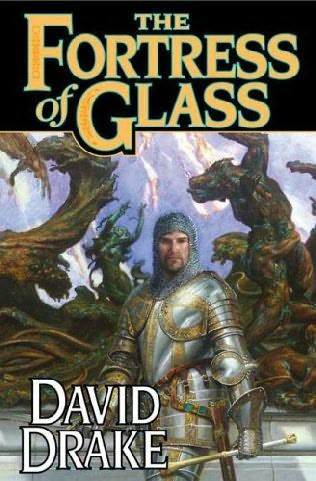
Fortress of Glass


By David Drake

Volume One in the Crown of the Isles Trilogy.
A new book in the long running Lord of the Isles series and the first book in a new trilogy, this book does not require that the reader be familiar with the preceding books, although it would be helpful. Still, the text informs the reader as to the characters backgrounds but not in a lot of detail.
This book finds Prince Garric paying a formal visit to the ruler of First Atara, an island nation, ruled by King Cervoran. Independent for generations, now First Atara will be recognizing the supremacy of Valence III, Lord of the Isles and father of Garric. Upon nearing the island, Garric is greeted with the news that King Cervoran is dead and is to be cremated shortly.
Meanwhile, a charged atmosphere hangs over Garric's fleet. His wizard, an old lady, senses that something stupendous is about to happen and it does when a meteor falls from the sky and into the ocean near the fleet.
Garric's party survives the meteor and subsequent tidal wave and arrives on First Atara, ready to witness the dead king's cremation. Once again, strange powers fill the air and another meteor streaks down, this time toward the island only to burst in the air above the dead king and his pyre. Stunned by the meteor, few people notice that King Cervoran is no longer dead. Trapped by the rising flames of his pyre, he is sure to die a second death until he is helped down by one of Garric's people, the lady Ilna, a weaver with mystical powers she acquired when she was in hell. Ilna saves the resurrected king, but what exactly she has saved remains to be seen.
During the furor Garric has disappeared, magically snatched away from his world and placed in a dismal swamp world, destined to help the peaceful Grass People dwelling there who are being hunted to extinction by blood thirsty cat people who view humans as cattle to be eaten.
Back on First Atara, Princess Sharina, Garric's sister, is forced to take over his duties. Her first duty is to protect the island from deadly mobile plants that have crawled out of the sea soon after Cervoran rose from the dead. These giant plants seem unstoppable as they seize and dismember the defenders at will. Luckily Cervoran, who is a powerful wizard, has a plan and uses his magical powers to temporarily halt the plants advance. Cervoran knows the plants have been sent to the island by the Green Woman, a wizard who arrived on his world via the meteor that crashed into the sea.
Taking the battle to the Green Woman, Cervoran sails out to confront her and the two wizards struggle against each other but the battle is inconclusive. Cervoran is rescued by Ilna again, this time from drowning. As they head back to the island, a huge crystal fortress arises out of the sea at the place where the meteor splashed down. Now it's a battle to the death between Cervoran and the Green Woman with the people of First Atara and Garric's friends and family caught in between. Before it is over, loved ones will be killed, treachery unmasked and Garric's people scattered throughout time and space.

This novel started off pretty slowly but once it got going it really moved along. It turns into a rip-roaring tale with lots of battles, lots blood and gore (too much for my taste) and people caught in desperate situations that seem hopeless. Garric's sojourn among the Grass People was especially interesting, as were the stories of the other characters who were magically transported to strange, alien locations. I did get tired of reading about the people left behind on the island who had to continue to cope with the repeated assaults of the killer plants sent against them by the Green Woman. That and the continual gore got pretty old. Despite those drawbacks I found the book pretty interesting and at times surprising and I will certainly check out the next book in the trilogy, The Mirror of Worlds.

For another review of the book, see Bookreporter.com.

New Words

Apotheosis: the occasion when someone (often an emperor) becomes a god or goddess after death. '"But I thought -- that is, the council did -- that since you were arriving just in time, you could preside over the apotheosis ceremony of King Cervoran and add, well, luster to the affair."'

Coffle: a chained line of prisoners, slaves or animals. 'The last of the coffle moved through. The gates groaned shut on their rope hinges.'

Masar: a mazer, a large drinking bowl or goblet, originally of a hard wood, probably maple, later of metal. 'Instead of being terra cotta or a simple wooden masar, the sort of thing people who dressed like Antesiodorus generally drank out of, this was glass clearer than the water that filled it.'

Bight: the term bight is used in knot tying to refer to any curved section, slack part, or loop between the two ends of a rope, string, or yarn. '"Get out of the way!" Ilna said, making a quick change to the pattern -- gathering a bight in the middle of the fabric because there wasn't time to do the job properly with an additional length of yarn.'

Misfortune


By Wesley Stace

It's the early 1800s and a baby has been tossed on a garbage heap to die only to be rescued by the richest man in all the kingdom. That is the baby's good fortune, right? Maybe not so good, though, because the man who rescued the baby isn't playing with a full deck. When he looks at the baby he sees his dead sister reborn, this despite the fact that the baby is a little boy. So, living in safety and luxury, yet forced to deny his gender and live his life as a girl, is this his good fortune or misfortune?
This is the conflict that Rose must deal with, raised his whole young life with the belief that he is a girl when, of course, he is not. The truth doesn't begin to dawn on Rose until he enters his early teens and starts to develop those characteristics of a young man on the verge of manhood. At this point, his previously affectionate and indulgent adoptive father turns against Rose, unable to bear the sight of his daughter becoming a man. So distressed is the father that he refuses to see Rose and the father gradually fades away and dies.
Although Rose is the official heir of his father's millions, other claimants appear, scenting the possibility of gaining a toehold on the millions. Rose is soon forced to reveal the fact that he is a boy who was raised as a girl by his mentally ill father. At this point the relatives take charge and Rose is forced to put off his girly garb and don the breeches and boots befitting a man. Rose, who has been raised his whole life only wearing female attire, feels constrained and disoriented in his boy clothes. Plus the relatives who are now running everything because Rose is underage are a nasty and unpleasant lot who are bent on living the high life, no matter how much it costs Rose's estate.
Eventually the truth of Rose's origins is revealed and then the relatives hire lawyers to dispute Rose's claims to the estate. At this point life has become so intolerable that Rose runs away, leaving the evil relatives in command of all the vast assets and the estate that his father left him.

I did enjoy reading about poor mixed up Rose, but the first part of the story was more engrossing than the later part dealing with Rose's life after he ran away. Being a woman and knowing what it is like to wear a dress or to wear pants, I definitely vote for pants as the most comfortable and the most efficient type of clothing and I would think that Rose would have found the shift from yards and yards of stifling fabric to the simplicity of trousers to be immensely freeing. I would think that, as a boy, he would be thrilled with the freedom available to him that girls of that time were not permitted. So at the point where Rose puts off his dresses and corsets and is forced to switch to the hated pants I somewhat lost interest. Later Rose settles on a kind of compromise, wearing dresses but keeping his mustache, a frankly freakish combination that was even harder to understand than his distaste for his men's clothing. Still it was a pretty good story though the ending is too pat. The author was trying to write a novel in the style of the nineteenth century Gothic novel and perhaps such coincidences are typical of those novels. I would have liked to have the novel center less on Rose's life of luxury in the mansion and more about his escapades after he ran off, but that part of his life is touched on very briefly. Still, despite the rather draggy latter part of the story, I mainly enjoyed reading about Miss Fortune's Misfortune.

For another review see BookPage.
New Words

Chaunters: a chaunter is a street seller of ballads and other broadsides. 'There was always the crowd of chaunters, and they'd be looking for the opportunity of some work as the afternoon wore on.'

Lady Skimmington: in Wiltshire bands of peasants protested against the enclosure of common land by dressing as women and calling themselves Lady Skimmington; a man who wears women's clothes. 'Some silently suspected that he might not be interested in women at all, that he was a bit of a Lady Skimmington.

Water budgets and compony counter-componies: In heraldry, a water budget is an emblem which represents the ancient water budget, or bucket, consisting of two leather vessels connected by a stick or yoke and carried over the shoulder. In heraldry, a compony counter-compony is a border composed of two rows of squares or rectangles in alternating colors, like a checkerboard. 'Others could keep their escutcheons of pretense, their water budgets and their compony counter-componies, he was happy with this simple sign and the motto beneath: Amor Vincit Omnia [Love Conquers All].'

Barleybreaks: an old English country game. 'Despite his relative invisibility in the parish calendar, he could be relied upon to appear, with great aplomb, at the annual games in which the May queens and their attendants played at barleybreaks for the whole town.'

Sarcenet: a fine, soft silk cloth. 'The counterpane of the Great Bed, purple velvet edged with a delicate blue and yellow sarcenet, was heavily weighed down by the family arms embroidered upon it.'

Orgeat: a sugared milk beverage with pulverized almonds or originally barley; brandy was frequently added. 'A half-finished decanter of orgeat stood on her bedside table, the stopper still spinning on the silver tray.'

Encaustic: a wax-based paint that is fixed in place by heating; a painting produced using this paint. 'Everything else was an exceptional facsimile, down to the minute encaustic tiles with the family motto inside the front door; if the actual hall ever fell into neglect and disrepair but the Hemmen House survived, then the contents and the spirit of its arrangement would be easily recalled.'

Quidnuncing: a quidnunc is a nosy person, a busybody. 'The lower floor was for noise, dirt, and business, and the most useful rooms were there: a breakfast room, a small dining room and a dinner room, a room for afternoon entertainments, and another for "quidnuncing," all branching from the massive Baron's Hall.'

Parterre: in landscape gardening, a formal area of planting, usually square or rectangular. 'Looking beyond the Terra-cotta Bridge, which crossed the river that snaked along the bottom of the parterre, her eyes fell upon the Northern Avenue.'

Periphrasis: the substitution of an elaborate phrase for a simple word or expression. 'I would have excited your apprehensions with periphrasis such as "It might have been at about this time that ...," or I would have spoken too knowledgeably and later been caught in a lie.'

Recto and verso: the recto is the right-hand page and the verso the left-hand page of a folded sheet or bound item, such as a book, broadsheet, or pamphlet. 'It was a letter, recto and verso, from Mary Day's printer to the author, addressed simply as M, outlining certain changes he was bound to make to the text of "Sophia of Light" to enable him to include the designs she requested.'

Kapellmeister: German for the leader of a choir or orchestra. 'The dispersal of the orchestra around the country, and the return of the kapellmeister to the court at Prague whence he had come, gave my father pause.'

Vitrine: a glass-fronted cabinet which stood independently or on a stand and was used to display china, silver and curios. 'In the downstairs library, the desk sat next to a vitrine called the Museum, full of those family mementos that were valuable to my father: my first tooth, which my mother said he handled as though it were a sacred relic; the cameo broach that bears my mother's profile; the locket containing my miniature drawing of them at the desk.'

Idée fixe: obsession. 'I was my mother's idea and my father's idée fixe.'

Fard: to paint, especially one's face. 'The powder, a noxious combination of lead plate, vinegar, and perfume, prepared (to my horror) in horse manure, suffocated and chafed my skin, so every night I rubbed my face with Mother's fard of sweet almond oil, melted with spermaceti and honey, which soothed me until the next morning's onslaught.'

Rubric: rubrics are the instructions that form chapter headings or titles that are not a part of the text. The word rubric is derived from the Latin word, rubrica, which means “red” because the color of the ink used to write rubrics was red. '"The rubric eludes him, but the pictures will give him enormous pleasure and perhaps stir him to greater dalliance with his muse."'

Senex: Latin for old man. In Ancient Rome, the title of Senex was only awarded to elderly men with families who had good standing in their village. 'Hood, in his usual position by the Hemmen House, was wrapped in a very large towel with, I assumed, some pajamas beneath; this togaed senex was the very same man whom I had only recently seen out of formal attire for the first time.'

Parturient: of or relating to or giving birth. '"Adam -- the first man! The only parturient male!" exclaimed my mother.'

Clinquant: glittering with gold or silver, tinsel or spangles. 'At Calais, she reminded me (not, I thought, that I had ever known), the French had stood, according to the national poet, "all clinquant, all in gold, like heathen gods."'

Belvederes: a belvedere is a pavilion or raised turret, built for the view or for its own appearance sake. 'Step back in time as you wander through the spectacular formal gardens and lose yourself on the estate, in a forgotten world of belvederes, follies, and surprise views.'

Son et lumières: sound and light shows. 'Animatronix™ figures bring the servants' quarters to vivid life once again for the twenty-first century in a series of son et lumières in kitchen and laundry.'

Bildungsroman: a novel about the education and maturing of a young person; also known as a coming of age story. 'I wanted to write a novel that creates a whole world and tells a complete story, a bildungsroman, a coming-of-age story -- but with a subject matter they couldn't have written about in the nineteenth century.'

Monday, December 29, 2008

Why Do Men Have Nipples?

By Mark Leyner and Billy Goldberg, M.D. An informative little book that answers those quirky questions you'd like to ask your own doctor but don't. As for the title question, according to the authors, the male fetus starts out as female and when it switches to male at about six weeks of development some female characteristics remain. The book is divided into nine chapters dealing each with a specific category of questions, starting with 'You are what you eat,' which addresses questions like "Does it really take seven years to digest chewing gum?" and "Can carrots help improve your vision?" and ending with, appropriately, 'Getting Older,' which answers questions like "Why does hair turn gray?" and "What's up with the ear hair?" This book is packed full of answers to questions that you never even knew you had, like "Can you die from chasing Pop Rocks with Coke?" and "Is it dangerous to hold in a sneeze?", two things I had never thought about or considered. To find the answers to these and much more, delve into Why Do Men Have Nipples?, it is interesting, funny and informative. New Words Autodidact: a self-taught person. 'He [Leyner] was a medical autodidact with an astonishingly bizarre and encyclopedic store of arcane medical knowledge.' Conflate: blend; mix together different elements. 'Leyner: I love when you conflate urology and heavy machinery.' Focal seizure: also called partial seizure; it is a seizure which affects only a small part of the brain. 'I mistake Leyner's gesticulations for a focal seizure and I run across the room to administer first aid.'

Neverwhere


By Neil Gaiman

Richard Mayhew is a successful young man living in London. He has a fiancee, Jessica, who is ambitious and very sure of herself and not too popular with Richard's friends. Her true character is revealed one weekend night when she and Richard stumble across a young, injured street person and Jessica sees no reason to involve herself in the injured woman's troubles. Richard, despite Jessica's protests, helps the girl, whose name is Door. Richard, involved with Door, fails to show up to an important dinner with Jessica and her boss and Jessica breaks off the engagement.
Trying to help Door get somewhere safe, Richard is introduced to Door's world, which is called London Below. It seems there is a vast other city, invisible to London Above, where people of strange appearance and strange abilities live out their lives in the sewers, subways and basements of London Above. Richard delivers Door safely but when he tries to go back to his normal life he finds that he has become unreal to it. He no longer exists and everyone who knew him has forgotten him. His credit cards are invalid, his bank account has vanished, his apartment has been rented and he is forced to retreat to London Below just to survive.
Tracking down Door, Richard is desperate to get his old life back. Once he finds her, he becomes involved in her problems which could cost him his life as Door is a marked woman, being hunted by two ruthless and very creepy killers, Mr. Croup and Mr. Vandemar. Door leads Richard on a perilous adventure through the filthy, gloomy byways of London Below as they flee the two deadly assassins and Richard struggles to get back to reality and London Above.

This book started out as a series on British TV. The landmarks and locales of London play an important part in the story and were probably a lot more meaningful to British viewers than they could be to a person who is not familiar with the sights and locales mentioned. For example, the angel Islington, which is an angel named Islington in the book which is probably a lot more charming and amusing if you know, which I did not when reading the book, that there used to be, long ago, an inn in Islington named the Angel and that there is no actual angel in Islington. So, yeah, those kind of details totally meant nothing to me, unfamiliar as I am with the streets of London and its surrounds.
But not only that, the whole depiction of the street people lifestyle just didn't appeal. Bit of a spoiler here: but when Richard gets his normal life back he finds himself bored and dissatisfied. I couldn't relate, better boredom that eating alley cats and wearing the same unwashed clothing for weeks at a time. Give me a hot shower, a soft bed, clean clothes and a good meal over excitement any day. I found the characters too grubby, too creepy and too elitist. Nevertheless, Gaiman presents a fascinating netherworld full of strangeness and strange people and it is a lot of fun to picture such dwelling places beneath the streets of our big cities, as the book makes clear that all the big cities of the world have their hidden counterpart just out of sight. So, though it had it problems for me, I still liked reading about Richard, Door and London Below.

New Words

Arbalests, mangonels, trebuchets, glaives and knobkerries: An arbalest is a crossbow; a mangonel is a catapult; a trebuchet is also a catapult; a glaive is a long-handled blade or a broadsword; and a knobkerry is a club. 'He made his own, out of whatever he could find, or take, or steal, parts of cars and rescued bits of machinery, which he turned into hooks and shivs, crossbows and arbalests, small mangonels and trebuchets for breaking walls, cudgels, glaives and knobkerries.'

Inhume: to bury; place in a grave or tomb. '"We should butcher the bitch. Annul, cancel, inhume, and amortize her."'

Grimoires: a grimoire is a book of instructions in the use of magic, especially summoning demons. 'But the shelves were filled with a host of other things: tennis rackets, hockey sticks, umbrellas, a spade, a notebook computer, a wooden leg, several mugs, dozens of shoes, pairs of binoculars, a small log, six glove puppets, a lava lamp, various CDs, records (LPs, 45s, and 78s), cassette tapes and eight-tracks, dice, toy cars, assorted pairs of dentures, watches, flashlights, four garden gnomes of assorted sizes (two fishing, one of them mooning, the last smoking a cigar), piles of newspapers, magazines, grimoires, three-legged stools, a box of cigars, a plastic nodding-head Alsatian, socks ... the room was a tiny empire of lost property.'

Fuliginous: pertaining to soot; sooty. 'At the apex of the bridge, another monk was waiting for them: Brother Fuliginous.' [Brother Fuliginous is one of the Black Friars.]

Kris: a double-edged, wavy-bladed knife or short sword designed primarily for thrusting. 'It was made of a bronze-colored metal; the blade was long, and it curved like a kris, sharp on one side, serrated on the other; there were faces carved into the side of the haft, which was green with verdigris, and decorated with strange designs and odd curlicues.'

Friday, December 26, 2008

Rabbit, Run


By John Updike

Rabbit Angstrom used to be the star of the high school basketball court. Now he is just another schmuck stuck in a boring job, married to a woman he doesn't really like, with a small son and a baby on the way. What he would really like to be is that high school kid again, sinking those winning baskets.
Coming home from work one day, and after a petty quarrel with his wife, Rabbit gets in his car, supposedly to run an errand, but ends up driving all night, headed to the southern sun and a warm ocean beach. When morning comes, he has second thoughts, and returns back to his home town where he contacts his old high school basketball coach. The coach hooks Rabbit up with a call girl and Rabbit ends up at the call girl's place, spending the night. After that night, Rabbit thinks he is in love with the girl and moves in with her.
Later, when his wife goes into labor, Rabbit returns home to take care of his family, abandoning Ruth, the call girl, who now pregnant with Rabbit's kid. Feeling romantic, Rabbit tries to talk his wife into having sex, even though she has just given birth a couple weeks ago. When she refuses, he goes off in a snit, leaving his wife to deal with the baby and their young son by herself, with dire consequences. Returning to deal with the aftermath, Rabbit once again shows his true colors and ends up running away again, back to Ruth who tries to talk him into making some kind of stand, but, of course, he can't.

It really hard to like a story about a person who is so despicable. This is what he says to his very pregnant wife when he hears she was trying on bathing suits in anticipation of the day when she can again fit into one.
"What the hell ails you? Other women like being pregnant. What's so damn fancy about you? Just tell me. What is so frigging fancy?"
Real nice guy, that Rabbit.
Once he moves in on the call girl, Ruth, he won't let her use a diaphragm because he doesn't like the way it feels, so naturally she gets pregnant. Later when he is back with his wife after she has given birth, he wants to have sex and she can't as she tries to explain to him:
"No I can't. Even if I wasn't all tired and confused from Rebecca's crying all day I can't. Not for six weeks. You know that....Why can't you try to imagine how I feel? I've just had a baby."
"I can. I can but I don't want to, it's not the thing, the thing is how I feel. And I feel like getting out. ... You can just lie there with your precious ass. Kiss it for me."
What a swell guy.
So, yeah, reading about this child in a man's body didn't have much appeal for me. In fact, if anyone should have died in this story, it should have been Rabbit. I think the only part of the story that I enjoyed was Rabbit's aborted drive south to the ocean, which called to mind the pleasure of driving just for fun of going somewhere.

New Words

Suntans: a type of pants; chinos. 'In frightened haste he takes clean Jockey pants, T-shirts, and socks from a drawer, three shirts in cellophane and blue cardboard from another, a pair of laundered suntans from a third, draws his two suits and a sports shirt from the closet, and wraps the smaller clothing in the suits to form a bundle he can carry.'

Exegetical: exegesis is an explanation or critical interpretation (especially of the Bible). 'To know him back in seminary you would never think he would take all this so seriously; he and his friends sitting in their drafty old rooms lined with handsome blue exegetical works made it all seem an elegant joke.'

Wednesday, December 17, 2008

Lolita


By Vladimir Nabokov; annotated by Alfred Appel, Jr.

Humbert Humbert is a pedophile from Europe. He lusts after young girls which he calls nymphets, claiming these youngsters have a come-hither and alluring appearance. Possessed of independent means, Humbert leaves Europe and heads to America, looking to prey on some child there. He finds a home with Charlotte Haze who has a daughter, Dolores, who is twelve and of whom Humbert becomes obsessed at first sight. Figuring that being married to Charlotte will give him better access to Dolores, with whom Humbert has only had limited contact so far (one particularly nasty session occurs when the girl innocently lays her legs in his lap and Humbert rubs himself to climax against her legs while singing a loud, silly song to cover what he is doing), Humbert marries the eager Charlotte. The jig is up, though, when Charlotte finds his journal in which he details his lust for her daughter and his scorn for herself. In her agitation and distress, Charlotte rushes out of her house and is struck and killed by a car, leaving Humbert as the sole guardian of Dolores.
Humbert hits the road with Dolores after taking her out of summer camp and without telling her of her mother's death. He has his cruel way with the girl then spends the next year traveling the country with his captive. Eventually he wearies of the constant travel and they settle down in a town where Dolores attends school. Humbert keeps Dolores in his control with threats and lies, leaving her to believe that she will be in as much trouble with the law as he if she turns him in and being a naive kid she believes him. Still she resents and despises Humbert and she becomes involved with another man behind Humbert's back. Humbert suspects this but can't prove it so he pulls Dolores out of school and they start traveling around again. Dolores maintains contact with her lover behind Humbert's back and eventually gives Humbert the slip and runs off with the other man, a fellow called Clare Quilty, who is as twisted and as sick a bastard as Humbert himself.
The last part of the novel is mostly about Humbert's desire to hunt down Dolores and to kill Quilty for stealing her from him. As he progresses he finally admits to himself just exactly how much damage he did to an innocent child and how much she has lost because of him.

This book was a giant pain to read. Going into it, with some preconceptions, it turned out not to be so much erotic as it was difficult. It is stuffed full of French phrases, hard and obscure words, and literary allusions up the wazoo. Frankly, if I didn't have the annotated version I doubt I would have read it past the first few chapters. Even with the annotated version the literary references were just too much. This book is not light reading! The Annotated Lolita was put together by Alfred Appel, Jr., and it was super helpful.
Despite its intellectual slant, the subject matter is sad and depressing and upsetting. Humbert was scum and reading about his abuse of Dolores was not fun. Humbert and Quilty get theirs in the end but Humbert's regrets and capture and Quilty's murder are not enough to make up for having to wallow in their filth. I didn't like the book but apparently it does have its fans. For another review see The Atlantic.

New Words
Usually, when I put a word on the new word list I include the sentence from the book that contained the word. However this book had so many new words that I am not going to include the pertinent sentence, it would just make the list much too long.

Solecisms: a solecism is a mistake in grammar; an idiom.
Etiolated: etiolate means to deprive of strength; weaken.
Apotheosis: A glorified example, the apex of perfection.
Paleopedology: paleopedology is the study of geologic soils.
Aeolian harp: a harp having strings tuned in unison; they sound when wind passes over them.
Lycée: a French academic high school.
Solipsism: the philosophical theory that the self is all that you know to exist.
Plage: the beach at a seaside resort.
Beetle-browed: sullen or unfriendly in appearance.
Manqué: Unfulfilled due to some inherent flaw or an often uncertain constitutional lacking of some kind.
Uranists: a uranist is a homosexual.
Pastiches: a pastiche is a work of art that intentionally imitates other works, often to ridicule or satire.
Mympholepts: A nympholept is a person suffering from nympholepsy, which is a frenzied state of (usually erotic) emotion, especially concerning something or someone unattainable.
Fascinum: an ivory phallus used in certain ancient erotic rites.
Axillary: of or having to do with the armpit or underarm areas.
Frétillement: movement; wriggling.
Grues: a grue is a prostitute, a slut, a drab.
Pot-au-feu: a stew of meat and vegetables.
Estampe: a print or engraving.
Coruscating: glittering, sparkling.
Favonian: pertaining to the west wind; mild, gentle.
Phocine: pertaining to a seal; seal-like.
Nates: the buttocks.
Charshaf: the veil worn by Turkish women.
Pederosis: pedophilia.
Monogrammic: of, pertaining to, or resembling, a monogram.
Iliac: Iliac refers to the ilium, which are the large, wing-like bones of the pelvis.
Catullus: a Roman lyric poet remembered for his love poems to an aristocratic Roman woman (84-54 BC).
Neuralgia: severe sharp pain along the course of a nerve.
Incondite: unpolished, unrefined, referring to literary works; jumbled, long winded.
Cretonnes: Cretonne is a heavy unglazed cotton, linen, or rayon fabric, colorfully printed and used for draperies and slipcovers.
Congeneric: Congener means a member of the same kind, class, or group.
Saporous: tasty.
Acrosonic: This word was coined up by Nabokov and it meant a noise reaching to and past the sonic barrier.
Olisbos: a dildo.
Argent: the heraldic color silver or white.
Glaucous: sea-green or pale blue-green.
Tombal: like a tomb.
Lentigo: lentigo is a freckle; a small brownish spot on the skin. Plumbaceous umbrae: Latin for leaden shadows.
Mägdlein: German for little girl.
Purblind: having poor sight; slow in understanding.
Backfisch: German for an immature, adolescent girl; a teenager.
Lentor: slowness, slugishness; viscosity.
Antiphony: an antiphon is alternate, or responsive singing by a choir split into two parts; a piece sung or chanted in this manner.
Nebulous: in the form of a cloud or haze; hazy; vague or ill-defined; relating to a nebula or nebulae.
Emeritus: retired or honorably discharged from active professional duty, but retaining the title of one’s office or position.
Callypygean: also spelled callipygian, it means pertaining to or having finely developed buttocks.
Clathrate: having a lattice-like structure pierced with holes or windows.
Swooners: Nabokov coined this word and uses it to refer to some type of clothing that was worth swooning over.
Trochaic: one stressed syllable followed by unstressed syllable.
Gouache: a thick, opaque watercolour paint; a painting made with this paint.
Inutile: lacking in utility or serviceability; not useful; unprofitable.
Samaras: a samara is a dry fruit with one or two flat wings attached to a seed, as on ash trees and maples.
Teleological: of or pertaining to teleology; showing evidence of design or purpose.
Canthus: either of the corners of the eye where the upper and lower eyelids meet.
Kurort: German for health resort, spa, watering place.
Lanugo: soft down or fine hair, specifically as covering the human fetus.
Pollex: Latin for thumb.
Viatic: of or relating to traveling, a road, or a way.
Natatoriums: a natatorium is a swimming pool, especially indoors.
Pavonine: like a peacock; iridescent.
Oculate: relating to the the eye.
Raffish: cheaply or showily vulgar in appearance or nature; tawdry; low-class; disreputable; vulgar.
Leporine: of, relating to, or resembling a hare or rabbit.
Salutory: Salutary. Unpleasant, but ultimately providing a useful lesson; promoting good health; wholesome; curative.
Orchideous: like an orchid.
Habitus: Latin for moral condition, state, disposition, character.
Mythopoeic: giving rise to myths.
Dackel: a dachshund.
Remises: carriage houses.
Envoy: An envoy (or envoi) is a short stanza at the end of a poem used either to address an imagined or actual person or to comment on the preceding body of the poem.
Ballade: not to be confused with ballad, a ballade is a a poem consisting of three stanzas and an envoy.
Tesselated: marked with little checks or squares, like tiles.
Tyros: a tyro is a novice: someone new to a field or activity.
Wimbles: a wimble is any of various hand tools for boring holes.
Syncope: in phonetics, syncope is the loss of one or more sounds from the interior of a word; especially, the loss of an unstressed vowel. Syncope is also a brief period of fainting or collapse.
Purling: gently murmuring, as a brook.
Alembics: an alembic is a kind of flask used by alchemists for distilling.
Fatamorganas: mirages.
Erlkönig: the king of the elves, from a poem where an elf king pursues a little boy traveling with his father.
Mordant: a substance used in dyeing to fix the coloring matter.
Gitanilla: little gypsy girl.
Maquette: a small model of an intended work, such as a sculpture or piece of architecture.
Telestically: with the projection of a purpose, with a definite end in view, inwardly expressed.
Logodaedaly: the arbitrary or capricious coining of words.
Logomancy: Nabokov's coined word, logo (word) plus -mancy (divination).
Undinist: a person who derives sexual pleasure from urine and urination.
Bodkin: a dagger or stiletto.
Ancilla: accessory, aid.
Appended: Append means to hang or attach to, as by a string, so that the thing is suspended; to add, as an accessory to the principal thing; to annex; as, notes appended to a chapter.
Lithophanic: lithophane is a porcelain panel with a relief decoration that is visible when light passes through it.
Turpid: Foul; base; wicked; disgraceful.
Physiognomization: Physiognomy is the art of judging human character from facial features; divination based on facial features.
Penele: a coined word, penele means penis-like.
Selenian: of or relating to the moon.
Flavid: yellowish or tawny.
Herculanita: heroin.
Palearctic and Nearctic: one of the four world faunal regions which is subdivided into the Palearctic (Europe and Asia) and the Nearctic (North America).

Wednesday, December 10, 2008

On Beauty


Zadie Smith

Howard and Kiki Belsey live in a suburb of Boston where Howard is a college professor. They have three kids, two in college and one younger. Howard teaches a course about art appreciation, or it might be better to say art unappreciation, as he strives to strip the romance and symbolic meanings that have been traditionally attached to our perceptions of art. He especially likes to go after Rembrandt, pointing out that Rembrandt was just a guy trying to earn a living painting what his wealthy patrons wanted him to paint and that's all.
Howard and his wife are liberals, believing all the usual liberal tenets. Their son Jerome is a born-again Christian, much to Howard's dismay. Howard's enemy and nemesis is Sir Monty Kipps, a conservative Christian who despises liberal doctrines and whose mission is to take the "liberal out of liberal arts".
Howard's oldest child, Jerome, briefly worked for Monty and had a short affair with Monty's beautiful and wayward daughter, Vee. The news that Monty and family are moving to the Belsey's hometown and that Monty will be lecturing at Howard's college doesn't make anyone in the Belsey family happy, especially Howard. To Howard, Monty stands for everything that Howard despises, and vice versa.
To complicate things, Howard and Kiki are going through a rough patch in their marriage due to Howard's infidelity. Theirs is a mixed marriage, Kiki is African American and Howard is white and from England. Their youngest son, Levi, is suffering from an identity crisis and trying to identify himself with the hip-hop street culture of which he really has no experience, being a child of privilege. He ends up hanging around with a gang of Haitian refugees and, in his efforts to ingratiate himself with them, gets into trouble. And Kiki starts a friendship with the enemy when she discovers that she really likes Monty's wife Carlene despite their differences.
Howard's and Kiki's daughter, Zora, who goes to the same college her dad teaches at, becomes enamored of a young street poet, Carl, and comes into conflict with Monty's daughter Vee over this handsome young rapper. Howard also finds himself entangled with Vee and trying to conceal it from his wife. Meanwhile, Howard and Monty are engaged in a power struggle at the college.
Everyone in the Belsey family ends up feeling betrayed. Howard feels betrayed by his wife's tolerance and friendship for the Kippses. Kiki feels betrayed by Howard's continuing infidelity. Jerome feels betrayed by Howard's relationship with Vee. Zora feels betrayed by Carl's relationship with Vee. And Levi feels betrayed by his parents, who are not poor and not street and don't understand, he thinks, what it means to be Haitian.

This is a very interesting and often amusing book about a modern college family, a family of mixed race and mixed culture with an intellectual father and a non-intellectual mother and three kids who are like them and yet different. Lots is going on in this story and it was rather sad watching Howard destroy his marriage. I kept hoping Howard and Kiki would work it out, but how can they when Howard keeps cheating on his wife, a woman he claims to love. Kiki tries to keep it together but finally admits that her marriage has run its course and that she has had enough of Howard Belsey. I do wish Murdoch had played a larger part in the story, I really enjoyed reading about Kiki's little dog. This was a good story about a family and a failing marriage.

On a side note, I was reading Lolita by Vladimir Nabokov at the same time as I was reading On Beauty and, in a strange coincidence, Lolita is mentioned in the book:
"She jumped off the bed and into his lap. His erection was blatant, but first she coolly drank the rest of his wine, pressing down on him as Lolita did on Humbert, as if he were just a chair she happened to sit on. No doubt she had read Lolita.


New Words

Gnomically: in a gnomic manner -- mysterious and often incomprehensible yet seemingly wise. "'It's just what it is,' he said gnomically."

Pulvinate: cushion, cushion-shape, flattened pads or pad-like. "Their pulvinate bellies were red satin, and it was here that the needles pierced."

Crepitations: clicking, rattling, or crackling noises. "The Boston primness Howard associated with these kind of events [concerts] could not quite survive the mass of hot bodies and the crepitations of the crickets, the soft, damp bark of the trees and the atonal tuning of instruments -- and all this was to the good."

Cernuous: having branches or flower heads that bend downward; drooping. "Walking up Redwood Avenue with its tunnel of cernuous willows, Levi found he had lost the will even to nod his head, usually an involuntary habit with him when music was playing."

Vol-au-vent: a small canapé - circular pieces of puff pastry with a small hole which accommodates various fillings. "'You know, I wasn't really in the mood to stuff three hundred tiny little vol-au-vent cases with crab paste,' she said, following her brother through the open front door."

Decline: in certain languages, to give the inflected forms of a noun, pronoun or adjective. "'You can decline a Latin noun, but apparently you can't even --'"

Aperçus: discerning perceptions; insights (plural form of aperçu). "He segued into Aristotle's praise of friendship, and from there to some aperçus of his own."

Lido: a public outdoor swimming pool and surrounding facilities, or part of a beach where people can swim, lie in the sun or participate in water sports. "A sprawling North London parkland, composed of oaks, willows and chestnuts, yews and sycamores, the beech and the birch; that encompasses the city's highest point and spreads far beyond it; that is so well planted it feels unplanned; that is not the country but is no more a garden than Yellowstone; that has a shade of green for every possible felicitation of light; that paints itself in russets and ambers in the autumn, canary-yellow in the splashy spring; with tickling bush grass to hide teenage lovers and joint smokers, broad oaks for brave men to kiss against, mown meadows for summer ball games, hills for kites, ponds for hippies, an icy lido for old men with strong constitutions, mean llamas for mean children and, for the tourists, a country house, its façade painted white enough for any Hollywood close-up, complete with a tea room, although anything you buy from there should be eaten outside with the grass beneath your toes, sitting under the magnolia tree, letting the white upturned bells of blossoms, blush-pink at their tips, fall all around you."

Windrush: As a result of the losses during World War II, the British government began encouraging mass immigration for the first time in order to fill shortages in the labor market. This included Poles and Italians from Europe, however to provide the numbers required the government turned to the countries of the empire and commonwealth countries. Many West Indians were attracted by better prospects in the United Kingdom. The ship Empire Windrush brought the first group of several hundred immigrants from Jamaica to Tilbury near London on June 22, 1948. The 492 passengers from Jamaica were the first large group of West Indian immigrants to the UK after the Second World War. "A few minutes later the children filed out again, feeling a degree more confused as to the true character of the person whose obituary was to appear in tomorrow morning's Times: Lady Kipps, loving wife of Sir Montague Kipps, devoted mother of Victoria and Michael, Windrush passenger, tireless church worker, patron of the arts."

Eglantine: sweetbrier; Eurasian rose with prickly stems and fragrant leaves and bright pink flowers. "Standing in the pebbled forecourt under the bare branches of a cherry tree, Howard could almost imagine the busy main road completely vanished and in its place paddocks, hedgerows and eglantine, cobbled lanes."

Concameration: an arch or vault. "Howard alone looked up into the simple concameration of the roof, hoping for escape or relief or distraction."

Flâneur: French for stroller; a person who strolls walks the city in order to experience it. "At this distance, walking past them all, thus itemizing them, not having to talk to any of them, flâneur Howard was able to love them and, more than this, to feel himself, in his own romantic fashion, to be one of them."

Halal: a halal butcher shop is one where the meat is prepared in accordance with Muslim ritual and laws. In Islam, halal is an Arabic term meaning lawful or permissible and not only encompasses food and drink, but all matters of daily life. "Whatever the fear or force that had thrust him from Carlene Kipps's funeral out on to these cold streets was what now compelled him to make this rare trip: down the Broadway, past the McDonalds's, past the halal butchers, second road on the left, to arrive here, at No. 46 with the thick glass panel in the door."

Dyad: any two entities regarded as some kind of unit; two units regarded as a pair or opposite in a whole. "'There are,' said Jack, bringing his hands together, 'a dyad of reasons why last month's meeting was delayed, rescheduled ... maybe in fact it would be more accurate to say repositioned, for this date, for January tenth, and I feel that before we can proceed with this meeting, to which, by the way, I warmly welcome you all after what I sincerely hope was a pleasurable -- and most importantly -- a restful Christmas break -- yes, and as I say, before we do proceed with what promises to be a really rather packed meeting as far as the printed agenda is concerned -- before starting I just wanted to speak briefly about the reasons for this repositioning, for it was, in itself, as many of you know, not entirely without controversy.'"

Mythemes: in the study of mythology, a mytheme is the essential kernel of a myth, an irreducible, unchanging element, one that is always found shared with other, related mythemes and reassembled in various ways or linked in more complicated relationships. "'And publications next year will include Dr J. M. Wilson's "Windmills of My Mind": Pursuing the Dream of Natural Energy Branvain Press, which is due for publication in May; Dr Stefan Guilleme's "Paint It Black: Adventures in Minimalist America, Yale University Press, in October; Borders and Intersections, or Dancing with Anansi: A Study in Caribbean Mythemes by Professor Erskine Jegede, published by our own Wellington Press this August ...'"

The Noah Confessions


Br Barbara Hall

Lynnie is turning sixteen and is sure she is getting a car for her birthday. It's what every one gets on their sixteenth at the upscale high school she attends. It never crosses her mind that it will be any different for her, after all, her dad is a successful lawyer and can certainly afford to get her a car. But she doesn't get a car. She gets a rather beat-up charm bracelet that used to belong to her mom, who died some years ago. While this is a sentimental and meaningful gift, it sure isn't a car. Yet Lynnie's dad can't understand why his daughter is a little peeved. He gives Lynnie a letter that her mom wrote when she was about Lynnie's age, hoping it will enlighten his daughter as to his reasoning; Lynnie thinks she didn't get a car because her mom died in a car crash.
Her mother's letter to Noah, a boy at her school, reveals a nightmare family. Lynnie's grandfather was a sociopath and her grandmother was depressed and losing touch with reality. Lynnie's mom witnessed her father commit several crimes and it blighted her whole childhood even to the point of blaming herself for her father's acts.
After Lynnie reads the letter, she is very upset at her parents for keeping this sad family history from her. As she faces up to the truth she begins to understand and accept the choices her parents and especially her father have made for her, even though it takes a near death experience along the way.

This novel wasn't what I hoped it would be. I guess I misunderstood the blurb that said, "And so Lynnie begins the journey to Union Grade, Virginia, into the world of her mother." I thought this meant she was going there physically. Instead she just reads her mom's letter. I thought this story would be about the contrast between her wealthy California lifestyle and the down home, back east lifestyle of a more rural setting in Virginia. It wasn't that at all. I was also hoping, since the blurbs went on to say that the author had worked on the TV shows Northern Exposure, Chicago Hope, and Judging Amy that the book would be in a lighter, funnier vein. It wasn't. So I was doubly disappointed.
It also seemed to me that Lynnie got upset way out of proportion when she discovered her mother's dodgy past. So her parents didn't tell her the whole truth of their backgrounds. What law says children are entitled to know all the family's dirty secrets? Some things are best left unsaid until the child has reached adulthood. It's better for the kid and better for the family.
Finally, I never really got what her mother's hardships had to do with Lynnie not getting a car. If her dad felt she wasn't mature enough to have a car, why not just say so: "Lynnie, I just don't feel that you are ready for the responsibility that comes with having a car." Enough said. I'm sure lots of teens have heard those words whether they are rich and privileged or have to earn the money for a car themselves.
Bottom line, this preachy novel just didn't engage me.

Tuesday, December 09, 2008

Kitty and the Midnight Hour


By Carrie Vaughn

Kitty is a late night talk radio host and her topic is the weird and strange, the supernatural, which is a natural for her since she is a supernatural: she's a werewolf. Nobody else knows except for the members of her werewolf pack and a few of the local vampires. She hasn't even told her mother.
Kitty was attacked one night, first by her date and later on by a werewolf. She was taken in by the attacking wolf's pack and thus became the youngest member of the pack, which works just like a real wolf pack, with all the dominance and submissiveness, and the crawling and whining that is typical of wolves. As the newest member of her pack, Kitty is subservient to all the other werewolves. Not only does Kitty find herself at the bottom of the pack, she also has to turn a portion of her work earnings over to the alpha male and female, Carl and Meg.
Since Kitty started leading the talk on her radio show to the supernatural, ratings have soared and her show is being broadcast by more and more stations and Kitty starts to make more money. This makes Carl happy and yet unhappy. He likes the extra money but he doesn't like the extra publicity and neither do the local vampires. Kitty manages to win Carl over to her side, briefly, but some one has hired a hitman to take Kitty out. No only does she have to protect herself from the hitman, she has to discover who hired him and also try to track down a rogue werewolf who is attacking women and making the werewolf community look very bad at a time when humans are just finding out about them, thanks to Kitty spilling the beans on her radio show.

This was an OK story. The wolf pack interactions were very wolf-like, uncomfortably so. I kept waiting for her to say, "Now wait a minute, I'm not really a wolf and I refuse to act like one." She does eventually come to a similar conclusion although it is not so clearly stated. Another problem I had was the indifference the human world showed to the revelation of werewolves and vampires in their midst. This would be a huge story, generating a media circus this likes of which would rival baby Jessica in the well (for those of you old enough to remember that) but in Kitty's world it hardly even raises an eyebrow. Another problem I had was how easily the police accepted Kitty's werewolf activities. At one point Kitty eats a fellow werewolf's throat out and kills him and the cops pretty much just let her go home, no questions asked. Very understanding cops for ones just introduced to whole idea of werewolves and vampires. Also, I found the book a little too violent and gruesome for my taste. From the ending I would say that this book is definitely intended to be the first in a series. Even though I had a quite a few problems with the story, I will probably continue to follow the adventures of Kitty if the next books in the series happen to come my way.
The book cover features a woman dressed rather provocatively and a few blurbs that describe the novel as sexy. However, the sex was rather minimal (I can only recall one sex scene and one almost-sex scene) so if you are looking for a sex romp, this is not it.

For another review of the story, see Publishers Weekly.

Tuesday, December 02, 2008

Wit's End

By Karen Joy Fowler

Rima is recovering from the loss of her family: her mother died when Rima was little, her brother died in a car accident not that long ago and her father died recently. When her godmother invites her out to California, Rima gladly accepts, eager to get away from her tragic home.
Rima's godmother, Addison Early, is a famous and prolific mystery writer who hasn't published a new Maxwell Lane (her fictional detective) in about three years. Fans and friends are worried that she has run out of ideas or has writer's block. Whatever the problem is, Addison is not talking about it.
Addison is a bit of an odd duck. She has no relatives and has never been married. She lives in a beautiful seaside home called "Wit's End." Her home is filled with miniature tableaus depicting the scene of the crime of almost every one of her mystery novels. She has two wiener dogs and two young people who come every morning to walk the wiener dogs. She is also a person who keeps her own counsel.
Rima comes to Wit's End hoping to find an answer to something that has puzzled her for a long time. She wants to know just exactly what Addison's relationship to Rima's dead father was. Rima suspects they were lovers, which would explain the animosity her parents seemed to hold toward the woman they choose to be Rima's godmother. So Rima set out to solve this mystery and to try to develop some kind of relationship to this woman who is really just a stranger to her.

I came to this novel with two expectations. First, since it was written by the author of The Jane Austen Book Club, which was a highly successful novel that was made into a movie, its author could probably be relied upon to tell a good story. Second, it was in the mystery section, so I assumed it was a mystery novel. I disappointed on both accounts.
I found this novel hard to follow. So much that occurs seemed to me to be just hinted at, creating bogus suspense, suspense that could have been easily resolved if Rima would have simply asked Addison, "Hey, what was the deal with you and my father?" Or when Rima saw the box in the attic with her dad's name on it, why didn't she just ask if she could look in it? Why all the pussyfooting around this woman Addison? It's not like Rima was stuck in Wit's End, dependent upon the largess of her godmother.
Another problem I had was, since I thought this was a mystery novel, I kept waiting for someone to be killed. Yes, there is a murder, but it happened decades ago and the murderer is never brought to justice or the murder even really solved, although what happened is pretty much guessed towards the end of the book.
This book was kind of like one of those TV soap operas where all the misunderstandings and hurt feelings could be cleared up with a little openness and honesty. I never did understand why Rima was so careful of Addison's feelings. I just didn't understand these characters. I especially didn't understand why Addison was so coy about her background. So what if her family was screwed up? Whose family isn't? To me this whole novel was mountains out of mole hills.

For another review see The Washington Post.