Showing posts with label animals. Show all posts

Tuesday, May 27, 2025

Belshazzar


By Chaim Bermant


This is Belshazzar's own story as told by him. It starts out fairly nice, Bel living with a family and having a good life. But he gets into trouble and is sent to live with an elderly couple. 

Things are OK at first and he is rather spoiled by the old people and he gets a bit chubby. But then the old lady dies and the old man's daughter moves into her dad's house to take care of him. The daughter and her boy friend don't like cats and don't take good care of Bel. It goes from bad to worse when the old man gets put in a nursing home. Bel ends up homeless and in desperate circumstances when he is rediscovered by the family who gave him away in the first place. They bring him back to their house, presumably to live out his final days in a loving home. 


This was an OK read. It is a very short novel, only 64 pages long. It really points out how thoughtlessly cruel humans are to the animals that depend on us for their lives. And how hard it is for domesticated animals to survive on their own when we abandon them to forage for themselves.


Wednesday, March 05, 2025

The Book of the Pig


By Jack Denton Smith, photos by Ozzie Sweet


I would call this book a brief introduction to the domesticated pig. It has lots of photos, but all in black and white, a strike against it, in my opinion.

It discusses the origins of the domesticated pig and its temperament and the benefits it provides for humanity and not just as delicious food. It also gives brief descriptions of the various commercial breeds of swine.


Clearly the author really appreciates and admires pigs which he claims are not the messy smelly critters they have been portrayed to be. He even says pigs are the smartest domesticated animal, smarter even than dogs, citing a five-year research program at the University of Kentucky which found that:

"...pigs not only are the smartest of all farm animals, but also are more intelligent than dogs, mastering any trick of feat accomplished by canines in much shorter time."

The author also quotes naturalist W.H. Hudson on the innate quality of swine:

"The pig is not suspicious, or shrinkingly submissive, like horses, cattle and sheep; nor an impudent devil-may-care like the goat; nor hostile like the goose; nor condescending like the cat; nor a flattering parasite like the dog. The pig views us as fellow citizens and brothers, and takes it for granted that we understand his language." 


So the book is a good, short introduction to the humble farm animal, the pig. But at only sixty-three pages it is only an introduction. It definitely paints pigs in a much kinder light than they are usually portrayed. It's just too bad none of the many photos are in color.  That would have really improved what is basically a picture book. Although the blurb on the inside flap of the book cover calls it a "photo essay." 


Thursday, May 16, 2024

Man and Dog


By Brad Steiger


From the book jacket:

"Brad Steiger explores the bond between human and canine by relating true stories of the remarkable social-spiritual contract that has existed between humankind and its loyal companions for thousands of years. He shares fascinating true stories about the creatures that have more than earned the title of 'man's best friend,' such as:

  • A man, paralyzed and alone, who was kept alive by his dog for nine days
  • The dog that brought a girl back from a five-week coma
  • A dog named 'Blaze' that saved a family from fire
Brad Steiger also reveals the findings of current medical research into the positive effects pets have on our lives, from lowering blood pressure and alleviating stress to easing the pain of bereavement.

In this charming, thought-provoking, often astounding book, Brad Steiger fully substantiates the 'ancient contract between dogs and human.'"


The book jacket also includes a review by Publishers Weekly: "Remarkable tales of canine heroism...Steiger gives advice on how to communicate with dogs, discusses the value of pet therapy and offers several instances of ghost dogs appearing to their owners. Also covered are findings of current medical research into the positive effects of pets on humans, such as lowered blood pressure...enjoyable."


The book is chock full of mystical claims and other such other worldly stuff. I enjoyed the ghost stories and the stories about the bond between people and their dogs and the stories of dogs helping people. But the mystical content did not interest me and I skipped most of it. 


Saturday, February 29, 2020

Our Love of Bees

By Jaret C. Daniels

This little picture book give the reader the basics about bees, mostly honey bees.

I picked the book thinking it would be about lots of different kinds of bees. But it is mostly just concerned with honey bees. Lots of information about honey bees but the other bees not so much.
My fault, I should have looked at it a little closer before taking it home.

Thursday, January 17, 2019

The Mating Game

By June Johns

Zoos are one of the places of last resort for the world's endangered animals. So breeding these animals to propagate the species is very much a part of many zoos today.
But breeding the different species is no easy task. So many animals, especially the most endangered, have a very specific set of requirements for successfully bearing and raising their young.
From monkeys and apes, to rhinos and hippos, bears, penguins, reptiles, snakes and even more, June Johns takes a look at the reproductive lives of the animals found in one particular zoo in England.
So, apparently, the love lives of animals of all sorts are fraught with danger and murder. Moms killing their babies, dads killing their offspring, the grown offspring killing their parents...who knew raising babies in a zoo setting was so brutal and bloody?
This book was written in the 1960s. Hopefully zoos have grown more learned in their dealings with their resident animals and are able to provide safer, more nurturing habitats for all the animals under their care.

This was an interesting read. It is not a book meant to amuse the reader, it is very factual in its descriptions but I found it quite engrossing.

Thursday, December 13, 2018

Critters : Adventures in Wildest Suburbia

By A.B.C. Whipple

From the inside flap of the book jacket: "Squirrels in the bird feeder, raccoons in the garbage, Canada geese on the lawn, rabbits in the garden, deer in the orchard—during forty years in the suburbs A.B.C. Whipple has coped with them all, even including a skunk that decided to winter in his cellar."

That makes it sound like it is going to be a really fun and amusing book, but no. It is more like a zoology text book, with the amazingly (and boringly) in depth descriptions of the habits and life cycles of these common creatures.
In the chapter about the cellar skunk, we get a lecture on "aposematic coloration", info on skunk diet, skunk mating habits & the chemical composition of skunk spray (key word: butylmercapton).
In the chapter on raccoons, we explore the origins of the washing behavior, their mating habits, their diet, a bit of their history in North America & rabies.
Similar topics are touched on in all the other chapters about all the other animals.
The author can't just tell an amusing tale. No, he has to educate the reader. Which is fine if you are in the mood to be educated. Not so much if you just want a light, amusing read.

Tuesday, August 29, 2017

Zoo Vet

By David Taylor

David Taylor always knew he wanted to be a wild animal veterinarian. When he started out as a vet, there weren't many vets who specialized in treating wild animals. Most vets considered it to be a side job to their main practice of treating farm animals & pets. But after being in a regular veterinary practice, Taylor took the bold step of focusing solely on wild animals, mostly to be found in zoos. He took an especial interest in marine mammals, notably whales & dolphins.
Even though his greatest interest was in whales and dolphins, he still treated a wide variety of other creatures from snakes to great apes to camels, hippos and any other creature that became ill or injured in a zoo. He even treated humans on occasion!
He had an amazing career that took him on adventures all over the world, seeing, treating and learning about a great variety of creatures.

This was a very enjoyable book as the author takes us along on his adventures among the animals of the world.
However, there is one story where he claims he was driven around a city in France by a chimpanzee on a motorcycle. He claims the chimp obeyed all the traffic laws and maneuvered through city congestion without a hitch. I tried looking it up online and couldn't find anything about such a remarkable animal, which casts doubt on the story. The author pulling the reader's leg? Maybe.

Tuesday, June 13, 2017

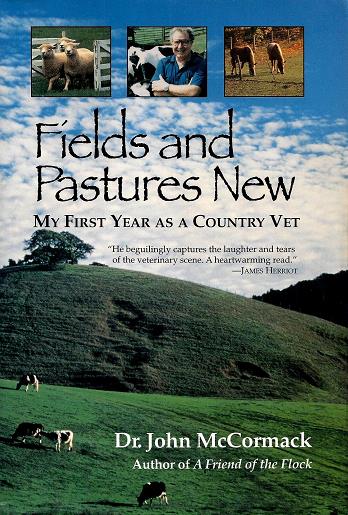
Fields and Pastures New

By Dr. John McCormack

The setting is the early 1960s and John McCormack and his wife and children have moved to rural Alabama for John to start his career as a private practice veterinarian.  This would be a first for the locals too because there had never been a veterinarian in their area before.
Since it was a rural location, a lot of his work would be with farm animals and farmers. Folklore was quite important to these people and folk remedies were the order of the day, with the vet often being called in only when all else had failed. People also relied upon an untrained local man, Carney Sam, who, just like them, subscribed to strange and mostly worthless folk remedies to treat their ailing animals. Like rubbing turpentine on a horse's belly to treat kidney problems. The thinking was that the turpentine would be absorbed through the skin and travel to the kidneys. Total rubbish, but those sorts of treatments were very popular.
But Dr. John is a modern veterinarian and his methods relied upon proven, scientific knowledge. They weren't foolproof, of course, but they were certainly much more effective than the strange and useless cures inflicted upon the poor, suffering critters they were meant to treat.
So rural, backward Alabama got itself a fancy new vet and before long, it was  clear that the community was very lucky to have Dr. John in their midst. And it was clear to Dr. John and his family that they had found themselves a warm and welcoming new home.

This was an interesting read, the memoir of  a young vet establishing himself in his new location, coping with the backwards farmers and the less-trying doctoring of the local dogs, cats and other pets in addition to the work with livestock. The author has real feelings of affection for his neighbors and clients and he and his wife and kids become a greatly appreciated part of the community.

For another review, see https://www.kirkusreviews.com/book-reviews/john-mccormack/fields-and-pastures-new/.

Sunday, May 08, 2016

Ranch of Dreams

By Cleveland Amory

Cleveland Amory loved animals and his love of animals only intensified after he read Black Beauty as a child. The book inspired a dream to have a place where animals could live out their lives in peace and comfort.
As an adult, Amory had a successful working life as an author, reporter and TV commentator and was financially able to buy a ranch in Texas and start his dream of a sanctuary for animals. Thus began Black Beauty Ranch. The first animals placed on the ranch were wild burros destined to be exterminated by the Park Service. Amory and Fund for Animals rescued hundreds of burros. But burros were not the only creatures who found a second life on the Black Beauty Ranch. Elephants, chimps, dogs, cats, goats, bison, big cats, and, of course, horses all found a home there. In this book, Amory tells harrowing stories of the unnecessary suffering inflicted on animals by callous and uncaring human beings and points out the desperate need for intervention by those who can see the world beyond their own selfish needs and desires.

The Black Beauty Ranch sounds like a wonderful place and Amory's role in establishing it makes for a terrific and inspiring tale. A worthy read for anyone who cares at all about this planet and the creatures that share it with humanity.

The Black Beauty Ranch is now run by the Human Society. Cleveland Amory died in 1998 but he left behind an amazing legacy. The Humane Society has a short video on YouTube about the ranch:  https://www.youtube.com/watch?time_continue=1&v=6lifGkijVhc

Sunday, April 17, 2016

Is There a Doctor in the Zoo?

By David Taylor

Even as a small child, David Taylor wanted to care for wild animals, to treat their wounds and cure their ills. Encouraged by his loving grandmother, together they launched him on his career as a vet who specializes in exotic animals.
Taylor got his professional start in a small two-man practice with a veterinarian who also had a zoo as a client. This man sort of inherited the zoo as a client and it was not a particularly important part of his practice. In fact, he was often called in as a mere formality so the zoo keepers could claim that the animal was attended to by the vet before it died.
But Taylor wanted to learn how to take proper care of the zoo creatures, not just be there as a last resort when all else had failed the zoo keepers. To that end, he embarked on a course of self-education, learning all he could from the keepers and other experts on the medical care of exotic creatures, everything from irascible parrots, unpredictable monkeys and apes, giant snakes, zebras, camels, seals and even dolphins and porpoises.

This book is the sequel to his first book, Zoo Vet. Although, time wise, it comes first as it details his efforts to become an expert in the care and treatment of zoo animals. Dr. Taylor has an excellent sense of humor and no problem poking fun at himself in his often messy and painful encounters with his animal patients. I especially enjoyed his description of how he freed a dugong that was being held in cruel and inhumane conditions and beaten daily to futilely provoke it into weeping, as its keeper thought that dugong tears were a cure for impotence. Even more amazing was the revenge he enacted on a bunch of drug runners who were torturing a poor animal for their simple-minded amusement. That episode alone made the whole book for me. The rest was just icing on a very tasty cake.

Sunday, January 31, 2016

Nop's Trials

By Donald McCaig

Nop is a border collie. He is a working dog, helping his owner with herding sheep on the farm. Lewis, Nop's owner, also entered Nop in sheep dog trial, which is a contest for sheep-herding dogs. Nop won the last local trial which angered one of the contestants. This man, Doug, when he was drunk, said he would pay anyone who took care of Nop $500. Two men who heard him believed him and snatched Nop one night when the dog was running loose.
But Nop is a very valuable dog. His owner was offered $5000 for Nop, which he declined. When the thieves discover this, they panic and sell the dog to a man who works for the rodeo. This man puts Nop in the rodeo with a monkey riding him and they herd calves for the amusement of the crowds.
Doug sees Nop on TV and buys him from the rodeo man, intending to breed Nop to his prize-winning bitch, also a border collie. But he becomes worried when the police and Nop's owner come looking for Nop and he gives Nop to two thugs to dispose of.
One of the thugs has a soft heart for dogs and just dumps him in the city where he is briefly adopted by a bag lady. She doesn't have him long, though, because the shelter where she wants to live doesn't allow pets. Nop is then destined for an animal shelter.
The custodian who was instructed to take Nop to the shelter instead sells him to a lab that uses animals to test drugs. Nop's future looks very bleak, indeed, and his faith in humans will be tested to the maximum.

This was an OK book. It was a very depressing read, as Nop goes from one bad situation to another, as Nop encounters one bad person after the other. The only one who treats kindly, other than his owner, Lewis, is the bag lady. But she only has him for a few days.
However, it works out in the end. I don't know if wading through all the cruelty is worth it though.

Wednesday, December 23, 2015

Quail in My Bed

By Burley Packwood

The true story of three tiny quail chicks who accidentally entered the lives of Packwood and his wife Betsi.
A few days before they were scheduled to leave on an extended camping trip, Betsi found an abandoned baby quail. She named the quail Pedro and assured her husband that the chick would not interfere with the trip. Amazingly, a few days later, she found another chick, this time wandering the aisles of a store. This one she named Pedra.
So both chicks came with them on the camping trip, coddled and cuddled by Betsi. Packwood hardened his heart against the quail but gradually came to admit that they added a lot to the trip, being entertaining little birds.
Unfortunately, Pedro managed to escape and they never found him. Native to the desert southwest, Pedro got loose in the northern United States into a habitat ill-suited to his breed, the Gambels quail. He most certainly perished when winter arrived.
Pedra remained with them on their trip although they promised to free her when they returned home to Arizona. Meanwhile, she wormed her way into the author's affections and he came to cherish the little bird as she did him, regarding him as the love of her life.
Upon returning home, they gave Pedra her freedom but she refused to go. She stayed with them, sleeping inside and have free range in their house. She also had free access to the outdoors and she spent a lot of time out there but never strayed away from their patio area.
She had quite a few ailments, possibly a result of her domesticated lifestyle. She nearly died of a lung ailment, and, on the road to recovery, was bitten by a poisonous spider. Her recovery from that and a subsequent fall was slow and painful but she eventually pulled through.
Betsi soon found another lost quail chick and Pablito joined Pedra. Pablito was a ball of fire compared to Pedra and his antics kept the two people very well entertained. Pedra pretty much ignored the new addition except when the chick tried to nestle under her feathers. Pedra refused to adopt the little orphan and usually gave him a good pecking for his efforts.
Even though he totally opposed the addition of quail to his home, the author soon came to realize that their life was much richer for the presence of the little birds.

I thoroughly enjoy this story of raising young orphan quail. I personally have never seen a wild quail where I live, but from what the author says, they must be quite common in Arizona. From this book and the previous quail book I recently read, That Quail, Robert, quail sound like very interesting and amusing little birds. Although I don't suppose the author is promoting the adoption of wild quail as pets.

Saturday, October 31, 2015

That Quail, Robert

By Margaret A. Stanger

Orleans, Massachusetts, July 1962. Mildred and Tommy Kienzle know that a quail has a nest in their yard. They then notice that the nest is empty except for two eggs. One of the eggs was obviously damaged but the other was fine. They took it in the house more as a curiosity than from any expectation that it would hatch. In fact, they just left if sitting on the counter. But it soon became apparent that this egg contained a living chick and in three days, Robert made her first appearance.
She quickly made herself at home with the Kienzles and with the author, Margaret Stanger, who was a kind of godmother to the chick. Robert, named so because they believed she was a male until one day when she laid an egg, loved people. She was friendly and greeted visitors with a glad cry. She loved attention and she loved to snuggle.
Robert also loved going outside, where she chased and ate bugs, took dirt baths, and dined on vegetation. But she always wanted to be back inside after awhile. She never showed any inclination to leave the Kienzles and join the wild quail. She was courted, at one time, by a male quail, and did produce several eggs, but showed no interest in nesting or paying any attention to her clutch. None of the eggs hatched.
She wasn't kept locked up and she could have flown away at any time. But she never did. Sometimes she would fly up on to the roof and sit there briefly, but she always wanted to be back in the house with her family and friends.
Robert was quite a sensation in her time and acquired many admirers. Her guest book was filled with signatures from people who came to see the little quail for themselves. A postcard with her picture was even created for her fans.
Unfortunately, quail are not long-lived creatures and even the protected environment in which Robert lived did not extend her lifespan. But even though the time she spent with the Kienzles and Margaret Stanger was all too brief, she was greatly loved and greatly missed. She was a gentle, affectionate and amusing companion.  She rarely caused problems, her worst crimes being the time she knocked over a glass of juice because she wasn't getting enough attention, the time she took a bath is a dish of broccoli, for the same reason. And the time she took a bath in a bowl of flour just because it felt so good.

This was a fun story, despite its inevitable end. Robert required a lot of care but she also brought a lot of joy into the lives of those who knew her. I know she gave me joy just reading about her. A very sweet story about a very sweet and entertaining little bird.

On a side note, I encountered three terms that I had never come across before: spatchcock, keeping room and borning room.  Spatchcock in, "He [a dog] was most often in a spatchcock position, front legs stretched out before him and hind legs stretched out behind, laying on his stomach." So I looked it up and spatchcock refers to splitting a fowl open and spreading it out flat for grilling.
Keeping room, "The routine was for me to get my book, lie down on the day bed in the keeping room, spread the blanket on my middle and call Robert." A keeping room was a room next to the kitchen and thus warmer than the rest of the house in winter. So people would gather there in the evening and even sleep there at night. It is somewhat equivalent to a family room.
Borning room, "The red velvet hat [Robert's bed] was put in the carton up on a high shelf in the little bedroom off the kitchen which in these old New England homes is called the 'borning room.'" So this is a bedroom, as the author says, next to the warm kitchen, designed for the woman of the house to use while giving birth.


Friday, June 19, 2015

City Girl, Country Vet

By Cathy Woodman

Maz in a veterinarian working in London. She has become involved with her boss. But he has decided to go back to his wife and now Maz has not only lost her lover, but she has also lost her job.
Emma, an old friend and fellow vet, wants to take an extended vacation and has asked Maz to fill in for her at her practice in rural England. Maz has her doubts, but eventually decides to do it.
Maz takes over the practice. But problems ensue, including money problems that Emma failed to mention. The locals are a bit judgmental and a rival vet has lots of nasty things to say about Emma and Maz. The only bright spot in Maz's life is Alex, also a vet, who seems interested in Maz. Trouble is, the angry rival vet is his father. Can Maz really trust anything this man says or is he just a spy for the oppostion?

I was disappointed in this story. Maz seems to be, at times, almost incompetent at her job. She makes too many mistakes, doesn't seem to know how to deal with people and goes from bad to worse. It was all rather depressing. Even the concluding events were depressing, with an old woman choosing to commit suicide due to Maz's charging into the woman's home and threatening to take all her cats and dogs away and with Alex ending up in the hospital in a coma.


Wednesday, December 31, 2014

Zoo Story

By Thomas French

The true story of Lowry Park Zoo of Tampa, Florida.
After some serious problems, with shabby exhibits and poor maintenance, Lowry Park Zoo reinvented itself, with new and better exhibits, key of which was the new elephant area, featuring five elephants, four of which are young elephants, straight from a reserve in Africa. These four elephants were removed from the local herd, which had grown to numerous for the limited resources of the reserve. The reserve managers didn't want to kill them and figured they would be better off in a zoo. And so they were shipped by plane from Africa to Florida to their new home at Lowry Park Zoo.
At the time of the elephants' arrival, Lowery Park Zoo was run by Lex Salisbury, a dynamic and tyrannical leader with a grand vision for the future of the zoo. His story ends rather sadly, when his ambitions extend too far and end up biting him in the ass, accused of dubious dealings and fired from his job and threatened with criminal charges.
But for the caretakers, it is all about the animals. Underpaid and overworked, these people love animals and put up with the minuses just because they want to be with the animals. It is really hard, demanding and draining work, especially when things don't go the way one would want. Things go bad, animals get sick and die and in one sad case, a tiger escaped and had to be killed.

This was quite an interesting and enlightening book, an intriguing look at what goes on behind the scenes at a zoo.
For another review, see http://www.csmonitor.com/Books/Book-Reviews/2010/0721/Zoo-Story-Life-in-the-Garden-of-Captives.

Thursday, June 06, 2013

The Whispering Land

By Gerald Durrell

The true story of Gerald Durrell's trip to Argentina in the late 1950s to gather animals for his zoo in England. It took him eight months to get the animals he wanted and along the way he made many new friends among the locals, encountered rare and interesting animals and had a pretty good time of it, all in all. The only thing he wasn't able to get done was capturing some vampire bats. He even went so far as to sleep outside one night with his bare foot uncovered, hoping to entice the bats with his own vulnerable toes. The bats were certainly in the area but were not interested in his toes. Later on he reflected that it was probably for the best because if he had been bitten he would have most likely had to undergo a series of injections to prevent the development of rabies!

This was an enjoyable story, lots of critters, some adventure, and descriptions of exotic landscapes and of the many friendly and helpful people without whom his expedition would have been much more difficult and much less successful. While reading it, some fifty plus years after it was written, I couldn't help but wonder if the wild and untamed landscapes he describes have changed much over the decades and if the sleepy little villages are still sleepy and quiet and the abundant wildlife still abundant . . .

Sunday, April 21, 2013

My Wilderness Wildcats

By Mike Tomkies

I didn't really know anything about the wildcats of the England, Scotland and Wales. I didn't even know there were wildcats or what a wildcat was exactly. Turns out the wildcat is a small cat, about the same size as the domesticated house cat, but with a much different temperament. They truly are "wild cats" and cannot be tamed, unlike many large wild cats, such as tigers and lions. They are native to Europe but are rare.
Wildcats have pretty disappeared from England and Wales but can still be found in the more remote areas of Scotland. Tomkies was given two small wildcat kittens who had either lost their mother or been abandoned by her. Tomkies lived in such an isolated area of Scotland that there were no roads leading to his house, it could only be reached by boat. Being a naturalist, and not really knowing much about wildcats, Tomkies felt the two kittens would make interesting study subjects. He named them Cleo and Patra and built pens for them and raised them on meat and milk. In time he also acquired a rather elderly male wildcat, a refugee from a zoo, and was able to successfully breed him with one of the females who produced two kittens, Fred and Mia. Eventually, he released all the wildcats back into the wild, in the fullness of time.

This was quite an interesting read, although at one point it became a bit repetitious as he described his routine of giving the wildcats some freedom, while continuing to feed them, then capturing them and once again placing them in pens. He was worried that they couldn't make it on their own, but they proved him wrong. Even the elderly male who had spent most his life in a zoo eventually became a skilled and successful hunter. But besides the wildcats, this book is an interesting glimpse of a life lived in the back country, without electricity or central heating, just a man and his dog and a some wildcats.

Sunday, September 02, 2012

Rider at the Gate

By C. J. Cherryh
Set on an alien planet much like Earth, with mountains, prairies, oceans, rivers, forests and animals, humans have settled into walled, scattered communities and are maintaining a limited technology, equal to about the early 1900s, with limited access to telephones, electricity, and motor vehicles, trucks mainly. Because, although this planet is bountiful and fertile, its animal life is telepathic and the effect on humans is not good. So people wall themselves away from contact with the wildlife and try to maintain a grasp on their sanity. Except for the riders.
Native to the planet is a large omnivore resembling horses which the people call nighthorses. Nighthorses are attracted to human intellect and are able to bond with a chosen human, who becomes the nighthorse's rider. Riders travel with truck caravans as guards against the native wildlife and riders also serve as buffers between wildlife and the human towns, using the nighthorse telepathy to send any curious wild creatures running.
The problem with having nighthorses in your community is that they broadcast human and nighthorse images indiscriminately. So when a nighthorse rider is killed, her fellow rider and lover is grief-stricken and his grief is broadcast throughout the community, which turns on him and sends him out into the winter with only his nighthorse for company.
The rider, Guil and his nighthorse, Burn, driven away from humankind, set out to discover what really happened to Guil's lover, the woman who was killed while guiding a truck convoy through the mountains.

This sounds like an exciting premise for a book: one man and his telepathic horse, struggling to survive the winter storms of an alien world and also track down the truth behind his lover's death.  Yet somehow it just fell short. Most of the time I was just bored with it. Part of the problem was the author doesn't tell you up front what the deal is with the native animals and the nighthorses, the telepathy and how it can drive humans to the brink of insanity and how fearful the people are of that happening. So for much of the start of the book, I had a hard time figuring out what was going on with these people. The Guil character comes home to his village and is greeted with the news of his lover's death and instead of sympathy and compassion, he is driven out into the cold and shot at in the process. It just didn't make any sense. And then this "rogue" that everyone is so terrified of, I didn't get until almost the last third of the story that the rogue was a nighthorse; I kept expecting some kind of hideous monster to come charging out of the forest, instead of just a confused and anguished nighthorse.
This book might appeal more to readers who really like horses. I am not a fan of horses, I don't dislike horses but I don't care to socialize with them either. I am no more inclined to climb on the back of a horse than I would be to climb on the back of rodeo bull. To me, they are both large scary animals to be viewed from afar. But if you really like horses, then a book where the rider has a mental bond and communion with the horse might be an enjoyable read.

Friday, April 06, 2012

Merle's Door


By Ted Kerasote

Ted was on a rafting trip on the San Juan river with friends when a young stray dog showed up at their campsite. The dog was thin and hungry but seemed friendly and approachable. When it came time to move on, Ted and his friends decided to bring the dog with them. And so the dog, whom Ted named Merle, became a very important part of Ted's life.
Having lived wild for so long, Merle had a very stong independent streak. He wanted to be outside, a lot. But he also enjoyed the comforts of a warm bed and shelter from the cold. At first, Ted tried to convince Merle to use a very nice, insulated dog house that Ted set up for him. But Merle had a fear of confined places and refused to use the dog house. So Ted put in a dog door and life was perfect for Merle. Now he could come and go as he pleased, indulging his need to hunt and prowl and then come home to a safe, warm house when he wanted.
Ted and Merle led a very active lifestyle, hunting, skiing, mountain biking and Merle was there for most of it, even the skiing. Merle had his own version of skiing which he hugely enjoyed, sliding down hill on his tummy like an otter.
Together the two of them had an almost perfect lifestyle, especially Merle. About the only cloud in Merle's life was when Ted had to leave for one of the trips required by his job. Merle would be all sad and gloomy when he realized Ted was preparing to go, but as Ted latter discovered when he came back unexpectedly, Merle continued on with his carefree ways, making his daily rounds, greeting the local dogs and humans in the small mountain village in which he lived, acting as if he hadn't a care in the world. So much for the image of the sad dog, laying by his master's door, pining for Ted's return! That was Merle, though, loving yet independent. And his independence was supported and nurtured by Ted, who was fortunate enough to live in an area where free-roaming dogs were accepted and rural enough to be safe from most man-made dangers.

I enjoyed this loving memoir about Merle. He was a special dog, smart, independent, but also loving and loyal. It was fun reading about their good times together and brought back fond memories of good times I have spent with my dogs, both past and present. I would think most dog lovers would also enjoy this book.

Sunday, March 11, 2012

You Had Me at Woof: How Dogs Taught Me the Secrets of Happiness


By Julie Klam

Although she was raised with dogs, author Julie Klam didn't rush into getting a dog of her own. In fact, at thirty, she was still single and rather lonely. Then one night she dreamed about a dog, a little Boston terrier and she decided it was an omen: she needed a Boston terrier of her own.
So, looking for her dog, she found out about Boston terrier rescue. And that is how she found Otto, the dog of her dreams and the first in a long line of Boston terriers and Boston terrier-ish dogs, as she became more involved in dog rescue. Many of the rescue dogs were untrained, unhousebroken, neurotic and destructive. Plus, she and her family lived in an apartment, which meant walking the dogs several times a day. She took on a lot of responsibility but she (and her husband and child) helped a lot of unwanted dogs, mostly Boston terriers.

This was an Okay read. Some of the things she tolerated with the rescue dogs would make me think twice -- especially the hyper dog who took a chunk out of her young daughter's arm. She got lucky it was only her arm -- it could have been the girl's face! That would have the end of it for me. The author is definitely a bit of a nut when it comes to rescue dogs.