By Connie Willis
The sequel to Blackout, finds the time travelers stuck back in 1940s Britain in the thick of World War II. Their job now is to survive and hope that someday the people back in Oxford of the future will figure out their plight and send someone to rescue them. Surviving is the problem, with bombs falling on London and Britain, no place is truly safe.
Polly and Eileen have jobs as sales clerks. Mike finds them but he gets cut off from them trying in vain to find other time travelers in the area. Eileen discovers that Binnie and Alf are living on the streets after their mother died and she takes them under her wing. Both she and Polly get involved in Sir Godfrey's amateur theatrics and it nearly costs Polly her life. Mr Dunworthy, their boss from the Oxford Future comes back to save them only find himself trapped in the past too.
Now it is all upon a teenage boy in Oxford Future with a huge crush on Polly to try to locate them in time and effect a rescue. Before Hitler manages to blow them all to bits.
While not as exciting as the first book, still this is a good read, about missed connections and odd coincidences. And if you are smart enough and have a really good memory, (unlike me) you may be able to figure out the direction of the story. It is all laid out in the end and tied neatly together. Which makes for a tidy and slightly unsatisfying end, as one of the most interesting characters in the story **spoiler alert** doesn't make it out alive.
Check out The Guardians review: https://www.theguardian.com/books/2011/nov/16/all-clear-connie-willis-review.
Thursday, October 19, 2017
The Chemist
By Stephenie Meyer
She was called Juliana until she found herself in the crosshairs of a corrupt government agency. Now she sleeps with one eye open and a pocketful of fake identities. Currently going by the alias Alex, she is a young, brilliant scientist, best at what she did for the government, but apparently someone decided she knew too much and needed to be silenced.
Alex hates her new life on the run, never trusting anyone, always looking for her assassin. So when her old boss tracks her down and promises to call off the dogs if she will do one last job for him, against her better judgment, she agrees, pressured by the desire for a normal life and by the even stronger desire to prevent a terrorist from releasing a virulent, deadly disease upon the nation.
Her old boss points Alex in the right direction and she is able to locate the terrorist. But he just doesn't look like the kind of man who would be a mass-murderer. In fact, he seems kind, gentle and basically decent. (Also very good-looking.)
So she kidnaps the man, Daniel, using her particular set of unique skills and interrogates him. But no torture she inflicts upon with her chemical potions is able to get him to confess where he has stashed the deadly disease. And he continuously denies any knowledge of anything about a disease, insisting he is a just an ordinary guy who teaches school for a living. The interrogation is interrupted by hired killer who crashes her torture session to rescue Daniel. Turns out the new guy is Daniel's black-ops twin brother Kevin whom Daniel thought was deceased. And he is highly upset that Alex is torturing his brother. In the struggle that follows, Alex's hidden defenses take Kevin (and his killer dog) down and she is able to secure him and his dog.
Like Alex, Kevin used to work for the government and then became a liability. His old boss and her old boss got together and hatched a scheme that would have the two of them efficiently eliminate each other. Poor Daniel was nothing but a pawn to lure the two of them in. But due to Alex's foresight, they both survive the encounter and put their heads together to take on the bad guys who are trying to take them down.
This was a gripping, exciting story. Alex is a very resourceful, highly competent heroine who, despite her diminutive size, comes out the victor, eventually. She usually is the one who saves the day in any deadly encounter. Together, she and Kevin are a match for anything their ex-bosses try to throw at them. Yet, despite her deadly past, she and Daniel fall hard for each other, with brother Kevin looking on in disgusted bemusement. So this is part thriller, part spy novel and part romance story and a really fun and engaging read.
Kirkus Reviews rated it "B for Badass": https://www.kirkusreviews.com/book-reviews/stephenie-meyer/the-chemist/.
Saturday, September 30, 2017
China Boy
By Gus Lee
They could see the writing on the wall: the Communists were winning. As rich Chinese people, they could stay and end up in a re-education camp. Or they could flee. So leaving behind the wealth, status and position they fled, ending up in San Francisco, California. And California was were Kai Ting was born, the only son of his mother and father.
But life in California was so different. For one thing, they were no longer wealthy. Accustomed to lives of wealth and influence, in America, that was no longer the case. Even though the father had a steady job, they could only afford a home in one of the roughest neighborhoods of San Francisco.
Life was hard for Kai. He was the only Chinese boy in his neighborhood. Also, he was small and garbled his words. The local street kids were brutal and he stayed inside with his mom and his sisters where it was safe.
But then his mother died and his father remarried. The stepmother was not a kindly or understanding woman and she was determined to destroy Kai's Chinese culture. She locked him out of the house all day, only letting him inside at night. This left him to the mercy of the cruel street kids and he was constantly being beaten and abused by them. His father was incapable of standing up to his new wife and the best thing he figured out to do was enroll his son in boxing classes at the YMCA.
Kai meets a group of caring and committed men at the YMCA. They see his struggle and they guide him into understanding himself and his place in the community and they give him the tools to stand up to the vicious characters in his neighborhood. The novel ends with Kai facing the worst of them and finally also fighting against his stepmother's abuse.
This is an OK story. There is a huge amount of boxing in the story. Lots and lots of boxing. The only thing that makes all the boxing bearable are the stories about the instructors at the YMCA. But even so, I was getting pretty tired of the boxing towards the last section of the book. Not a fan of boxing, nor reading about boxing. All the boxing sort of ruined it for me. I know, the boxing saved his life. But if I had known the book had so much boxing in it, I wouldn't have bothered to read it.
Kirkus Reviews: https://www.kirkusreviews.com/book-reviews/gus-lee/china-boy/.
In the Fall
By Jeffrey Lent
Norman Pelham left his family's farm in Vermont to fight against the rebels in the Civil War. He suffers a head wound and is found in the woods by a runaway slave, Leah. Leah is young and beautiful and, for Norman, it is love at first sight. He takes her home to Vermont.
His mother and sister are not thrilled to that Norman has married a black woman, but they accept it. Norman takes over the farm and he and Leah have three kids, two girls and a boy.
There are no other black people in rural Vermont where the Pelhams live. Leah encounters a black man at a fair and she starts brooding about her past. She decides she needs to confront her past and try to locate her relatives she left behind. So she leaves the farm and heads down south. What she finds out disturbs her greatly and she returns home to Vermont only to commit suicide.
Her youngest child is wrecked by his mother's death and grows up to runaway from the farm, never to return. He enters into a life of crime as a bootlegger. But he comes to a bad end, never telling his only child, Foster, the truth about his past. Finding a letter in his father's effects, Foster learns that he has family in Vermont and travels to the farm, which is now being run by Norman & Leah's two old-maid daughters. Foster is totally surprised to discover that his grandmother was a black woman. Getting to know his two aunts and learning about the grandmother's death, Foster decides he will go down south and try to understand what was so terrible that his grandmother preferred to be dead rather than live with the truth.
This is really engrossing family saga. I kept hoping that things would work out for these sad yet worthy people and it was heartbreaking to see them suffer and fall. But young Foster is the one who uncovers the past and brings a measure of justice to the author of his grandmother's despair. Just a wonderful story, I enjoyed tremendously.
Publishers Weekly review: https://www.publishersweekly.com/978-0-87113-765-4.
The Last Laugh
By Lynn Freed
Three ladies on the cusp of seventy decide to leave their homes in California for a house on a Greek island. They want to escape the demands of their families and just kick back and enjoy being together.
But all three women have complicated lives, with lots of attachments and kids and grandkids, ex-husbands, ex-lovers, dead husbands and other hangers-on. Inevitably, their attachments follow them to Greece and bring with them all the old complications. Because, no matter where you go, you are always there.
I read this book partly because it was described as, "wildly funny," "hilarious," and "rich in humor." These people who describe books this way must be much more easily amused than I am. I didn't find the book to be funny, in fact, it became rather grim and disturbing towards the end, when one of the ladies kills someone.
But, even though it wasn't particularly funny, I still found it interesting, especially since I have that fantasy too, of traveling to Greece and staying on one of the islands. The book cover is the other reason why I picked the book up, the building on the cover looks like something you would see in Santorini. The author certainly fed the fantasy, as she makes the islands & the people & the food very appealing!
Kirkus Reviews: https://www.kirkusreviews.com/book-reviews/lynn-freed/the-last-laugh-freed/.
Notes From a Small Island
By Bill Bryson
Bryson, originally from Iowa, lived (and maybe still lives) in Great Britain for many years. One of the things he enjoyed/enjoys doing is traveling around Britain and seeing the sights and hiking the trails and footpaths and viewing Britain from an American perspective.
Only a few pages into the book, Bryson describes how he spent his first night in Britain on a bench outdoors because he couldn't afford the rates at the only hotel open at that time of night. He got so cold he put on all his warmest clothes and even put a pair of flannel boxers on his head. Early the next morning, he got up and asked a local man if he knew of a restaurant that might be open. He did and directed Bryson to it, saying it was where the truck drivers ate and so would have good food. He then recommend to Bryson that, "You might want to take them pants off your head before you go in."
Bryson was smitten by British place names. He listed as "endearingly insane" towns such as Chew Magna, Prittlewell, Little Rollright, Titsey, Woodstock Slop, and Nether Wallop.
This book is a lot of fun. Bryson always amuses and he still manages to make parts of Britain sound appealing, even in the pouring rain. One of the best things about Bryson's travel tales is his great sense of humor and his ability to laugh at himself.
Kirkus Reviews: https://www.kirkusreviews.com/book-reviews/bill-bryson/notes-from-a-small-island/.
Friday, September 01, 2017
Artists in Crime
By Ngaio Marsh
The setting is 1930s Britain. Inspector Alleyn is on his way home from the Far East when he meets a talented female artist. He admires her work, she is not receptive.
Back home in Britain, he is called to investigate a murder at a country estate that just happens to be the home of the standoffish artist, Agatha Troy.
Miss Troy is running an artist colony out of her home and several artists are working together on their projects. The current project is a nude study featuring a young woman model. This woman is the victim that has sent Alleyn to the scene. She was stabbed to death while posing for the artists, by means of an unlikely trap.
So Alleyn has to interview this collection of free spirits and try to determine which one of them had it in for the dead woman. It turms out the woman was a blackmailer with multiple victims among the group. Alleyn has to figure out who had enough and decided to finish her off to shut her mouth. But first he has to get past the red herring set up to point the police in the wrong direction. And keep his mind on his work while falling for the aloof and elusive Agatha Troy.
This was an okay read. I did find the police interviews with the suspects rather dull after a bit. And I wasn't surprised when the main suspect turned up dead. But the identity of the real killer came as a bit of a surprise, although a person cleverer than me probably saw the clues right away.
I do have a quibble with the story. One of the plot details features aspirin. The story implies that taking aspirin is similar to taking a sleeping pill. Now, I don't know about the aspirin they had in Britain in the 1930s, but aspirin here in the States is merely a pain reliever and does not induce sleep.
My copy of the book was published in 1980, but the original novel dates from the 1930s. I am wondering if the author used some other pain reliever common in Britain with the soporific side effect mentioned in the story and the publishers here changed it to aspirin, which would be more familiar to an American audience. Because it is hard to believe that a woman as smart as Ngaio Marsh would make such an obvious mistake about the effects of aspirin.
Wednesday, August 30, 2017
Bogmail
By Patrick McGinley
Roarty doesn't like the young man who has recently come to work for him at his pub. It all started when Roarty found out that the man seduced his teen daughter.
One night, after hours, Roarty comes into the bar with a heavy encyclopedia in his hands and sees his enemy bent over, unseeing. On an impulse, he smacks him in the head with the book and kills him instantly. The only blood spilled are a few drops from where the man's head bangs against a barrel.
What to do with the body? He decides to bury him in the local bog. He waits until very late at night and packs up a few of the man's belongings (the man lived in a room at the pub as does Roarty) and hauls him and the pack out to the peat bog and buries him.
He is quite pleased with himself until he gets a note in the mail demanding money. The blackmailer, or bogmailer as he (or she) likes to call himself (or herself), has dug up the body and the pack and is threatening to tell the police unless Roarty buys his silence.
But who in this small Irish village is the bogmailer? Roarty reviews his friends and customers and finally decides it is the English fellow, Potter, who recently moved to the village. He begins to plot against Potter, without really being sure that Potter is the bogmailer. Which is a bit of a shame because he really likes Potter.
This was pretty interesting during the first half of the story, but then I started getting bored with it and just wanted it to be done. Also, the book is touted as being hilarious & bawdy. I didn't find it to be so. Another strike against it is the enormous amount of unfamiliar words, including untranslated foreign phrases. I made a list:
- Do shláinte, a chailleach! - a toast meaning, your health, woman.
- Sláinte na bhfear agus go ndoiridh tú bean roimh oiche. Google translates this as, "men's health and keep you a woman before night." Yeah.
- elvers - an eel
- coulter - part of a plow? (not sure about this one)
- lough - loch (a lake or a narrow arm of the sea)
- syrinx - voice organ in birds, part of the larynx
- terminus a quo - the earliest possible date for something.
- slane - spade for cutting turf or peat
- suggilation - post-mortem bruise
- wethers - castrated ram
- selvage - a zone of altered rock at the edge of a rock mass
- yeld ewes - ewe that is not pregnant? Not sure about this one.
- louping-ill - a tick-borne viral disease
- grass tetany - livestock disease caused by lack of minerals in the diet
- reactor cattle - cattle that have tested positive for disease? Not sure about this one.
- ruamheirg - rusty colored water
- cál leannógach - loud voices? Not sure about this one.
- replevy - to take possession of goods under a replevin order
- replevin - legally speaking, a procedure whereby seized goods may be restored to their owner
- dulse - edible seaweed
- anthelmintic - medicine used to expel worms
- sloke - edible algae
- sloc earraigh - algae that grows in the springtime? Not sure.
- gillie - a man or boy who attends someone on a hunting or fishing expedition
- rhotacism - is the inability to pronounce or difficulty in pronouncing the sound r
- barytes - a mineral consisting of barium sulfate
- orificium urethrae - where urine exits the urethra? Not sure.
- poteen - alcohol made illicitly, typically from potatoes
- trampcocks - piles of hay? Not sure.
- bumf - useless or tedious printed information or documents, junk mail
- sheepshairn - sheep dung? Not sure.
- popply - bubbly, rippling, or choppy water
- airt - compass point, quarter, direction
- duibhean - a bird, cormorant
- exiguity - leanness, meagerness, meagreness, poorness, scantiness, scantness
- Jansenist - Catholic theological movement, primarily in France, that emphasized original sin, human depravity, the necessity of divine grace, and predestination
- sacerdotal - relating to priests or the priesthood; priestly
- Chindits - special operations units of the British and Indian armies, which saw action in 1943–1944, during the Burma Campaign of World War II
- Lollardism - pre-Protestant religious movement critical of the Catholic Church
- Rerum Novarum - encyclical issued by Pope Leo XIII on 15 May 1891, "revolutionary change"
- De Senectute - "On Old Age" an essay by Cicero in 44 BC on aging and death
- mensuration - the measuring of geometric magnitudes, lengths, areas, and volumes
- numinous - having a strong religious or spiritual quality; indicating or suggesting the presence of a divinity
- gliobach - Didn't find this one. Here is the sentence: "Good lord, have noticed that gliobach of sea fowl?" From the context, it would seem to be flock, but I couldn't verify that.
- Gadus pollachius - Atlantic cod? Not sure.
- heresiarch - founder of a heresy or the leader of a heretical sect? They are talking about fish, I don't understand this one at all: "I had not thought of Gadus pollachius as a British heresiarch."
- pelagic - fish that inhabit the upper layers of the open sea
- pelagian - person who believes in the theological doctrine of Pelagius (These last four are some kind of erudite pun: Gadus pollachius, heresiarch, pelagic & pelagian. It's beyond me, though.)
- cunt splice - a kind of knot in a rope
- futtock plate - A plate (usually metal) attached horizontally near the top of the lower mast of a square rigged ship in order to secure the topmast
- hypostasis - the accumulation of fluid or blood in the lower parts of the body or organs under the influence of gravity, as occurs in cases of poor circulation or after death
- penumbra - partially shaded outer region of the shadow cast by an opaque object
- litterateurs - person who is interested in and knowledgeable about literature
- shebeen - an illegal bar or club where alcohol is sold without a license
- gleety - mucous discharge? Not sure.
- Die Davidsbündlertänze - a group of eighteen pieces for piano composed in 1837 by Robert Schumann
- deoch a' dorais - convivial night-cap, the last drink before departing
- Hibernicis ipsis Hibernior - more Irish than the Irish themselves
- Fünf Stücke im Volkston - "Five Pieces in the Popular Style" music composed by Robert Schumann in 1849
- furcula - wishbone of a bird (Why couldn't the author just say wishbone?!)
- climacteric - critical period or event
- gauger - an exciseman who inspects dutiable bulk goods? Not sure.
- spancelled - rope with which to hobble an animal, especially a horse or cow
- blue till - till is material deposited directly by glacial ice and showing no stratification. As to blue till, I couldn't find it.
- ombrogenous - a type of bog
- soligenous - a bog that receives water from rain and slope run-off
- jackeens - mildly pejorative term for someone from Dublin, Ireland; a contemptuous designation for a self-assertive worthless fellow
- scideens - couldn't find this one. Here is the passage: "'He didn't even call them potatoes. He called them...' 'Scideens.'"
- innominate - not named or classified
- terribilità - awesomeness or emotional intensity of conception and execution in an artist or work of art, originally as a quality attributed to Michelangelo by his contemporaries
- coenobites - member of a monastic community
- sodality - confraternity or association, especially a Roman Catholic religious guild or brotherhood
- Timor et tremor - fear and trembling? Not sure.
- timor mortis conturbat me - "fear of death disturbs me"
- taurine - relating to, or resembling a bull
- shanachie - teller of old tales or legends
- odium theologicum - "theological hatred" — the name originally given to the often intense anger and hatred generated by disputes over theology. It has also been adopted to describe non-theological disputes of a rancorous nature.
- antinomies - contradiction between two beliefs or conclusions that are in themselves reasonable; a paradox
- tow - waste fiber left after processing the flax plant to spin linen, it may also sometimes refer to the waste from hemp and jute
- cotta - surplice, a loose white linen vestment varying from hip-length to calf-length, worn over a cassock by clergy, acolytes, and choristers at Christian church services
- outshot - a lean-to
- wooden tester - a wood bed canopy? Not sure.
- phimosis - congenital narrowing of the opening of the foreskin so that it cannot be retracted
- soil pipe - sewage or waste water pipe
- Benthamite - utilitarian philosophy of Jeremy Bentham, holding that pleasure is the only good and that the greatest happiness for the greatest number should be the ultimate goal of humans
- jouking - a sudden, elusive movement, to dodge or duck
- tolle lege - "take and read"? Not sure.
- gal fiútair - couldn't find this one. Here is the passage: "'You only get it when the wind is north-east. Crubog calls it a gal fiútair. He says it's coal from Derry.'" I assume it means some kind of chemical odor.
- jugged hare - a whole hare, cut into pieces, marinated and cooked with red wine and juniper berries in a tall jug that stands in a pan of water
- palimpsest - something reused or altered but still bearing visible traces of its earlier form
Tuesday, August 29, 2017
The Cosmic Rape
By Theodore Sturgeon
The hive mind. Draws its power from enormous numbers of members within the hive. But what happens when the hive mind meets up with what it has never encountered before in all its existence: the solitary intelligent minds of the human race?
Told in a series of vignettes of the lives of ordinary people, just going about their normal activities. Then in an instant, it all changes as people find themselves thinking, not as individuals, but as one united organism. Guess what, hive mind: a new sheriff is in town. And its name is Humanity.
This is just a weird story. The united humans attack and destroy the invading machines of the hive mind. Then they join the hive mind willingly, which apparently gives humanity ascendancy over the hive.
The first human taken over by the hive mind, a drunken bum, never gets to enjoy the rewards of the hive and spends the rest of his life in solitary misery and loneliness, supposedly because that is what he truly desires. Weird.
The Mist
By Stephen King
Summertime on the lake and a bad thunderstorm knocks down trees and power lines. Waking up to a changed world is bad enough, but what is that strange mist coming in across the lake? Doesn't look like any normal mist, so white and menacing. Never mind, the wife needs some odds and ends at the grocery, so head into town with the kid to the store. Question is, will you be able to get back home? Because the mist has arrived and it is full of terrors.
A gripping, scary story that illustrates the fragile grasp people may have on sanity and civility in a midst of a terrible crisis.
Labels:
fiction,
good read,
horror,
King (Stephen),
science fiction
Camelot in Orbit
By Arthur H. Landis
Something is rotten on the world of Fregis (aka Camelot) and Kyrie Fern has been sent by the Galactic Foundation to straighten things out before the whole planet is destroyed. Kyrie Fern is an adjuster-manipulator who job is to restore balance. Passing as one of the native peoples and going by the alias of Harl Lenti, he is just the guy who has the ability to take on the hidden evil threatening to engulf the whole world.
Landing among the northern people, Harl gains the reputation of a hero and is thought to be the Collin, a mythic figure come to life to protect the north. As the evil from beyond slips its influence into the minds of many of the important lords of the north, the Collin is sent forth by the king to gather an army and, along with the king's daughter, confront the Kaleen, the Dark One, who trying to rule the whole world. Harl will use his superior technology, his understanding of human nature and his skill at warcraft to bring down a threat that could expand beyond the bounds of one planetary system. He will be helped in this by the strange and deceptive pug boo, Hooli. Disguised as a placid little creature similar to a koala bear, Hooli has ways and means beyond that of Harl and beyond that of even the Galactic Foundation. But are Hooli's goals in line with those of Harl? Whatever they are, Hooli isn't going to make it clear anytime soon.
This was an enjoyable adventure story, with interesting people on an attractive alien world. I wish that the dottles, a six-legged riding animal, really existed. They sound amazing.
Labels:
fantasy,
fiction,
good read,
Landis,
science fiction
Me Talk Pretty One Day
By David Sedaris
A collection of David's stories of his childhood and into his adulthood, poking gentle fun at himself and his family, for the main part.
An enjoyable and amusing read, if taken with a grain of salt.
For a review, see https://www.publishersweekly.com/978-0-316-77772-8.
A collection of David's stories of his childhood and into his adulthood, poking gentle fun at himself and his family, for the main part.
An enjoyable and amusing read, if taken with a grain of salt.
For a review, see https://www.publishersweekly.com/978-0-316-77772-8.
Labels:
good read,
humor,
memoir,
Sedaris,
short stories
Zoo Vet
By David Taylor
David Taylor always knew he wanted to be a wild animal veterinarian. When he started out as a vet, there weren't many vets who specialized in treating wild animals. Most vets considered it to be a side job to their main practice of treating farm animals & pets. But after being in a regular veterinary practice, Taylor took the bold step of focusing solely on wild animals, mostly to be found in zoos. He took an especial interest in marine mammals, notably whales & dolphins.
Even though his greatest interest was in whales and dolphins, he still treated a wide variety of other creatures from snakes to great apes to camels, hippos and any other creature that became ill or injured in a zoo. He even treated humans on occasion!
He had an amazing career that took him on adventures all over the world, seeing, treating and learning about a great variety of creatures.
This was a very enjoyable book as the author takes us along on his adventures among the animals of the world.
However, there is one story where he claims he was driven around a city in France by a chimpanzee on a motorcycle. He claims the chimp obeyed all the traffic laws and maneuvered through city congestion without a hitch. I tried looking it up online and couldn't find anything about such a remarkable animal, which casts doubt on the story. The author pulling the reader's leg? Maybe.
Labels:
animals,
Britain,
good read,
memoir,
nonfiction,
Taylor (David)
Monday, July 31, 2017
Outside Passage
By Julia Scully
Julius and Rose went to Alaska to make their fortune. But things turned out badly and they ended up in San Francisco, where their luck went from bad to worse. So bad, that Julius killed himself, leaving his wife and two young daughters stranded. Rose got so desperate that she put the two girls into a orphanage and went back to Alaska, hoping to achieve what had eluded her and Julius in the past.
Julia and Lillian were fairly happy in the orphanage. It was an orderly place, although, of course, some problems existed. But overall it was a secure and safe environment and the kids there attended public school. But then Rose came back and moved the two girls to another orphanage, this time in Seattle. This place was not as well run as the previous place and the children were underfed. Julia even resorted to stealing food from the kitchen.
But eventually, their mother felt secure enough at her work in Alaska that she sent for the girls to join her there.
Life in Alaska was the opposite of everything the girls had know before. Rose was living on the barren tundra, running a roadhouse patronized by the local gold miners. Used to the city, now there was just a few buildings and the vast, gray outdoors. Used to life in an institution with rules and order, now they were free, nothing really expected of the two girls.
Then World War II happens and once again they are on the move. Nome, Fairbanks, even back to California. And as the world changes, Julia begins to realize that she wants more out of life than her mother's seeming content with the small, narrow life of a small town in Alaska.
This was a pretty interesting story. I would have liked it to go on beyond the author's youth, but it ends with her heading off to college. It's not really a story of roughing it in the wilderness, which is sort of what I was expecting. It's really about a young girl surviving the trauma inflicted upon her by fate and by her parents, especially her mother. But it is a good read.
Labels:
Alaska,
autobiography,
good read,
memoir,
nonfiction,
Scully
The Traveler in Black
By John Brunner
The traveler in black is a being who sole purpose is to oppose chaos. He does this by granting people's poorly considered wishes, with a result much like that of King Midas: everything Midas touched turned to gold, including his loved ones and his food. (If he hadn't had his wish reversed, Midas would have soon starved to death.) Although how this is supposed to reduce chaos eludes me. Anyway, this is a collection of stories where the travel in black confronts the illogical locals and tries to set them on the path from chaos to order, from superstition to logic, mainly by granting wishes that were better left unsaid.
I enjoyed the stories and the comeuppances the ill-considered wishers find themselves facing. Just a nice, light, amusing read, one I have enjoyed over and over again.
Aisles
By Paul Magrs
Robin likes to spend his nights in chat rooms, chatting up the "ladies." A new chatter enters, using the handle Iris Murdoch, which is the name of a famous, deceased British novelist. Robin is immediately intrigued, especially when it seems that this woman is claiming to be the real Murdoch.
Meanwhile, Robin's wife, Glenda, is helping Tony cope with the sudden death of his wife in a car crash. Glenda and Tony were at a retirement party for Glenda. Tony's wife was running late and was on her way to join them when she lost control of her car on an icy stretch of road.
And that is about it. There are also a couple of gay guys who are fooling around. And Robin keeps chasing after the elusive Murdoch. As a story, there really isn't much to this one. Total waste of my time, reading it, and a huge disappointment.
Razor Girl
By Carl Hiaasen
Buck Nance is a reality TV show star doing an appearance at a club in Key West when his racist and homophobic comments and jokes upset the patrons and send Buck fleeing into the night. His agent, Lane, is usually there to keep Buck safe and happy, but Lane is a no-show. In fact, Lane has been kidnapped.
While driving to join Buck at the club, Lane was in an accident that was really an on-purpose. Rear-ended by a pretty young woman, Merry Mansfield, Lane lets her hitch a ride in his car and he soon finds himself kidnapped. But it turns out to be a case of mistaken identity, wrong man, wrong car.
Merry's accomplice plans to murder Lane just to get rid of him but Merry lets him go free (he is quickly kidnapped again by a local whack-o). She and her accomplice then proceed to kidnap the correct man, who has run afoul of some East Coast gangsters.
Meanwhile, Andrew Yancy, ex-cop and current health inspector, is alarmed to find the empty lot next to his house is under assault by people who plan to build a large house on it and block off his view. This is not acceptable and Yancy is determined to go the limit to scare the potential new neighbors away. He gets drawn into the Buck and Lane fiasco when Buck's shaved off beard is discovered in the kitchen off a local restaurant. And once again, Yancy is hoping to get his police job back if he can prove himself to the sheriff and solve the mystery of Buck and Lane's disappearance. Which leads him into the conniving arms of little miss rear-ender, Merry Mansfield.
A very satisfying story, a complex plot but told in an easy to follow style, sort of amusing in a twisted kind of way, the only thing I didn't like about it was Merry Mansfield who sends Yancy's lover from the first Yancy novel, Bad Monkey, packing. Merry Mansfield is just Hiaasen's Florida Man in a sexy female package and she set my teeth on edge.
Origins
By Taran Matharu
Arcturus is an orphan. He works as a stableboy at an inn but is very unhappy and has a plan to run away. On the chosen night, he wants to steal a horse from the stable. A rich young man is spending the night at the inn and Arcturus tries to steal the man's horse. But the horse gets loose and runs off. The saddlebags are still in the stable and Arcturus proceeds to rummage through them, hoping to find food or money or anything of use. Instead he finds a paper which he proceeds to read. The paper contains the formula for summoning a demon and the spell shouldn't work for a commoner like Arcturus. But it does work and it summons a large, cat-like creature who immediately bonds with Arcturus. But before Arcturus can continue on with his plan to run away, he is caught and locked up.
Since he has summoned a demon, the king decides he needs to be watched and Arcturus is sent away to an academy for those with the talent to summon demons. Being a commoner, he is not well received by his fellow students. And he is targeted by the young man whose saddlebags he rifled, who, it turns out, is also a student at the academy. And who, spoiler here, turns out to be related to young Arcturus.
This book is the prequel to the first book in the Summoner series, Novice. It is a stand-alone novel and fills in the background of one of the characters in the series.
This was an OK read. It is definitely geared towards preteens, teens and young adults. The plot of young, special children at a boarding school has been done to death, in my opinion. It really didn't interest me much and I found the intolerance of the privileged classes and the resultant drama more annoying than interesting.
I bought both this book and the first book, Novice at the same time. But after reading this one, I now have no interest reading Novice. I am not the right audience for this series.
Thursday, June 29, 2017
Dancing at the Harvest Moon
By K.C. McKinnon
Maggie's married life ends when her husband and the father of their two grown daughters announces he has found a new love, his pretty, young twenty-something assistant.
Maggie has money of her own, she is an accomplished professional woman. In the aftermath of divorce, she begins to think longingly of her first love, a boy she met while working as a waitress in a resort town in Canada, Robert Flaubert.
At the time, Maggie decided she wanted more out of life and went back to America to continue her education, meeting the man who became her husband and earning a doctorate.
She has some guilt about the break-up with Robert and is fantasizing about returning to Canada and getting in contact with Robert again, maybe to put to rest the guilt and her feelings about him. But she hasn't been in touch with him or with any of her old friends from Canada for over twenty years. How will they respond?
She heads back to the restaurant/dance hall were it all started, the Harvest Moon. When she gets there, she finds the place closed and for sale. So she buys it, intending to fix it up and reopen the dance hall.
Getting back in touch with old friends, she is grieved to find out that Robert died years ago. But he didn't spend his life yearning for his lost lover. He was happily married and had a son, a son who is the very image of his late father, as Maggie is shocked to discover. The son, a man in his mid-twenties, is very definitely interested in getting to know his father's old flame a whole lot better. A whole lot better!
What a book! Frankly, I just skipped vast amounts of the text. Too many lyrical descriptions, too many old love letters from Robert, too much poetry. Yeah, it was that kind of book. And Maggie is a bit of a dope. You learn at the beginning of the book that she has earned a doctorate. Yet as she is getting the Harvest Moon ready for reopening, she feels, "a kind of self-satisfaction that Maggie had never felt before" as if doctorates grow on trees. So silly, she spends a few weeks cleaning up an old house and never mind the years she spent getting her doctorate. And, at one point in the story she sneers at another woman for her feminist leanings: "'Are you a feminist?' Maggie asked mockingly."
Anyways, I think Maggie is dopey and I think this story is dopey too.
For another review, see https://www.kirkusreviews.com/book-reviews/kc-mckinnon-2/dancing-at-the-harvest-moon-2/.
Turn Left at Thursday
By Frederik Pohl
Seven science fiction stories:
A common theme in the stories is people sweating or shivering.
Seven science fiction stories:
- Mars by Moonlight — Are they criminals? The small group of colonists on Mars have no memory beyond a set point of their past lives. They have been told they are in a penal colony and have had their memories erased as part of their rehab and punishment. But when a stranger turns up dead, the whole lie begins to unravel.
- The Richest Man in Levittown — Harlan finds himself suddenly wealthy due to the death of his rich Uncle Otto. Now the whole world is beating a path to his door with a variety of investment opportunities. But Harlan is not interested and turns them all down, including an old friend, McGhee. McGhee has created a pill that lets a person remember everything. He just needs a backer. As they are talking, the pills fall on the ground and Harlan's baby eats a handful. Nothing good will come from this.
- The Seven Deadly Virtues — Life on Venus is hard. It's way too hot, way too muggy and power is concentrated in the hands of the elites. Step out of line and the consequences are terrible.
- The Martian in the Attic — A man figures out the secret of a man's great success: all his fabulous inventions are really the product of a Martian the man holds captive. The man tries to use the information as blackmail only to have it all blow up in his face.
- Third Offense — Using time travel, a criminal is sentenced to various terrible locations in the past in an attempt to rehabilitate him.
- The Hated — Astronauts returning from a trip to Mars have so much animosity for their fellow crew members that they are required to live in restricted areas to protect each other from their murderous wrath.
- I Plinglot, Who You? — Plinglot, posing as a human, is meeting with various factions on Earth with the goal of setting off world war and destroying humanity. But maybe we humans are not quite as easily manipulated as he thinks.
A common theme in the stories is people sweating or shivering.
- From Mars by Moonlight: "...he shivered and his breath made a white mist in the thin air." "...he was sweating like a hog..." And more.
- From The Richest Man in Levittown: "He was sweating—you could see the black patches on his blue shirt."
- From The Seven Deadly Virtues: "I felt her shiver in spite of the fact that the temperature was one hundred and ten." "...even inside the thermosuit I was wringing wet."
- From Third Offense: "They marched off in the shivering cold." "...a cold place that stank...of sweat and sickness."
- From The Hated: "I began to sweat, although this place was air-conditioned too." "And I was drenched with sweat."
- From I Plinglot, Who You?: "...sweating, his forehead glistening..."
Masters of Time
By A.E. Van Vogt
Norma stood on the bank and contemplated throwing herself into the water. But her courage failed and she turned away only to find herself confronted by a strange man, Dr. Lell. Amazingly, he seemed to know a lot about Norma and he even offered her a job and a place to live.
Dr. Lell claimed to be recruiting men to fight in a war and he needed someone one to handle the front desk. And she could live in the apartment above the office. Hungry and broke, Norma agreed to the deal. Only to find out that it was all a lie.
Dr. Lell is recruiting men to fight in a war, that part was true. But the war being fought far in the future and the recruits would never be coming home. Not only that, but he had control of Norma's mind and even of her body. Every time she tried to break away, he punished her by taking away her youth and turning her into a withered crone.
In desperation, Norma turned to a lost love from her past, Jack Garson. He came to the recruiting station and, unable to do anything to help her despite his best efforts, he found himself kidnapped to the very far future and forced to fight in a war that he didn't understand or care about. But he was determined to escape and to find some way back to Norma.
This was an OK read. I did find a bit difficult to follow, something I have experienced in the past when reading a Van Vogt story. And, once again, it takes a man from a more primitive time to straighten things out for the poor, misguided future folks, just like in the other novel I recently read, The Long Way Home.
The Long Way Home
By Poul Anderson
Captain Edward Langley and his crew of two men and one alien creature, Saris, are traveling in an experimental space craft. This craft can travel incredible distances in mere seconds. But what the four didn't understand was that it was also traveling through vast amounts of time in mere seconds too. So when they come home to Earth it is the Earth of 5000 years in the future. And they have no way to ever return to their own time.
Earth is on the brink of interstellar war. Humans have widely colonized other planets and one group, the Centaurans, is getting a bit big for their britches and is pushing against Earth government, the Technon (a super computer). A third party is also involved, a confederation of planetless traders known as the Company. And, unknown to the major players in the developing conflict, a shadowy fourth party is pulling strings behind the scenes.
Into the midst of this lands Langley and his crew and Saris, the alien, who has telepathic power to control electronics. All the interested parties want to gain control of Saris in order to study his power and develop it into a weapon.
Langley and company become pawns in the hands of the competing factions, as they are also trying to grapple with the knowledge that everything they loved and knew is long dead and buried.
This book didn't do it for me. It's basically a political story, as four different interests try to gain an advantage over each other. I am not a fan of political stories, a subject I find boring. Also, the idea that it takes a man from 5000 years in the past to unmask the hidden fourth party was really not believable.
For another review, see http://www.sfreviews.net/longwayhome.html.
Holidays in Hell
By P.J. O'Rourke
O'Rourke sets off the discover life in some of the trouble spots and places of interest around the world:
Written during the era of President Reagan, O'Rourke's disdain for the Republican Idol comes through loud and clear:
O'Rourke is a conservative Republican. I wonder what he thinks of the latest addition to the senile president lineup?
For another review, see http://www.roadjunky.com/897/holidays-in-hell-by-pj-orourke-travel-books/
O'Rourke sets off the discover life in some of the trouble spots and places of interest around the world:
- A Ramble Through Lebanon
- Seoul Brothers
- Panama Banal
- Third World Driving Hints and Tips
- What Do They Do for Fun in Warsaw?
- Weekend Getaway: Heritage USA
- The Post-Marcos Philippines
- Christmas in El Salvador
- At Sea with the America's Cup
- Intellectual Wilderness, Ho
- In Whitest Africa
- Through Darkest America: Epcot Center
- Among the Euro-Weenies
- Thirty-six Hours in Managua
- Through Darkest America, Part II
- Mexican Border Idyll
- The Holyland—God's Monkey House
Written during the era of President Reagan, O'Rourke's disdain for the Republican Idol comes through loud and clear:
"The last time an old, sick, addled American president (Roosevelt) sat down with a Soviet leader who'd had great press ("Uncle" Joe Stalin), half of Europe was given away."Now the USA has another "old, sick, addled" president, Donald Trump, who is also no match for a dangerous, tyrannical Russian leader, Vlad Putin.
O'Rourke is a conservative Republican. I wonder what he thinks of the latest addition to the senile president lineup?
For another review, see http://www.roadjunky.com/897/holidays-in-hell-by-pj-orourke-travel-books/
Thursday, June 15, 2017
The Bachelor Home Companion
By P.J. O'Rourke
O'Rourke gives "advice" on the bachelor lifestyle, addressing such items as:
"Bill Clinton was only a microscopic polyp in the colon of national politics, and Hillary was still in flight school, hadn't even soloed on her broom."
"Plus a home gives you something to do around the house. Furthermore, there is no real satisfaction in pissing out of somebody else's window."
"Don't cook steaks in the toaster, even little ones. I've tried this and the fire department comes."
"Stay away from goofier kinds of lettuce. Any lettuce that comes from the store in a form that can't be thrown from third base to home is too exotic."
"The next best vegetable is the jalapeno pepper. It has the virtue of turning salads into practical jokes."
"But yogurt does make good shaving cream."
"Eggs: When something starts pecking its way out of the shell, the egg is probably past its prime."
O'Rourke gives "advice" on the bachelor lifestyle, addressing such items as:
- House Cleaning
- Home Ownership
- Cooking
- Entertaining
- Home Decorating
- Home Repair
- Lawn and Yard Care
- Children
"Bill Clinton was only a microscopic polyp in the colon of national politics, and Hillary was still in flight school, hadn't even soloed on her broom."
"Plus a home gives you something to do around the house. Furthermore, there is no real satisfaction in pissing out of somebody else's window."
"Don't cook steaks in the toaster, even little ones. I've tried this and the fire department comes."
"Stay away from goofier kinds of lettuce. Any lettuce that comes from the store in a form that can't be thrown from third base to home is too exotic."
"The next best vegetable is the jalapeno pepper. It has the virtue of turning salads into practical jokes."
"But yogurt does make good shaving cream."
"Eggs: When something starts pecking its way out of the shell, the egg is probably past its prime."
Tuesday, June 13, 2017
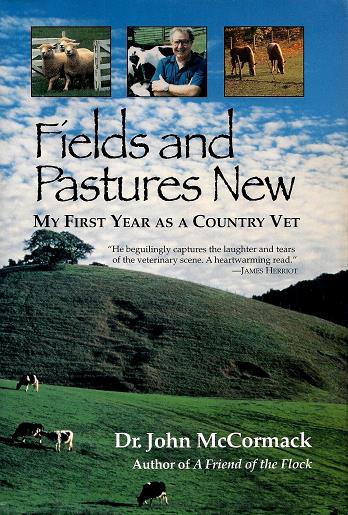
Fields and Pastures New
By Dr. John McCormack
The setting is the early 1960s and John McCormack and his wife and children have moved to rural Alabama for John to start his career as a private practice veterinarian. This would be a first for the locals too because there had never been a veterinarian in their area before.
Since it was a rural location, a lot of his work would be with farm animals and farmers. Folklore was quite important to these people and folk remedies were the order of the day, with the vet often being called in only when all else had failed. People also relied upon an untrained local man, Carney Sam, who, just like them, subscribed to strange and mostly worthless folk remedies to treat their ailing animals. Like rubbing turpentine on a horse's belly to treat kidney problems. The thinking was that the turpentine would be absorbed through the skin and travel to the kidneys. Total rubbish, but those sorts of treatments were very popular.
But Dr. John is a modern veterinarian and his methods relied upon proven, scientific knowledge. They weren't foolproof, of course, but they were certainly much more effective than the strange and useless cures inflicted upon the poor, suffering critters they were meant to treat.
So rural, backward Alabama got itself a fancy new vet and before long, it was clear that the community was very lucky to have Dr. John in their midst. And it was clear to Dr. John and his family that they had found themselves a warm and welcoming new home.
This was an interesting read, the memoir of a young vet establishing himself in his new location, coping with the backwards farmers and the less-trying doctoring of the local dogs, cats and other pets in addition to the work with livestock. The author has real feelings of affection for his neighbors and clients and he and his wife and kids become a greatly appreciated part of the community.
For another review, see https://www.kirkusreviews.com/book-reviews/john-mccormack/fields-and-pastures-new/.
Labels:
animals,
good read,
McCormack,
memoir,
nonfiction
Wednesday, May 31, 2017
Slaves in the Family
By Edward Ball
Edward Ball's ancestor came to America and started plantations near the Atlantic coast, growing rice. They used slaves from Africa to do the plantation work. At one point, the family owned several plantations in the same area of South Carolina. They owned thousands of slaves. They also fought to keep their slaves in the Civil War.
Knowing this, Ball set out to connect with the descendants of those slaves that he was able to track down by perusing family documents and historical records. In several cases, he was able to find these people and give them the information he was able to gather about their ancestors and from their family lore piece together more of the story of their ancestors' history, even to the probable location their African origins.
Not surprisingly, he also figured out that his ancestors had mixed race children from informal liaisons with their female slaves. Ball was able to track down some of the descendants of these relationships, people who are distantly related to himself.
He encountered some anger but he also gave people a better understanding of their own personal history and this valuable information was welcomed by the families.
This was a very informative read as it goes quite deeply into the slave-owning experience of the author's own family. And his interviews with the descendants were touching to read. It's a long book and I must admit I got a bit bored with it towards the end. But I do feel it is a worthwhile book to read.
For another review, see http://www.thedailybeast.com/if-you-only-read-one-book-about-the-legacy-of-slavery-slaves-in-the-family.
Tuesday, May 30, 2017
The Statement
Pierre Brossard chose the wrong side in World War II. He was a Nazi collaborator and was responsible for the murder of at least fourteen Jewish people. He has been on the run for decades, helped out by a shady association of Catholic clergy who see no problem with helping out a mass murderer because, "the Church's law of asylum supersedes...the laws of the civil authority."
But now someone is on Pierre's tail. Driving up a isolated road, Pierre is waylaid by an assassin. But Pierre is too canny and shoots the killer first. He then flees to his Catholic refuge.
But this murder brings to the front the question of Pierre's real character. All along, the church claimed to believe that Pierre was truly repentant of his war crimes. But now that he has killed again, doubt arises and the church moves to distance itself from him. The word goes out and Pierre finds that he is no longer as welcome at his old haunts as he used to be.
Meanwhile, the police are actively involved in tracking Pierre down after decades of letting it slide. His face is in the newspapers and he is running for his life. facing down and killing a second man who came gunning for him. But the question he needs to ask himself and fails to do is how these killers know his routine and the locations of his hiding places. Because, although the killers want the world to believe Pierre is being hunted by Jewish avengers, this is not the case at all. Even though that is what Pierre fervently believes, his guilty conscience prevents him from seeing the simple truth.
This was an OK read. I found it a bit dull, to be honest. I also found the ending unsatisfying.
For another review, see https://www.kirkusreviews.com/book-reviews/brian-moore/the-statement/.
Paradise News
By David Lodge
Bernard's aunt is dying and she wants to see her brother before she dies. The aunt, Ursula, lives in Hawaii and Bernard and his father, Jack, live in Britain. Jack, who is rather frail, is not eager to undertake such a long trip. In fact, he has never flown on an airplane before and is rather alarmed by the whole idea. However, the thought that the estranged sister has money does much to reconcile Jack's family to the idea.
Bernard is a part time teacher and he has the time to escort his dad on the long trip. Bernard is a bit of a black sheep as is Ursula. Ursula married against the advice of the family. Bernard is an ex-priest who lost his faith and is regarded as a failure by the family.
Bernard bought a package tour for himself and his dad because it was the cheapest travel option and they end up traveling with a small group of their fellow Brits whose activities form a sort of backdrop to Bernard's story.
Arriving in Hawaii, not even there for one full day, Jack, used to British traffic patterns, steps in front of a car and gets hit. He is not gravely injured, but his hip is broken and he will be stuck in the hospital for quite a while. Meanwhile Ursula has taken a turn for the worse and she is also confined to her bed. The reunion is delayed for the time being.
With his dad and his aunt in the hospital, Bernard is left to his own devices and he gets to know the woman who knocked his dad down with her car, Yolande. Yolande is at a turning point in her life. Her husband has left her for another woman (younger, of course) and Yolande is fighting the divorce, mostly because she is angry. She is attracted to Bernard and escorts him to some of the local tourist attractions. They end up in a relationship and she helps him with some of his personal problems.
Jack and Ursula eventually get to meet at Jack's hospital and they confront some issues and misunderstandings from their childhood and both find comfort in the reconciliation.
Soon Jack is well enough to travel home and they leave the islands behind, with hope for the future.
This was an entertaining story. Bernard is a good guy and the story ends very nicely. And it is nicely amusing too, not hilarious, but just sweetly, mildly amusing.
For another review, see https://www.kirkusreviews.com/book-reviews/david-lodge/paradise-news/.
In a Sunburned Country
By Bill Bryson
Australia: perhaps the most exotic place in the world. Full of flora and fauna found nowhere else on our planet, some of which is dangerous and/or toxic. Much of it is inhospitable, uninhabited and pretty much unexplored. Parts of the interior have never been closely surveyed and may possibly contain unknown reserves of mineral wealth.
Australia is nearly the same size as the continental United States but sparsely populated, with most of the people living in cities on the southern and eastern coasts. The coasts have the best climate, with lush forests and land suitable to grow crops. The interior is desert of the harshest, most deadly kind.
Bill Bryson has a love affair with Australia, despite its much touted dangers. He set off on a tour of the civilized places, visiting some of Australia's most outstanding and amazing attractions. Throughout his trip he finds the people welcoming and helpful and the natural wonders simply amazing. He rarely has a harsh word to say and is looking forward to returning in the future.
I enjoyed the book a lot. Bryson has a lovely sense of humor and doesn't mind poking fun of himself. I laughed out loud several times as Bryson describes some of the predicaments he gets himself into.
But besides the humor, Bryson's descriptions made me long to visit Australia some day. If I could, I would go there without hesitating, eager to see all the sights that Bryson does such an excellent job describing.
For another review, see https://www.publishersweekly.com/978-0-7679-0385-1.
Labels:
Australia,
Bryson,
good read,
nonfiction,
travel
Monday, May 15, 2017
Middlesex
By Jeffrey Eugenides
Callie was born a male. But due to his lack of testicles and minuscule penis, he was misidentified as a female. So his parents, believing he was a girl, raised him as a girl. Which was fine. He was a very pretty little girl and did all the girly things most little girls do. But then when he didn't go through the usual transformations that occur to most young teen girls, his parents decided to take him to a specialist in New York City. The doctor recommends to the parents that Callie have surgery to remove his undescended testicles and put him on hormone therapy and let him live out his life as the female he has been raised to be.
But Callie reads his medical file and suddenly his life makes sense: his attraction to girls, his budding mustache, his gangly body, his height. And he runs away to California.
But before we get to this point in the story, we have to delve into Callie's antecedents. We have to learn about his grandparents, brother and sister, who fled Europe to the safety of America. We have to follow them as they get married (to each other!), have two kids and settle in Detroit. Then there is their son, Milton, who marries a cousin, Tessie and who gives birth to two sons, one of whom is Callie who they think is a girl. It takes almost 200 pages for the story to even get to the moment of Callie's birth. Then we have to read about her childhood before we get to the meat of the story, Callie's struggle to understand the truth about himself.
This book is really a family saga and is more concerned about the story of the whole family than it is about the story of Callie's sexual identity. I wanted the story of Callie, not the story of the whole family. Two hundred pages into a five hundred page novel and Callie is only briefly touched on, which was rather annoying. For me, the story didn't really get that interesting until it focused more on Callie and less on her family.
Also, this novel is described, by some, as a comedy and as a comic epic, as hilarious, funny, playful. I didn't find it to be any of those things.
For another review, see http://www.thedailybeast.com/articles/2012/11/29/american-dreams-middlesex-by-jeffrey-eugenides?source=dictionary.
The story of Callie reminded me of David Reimer. He was a boy whose penis was accidentally removed as a baby and who, as a result, was castrated and raised as a girl until he rebelled and reclaimed his male identity. I wonder if Eugenides based his novel on David's tragic story.
The Passage
By Justin Cronin
A new virus has been discovered in a South American jungle. The bad news: it kills most. The good news: those who survive are changed into super-beings. The further bad news: they become remorseless, bloodthirsty killers. In other words, they become vampires.
So the government, with dreams of deathless superhuman soldiers decides to take this virus and engineer the vampire-ness out of it and retain the superhuman-ness. To do so, they require human subjects: men on death row whom no one will miss.
But all they get are more vampires. Finally, they think they have refined the virus to what they want. They think the reason they keep getting vampires is that the test subjects are too old, too flawed, too evil. They decide they need an innocent child, a homeless child with no family, who, like the condemned men, will not be missed. That is how they acquire Amy, who they heartlessly inject with their vampire virus. But they are wrong that no one will miss Amy. Two people who have encountered her have an instant bond with the little girl: a nun and the FBI agent who brought Amy to the secret government facility in Colorado.
So Amy gets injected with the vampire virus and becomes ill and slowly begins her transformation into superhuman. Meanwhile the 12 convicts/vampires are exerting their superhuman powers on the people of the facility resulting in a disaster: The vampires get loose and bring down Armageddon on the world. Most people die but lots of people become vampires too. The surviving people live in hiding and in isolated locations as they fight to survive the vampire onslaught.
And then there is Amy. What can she bring to the struggle of humanity vs vampire? For in her case, the scientists were right. She has the strengths and vitality of the vampires but without their craziness and thirst for blood. She may be humanity's best hope, if she is up to the job.
This was a really long book: 891 pages. Parts of it were really interesting and parts just seemed like they could have been condensed quite a bit. I know I skipped through some of the later part of the story. This is a bloody story. People are slaughtered, torn to shreds. Animals are slaughtered, torn to shreds. Characters that you start to care about are killed. A pet dog is killed, pointlessly, I thought. Just to be cruel, it seemed to me.
This book is the first in a trilogy. It is an interesting story but just too bloody for me. Once the author killed off that poor dog, I knew I wouldn't be reading the next book in the trilogy. Plus it is just too damn long.
For another review, see http://www.thedailybeast.com/articles/2010/06/24/justin-cronins-the-passage-reviewed-by-lizzie-skurnick.
Labels:
Cronin,
fantasy,
fiction,
good read,
science fiction
Wednesday, May 10, 2017
Long Hot Summoning (The Keeper's Chronicles #3)
By Tanya Huff
Diana Hansen has just graduated from high school and now she is, at last, a Keeper. As a Keeper, Diana, along with her older sister Claire, who is also a Keeper, has to maintain the balance between Light and Darkness. Mainly they have to keep the powers of Darkness from taking over the normal world.
Diana's first summons as a Keeper is to a shopping mall. Some strangeness has been spotted at the Erilking's Emporium, a gift shop. Upon arrival at the mall, the first clue that something is up is the excess number of minivans in the parking lot. Sure enough, Darkness is trying to sneak into the world and is doing so by creating a mall identical to the real mall in the Dark realm. It is to this counterfeit mall that Diana, her angel cat Sam, and Claire must enter and put a stop to the foul plan. In the process, they are helped by King Arthur and his merry band of mall elves who are a group of homeless teens who somehow got sucked into the Dark realm and have been transformed into elves, which is some kind of side effect of being too long on the Dark side of things.
Meanwhile, back home, Claire's boy friend (husband?) and her elderly cat Austin are facing problems of their own. Namely, an ancient Egyptian mummy who is surreptitiously draining the life force from all around her in order to restore herself back to life.
This was a fun and enjoyable read. The book is quite amusing, with lots of silliness, fantasy and adventure. I did feel a bit lost at times, not having read the previous two books in the series, especially at the beginning. It never really explains why the cats can talk or why the cat Sam used to be an angel or why he stopped being an angel. Or even what the whole deal is with the cats. This is one of those series where it really helps to have read the previous stories. But even feeling a bit lost at times, I still liked the book a lot.
For another review, see: http://www.errantdreams.com/2014/06/review-long-hot-summoning-tanya-huff/.
Sunday, April 30, 2017
Billionaire Blend
By Cleo Coyle
A new customer at Village Blend ( a New York City coffeehouse) has the baristas abuzz. Handsome billionaire Eric Thorner has been coming in and quizzing the staff on their knowledge of coffee. Manager Claire Cosi finally gets to meet him and dazzle him with her encyclopedic knowledge of all the ways coffee can be prepared. It turns out Eric has a proposition for her. But before she can find out what his proposition is, his car, parked outside, explodes, killing his chauffeur and heavily damaging the coffee shop and hurting him and Claire too.
Even though she is hurt (but not badly) Claire has the presence of mind to tend to Eric and call 911. Eric is hustled off to the hospital and Claire is left to deal with the disaster that has put the coffee shop out of business for the foreseeable future.
But the tech tycoon steps up and arranges for the shop to be speedily repaired, including the addition of an awesome new coffee machine, the Slayer (http://slayerespresso.com). And he explains what he wanted from Claire before the blast: he wants her to develop a special coffee made of the most delicious, subtle and expensive coffee beans in the world.
But who wanted Eric dead? Claire has a large bump of curiosity and the chance to tackle a new mystery plus make some much need cash has her putting her concerns aside and embarking on new adventure, traveling the globe with Eric and Matt (her ex-husband) searching for the perfect coffee bean and solving the many mysteries in Eric's life.
This was an OK read. I have nothing against it. It was quite acceptable. But it never really grabbed me the way I would like a book to do.
For another review, see https://www.kirkusreviews.com/book-reviews/cleo-coyle-2/billionaire-blend/.
Sunday, April 23, 2017
Give Up the Ghost
By Juliet Blackwell
Mel Turner is a building contractor. She does a lot of renovation work. She also has the dubious ability to see ghosts.
Andrew Flynt is the proud owner of a renovated Victorian mansion. The mansion's insides were completely gutted and modernized. But in the process of renovating the house, a ghost became aroused and upset and made life difficult for the Flynts. So they decided to sell the house. But the ghost keeps scaring potential buyers away.
Flynt hired a psychic to help him with the problem and the psychic, Chantelle, told him the ghost didn't like the changes and she gave him a list of things that needed to be restored to put the ghost to rest. Thus the hiring of Mel Turner.
The first thing Turner decided to do was pay a visit to Chantelle. But when she arrived at Chantelle's apartment it was only to find her dead with her brother kneeling beside his sister's body.
And Mel Turner's new renovation project just got a lot more complicated.
This was a fairly good read. It really got my interest for the first half of the book. But then it just seemed to drag on and on and I was getting tired of it. But I think the first part was stellar, I just wish it held up better.
For another review, see https://suspense.nightowlreviews.com/v5/reviews/roxanne-reviews-give-up-the-ghost-by-juliet-blackwell.
Sunday, April 16, 2017
Kitchens of the Great Midwest
By J. Ryan Stradal
Eva Thorvald is a gifted chef with an exquisite palate. She throws occasional private dinners which have very long waiting lists and cost thousands of dollars per person. This is her story.
It starts out with Eva's mother deserting baby Eva and her father, Lars. Lars soon dies and Eva is adopted by Lars' brother Jarl and his wife, Fiona.
In grade school, Eva was picked upon and bullied. She got her revenge in a very unusual way and then ran away to her cousin, Braque, Braque is in college and has just discovered she is pregnant when Eva shows up.
Eva's refined palate and passion for food leads her to a career in the food industry. In the course of time, her life intersects with lots of other people as she finds her niche in the world of fine cuisine. Yet, at the end of the book, Eva is eating mac and cheese, broccoli and drinking beer with Pat Prager's Lutheran peanut butter bars for desert. And that suits her just fine.
Even though this is the story of Eva, the book jumps around a lot and the story switches from one perspective to another, with Eva's story set off to the side. There are so many characters and their lives intersect in many different ways. I had to make a list to keep track of them all. Still, it was a really interesting story and very unforgettable.
For a better review, see https://www.nytimes.com/2015/08/09/books/review/kitchens-of-the-great-midwest-by-j-ryan-stradal.html?_r=0.
Tuesday, April 11, 2017
Girl Waits With Gun
By Amy Stewart
It's the early 1900s and Constance, Norma and Fleurette are out for a ride in their buggy when a car smashes into it, injuring both Constance and Fleurette. Unfortunately, the man driving the car was a thoroughly unpleasant person. He claimed the women ran into his car and he refused to pay for the repairs to the buggy.
Constance tracked him down to his office in the factory his family owned. She found him surrounded by his gang of toughs but that didn't stop her from demanding payment.
She may have been in the right, expecting him to pay for the repairs. But he is of another mind and thus begins a trying time for the three women with harassing letters, bricks thrown through the windows of their farm house and threats to kidnap the youngest one, Fleurette, who is only eighteen. Their house is broken into, their furniture and knick-knacks smashed, and a fire started in the kitchen in an attempt to burn down the house.
Constance goes to the sheriff and he and his deputies try their best to keep the women safe from the gang. The sheriff even goes so far as to arm the three women with pistols and teach them how to use them safely. And working together, Constance and the sheriff will attempt gather enough evidence to put Mr. Evil Factory Punk and his gang of toughs behind bars for a good while.
The three women live in an isolated farm house they inherited after their mother died. The two older sisters are in their thirties and the youngest is a mere teenager. Since there is no man in their lives, the gangsters view them as easy targets. But Constance is made of stern stuff and she refuses to knuckle under to the threats and scare tactics.
This was an interesting story, based loosely on the real Constance Kopp, who was one of the first women to be a sheriff's deputy. The sheriff was so impressed with her during the course of that terrible year when she and her sisters were under attack, that he offered her a position as deputy and she accepted.
However, I was rather disappointed because, once again, I was fooled by the blurbs which claimed the book was "romping, hilarious" and "funny" and that it had "humor." What the blurbers consider to be funny and what I consider to be funny must be vastly different. I didn't find the book the least bit amusing. This is not to say it was not a good and interesting story and I enjoyed it very much. But funny? No.
For another review, see https://www.kirkusreviews.com/book-reviews/amy-stewart/girl-waits-with-gun/.
Subscribe to:
Posts (Atom)